
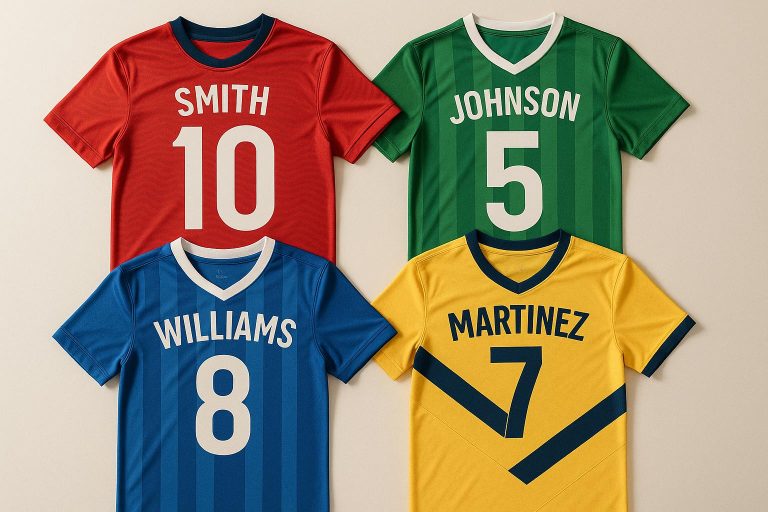
When designing soccer jerseys, compliance with league rules is essential to avoid fines, disqualifications, or game forfeits. Here’s what you need to know:
- Research league rules: Review your competition’s regulations for jersey colors, numbers, logos, and patches. For example, NCAA mandates 8-inch back numbers and 4-inch front numbers in contrasting colors.
- Include required elements: Ensure jerseys have proper player numbers, team crests, and allowable logos. Goalkeeper kits must stand out from teammates and referees.
- Choose quality materials: Use durable, lightweight, and moisture-wicking fabrics like polyester. Sublimation printing ensures long-lasting designs that meet visibility and compliance standards.
- Review and finalize designs: Use a compliance checklist and seek expert validation to prevent costly mistakes.
- Work with professionals: Companies like Wooter Apparel streamline the process, ensuring jerseys meet all rules while reflecting your team’s identity.
Research League and Tournament Rules
Before designing or ordering team jerseys, it’s crucial to review your league or tournament’s official rules. These guidelines determine whether your uniforms meet the required standards or could lead to penalties – or even disqualification.
Start by finding the official rulebook for your competition. You can usually locate it online or request it directly from the event organizers. This ensures you’re working with the most up-to-date and specific requirements. For example, the NCAA updates its rulebooks annually, including detailed uniform regulations. Similarly, high school associations like the Ohio High School Athletic Association (OHSAA) provide clear uniform guidelines on their websites.
Keep in mind that standards vary widely between leagues. A design that works for one competition might break the rules in another. For instance, collegiate soccer teams using a sublimated manufacturer logo could violate the NCAA’s strict limit of 2.25 square inches for such logos. This could force the team to wear alternate kits or face penalties.
Key Rules to Check
Jersey colors are one of the first requirements to verify. Most leagues follow a home-and-away system: the home team typically wears light-colored jerseys (often white), while the visiting team wears dark colors to ensure a clear contrast on the field. According to NCAA rules, home teams must wear solid white jerseys and socks, while visiting teams are required to wear contrasting colors.
Player numbers come with specific size and placement rules that differ by league. For example, the NCAA and NFHS mandate that numbers on the back of jerseys must be at least 8 inches high, while front numbers need to be at least 4 inches high. The numbers must be in a solid, contrasting color that stands out against the jersey’s background. Additionally, no two players on the same team can share a number, and designs cannot obscure the numbers.
Manufacturer logos are another area with strict limitations. Most amateur and collegiate leagues allow only one logo per item of apparel, which cannot exceed 2.25 square inches in size. The logo must also fit within a simple geometric shape, such as a rectangle or square.
Sponsor patches are generally not allowed in amateur and collegiate soccer. However, some tournaments may permit small commemorative or memorial patches, as long as they fall within size limits of 2.25 to 4 square inches. Always confirm the specifics with your league before incorporating patches into your design.
What Happens When Rules Are Broken
Failing to comply with uniform regulations can lead to serious consequences, including disqualification, fines, and disrupted schedules. Teams caught with non-compliant jerseys during pre-game inspections may be forced to scramble for alternative uniforms or risk forfeiting matches altogether.
In some cases, teams only discover uniform issues right before major tournaments. This often results in expensive last-minute redesigns and rush production orders. Costs can quickly add up when you factor in expedited manufacturing, shipping fees, and potential penalties for missed games.
Beyond the financial burden, these situations can also harm team morale and add unnecessary stress for players and coaches. Instead of focusing on the competition, they’re left dealing with uniform problems – a distraction no team needs.
To avoid these headaches, make thorough research a priority. Rules can change frequently, so always use the latest guidelines when finalizing your jersey designs. It’s a small step that can save you from big problems down the line.
Select Required Jersey Design Elements
Once you’re clear on your league’s rules, the next step is identifying the essential design elements your jerseys must include. These components are non-negotiable and form the basis of a soccer uniform that meets both regulations and reflects your team’s identity.
Required Elements for Compliance
Player numbers are the cornerstone of any soccer jersey. Regulations require the back number to be at least 8 inches tall, while the front number must measure at least 4 inches tall. To ensure visibility, numbers need to be in a solid, contrasting color that stands out against the jersey’s background. For instance, if your team wears royal blue jerseys, white or yellow numbers would work well, but navy blue numbers would likely fail to provide enough contrast.
FIFA rules specify that the contrast must meet a Delta L value of at least 30. This ensures the numbers remain clearly visible under different lighting conditions and from various distances, making it easier for referees, players, and spectators to identify players during the game.
Team crests are typically placed on the left chest and must not exceed 100 cm² (approximately 15.5 square inches), as per FIFA standards. However, U.S. leagues may have their own size restrictions, so it’s crucial to double-check your competition’s guidelines. The crest must be securely attached using stitching, heat transfer, or sublimation to ensure durability.
Manufacturer and league logos also have strict size and placement rules. These logos are usually limited to 2.25 square inches and must not obstruct player numbers. Only one manufacturer logo is allowed per jersey, and it must not interfere with the visibility of other required elements. Professional leagues like MLS often mandate sponsor logos in specific locations, while amateur and collegiate leagues, such as the NCAA, typically prohibit sponsorships on uniforms altogether.
Goalkeeper Jersey Rules
Goalkeepers have unique uniform requirements to ensure they stand out from field players and referees during matches. The most important rule is that goalkeeper jerseys must feature a distinctly different color from their teammates and the opposing team’s outfield players.
This isn’t just for tradition – it serves a functional purpose. Referees need to quickly identify the goalkeeper for decisions involving ball handling or other specific situations. Players also benefit from this distinction when making quick decisions about passes and positioning.
Unlike field players, goalkeepers have more leeway with their shorts and socks. These don’t need to match the rest of the team’s uniform but must still adhere to league color and safety rules. Many goalkeepers opt for contrasting colors across their entire kit to maximize their visibility on the field. Other elements like team crests and logos follow the same guidelines as those for field players.
Follow Rules While Adding Team Style
Complying with regulations doesn’t mean giving up on your team’s unique style. Thoughtful design choices can incorporate team colors, patterns, and branding while staying within league rules.
Sublimated designs are a great way to add flair without breaking compliance. This method embeds colors and patterns directly into the fabric, ensuring vibrant designs that won’t fade, peel, or crack over time. It’s a practical way to enhance the look of your jerseys without compromising on quality or regulations.
Teams can also experiment with geometric patterns like stripes or hoops to create a striking visual effect. FIFA allows basic patterns with two equally prominent colors, giving designers room to be creative. Just make sure these patterns don’t interfere with the legibility of player numbers or other mandatory elements.
When selecting color combinations, aim to balance your team’s identity with visibility standards. For darker team colors, consider adding lighter accents in areas that won’t conflict with number placement. This approach preserves your team’s signature look while ensuring compliance with contrast requirements.
Commemorative elements can add a meaningful touch to your jerseys, provided they’re allowed by your league. For example, American flag patches (up to 2 x 3 inches) or memorial patches (up to 4 square inches) can be included with proper approval. These elements must be carefully positioned to avoid interfering with numbers or other required components.
Ultimately, the goal is to work within the rules while creating a design that represents your team. Professional designers can help you achieve a standout look that meets all regulatory requirements, ensuring your team looks sharp and avoids any uniform-related issues on game day.
Choose Proper Materials and Construction
The materials and construction of a soccer jersey play a huge role in ensuring comfort, performance, and compliance. A well-made jersey should handle the physical demands of the game while maintaining its look and durability throughout an entire season.
Material Standards for Soccer Jerseys
When it comes to soccer jerseys, polyester and advanced synthetic blends are the go-to materials. They strike the perfect balance between breathability, moisture-wicking abilities, and durability. These fabrics are designed to pull sweat away from the skin while allowing air to circulate, which is critical during high-energy matches.
Take the 2025 U.S. National Team kits as an example. These jerseys are crafted from 100% recycled polyester and feature sublimated graphics that not only meet FIFA’s compliance standards but also pay homage to the team’s heritage. Created by Nike in collaboration with national team players, these kits prioritize both performance and the team’s identity.
Moisture control is key. Polyester microfibers create a wicking effect, pulling sweat away from the skin to keep players dry. Many high-performance jerseys also include mesh panels in areas prone to heat, like the underarms and back, to improve ventilation.
Lightweight fabrics are another must-have. Heavier materials can weigh players down and cause fatigue, while lightweight options enhance mobility. At the same time, the fabric needs to be tough enough to withstand contact, frequent washing, and the rigors of a season.
Durability is just as important as comfort. FIFA’s 2025 Equipment Regulations require all kit elements to be permanently incorporated using approved methods. This ensures the jersey can handle high-contrast, long-lasting printing without fading or peeling. Look for features like reinforced stitching, abrasion resistance, and colorfastness to comply with these standards. Additionally, leagues like the NCAA and high school associations have strict guidelines ensuring numbers and logos remain visible and intact throughout a match. Choosing materials that meet both comfort and regulatory demands is non-negotiable for any team aiming for success.
Why Sublimated Designs Work Best
Once you’ve selected the right materials, the next step is choosing a printing method that can withstand the demands of the game. Sublimation printing has become the preferred choice for both professional and amateur teams. Unlike screen printing or heat transfer methods, sublimation embeds the ink directly into the fabric fibers, making the design a permanent part of the jersey.
This method ensures vivid, long-lasting colors and patterns that won’t peel, crack, or fade, even after repeated washing and heavy use. For compliance, sublimation easily meets the contrast requirements for player numbers – such as a Delta L value of at least 30 – because the colors stay vibrant all season long.
Sublimation also opens the door to unlimited design possibilities. You can create intricate patterns, gradients, and custom graphics without adding weight or texture to the fabric. Traditional methods often result in raised surfaces that can affect comfort and violate league standards for smoothness. With sublimation, you get the best of both worlds: stunning designs and a lightweight feel.
The benefits extend beyond aesthetics. Since sublimated designs are embedded in the fabric, there’s no risk of elements detaching or becoming non-compliant during play. This is crucial for teams that need their jerseys to last the entire season without replacements.
| Feature | Sublimated Jerseys | Screen-Printed/Heat-Pressed Jerseys |
|---|---|---|
| Durability | High (no peeling/fading) | Lower (may peel/crack over time) |
| Color Vibrancy | Excellent | Good, but may fade |
| Compliance | Easily meets standards | Risk of non-compliance if elements detach |
| Customization | Unlimited, complex designs | Limited by process |
Professional teams favor sublimation for all these reasons. It ensures that critical elements like names, numbers, and logos remain permanently part of the jersey, meeting FIFA’s strict regulations.
If you’re designing custom jerseys, look for providers who specialize in fully sublimated apparel. For example, Wooter Apparel offers high-quality, fully sublimated soccer jerseys that meet compliance standards while enhancing player performance. With a 4.9-star rating from over 1,200 reviews, their customers consistently praise the durability and comfort of their uniforms.
Investing in the right materials and sublimated construction not only ensures compliance but also enhances performance. Your team will benefit from jerseys that look professional, feel great, and hold up to the demands of the game – all without worrying about fading numbers or peeling logos.
sbb-itb-4d95ad3
Review and Finalize Your Jersey Design
After selecting the materials and construction methods, the final step is to thoroughly review your jersey design. This step is critical to avoid costly mistakes and last-minute changes before production begins.
Build a Compliance Checklist
Creating a detailed compliance checklist ensures that no important elements are overlooked. This checklist should cover every aspect of your jersey design, aligning it with league-specific requirements.
Start with the jersey numbers, as they tend to be the most scrutinized. Make sure they meet U.S. league size and contrast standards. For example, FIFA mandates a Delta L value of at least 30 to ensure proper visibility between the numbers and the jersey background.
Manufacturer logos are another common area of concern. Double-check that logos meet size restrictions. For instance, NCAA rules prohibit large chest logos or bold sleeve stripes, so it’s essential to verify your league’s specific guidelines.
Pay close attention to team logo placement and color schemes. Team colors must comply with league standards and be distinct enough to avoid confusion with opposing teams. Goalkeeper jerseys require extra care – they need to stand out clearly from both field players and referees.
Don’t forget league-specific patches or commemorative elements. Some tournaments require official patches in specific locations, and missing these can lead to non-compliance.
Your checklist should also confirm that all design elements are permanently affixed. Temporary features are not permitted.
Uniformity across the team is equally important. All player jerseys must maintain consistency in style, font, size, position, and color for names and numbers. Even slight inconsistencies can result in compliance issues.
| Element | Requirement | Issues |
|---|---|---|
| Back Numbers | 8+ inches tall with proper contrast | Too small or insufficient contrast |
| Front Numbers | 4+ inches tall matching the back style | Different font or size than the back |
| Manufacturer Logo | Within a 2.25 sq. in. geometric shape | Oversized or improperly placed |
| Team Colors | Must not conflict with league standards | Too similar to opponents |
Once your checklist is complete, move on to securing expert validation.
Get Expert Review and Approval
Even with a thorough checklist, an expert review is essential. Professionals can catch issues that might be missed during internal checks. League representatives, compliance officers, or professional design services can provide this additional layer of scrutiny.
If possible, submit your design to league officials for pre-production approval. Many leagues offer feedback before production begins, helping you avoid costly reprints or emergency fixes. Be sure to keep all approval documents for future reference.
Professional design services can also be a valuable asset. For example, companies like Wooter Apparel specialize in sports uniform compliance and offer free custom design services. Their expertise in U.S. soccer regulations ensures that potential problems are identified early.
The importance of expert review becomes clear when considering the consequences of non-compliance. Teams risk having to replace uniforms immediately or even forfeiting games. With major tournaments often announcing kit colors only a month before competition, having a compliant design ready is crucial.
When working with design services, request prototypes. Testing the jersey for comfort, durability, and visual appeal before full production allows for adjustments and simplifies compliance verification by league officials.
Throughout the review process, document everything – design mockups, compliance checklists, correspondence with league officials, and approval confirmations. This documentation serves as proof of compliance and can be invaluable if questions arise during the season.
Taking the time to carefully review and finalize your design, with the help of experts and a systematic approach, ensures your jerseys will meet all requirements and be ready for competition.
Work with Custom Jersey Design Services
Once you’ve got your design and material standards in place, teaming up with experts can ensure your soccer jerseys meet all compliance requirements. Designing jerseys that align with regulations can be tricky, but professional design services simplify the process by managing the technical details – leaving you free to focus on showcasing your team’s identity.
Benefits of Professional Design Services
Professional design services bring a level of expertise that most team managers simply don’t have the time or resources to develop. These companies stay up-to-date with the latest FIFA regulations and U.S. league standards, which include over 115 pages of specifications. These rules cover everything from the required color contrast ratios to precise logo placement restrictions.
The standout benefit? Their in-depth compliance knowledge. Professional designers rely on detailed checklists and trained staff to spot potential violations before production even begins. For example, they’re well-versed in specific rules like the 2.25-square-inch limit for manufacturer logos. This attention to detail pays off – teams working with professional services report a 30–50% drop in uniform-related rule violations compared to teams handling designs internally.
Another major advantage is the time saved. Instead of juggling tasks like researching compliance rules, sourcing materials, and coordinating with multiple vendors, team managers can work directly with a single point of contact who handles everything. Many services offer turnaround times of just 2–4 weeks from the moment the design is approved, with expedited options available for urgent timelines. They also use fully sublimated printing, ensuring the jerseys are both durable and compliant. These benefits set the stage for how Wooter Apparel stands out in supporting teams.
How Wooter Apparel Helps Teams
Wooter Apparel specializes in creating custom soccer uniforms that not only meet U.S. league standards but also deliver the style and quality teams want. Their process is designed to tackle the common challenges teams face when designing jerseys.
One of Wooter Apparel’s standout features is their free custom design service, which eliminates financial hurdles that might prevent teams from accessing professional expertise. Teams collaborate directly with experienced designers to create unique looks that reflect their identity while ensuring every detail complies with regulations. They also provide digital mockups so teams can see their designs before committing to production.
Their dedicated support ensures teams don’t have to compromise on either technical requirements or their vision. This support extends beyond the initial order – whether it’s reordering jerseys for new players or making updates, Wooter Apparel ensures consistency with the original design.
Wooter Apparel goes beyond just jerseys, offering matching shorts, warm-up gear, and accessories. This lets teams create a cohesive look for every occasion, from pre-game preparations to post-game celebrations.
Quick turnaround times are another highlight. Whether gearing up for a new season or replacing uniforms in a pinch, Wooter Apparel’s streamlined production process typically delivers orders within 2–4 weeks, with rush options available when needed.
Their pricing is competitive, with custom soccer jerseys ranging from $30 to $80 per jersey, depending on the level of customization and the order size. Bulk discounts make high-quality, professional uniforms accessible for entire teams without breaking the bank.
With their combination of compliance expertise, high-quality materials, and dedicated support, professional design services like Wooter Apparel take the hassle out of jersey design. Teams can focus on the game, knowing their uniforms are ready to meet both league standards and their own expectations.
Conclusion: Key Steps for Compliant Soccer Jersey Design
Designing soccer jerseys that align with league rules doesn’t have to be complicated. By following a clear and organized approach, you can create jerseys that meet all requirements while showcasing your team’s unique identity.
Start with thorough research. Review your league’s specific regulations and create a checklist that includes details like number sizing, logo placement, and color contrast. This prevents unnecessary revisions and ensures your design stays within the rules.
Choose the right materials and methods early in the process. Fully sublimated designs are a great option – they provide durable, permanent markings that adhere to compliance standards while giving you the freedom to incorporate your team’s branding.
Work with experts who know the rules. Collaborating with professionals who understand league regulations can make the process smoother. For example, Wooter Apparel offers free custom designs and combines compliance knowledge with creativity, ensuring your jerseys meet the standards and reflect your team’s spirit.
FAQs
What are the most common mistakes teams make when designing soccer jerseys to meet league rules?
One mistake teams often make is skipping over their league’s specific uniform rules before diving into the design process. These regulations can vary widely between leagues and tournaments, covering everything from jersey colors to the placement of numbers, logos, or sponsor details.
Another misstep is choosing materials or designs that clash with league standards. For instance, some leagues restrict the use of reflective elements or certain types of fabric. Double-checking that your design meets the league’s official rules can save you from last-minute headaches or costly redesigns.
To make things easier, consider partnering with a reliable custom uniform provider that’s familiar with these requirements. This way, your team’s jerseys will not only meet the necessary standards but also stand out with top-notch quality and visual appeal.
How does sublimation printing improve the durability and compliance of soccer jerseys?
Sublimation printing works by infusing the design straight into the fabric of soccer jerseys, rather than layering it on top like older printing techniques. This method ensures the colors and patterns stay bright and intact, even after numerous washes or the wear and tear of intense matches.
What’s more, sublimation printing effortlessly incorporates essential details like league logos, player names, and numbers, keeping everything aligned with league rules. Its long-lasting quality and accuracy make it a standout option for crafting soccer jerseys that excel in both performance and meeting official standards.
What should a team do if they realize their jerseys don’t meet league rules just before a big tournament?
If your team realizes the jerseys don’t meet regulations right before a big tournament, you’ll need to act fast. Start by thoroughly reviewing the league or tournament’s uniform rules to pinpoint the exact issues. Get in touch with the tournament organizers right away to explain the situation and see if temporary fixes, like covering logos or numbers, might be permitted.
If temporary fixes aren’t an option, consider contacting a custom uniform provider, such as Wooter Apparel, to discuss expedited production. They’re known for producing high-quality jerseys that meet compliance standards and might be able to deliver on short notice. In the meantime, have a backup plan ready – whether that’s using practice jerseys or borrowing compliant uniforms – to ensure your team can still compete.