
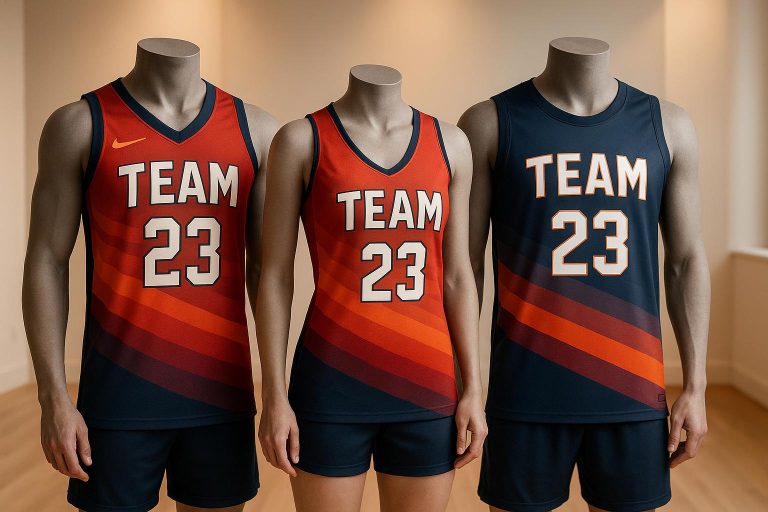
Properly designed basketball jerseys improve player performance and comfort. Gender-specific jerseys – tailored for men, women, and gender-neutral fits – address body structure differences, ensuring better mobility, focus, and confidence on the court.
Key Takeaways:
- Men’s Jerseys: Wider shoulders, straighter seams, and longer torsos for unrestricted movement.
- Women’s Jerseys: Narrower shoulders, bust shaping, tapered waists, and shorter lengths for a secure fit.
- Gender-Neutral Jerseys: Straight, relaxed fits suitable for diverse body types, ideal for coed or inclusive teams.
- Measurements Matter: Accurate chest, waist, hip, and torso length measurements are crucial for a proper fit.
- Customization Options: Sublimated designs with durable fabrics ensure long-lasting style and performance.
Wooter Apparel simplifies the process with free design services, sublimation technology, and tailored fits for all genders. Whether outfitting youth leagues, high school teams, or recreational players, focus on fit, comfort, and compliance for a professional look and enhanced performance.
Gender-Specific Fit and Measurements
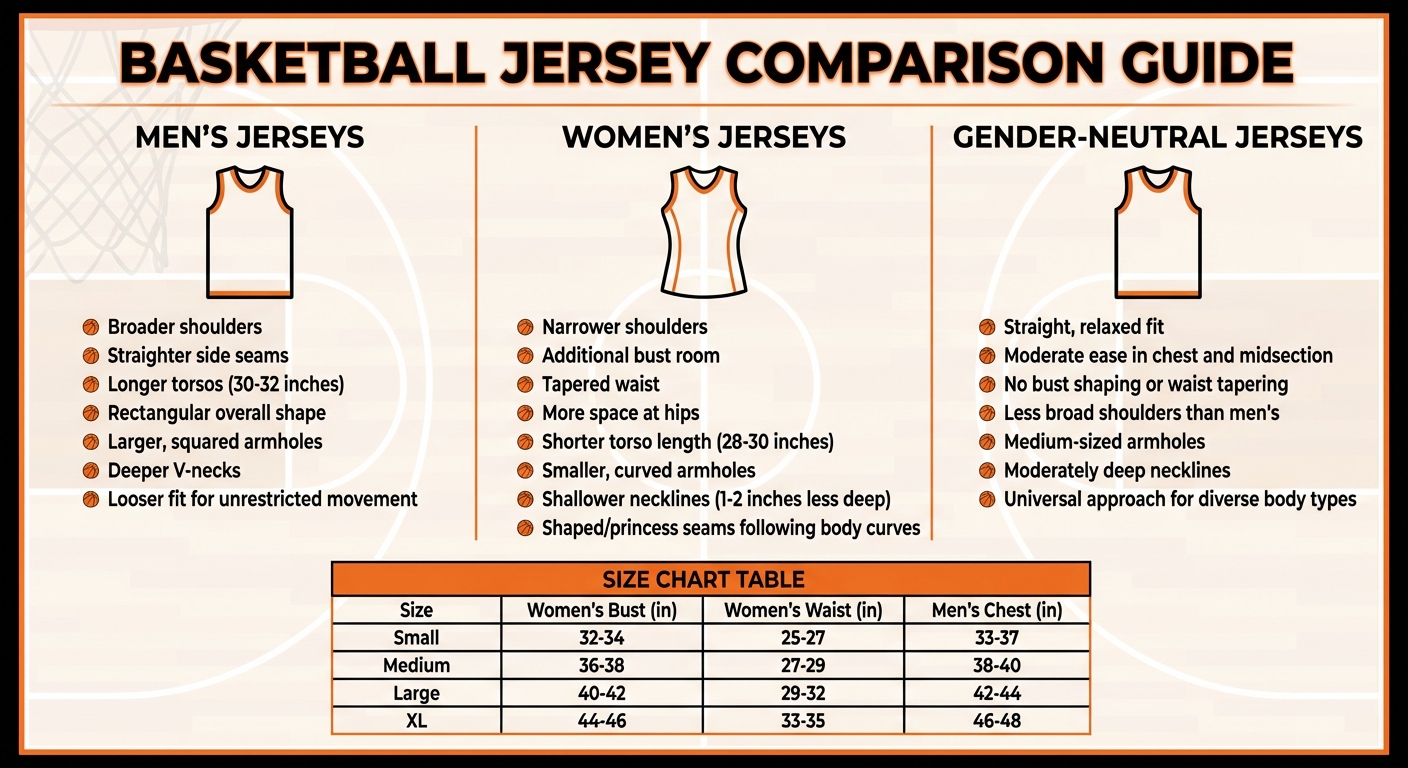
Basketball Jersey Fit Comparison: Men’s vs Women’s vs Gender-Neutral Designs
When designing basketball jerseys, understanding gender-specific measurements is key to ensuring comfort and performance.
How Fit Differs by Gender
Men’s basketball jerseys are designed with broader shoulders, straighter side seams, and longer torsos to fit wider chest and shoulder dimensions. The overall shape is more rectangular, offering freedom of movement without extra fabric gathering at the waist. On the other hand, women’s jerseys are tailored differently, featuring narrower shoulders, additional bust room, a tapered waist, and more space at the hips. These adjustments provide a secure fit that stays in place during fast-paced movements. Patterns often include shaped or princess seams that follow the body’s natural curves, ensuring an athletic fit that moves with the player.
Gender-neutral jerseys take a more universal approach, offering a straight, relaxed fit with moderate ease in the chest and midsection. Unlike women’s jerseys, they skip bust shaping and waist tapering, and compared to men’s jerseys, they’re less broad in the shoulders. This style works well for mixed-gender teams, nonbinary players, or teams looking for a uniform fit while keeping inventory simple and consistent.
How to Take Measurements
To get accurate measurements, follow these steps:
- Chest/Bust: Have the player stand upright with relaxed arms. Wrap a flexible tape measure around the fullest part of the chest or bust and across the shoulder blades. Keep the tape level and snug, but not tight.
- Waist: Measure at the natural waistline, which is around the belly button or where the body creases when bending side to side.
- Hips: Wrap the tape around the widest part of the hips, usually 7–9 inches below the natural waist for adults.
- Shoulder Width: Measure straight across the back, from the outer edge of one shoulder bone to the other.
- Torso Length: Start at the top of the shoulder (near the neck) and measure down to where the jersey hem should fall – typically mid-hip for game jerseys, ensuring coverage when arms are raised.
For best results, measure over a thin base layer, keeping the tape parallel to the floor. Having someone assist can help prevent errors like twisting the tape. Record the measurements in a shared spreadsheet, along with each player’s preferred fit type (men’s, women’s, or gender-neutral), to simplify the ordering process.
| Size | Women’s Bust (in) | Women’s Waist (in) | Men’s Chest (in) |
|---|---|---|---|
| Small | 32–34 | 25–27 | 33–37 |
| Medium | 36–38 | 27–29 | 38–40 |
| Large | 40–42 | 29–32 | 42–44 |
| XL | 44–46 | 33–35 | 46–48 |
Selecting the Right Fit for Your Team
For all-male teams, men’s patterns are the easiest to size, as they align with standard chest and height measurements. All-female teams benefit from women-specific cuts, which provide better shaping for the bust, waist, and hips, ensuring a secure and performance-ready fit. For coed, nonbinary, or gender-diverse teams, offering both men’s and women’s patterns – or a gender-neutral option – can give players the freedom to choose the fit that works best for them while maintaining a unified team look.
Survey your players to understand their fit and style preferences. If someone is between sizes or has larger hips or a wider waist compared to their chest, consider sizing up for better comfort and mobility, especially for positions requiring frequent pivots and lateral movements. Keeping these preferences logged will not only streamline current orders but also serve as a helpful reference for future team needs.
Step-by-Step Jersey Design Process
Planning Your Design Approach
Start by assessing your team’s composition to decide whether gender-specific or gender-neutral cuts are the best fit. For teams with separate men’s and women’s squads, gender-specific cuts are tailored to match distinct body proportions, offering a better overall fit. On the other hand, coed or recreational teams might benefit from gender-neutral designs, as they simplify the ordering process and create a unified look. However, keep in mind that gender-neutral designs may require a broader size range and additional testing to ensure they accommodate various body types comfortably.
It’s also important to consider the expectations of your league. For example, many high school, college, and club programs expect women’s teams to wear jerseys specifically designed for them. If previous unisex designs caused discomfort or fit issues, it’s a clear indicator that offering a women’s cut can improve both fit and comfort. At this stage, you’ll also want to establish core branding elements – such as team colors, logo placement, and graphic style. Keeping these consistent across all jersey types ensures a cohesive visual identity, even if the fits vary. Once you’ve determined your team’s needs and branding, outline the specific design variations for each type of jersey.
Design Elements for Men’s, Women’s, and Gender-Neutral Jerseys
Men’s jerseys typically feature larger armholes and a looser fit to accommodate broader shoulders. Women’s jerseys, by contrast, have shallower armholes, tailored necklines, and a closer fit to suit different body shapes. Gender-neutral options blend these features, aiming to fit a variety of body types while maintaining a unified team appearance.
To ensure consistency across all designs, establish clear placement guidelines for key elements like logos and graphics. For instance, you might center the team logo a specific distance below the neckline. Additionally, make sure player numbers and names meet league requirements for size and contrast, ensuring they are easy to read against the jersey’s background.
Creating and Refining Mockups
With your design elements in place, use digital tools – or take advantage of Wooter Apparel’s free design services – to create front and back mockups for each jersey type: men’s, women’s, and gender-neutral. Working in layers is especially helpful, as it allows you to adjust specific design elements like necklines or torso shaping without having to start from scratch.
Pay close attention to the alignment of logos, wordmarks, and patterns with key features such as necklines and side seams to ensure the design complements each jersey’s cut. Test the readability of player numbers and names by checking their spacing relative to the neckline and other graphic elements to avoid a cluttered appearance. Finally, gather feedback from coaches and players on aspects like comfort, style, and modesty. If possible, order prototypes to evaluate the fit and make final adjustments before committing to a full production run.
Performance and Style Features by Gender
This section delves into how specific design elements enhance both functionality and aesthetics on the basketball court, catering to different needs and preferences.
Performance Features for Each Jersey Type
Men’s jerseys are designed with larger, squared armholes and deeper V-necks to allow for maximum arm mobility during crucial moments like shooting and defending. The torso length, typically around 30–32 inches, accommodates taller frames. Women’s jerseys, on the other hand, feature smaller, curved armholes and shallower necklines – generally about 1–2 inches less deep than men’s – to ensure a secure fit and prevent the jersey from riding up during play. The shorter torso length, usually 28–30 inches, minimizes drag and enhances movement. Gender-neutral jerseys strike a balance with medium-sized armholes and moderately deep necklines, making them a versatile choice for a range of body types. UNITEFIT offers adjustable sizing options, which makes it particularly popular among coed recreational teams. Across all jersey types, moisture-wicking fabrics with 4-way stretch ensure breathability and flexibility, keeping players cool and comfortable during intense games.
These thoughtful design elements ensure that performance and comfort go hand in hand, laying the groundwork for a unified team aesthetic.
Style Choices and Team Branding
Women’s jerseys often feature tailored cuts, vibrant color schemes, and feminine graphic elements, such as rounded typography, to create styles that are both flattering and empowering. Men’s jerseys lean toward bold silhouettes with prominent team mascots and striking motifs. Gender-neutral designs, meanwhile, focus on inclusive color palettes and scalable logos, ensuring a cohesive look across all players. Wooter Apparel’s sublimated designs, which embed graphics directly into the fabric, eliminate issues like cracking and peeling, maintaining both style and durability throughout the season. For example, their Custom Racerback Basketball Jerseys for women and girls demonstrate how gender-specific tailoring can enhance both comfort and team identity.
Keeping a Consistent Team Appearance
Achieving a unified team look across various jersey cuts requires careful attention to shared design elements. Using Pantone color codes ensures precise color matching across men’s, women’s, and gender-neutral designs. Fonts should remain consistent, such as bold sans-serif styles for player numbers, while graphics like logos should be positioned uniformly – commonly on the chest or shoulder. League regulations often dictate that player numbers be 11–12 inches in height with high contrast against the jersey background. Wordmark sizes should also be adjusted appropriately; men’s jerseys can accommodate up to 12 inches wide, while women’s versions typically look best with an 11-inch maximum. Digital mockups are a valuable tool for visualizing how different jersey styles will appear together on the court or in photos, especially when incorporating unique hem shapes – curved for women and straight for men.
sbb-itb-4d95ad3
Working with Wooter Apparel for Custom Jerseys
When it comes to creating custom jerseys, Wooter Apparel makes the process smooth and efficient, blending performance with style. Here’s how they help refine your jerseys step by step.
Creating a Spec Sheet for Your Order
A well-detailed spec sheet is key to ensuring your jerseys meet expectations and arrive exactly as intended. Start by breaking down size categories: men’s jerseys (Small to 3XL, chest sizes 36–50 inches), women’s jerseys (Small to 3XL, chest sizes 32–52 inches), and gender-neutral options if needed. Don’t forget to include 10–20% extra jerseys to account for growth, replacements, or unexpected needs.
Next, specify your fabric preferences. Popular choices include lightweight polyester/spandex blends with 4-way stretch and moisture-wicking properties (3.5–4.5 oz/yd² or 120–150 GSM). Be precise about design details like team colors (use Pantone codes for exact color matching), logo placement, and player numbers that meet league standards (typically 11–12 inches tall). If gender-specific fits are required, make that clear – for example, tighter fits for women’s jerseys or looser athletic cuts for men. Once your spec sheet is ready, Wooter Apparel’s team will guide you through the design review process.
Using Wooter Apparel’s Free Design Services
Wooter Apparel offers free design services, saving you upfront costs while delivering polished, professional designs. Simply submit your ideas, along with reference images, mood boards, and your spec sheet, through their platform. Their design team will create digital mockups tailored to your needs, incorporating elements like gender-specific fits for a perfect finish.
They use a sublimation process to infuse dye directly into the fabric. This method ensures vibrant, long-lasting colors that won’t crack, peel, or fade, even after repeated washes or intense use.
"The design team took my thoughts and created several perfect options for our swim team, using our logo created by one of our swimmers."
– Tammy S., Customer Representative
Once you receive the digital proofs, review them carefully and provide detailed feedback. Whether it’s tweaking armhole cuts for women’s jerseys or improving the visibility of player numbers, communicate your adjustments clearly. The design team will quickly make revisions to ensure the final design meets your expectations and complies with league requirements. After finalizing the design, move on to sample testing to confirm the fit.
Testing Fit and Making Final Adjustments
Before moving into full production, it’s crucial to test the fit of your jerseys. Order fit samples to verify that the designs align with your initial measurements and mockups. Pay special attention to gender-specific fits: women’s jerseys should offer a closer fit to reduce drag, while men’s designs should allow for unrestricted movement without excess material.
"I ordered some prototypes so I could gauge their wear and make some tweaks. What they sent were above expectation and I’m looking forward to the next set I’m ordering."
– Duane R., Verified Customer
Gather feedback on key areas like armhole comfort and waist fit (women’s jerseys typically accommodate waist sizes of 25–40 inches). If adjustments are needed – whether for sizing, visibility of numbers, or fabric stretch – submit those changes before finalizing production. To stay on schedule, set clear timelines for revisions, allowing about a week per iteration, so your jerseys are ready well before the season starts.
Conclusion
Bringing the design process together, the final stages of creating basketball jerseys blend essential principles into a polished result. Designing gender-specific jerseys revolves around three main pillars: understanding fit differences for various body types, careful design planning, and collaborating with a reliable manufacturer. Tailored cuts improve mobility and ensure a secure fit for all genders, while gender-neutral options provide flexibility across diverse body shapes. Precise measurements are key to achieving a balance of comfort and performance, helping players excel on the court.
Early preparation can save both time and money. Finalizing details like team colors, logo placement, and player number formats early on simplifies production. Using digital mockups allows you to evaluate every aspect of the design across various gender-specific fits, ensuring a cohesive team identity even when the cuts differ. Choosing performance fabrics – lightweight, moisture-wicking, and with 4-way stretch – ensures that the jerseys meet the physical demands of the game while catering to the unique requirements of each gender.
Wooter Apparel makes the entire process seamless by offering free design services and sublimated jerseys that resist cracking, peeling, or fading. Their design team takes your specifications – sizes, colors, logos, and gender-specific fits – and transforms them into production-ready mockups. Testing samples in real game conditions is a crucial final step, allowing you to identify and address any fit issues before full production. This careful approach ensures that the final uniforms are not only visually striking but also performance-ready, helping every athlete perform at their peak. With Wooter Apparel’s expertise, teams can confidently create jerseys that combine style, comfort, and functionality.
FAQs
How do gender-specific basketball jerseys enhance player performance?
Gender-specific basketball jerseys are crafted to offer a more precise fit and enhanced comfort by considering the unique physical differences between players. By tailoring the design, these jerseys allow for better movement, fewer distractions, and greater freedom, helping athletes perform with confidence on the court.
Incorporating elements such as strategic cuts, breathable materials, and ergonomic shapes, these jerseys are designed to keep players comfortable and focused, supporting both their performance and self-assurance during the game.
What key measurements are needed to create a well-fitting basketball jersey?
To get the perfect fit for a basketball jersey, you’ll need to measure a few key areas: chest, waist, shoulders, sleeve length, and overall jersey length. Accurate measurements ensure the jersey feels comfortable and allows for unrestricted movement during gameplay.
What makes sublimated designs ideal for basketball jerseys?
Sublimated designs have become a favorite for basketball jerseys, thanks to their ability to produce bold, full-color graphics that are dyed directly into the fabric. This method ensures the designs stay intact – no cracking, peeling, or fading – even after tough games or countless washes.
What’s more, these jerseys are both durable and lightweight, offering players maximum comfort and freedom of movement on the court. The sublimation process also opens the door to endless design options, allowing teams to craft standout jerseys that are both eye-catching and high-quality.