
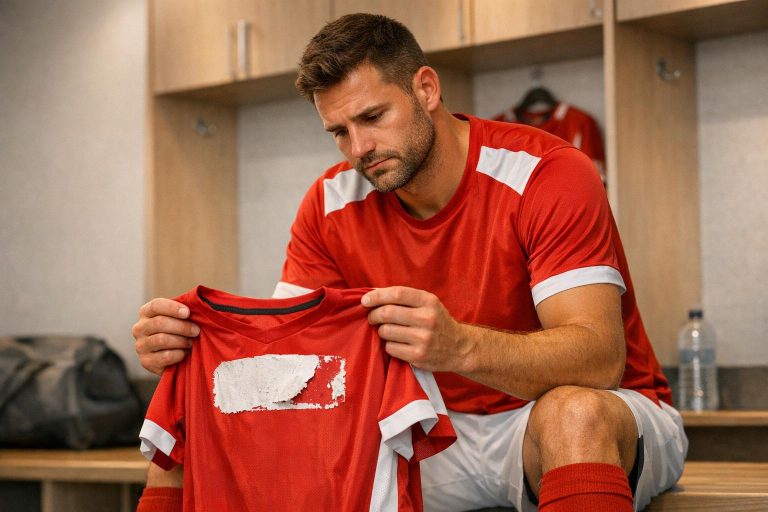
When teams or players fail to follow branding and sponsorship rules, the consequences are severe. It’s not just about fines – entire sponsorship deals can be lost, leading to significant financial and reputational damage. Here’s what you need to know:
- Fines Add Up Quickly: Violations like wearing unapproved logos or gear can result in fines starting at $10,000, doubling for repeat offenses.
- Sponsorship Deals Are at Risk: Companies like Under Armour have terminated multi-million-dollar contracts when rules weren’t followed, costing teams millions in lost revenue.
- Reputation Matters: Sponsors demand positive brand association. Violations can lead to terminated contracts, reduced future deals, and strained relationships.
- Long-Term Impact: Non-compliance can force teams to make tough financial decisions, such as UCLA’s $100M debt after losing a major sponsor.
To avoid these issues, teams need to:
- Review league and sponsor rules regularly.
- Use pre-production mockups for approval.
- Partner with reliable uniform providers to ensure compliance.
Non-compliance isn’t just about breaking rules – it’s about protecting your finances, reputation, and future opportunities.
NIL Rules Explained: What Athletes and Families Must Know
What Non-Compliance Means for Sponsorships
When players or teams fail to follow branding and uniform rules, it undermines the value sponsors expect from their investments. These breaches can damage the exclusive visibility sponsors pay for. For instance, if a player displays an unauthorized logo or covers a sponsor’s mark, it puts the entire sponsorship agreement at risk.
Common Branding Rule Violations
Some of the most frequent violations include unauthorized branding, exposing competitor logos, and improper uniform usage. Unauthorized branding – like displaying logos or equipment not approved by the league – is a particularly common issue. Players have even been fined for using gear that features non-authorized branding.
Another major concern is competitor exposure during televised events. For example, NFL players are prohibited from wearing logos of companies that compete with league sponsors starting 30 minutes before kickoff and continuing until 90 minutes after the game ends. Violations, such as wearing unauthorized helmet clips with competitor logos, highlight how strictly these rules are enforced.
Other infractions include displaying personal messages without approval, using unapproved gear like tinted visors, or failing to wear uniforms correctly. The NFL’s fine structure emphasizes how seriously these rules are taken. A first offense for unauthorized logos results in a $10,000 fine, with repeat violations doubling the penalty. These fines don’t just hit players’ wallets – they can also strain relationships with sponsors.
How Non-Compliance Affects Sponsorship Agreements
The consequences of non-compliance go beyond fines; they can damage or even end sponsorship agreements. If sponsors feel they aren’t getting the marketing exposure they were promised, they may walk away. A notable example occurred in June 2020 when Under Armour terminated its 15-year, $280 million apparel deal with UCLA. The company claimed UCLA failed to deliver the agreed marketing benefits during the pandemic. The dispute escalated when UCLA covered Under Armour’s logos with social justice patches, leading to a $67.5 million settlement in July 2022.
Akil Coad, Vice President of Compliance for the NFL, summed it up:
"The Compliance Department also protects all NFL business and licensing agreements and makes sure that uniforms are worn properly – with partners’ logos displayed and others covered or removed."
This focus on ensuring proper uniform management highlights how crucial it is for sponsors to get the exposure they were promised. Non-compliance doesn’t just break league rules – it undermines the trust that sponsorships rely on to succeed.
The Financial Impact of Non-Compliance

Financial Impact of Sponsorship Non-Compliance in Professional Sports
Breaking sponsorship and branding rules comes with hefty financial consequences. These violations can lead to multimillion-dollar fines, lost revenue, and long-term instability. Let’s dig into the financial fallout, from direct penalties to the less obvious loss of future opportunities.
Direct Costs: Fines, Termination Fees, and Legal Battles
Professional sports leagues impose strict branding rules, and the fines for breaking them can escalate quickly. For instance, in the NFL, wearing an unauthorized logo results in a $10,000 fine for the first offense, which doubles to $20,000 for repeat violations.
| Violation Type | First Offense Fine | Second Offense Fine |
|---|---|---|
| Unauthorized Logo/Branding | $10,000 | $20,000 |
| Personal Messages on Uniform | $10,000 | $15,000 |
| Lack of Brand Marks/Unapproved Visor | $5,000 | $10,000 |
| General Uniform Violations | $5,000 | $15,000 |
| Foreign Substances on Uniform | $5,000 | $10,000 |
While these fines are steep, they pale in comparison to the financial toll of sponsorship contract terminations. Take UCLA, for example. In May 2022, UCLA settled a legal dispute with Under Armour for $67,491,275. This battle began in August 2020 when Under Armour terminated a 15-year, $280 million sponsorship deal. The company claimed UCLA failed to deliver marketing benefits during the pandemic and alleged that social justice patches on uniforms had covered their logos.
Hidden Costs: Lost Revenue and Diminished Future Deals
The financial damage doesn’t stop with immediate fines. Non-compliance can erode future revenue streams and even harm a team’s market value. After UCLA’s deal with Under Armour ended, the school secured a replacement sponsorship with Nike/Jordan Brand. However, the new deal was worth just $7.7 million per year – 58% less than the previous annual sponsorship value.
UCLA Athletic Director Martin Jarmond highlighted the broader implications of this financial strain:
"I inherited a deficit with UCLA athletics. So when you have a significant financial challenge, it’s difficult to just maintain, never mind to invest".
The financial hit didn’t stop there. UCLA’s athletic department accumulated over $100 million in debt, partly due to the terminated sponsorship. This financial pressure even played a role in UCLA’s decision to leave the Pac-12 and join the Big Ten conference in 2024 – a move largely aimed at securing greater financial stability.
When non-compliance damages a team’s reputation with sponsors, it doesn’t just hurt in the short term. It can reduce the organization’s market value and force tough decisions that reshape its future.
sbb-itb-4d95ad3
Reputational Damage and Long-Term Consequences
Non-compliance doesn’t just result in immediate financial losses – it leaves a lasting stain on reputation. When teams violate branding rules or fail to uphold conduct standards, the fallout is significant. Sponsors not only pull their funding but also lose trust, making it far more difficult for teams to secure future partnerships.
Sponsor Trust and Morality Clauses
Sponsorship deals hinge on one key principle: positive brand association. Sponsors want their logos tied to success and integrity, not controversy. When teams fail to comply, that association turns toxic. As Ashfords explains:
"The core principle of sponsorship is to benefit from a positive brand association."
To guard against reputational risks, modern sponsorship agreements often include morality clauses. These clauses allow sponsors to terminate contracts immediately if the team’s actions harm their brand, whether through criminal behavior or negative publicity.
The speed at which sponsors react can be staggering. In March 2016, Nike suspended its deal with tennis star Maria Sharapova within 24 hours of her failed drug test announcement. Similarly, in June 2014, 888poker ended its sponsorship of soccer player Luis Suárez just a month after signing him, following his infamous biting incident during the World Cup. When FIFA was embroiled in corruption scandals in 2014–2015, major sponsors like Sony, Emirates, Johnson & Johnson, Continental, and Castrol chose not to renew their contracts. Adidas even ended its 11-year sponsorship deal with the IAAF three years early in 2016 after doping and corruption allegations surfaced.
These examples underscore how quickly sponsors can sever ties, leaving teams grappling with both financial and reputational fallout.
Team Image and Fan Perception
Non-compliance doesn’t just damage sponsor relationships – it reshapes how the public sees a team. In North America, sports sponsorships make up 70% of all sponsorship investments. That means maintaining a clean image is critical for attracting and keeping these lucrative deals.
When a team gains a reputation as a "high-risk" partner, it faces tougher sponsorship terms. Future sponsors might demand stricter clauses, such as clawback provisions to recover payments if violations occur. These conditions make negotiations more difficult and can lower the team’s overall market value.
Fan support is another critical factor. Research shows that ethical missteps significantly reduce support from casual fans. While die-hard fans might stick around, the broader audience – the one that sponsors care about – can shrink. This creates a ripple effect: declining fan engagement leads to reduced revenue and diminished appeal to potential sponsors.
Social media only intensifies this problem. Negative incidents often spark immediate backlash online, with fans and critics publicly calling out both the team and its sponsors. This pressure forces sponsors to distance themselves, leaving teams with damaged relationships that can be difficult – or even impossible – to repair.
How to Avoid Losing Sponsorships Due to Non-Compliance
Losing sponsorships due to non-compliance can be a costly mistake. The key to avoiding such issues lies in catching errors early – ideally, before production even begins. By implementing reliable systems and processes, teams can safeguard both their financial stability and reputation.
Review League and Sponsor Guidelines Regularly
League branding rules and sponsor requirements aren’t static – they evolve. What worked last season might not cut it this year. Take the NFL, for instance, which enforces strict regulations around third-party branding on items like footwear and gloves during games and media appearances. To stay compliant, teams should review these guidelines at the start of each season and whenever new sponsorship deals are signed.
One effective approach is creating a detailed compliance checklist. This checklist should cover key elements like logo size limits, placement rules, and restrictions on competitor brands. Share this checklist with all relevant decision-makers to ensure everyone is on the same page. When guidelines are clear and accessible, the chances of errors drastically decrease.
Once the rules are understood, the next step is to verify designs immediately to ensure alignment with these standards.
Use Pre-Production Mockups and Get Sponsor Approvals
Digital mockups are an essential tool for ensuring compliance before production begins. These proofs allow teams to double-check critical elements like color accuracy, logo placement, and overall design while there’s still time to make adjustments. Once production starts, changes are often impossible to implement.
To avoid complications, secure sponsor approval as soon as possible. Share the mockups directly with sponsor representatives and document their approval. Having a clear paper trail protects both the team and the sponsor if any disputes arise later.
For teams juggling multiple sponsors, sublimation printing offers an added advantage. This method ensures sponsor branding remains intact and visible throughout the season.
Partner with Reliable Custom Uniform Providers
Compliance is non-negotiable when it comes to maintaining sponsor trust, and that starts with choosing a dependable uniform provider. A professional provider will offer precise digital proofs for review and approval before production kicks off. This step ensures that sponsor logos meet size and placement requirements as outlined in contracts.
Sublimation printing is particularly effective for keeping sponsor logos vibrant and professional, even after repeated washes and wear. Wooter Apparel, for example, specializes in fully sublimated custom uniforms that meet league standards. Their sublimation process guarantees long-lasting designs that won’t fade or crack over time.
Teams can choose from packages like the MVP Uniform Package priced at $199.99, which includes jerseys, shorts, and warmups. Alternatively, individual items such as Custom V-Neck Basketball Jerseys start at $16.99. All designs come with unlimited color and logo placement options, plus player names and numbers at no extra cost.
Production typically takes 3 to 4 weeks after final design approval. To avoid delays, factor this timeline into your planning and coordinate directly with the design team to ensure all compliance checks are completed before uniforms are needed for the season.
Conclusion
Failing to follow sponsorship rules can seriously threaten both a team’s financial stability and its reputation. As Ashfords explains:
The sponsorship contract (and what it says) dictates the legal relationship between the parties. Its contents need to provide the sponsor with all the protection it may need for the duration of the sponsorship – especially in the event that things go wrong.
The financial fallout of non-compliance goes far beyond just fines. Teams might face immediate costs like legal fees and contract termination penalties, alongside hidden costs, such as losing future sponsorship opportunities and damaging key partnerships.
Reputational harm can be even harder to recover from. Time and again, high-profile cases prove that sponsors won’t hesitate to cut ties when violations jeopardize their brand image. Sponsors often act swiftly to avoid any association that could harm their standing.
Preventing these issues starts with preparation. Reviewing guidelines, approving pre-production samples, and working with dependable partners like Wooter Apparel (https://wooter.com) are simple but effective steps to stay compliant. As Ashfords also emphasized:
Sponsors can look weak when they don’t act fast – they should think ahead and have a planned course of action for when things go wrong.
Take the necessary steps now to protect your sponsorships and ensure long-term success.
FAQs
What are the most common branding rule violations in sports sponsorships, and how can they be avoided?
In sports sponsorships, some branding mistakes pop up more often than others. These include placing sponsor logos in unauthorized spots, exceeding size limits, using offensive or banned content, or skipping the required approvals from governing bodies. Such errors can result in fines, disqualifications, or even the loss of sponsorship agreements.
To steer clear of these pitfalls, it’s crucial to stick to the guidelines set by leagues or federations. Make sure logos are placed in the right locations, comply with size restrictions, and are applied using approved methods. By following these rules, you can safeguard your sponsorships and uphold a polished, professional reputation.
How can teams avoid losing sponsorships due to uniform non-compliance?
Teams looking to safeguard sponsorships should make compliance with branding and uniform rules a top priority from the outset. Start by thoroughly understanding the guidelines set by your sport’s governing body. This includes restrictions on logo sizes, placements, and ensuring no prohibited content appears on your uniforms. Incorporate these details into your sponsorship agreements, addressing key aspects like exclusivity, image rights, and timelines for usage.
To avoid last-minute issues, submit your uniform designs for approval well before deadlines. Many leagues require both a design review and a physical inspection, so early preparation is essential. Collaborating with an experienced manufacturer, such as Wooter Apparel, can streamline this process by providing expert design assistance and producing gear that meets compliance standards.
It’s also a good idea to perform regular checks on your team’s apparel throughout the season to confirm ongoing compliance. If the rules change, update your contracts promptly to reflect the new requirements. By staying organized and detail-focused, your team can build strong sponsor relationships while steering clear of penalties or disqualifications.
What are the long-term financial effects of losing a major sponsorship?
Losing a major sponsorship deal can hit hard financially. Companies might see revenue losses that stretch into the tens or even hundreds of millions of dollars. On top of that, there’s the potential for legal battles or settlement costs tied to the termination of these agreements, adding even more strain.
But the impact doesn’t stop there. A damaged brand reputation can make it tougher to attract new sponsorships down the line, which can affect cash flow and slow down growth. Staying compliant with branding agreements isn’t just about avoiding immediate trouble – it’s about safeguarding your financial future and keeping opportunities open.