
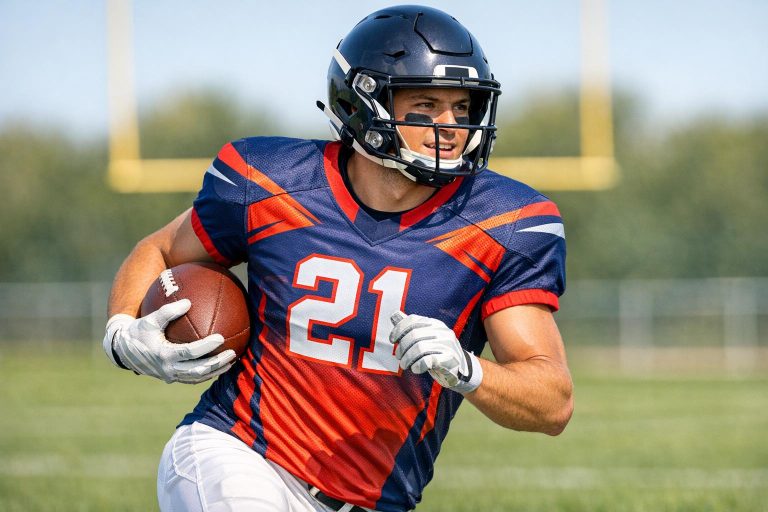
Wearing the right football jersey is about more than just looking good – it’s critical for performance, comfort, and safety. A poorly fitted jersey can restrict movement, interfere with gear, and lead to overheating or discomfort. Here’s what you need to know:
- Fit Matters: Jerseys that are too tight limit mobility, while loose ones can snag or shift during play. Proper fit ensures better movement and keeps gear like shoulder pads in place.
- Material Placement: Modern jerseys use specialized fabrics, like Lycra for flexibility and dazzle fabric for durability, in key areas to improve performance.
- Sizing Tips: Accurate chest, torso, and arm measurements are essential. Testing sizes with a refundable sizing kit ($125) can help avoid mistakes.
- Fit Types: Athletic fits balance padding space and mobility, while compression fits provide muscle support and reduced drag.
- Customization: Tailoring jerseys for specific positions ensures players get the flexibility and support they need.
Testing samples before bulk orders ensures the best fit for your team. Prices start at $29.99 for custom jerseys, with full uniforms ranging from $49.48 to $106.85.
Body Measurements for Proper Jersey Fit
Getting the right body measurements is key to avoiding jerseys that bunch up, limit movement, or leave gaps for padding. Taking accurate measurements ensures your players get a jersey that fits well and supports their mobility on the field.
Before committing to a full team order, consider using a Pro Football Jersey sizing kit to test sizes for your players. Wooter Apparel offers a sizing kit for $125.00, which includes five standard adult sizes (AXS, AS, AM, AL, AXL). The best part? The kit is fully refundable as long as it’s returned in good condition.
"I ordered some prototypes so I could gauge their wear and make some tweaks. What they sent were above expectation." – Duane R.
Chest and Torso Measurements
The chest measurement is crucial for ensuring enough room for shoulder pads and comfortable breathing during play. To measure correctly, wrap a tape measure around the fullest part of the chest, just under the armpits, while the player stands relaxed. Make sure the tape is snug but not tight, and keep it parallel to the floor. This allows space for pads and ensures the jersey won’t restrict deep breaths during intense moments.
For the torso, measure from the base of the neck down to where you want the jersey to end – usually at the top of the hip bone. This vertical measurement ensures the jersey offers enough coverage without riding up during movement. Many modern jerseys, including Wooter Apparel’s, use moisture-wicking polyester to provide both breathability and a comfortable fit.
Sleeve and Armhole Sizing
The armhole fit plays a big role in how well a player can throw, block, and tackle without feeling restricted. Tight armholes can cause binding when the arms are raised, while loose ones might bunch up under pads or leave gaps. The goal is to strike a balance between a secure fit and full mobility.
Wooter Apparel’s Pro Football Jerseys feature 180gsm dazzle fabric on the shoulders, which enhances flexibility and durability for unrestricted arm movement. When measuring, ask the player to raise their arms overhead and to the sides. The jersey should move with them without pulling across the chest or back. Using a sizing kit is a smart way to test this in action and ensure the fabric performs as intended.
Length and Waist Guidelines
The length of the jersey should provide enough coverage to stay in place during play without excess fabric getting in the way. Measure from the top of the shoulder down to the desired hem point, keeping in mind that jerseys are typically tucked into pants.
For waist sizing, measure around the natural waistline where the jersey will meet the pants. If your team uses high-rise integrated football pants, make sure the jersey length overlaps properly to avoid exposure during play. One buyer shared that Wooter’s sizing runs "a bit bigger" compared to other brands, emphasizing the importance of testing sizes with a kit. Accurate measurements help you navigate differences in sizing between manufacturers and ensure the best fit for your team.
Football Jersey Fit Types
Getting the right fit for a football jersey isn’t just about looking good – it directly impacts mobility and performance on the field. Football jerseys come in various styles, each tailored to meet different needs, from traditional athletic fits to snug compression designs.
Athletic Fit vs Compression Fit
Athletic fit jerseys are specifically designed to work with shoulder pads. They strike a balance between offering enough space for padding and maintaining a snug fit to minimize grabbing during play. This design ensures flexibility while keeping players protected.
Compression fit gear, on the other hand, hugs the body closely, offering added muscle support and reduced drag. These are often used as base layers or as training apparel. Available in short sleeve, long sleeve, hooded, and sleeveless options, compression shirts start at $19.99 and are engineered to enhance performance by supporting muscles during intense activity.
"Good quality, very authentic jersey, nicely done customizable. Well worth the money!" – Adrianne O.
The choice between these two fits often depends on the player’s position. Linemen tend to favor athletic fits to accommodate full padding, while skill players might layer compression gear for extra support and mobility.
Youth, Men’s, and Women’s Sizing Differences
Jersey sizing isn’t one-size-fits-all – it’s tailored to suit different age groups and genders, ensuring maximum comfort and performance.
Youth sizes, ranging from Youth Extra Small (YXS) to Youth Extra Large (YXL), are designed to fit growing athletes. These jerseys account for variations in torso length and shoulder width. Adult sizes, extending from Adult Extra Small (AXS) to Adult Extra Large (AXL), cater to a broader range of body types.
For female athletes, women’s football uniforms are crafted with specific proportions in mind. These jerseys often include features like racerback cuts to improve shoulder mobility and are tailored to fit differences in the shoulders, torso, and hips compared to men’s designs.
To help teams find the perfect fit, Wooter Apparel offers separate sizing kits for adults and youth at $125.00 each, allowing players to test samples before committing to a bulk order. With a stellar 4.9/5 rating from over 1,200 reviews, customers consistently highlight the jerseys’ authentic feel and quality. Many also stress the importance of trying on sizes to ensure the best fit.
Design Features That Improve Mobility
Design plays a huge role in enhancing a player’s mobility on the field. Beyond just getting the sizing right, the materials and construction of a jersey can make all the difference. Modern football jerseys are crafted with precision, using specific fabrics in key areas to balance protection and freedom of movement. For example, the main body often features interlock mesh made from 100% polyester, weighing between 140 and 280 GSM (grams per square meter). This material is tough enough to handle tackles while remaining breathable. Meanwhile, areas like the neck and shoulders, which see the most movement, use stretchy materials like Lycra to allow a full range of motion.
Sublimation printing is a go-to choice for custom designs because it permanently bonds ink to the fabric fibers. Unlike screen printing or heat transfers, sublimated graphics stay lightweight and durable, even with heavy use. These thoughtful design choices work together to support the agility and flexibility players need.
"I support the wooter for the ergonomic designs of the jersey they recently designed for my junior team no complaints, pure praise for the goods." – Jeremiah B.
Fabric Stretch and Breathability
Keeping players comfortable during intense games is a top priority, and moisture-wicking technology is a key feature that helps achieve this. Open-weave mesh fabrics promote airflow, which helps regulate body temperature in hot conditions and prevents the jersey from feeling heavy with sweat.
Flexibility is another crucial factor. Strategic stretch zones are incorporated into high-movement areas. For instance, neck trims often use 290gsm Lycra fabric, offering comfort and preventing any tightness around the collar. Additionally, blends of polyester with spandex or Lycra provide elasticity without compromising durability. The goal is to strike the perfect balance – light enough for speed but sturdy enough to endure the physical demands of the game.
Raglan Sleeves and Articulated Construction
A jersey’s design doesn’t stop at fabric and stretch; stitching and panel construction also play a big role in mobility. One standout feature is the use of raglan sleeves, which are designed to enhance movement. Shoulder panels, in particular, are critical. High-quality jerseys often use 180gsm dazzle fabric in these areas, ensuring flexibility while still holding up under physical contact. This design supports natural motions like throwing, catching, and tackling without restricting the player.
To ensure the jersey holds up during intense gameplay, reinforced stitching is used throughout. This stitching not only helps the jersey keep its shape but also ensures long-lasting performance. By combining flexible shoulder construction with carefully placed fabrics, the jersey works with the player’s movements, not against them.
| Fabric Component | Material Type | Weight (GSM) | Primary Benefit |
|---|---|---|---|
| Main Body | Interlock Mesh (100% Polyester) | 140–280 | Durability and breathability |
| Neck Trim | Lycra Fabric | 290 | Maximum flexibility and fit |
| Shoulder Panels | Dazzle Fabric | 180 | Flexibility and contact durability |
| Stretch Panels | Spandex/Lycra Blends | Varies | Full range of motion |
sbb-itb-4d95ad3
Wooter Apparel Custom Football Jersey Sizing Table


Football Jersey Sizing Chart: Youth, Men’s and Women’s Measurements
Getting the right fit is key to ensuring players have the mobility they need on the field. Wooter Apparel takes a slightly different approach to sizing by providing measurements of the finished jersey, not the player’s body measurements. This method gives you a better idea of how the jersey will fit once it’s worn.
"Most of our sizing charts give the exact measurements of our custom uniforms and apparel – not the measurements of the player." – Wooter Apparel
It’s worth noting that Wooter uniforms tend to run larger than typical retail sizes. The use of flexible fabrics adds extra room, making it easier for players to fit into a size down if needed. As Wooter Apparel explains, "In general, our uniforms run a bit bigger than average… even if you are an XL, you should be able to fit in a Large. This gives a lot of wiggle room and makes sizing a breeze." Keep in mind that due to manufacturing variations, finished garments may differ by +/- 5% from the listed dimensions. To ensure the best fit, measure a similar jersey that fits well, lay it flat, and compare its dimensions to the chart below.
| Size Category | Size | Chest (in) | Length (in) | Waist (in) |
|---|---|---|---|---|
| Youth | YXS | 28-30 | 22-23 | 24-26 |
| Youth | YS | 30-32 | 23-24 | 26-28 |
| Youth | YM | 32-34 | 24-25 | 28-30 |
| Youth | YL | 34-36 | 25-26 | 30-32 |
| Youth | YXL | 36-38 | 26-27 | 32-34 |
| Men’s | AXS | 34-36 | 28-29 | 30-32 |
| Men’s | AS | 36-38 | 29-30 | 32-34 |
| Men’s | AM | 38-40 | 30-31 | 34-36 |
| Men’s | AL | 40-42 | 31-32 | 36-38 |
| Men’s | AXL | 42-44 | 32-33 | 38-40 |
| Women’s | AXS | 32-34 | 27-28 | 28-30 |
| Women’s | AS | 34-36 | 28-29 | 30-32 |
| Women’s | AM | 36-38 | 29-30 | 32-34 |
| Women’s | AL | 38-40 | 30-31 | 34-36 |
| Women’s | AXL | 40-42 | 31-32 | 36-38 |
Use this chart to find the right size for your team’s needs, whether you’re after a looser, relaxed fit or a snug, performance-ready look. The jerseys are made with materials like 290gsm Lycra for the neck and 180gsm dazzle fabric for the shoulders, offering stretch and flexibility in areas that require extra movement. This makes it easy to size down for a more athletic fit without compromising comfort. This table is your starting point for creating jerseys that balance style, fit, and functionality.
How to Customize for Better Fit and Mobility
Position-Specific Customization
To get the most out of your jerseys, tailor them to the specific needs of each player’s position. Different roles on the field call for unique features. For example, linemen often need extra room in the chest and shoulders to accommodate their protective gear, while skill players like receivers and defensive backs benefit from a sleeker fit to reduce extra fabric. The 180gsm dazzle fabric used on the shoulders is designed to provide the flexibility needed for movements like throwing and catching, making it ideal for positions that require a wide range of motion. Running backs and linebackers, on the other hand, might prefer integrated pants with sewn-in pads for a secure fit that keeps gear in place during play.
When customizing, it’s crucial to measure players while they’re wearing their standard protective gear. A jersey that feels perfect without pads might become too tight or restrictive once the full equipment is on. The 290gsm lycra fabric in the neck trim is an excellent choice for offering stretch and comfort, especially for positions that demand constant head movement, like those on the line. For players needing extra compression support, consider offering variations in short sleeve, long sleeve, or sleeveless options to enhance muscle support and reduce loose fabric. After identifying these position-specific adjustments, always confirm the changes with physical samples to ensure the best fit.
Testing Fit with Sample Orders
One of the smartest ways to avoid sizing issues is by using sample orders. By testing physical samples, teams can confirm not only the fit but also the breathability of the fabrics and the flexibility of sublimated designs. This hands-on approach allows teams to make necessary tweaks before committing to full production, which typically takes about 3–4 weeks. With prototypes in hand, you can ensure that every player is equipped with the mobility they need to perform their best on game day.
Conclusion
Getting the right fit and ensuring mobility in sports jerseys comes down to precise measurements, smart material choices, and thoughtful design. Accurate body measurements are the starting point for creating jerseys that allow players to move freely and stay comfortable throughout the game. The materials used also play a key role – selecting fabrics that keep players cool, offer flexibility for quick movements, and remain durable under pressure is essential.
Details like stretchable neck trims and reinforced stitching ensure jerseys can withstand the demands of a tough season. When paired with position-specific designs – such as roomier cuts for linemen or streamlined fits for skill players – these features create uniforms that not only look great but also enhance performance on the field.
To avoid costly mistakes, teams should test sample orders before committing to full production. Sizing kits make it easier to confirm the right fit for every player, ensuring the entire roster is equipped with jerseys that promote ease of movement and boost confidence. Custom tweaks for different player roles and thorough testing are critical steps in delivering gear that performs as hard as the athletes wearing it.
With custom sublimated jerseys starting at just $29.99 for bulk orders and full uniforms ranging between $49.48 and $106.85 depending on quantity, professional-quality gear is accessible without straining the budget. By focusing on accurate measurements, movement-friendly fabrics, and proper testing, teams can set their players up for success – both in performance and comfort.
FAQs
What’s the best way to ensure my custom football jersey fits perfectly?
To ensure your custom football jersey fits just right, start by grabbing a flexible measuring tape and taking precise measurements. Focus on key areas like your chest, waist, shoulder width, and sleeve length (in inches). For the most accurate results, wear light, snug-fitting clothing while measuring. And don’t forget to double-check everything – accuracy is key!
Once you have your measurements, compare them with Wooter Apparel’s football-specific size chart. Think about the fit you prefer: a slimmer cut might suit positions like wide receivers that need extra mobility, while linemen may prefer a looser fit for added comfort. Also, consider the fabric – lighter materials work better for hot climates, while heavier fabrics are ideal for cooler weather.
Still unsure? Ordering a sizing kit can help you nail the perfect fit. After finalizing your measurements and preferences, share them with Wooter’s design team to ensure your jerseys are ready to shine on game day!
Why should we use a sizing kit before ordering custom football jerseys?
Using a sizing kit guarantees every player gets a jersey that fits just right. By taking precise measurements for chest, waist, inseam, and sleeve length before production starts, it removes any guesswork. The result? Jerseys that are comfortable, allow free movement, and let players focus on their game – not on adjusting their gear mid-play.
It also gives players the opportunity to try on different sizes – like AXS to AXL for adults or YXS to YXL for youth – before placing an order. This reduces the chances of expensive reorders or returns. Teams can place their orders with confidence, knowing the jerseys will fit perfectly from the start.
In the end, a sizing kit is a smart way to save time, money, and effort while making sure your team looks sharp and feels great on the field.
Why is the right material important for football jersey performance?
Choosing the right material for football jerseys is crucial because it affects how comfortable, durable, and flexible players feel during a game. Performance fabrics, such as moisture-wicking polyester or polyester-spandex blends, are excellent choices. These materials help keep players dry, allow for easy movement, and hold up against the demands of intense play.
On the other hand, fabrics like cotton fall short for sportswear. Cotton tends to absorb sweat, becoming heavy and restricting movement, which can hinder performance. Opting for lightweight, stretchable, and breathable fabrics ensures players stay comfortable and agile, giving them the freedom to focus entirely on the game.