
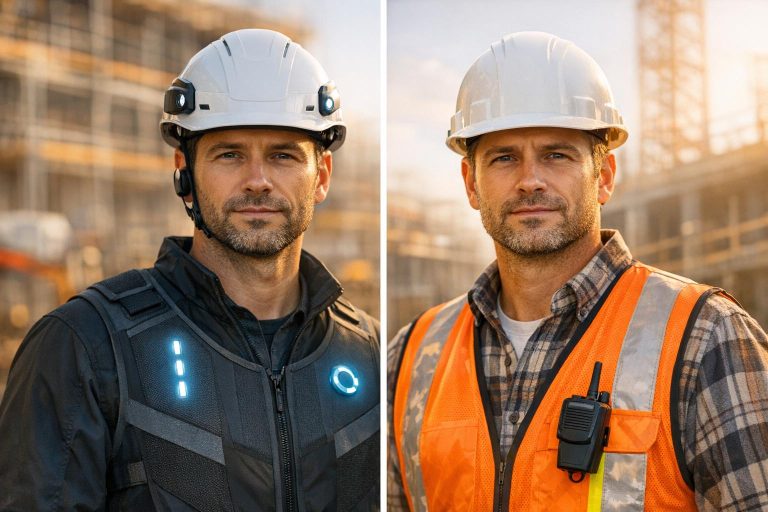
Wearable sensors and safety gear serve different purposes in injury prevention. Wearable sensors monitor real-time data like heart rate, fatigue, or environmental hazards, aiming to prevent accidents before they occur. Safety gear, like helmets and pads, acts as a physical shield to reduce harm during incidents. While sensors offer advanced monitoring and alerts, they require power, connectivity, and maintenance. Safety gear is simpler, more affordable, and always ready but lacks proactive features. Combining both creates a stronger safety system for workplaces and sports.
Quick Comparison
| Feature | Wearable Sensors | Safety Gear |
|---|---|---|
| Function | Monitors and alerts to prevent risks | Reduces harm during incidents |
| Connectivity | Wireless (Bluetooth, GPS, etc.) | None |
| Power Requirement | Battery-powered | No power needed |
| Cost | $1,000–$3,000 + fees | <$100 |
| Maintenance | Charging, software updates | Inspections for wear/damage |
| Proactive Prevention | Yes | No |
| Physical Protection | Limited | High |
Wearable sensors are ideal for early hazard detection, while safety gear provides reliable physical protection. Together, they enhance safety outcomes in industries and sports.

Wearable Sensors vs Traditional Safety Gear: Complete Feature Comparison
Wearable tech for improving health & safety
How Wearable Sensors Work
Wearable sensors function by monitoring two main types of workload: Internal Workload (tracking physiological responses like heart rate and perceived exertion) and External Workload (measuring physical activity such as distance covered, sprints, and impact forces). By combining these data points, the devices provide a comprehensive view of both the body’s activity and its response. This information is transmitted wirelessly to supervisors or medical teams, creating a safety system that goes far beyond traditional equipment. This real-time data exchange plays a critical role in identifying risks early, as discussed below.
Early Warning Features
The standout feature of wearable sensors is their ability to detect potential hazards before they escalate. Using multiple types of sensors, these devices monitor a range of factors. For instance, EEG bands built into headwear track brain activity to identify fatigue or microsleep episodes. Skin temperature sensors and sweat biomarkers can alert users to heat stress, while heart rate variability (HRV) sensors measure physical strain. GPS and proximity sensors also help prevent collisions by sending real-time alerts.
One particularly valuable metric is the Acute-to-Chronic Workload Ratio (ACWR), which compares an individual’s current training load to their 3–4 week average. When this ratio exceeds 1.5, the risk of injury increases by two to four times over the next week. The ideal range for training lies between 0.8 and 1.3 – enough to enhance fitness without risking overtraining. Additionally, kinematic sensors equipped with inertial measurement units (IMUs) can detect "near-miss" incidents, such as slips or awkward movements, by analyzing velocity, displacement, and orientation at high sampling rates (50–180 Hz).
Real-Time Data and Wireless Communication
The raw data collected by wearable sensors becomes actionable through wireless communication. Technologies like Bluetooth Low Energy (BLE), Wi-Fi, GPS, and RFID form the backbone of the Industrial Internet of Things (IIoT), a sector expected to reach $110 billion by 2025. When a sensor identifies a potential hazard, it immediately sends alerts to supervisors or medical teams, enabling swift responses. Some devices even support two-way, hands-free communication, allowing athletes to receive real-time guidance from remote experts during emergencies.
Jennifer Stiansen, Director of Marketing at JLG Industries, highlights the growing role of this technology:
"Wearable technology will become more common on construction sites due to its great advantages in improving worker safety and efficiency".
Machine learning further enhances these systems by analyzing real-time data, such as HRV and EEG readings, to identify early signs of fatigue or stress, preventing accidents before they occur. BLE tracking beacons create virtual safety zones with a range of up to 300 feet, allowing teams to monitor all members simultaneously. These communication tools make wearable sensors even more effective in sports and other high-performance environments.
Integration with Sports and Team Environments
Wearable sensors are seamlessly integrated into team settings through "smart clothing" or e-textiles. Instead of relying on bulky external devices, sensors are embedded directly into jerseys, chest straps, and safety vests to monitor metrics like heart rate, respiratory rate, and posture – all without restricting movement. For example, a study involving 20 professional Australian Football League (AFL) players used Catapult OptimEye S5 sensors during four matches to measure the frequency, speed, and force of impacts during tackles, helping assess injury risks.
The integration doesn’t stop at monitoring. Some smart boots come equipped with GPS, RFID, and IMU sensors to track movement and automatically alert teams in the event of a fall or injury. Devices like Kinetic’s REFLEX wearable, worn on the waistband, analyze biomechanics to detect improper posture or risky movements, notifying the wearer with a vibration to prevent musculoskeletal injuries. For teams using custom uniforms from Wooter Apparel, sensors can even be incorporated during the design phase, ensuring that safety features blend seamlessly with performance gear, without compromising comfort or mobility.
How Traditional Safety Gear Works
Traditional safety gear provides physical protection through its materials and design. Take a hard hat, for instance – it combines a tough outer shell to block impacts and penetration with an internal suspension system that absorbs shock and creates a protective gap between the shell and the wearer’s head. There are different types of helmets for specific needs: Type I helmets guard against impacts from above, while Type II helmets also protect against side impacts. For added safety, Class E (Electrical) helmets can handle up to 20,000 volts. These features work together to deliver immediate, reliable protection in various environments.
Passive Protection Mechanisms
The strength of traditional safety gear lies in its passive design – it doesn’t need power or activation to function. For example, high-visibility vests use reflective materials to improve visibility in low-light conditions, while safety glasses come with impact-resistant lenses to shield eyes from debris. According to the Bureau of Labor Statistics, 393 workplace fatalities in 2011 were caused by falling or flying objects, highlighting the critical role of such equipment.
"Hard hats, if worn properly and consistently, can protect crew members from falling or flying objects, electrical shock hazards and unintentional hard hits against fixed objects".
In sports, helmets, pads, and mouthguards provide similar passive protection. They absorb impact forces during collisions or falls, offering immediate mechanical defense without relying on technology like software or batteries.
Ease of Use and Reliability
One of the biggest advantages of traditional safety gear is its simplicity – it works as soon as you put it on. A helmet, for instance, doesn’t need charging, software updates, or connectivity to provide protection. Unlike wearables that depend on batteries or networks, traditional gear is always ready to perform when worn correctly. Zack Winters, Engineering Manager at FallTech, puts it plainly:
"The right gear prevents accidents, ensures compliance, and keeps your workplace safer for everyone".
Cost is another area where traditional gear shines. Basic helmets, safety glasses, and high-visibility vests are affordable, with prices ranging from $7.30 to $15.52, $1.22 to $2.61, and about $3.06, respectively. For budget-conscious teams, this gear offers dependable protection without the ongoing costs tied to tech-based solutions like software or battery replacements. That said, traditional gear does have its limitations.
Limitations of Traditional Gear
The primary drawback of traditional safety gear is its reactive nature – it only provides protection after an incident occurs. Unlike modern sensors that can monitor conditions and issue alerts, traditional gear can’t detect fatigue, track heart rates, or warn of heat stress. For example, if an athlete is overheating, a standard helmet won’t notify a coach or medical team. There’s no real-time communication or automatic alert system built into these tools.
"The use of head protection should never be considered a substitute for good safety practices and engineering controls".
Another challenge is maintenance. Traditional gear needs regular inspections to ensure it remains effective. Cracks, dents, or damage from UV exposure – often visible as a chalky surface – can weaken its performance. Even if a helmet looks fine on the outside, internal damage from a previous impact could compromise its ability to protect during future incidents. This inability to detect hidden issues, whether environmental or physiological, highlights the gap that wearable sensors aim to address.
Wireless Connectivity and Communication Comparison
This section dives into how wearable sensors stack up against traditional safety gear when it comes to communication and connectivity, building on earlier discussions about real-time data.
Real-Time Communication vs. No Connectivity
Wearable sensors come equipped with wireless connectivity, a feature completely absent in traditional gear. Using technologies like Bluetooth, RFID, Wi‑Fi, and GPS, these sensors can transmit data continuously to systems like smartphones, central hubs, or cloud platforms. This two-way communication allows them to send alerts and receive updates instantly.
This connectivity fundamentally changes how safety strategies work. Wearable sensors actively monitor conditions and alert users when they detect risks like overexertion or strong impact forces. On the other hand, traditional safety gear, such as helmets or pads, simply absorbs impacts without providing warnings or post-incident data.
"The true value of sensors lies in their ability to ultimately generate actionable insights from the raw data they collect, highlighting the importance of constant connectivity." – Qualcomm
The Industrial Internet of Things (IIoT) market, which includes connected wearables, is projected to hit $110 billion by 2025. This growth highlights the shift from reactive safety measures to proactive hazard prevention, made possible by wireless communication. However, this connectivity comes with drawbacks: wearable sensors need batteries, software updates, and network access, while traditional gear works instantly without relying on power.
Comparison Table: Wireless Connectivity
| Feature | Wearable Sensors | Traditional Safety Gear |
|---|---|---|
| Connectivity | Wireless (Bluetooth, RFID, GPS, Wi‑Fi) | None (Passive) |
| Data Transmission | Real-time, continuous streaming | No data generation |
| Communication Type | Bidirectional | N/A |
| Alerts & Feedback | Instant notifications, haptic vibration, sideline reports | Physical protection only |
| Power Requirements | Battery-powered, requires charging | No power needed |
| Remote Monitoring | Enables remote oversight | Manual visual inspection only |
| Primary Function | Hazard detection and performance monitoring | Impact absorption and physical shielding |
sbb-itb-4d95ad3
Effectiveness in Hazard Detection and Prevention
Traditional safety gear is designed to reduce the severity of injuries after an incident occurs. In contrast, wearable sensors focus on identifying risks in advance, allowing for proactive measures to prevent accidents altogether.
Early Hazard Detection with Wearable Sensors
Wearable sensors continuously monitor both physiological data and environmental conditions, giving workers and employers what researchers refer to as "situational awareness" – a real-time understanding of potential risks. This capability makes it possible to detect hazards before they lead to accidents.
For example, a construction company using helmet-mounted dust sensors and collar-attached noise monitors, alongside an automotive plant employing wrist and chest sensors, reported major improvements: respiratory incidents dropped by 30%, noise-induced hearing loss by 25%, and repetitive strain injuries by 40%.
"Wearable devices have significantly impacted ergonomic conditions in industrial settings… implementations have demonstrated a 38% improvement in optimizing ergonomic conditions compared to traditional approaches." – Jose E. Naranjo et al., Universidad Técnica de Cotopaxi
One of the standout benefits of wearable technology is its ability to identify risks that might otherwise go unnoticed. In sports, for instance, sensors track the Acute-to-Chronic Workload Ratio (ACWR) to gauge the likelihood of injuries caused by overtraining. An NFL team using Catapult OptimEye S5 sensors discovered that players with an ACWR above 1.6 faced a 1.5 times higher risk of soft tissue injuries. Armed with this data, trainers were able to adjust workloads and prevent injuries before they happened. This kind of proactive intervention highlights the stark contrast between wearables and the reactive nature of traditional safety gear.
Reactive Protection with Traditional Safety Gear
Traditional safety gear relies on a straightforward concept: it acts as a physical barrier to absorb impact and protect the wearer. A hard hat shields your head from falling objects, steel-toed boots protect your feet, and safety glasses keep debris out of your eyes. This type of protection is dependable and doesn’t require batteries, power, or network connectivity.
However, while traditional gear offers immediate physical protection, it doesn’t provide any warning about potential dangers. For example, a helmet can save your head in a fall, but it won’t alert you to the wet floor that caused the fall in the first place.
"Current safety practices, which are mainly passive in nature, have not yielded the desired optimum results." – Sensors 2021 Article
Although traditional gear has been instrumental in keeping workers safe for decades, it doesn’t address the underlying causes of accidents. With an estimated 2.3 million work-related deaths occurring globally each year, the need for prevention rather than just protection has never been more evident.
Evidence of Reduced Incidents
The advantages of wearable sensors become even clearer when looking at measurable outcomes. Unlike traditional gear, which only protects after an incident, sensors have been shown to reduce workplace injuries through early intervention. For instance, wearable devices have achieved 95% accuracy in monitoring posture and fatigue, helping to prevent accidents before they occur. Machine learning further enhances their effectiveness, with a 98.6% accuracy rate in assessing physical workload levels, enabling precise adjustments to prevent fatigue-related errors.
The economic benefits are equally compelling. Work-related musculoskeletal disorders alone account for up to 2% of GDP losses in industrialized countries due to disability and reduced productivity. By pinpointing ergonomic risks early, wearable sensors tackle these problems at their source, avoiding the costs of treating injuries after the fact.
Sports applications also reinforce the value of these devices. Studies show that elevated workload ratios significantly increase injury risk, but by using wearable sensors, coaches can adjust training regimens to keep athletes safe.
When combined, wearable sensors and traditional safety gear form a comprehensive protection system. Sensors act as an early-warning system to prevent accidents, while traditional gear provides a fallback layer of physical protection. Together, they address the needs of the 1.9 million people affected by work-related illnesses and the countless others at risk of serious injuries each year.
Challenges, Costs, and Integration with Custom Team Uniforms
Cost Considerations and ROI
When it comes to choosing between wearable sensors and traditional protective gear, cost is a major factor. Wearable sensors come with a steeper upfront price tag compared to standard helmets or padding, which typically cost less than $100. In contrast, wearable systems range from $1,000 to $3,000 per device, with additional monthly analytics fees of $5 to $30.
But the story changes when you consider injury prevention. Musculoskeletal injuries alone cost U.S. employers a staggering $17.7 billion annually, and workplace injuries lead to about $1 billion in losses every single week. Companies utilizing wearable technology have reported a 50–60% reduction in injury rates. Avoiding just one injury can save businesses thousands in both direct medical expenses and indirect costs like legal fees, insurance, and work reorganization. In fact, indirect costs can be up to 17 times higher than direct medical bills.
"Construction companies can save about $32,000 for every medically consulted injury they avoid." – ScienceDirect
For sports teams, the same logic applies. Starting with a pilot program that focuses on high-risk roles or players with a history of injuries can help assess the financial benefits. It’s also crucial to factor in the total cost of ownership, which includes expenses like battery replacements and software updates, beyond the initial purchase price .
Comfort and Practical Challenges
Unlike traditional gear, wearable sensors require regular charging and software updates . This can be a dealbreaker for athletes, who may resist wearing devices that feel bulky, rely on batteries, or risk failing during a game. Additionally, some materials used in wearables can cause skin irritation, and the devices may restrict movement. Conventional helmets and pads, on the other hand, provide protection without such complications.
Accuracy is another hurdle. Intense physical activity can disrupt optical heart rate sensors due to sweat and rapid movements, leading to less reliable data . Environmental factors like dust, humidity, and high-impact collisions can also damage the sensitive electronics in these devices. On top of that, over 70% of consumers cite high initial costs as a significant barrier to adopting advanced wearable health technology.
"To ignore the usability of the sensor seems egregious… Can I still complete my job whilst wearing this device and does the device not intrude on my job?" – Robert Houghton, Centre for Transport Studies, Imperial College London
Data privacy concerns add another layer of complexity. Athletes often worry about who controls their biometric data and how it could influence their playing time, contracts, or insurance . To address these concerns, teams need to implement encrypted systems and transparent data policies to build trust. Solving these challenges is key to advancing wearable tech and integrating it into custom team uniforms.
Custom Uniform Integration
Innovations in technology are helping to tackle many of these comfort and usability issues by embedding sensors directly into team uniforms. For example, conductive silver and carbon inks can be screen-printed onto fabric, eliminating the need for heavy wires and bulky electronics. Similarly, silver-plated yarns can replace traditional cables with lightweight, flexible conductors woven right into the fabric.
Wooter Apparel is a leader in this space, offering custom team uniforms for sports like basketball, football, baseball, softball, and soccer. Their designs are optimized for sensor integration while maintaining the flexibility and moisture-wicking properties athletes need. Compression-fit garments ensure better contact between sensors and the skin for more accurate data, and detachable wireless modules make the uniforms easy to wash and recharge without damaging the tech.
Placement is critical for seamless integration. For example, sensors positioned in the chest area can monitor heart rate, while those in the soles of socks can track balance, minimizing disruptions caused by shifting fabric . Heat-transfer application methods also help preserve the uniform’s natural range of motion. By embedding sensors directly into uniforms, teams can merge advanced safety technology with the aesthetics and functionality of traditional gear. With the global smart clothing market expected to hit $5 billion by 2030, this approach offers sports teams a chance to combine cutting-edge tech with a polished, professional look – something external gear has yet to achieve.
Choosing the Right Safety Solution
Key Takeaways
Traditional safety gear provides physical protection by absorbing impact after contact. Items like helmets, pads, and guards are straightforward, dependable, and don’t rely on batteries or software updates to function.
Wearable sensors, on the other hand, take a proactive approach. They monitor factors like fatigue and workload, identifying when an athlete might be approaching a higher risk of injury. For instance, when the Acute to Chronic Workload Ratio (ACWR) exceeds 1.5, injury risk can increase by 2–4 times. The optimal range typically falls between 0.8 and 1.3. However, wearables come with their own set of challenges, including battery upkeep, data management, and the need for strong privacy safeguards.
"Think of wearables as augmentation, not replacement." – eTraining
The best strategy combines both traditional gear and wearable sensors. While traditional equipment protects against physical impacts, sensors help prevent overtraining and detect early warning signs. This dual approach is gaining traction, with organizations spending an average of $72.21 per person on wearable devices.
Recommendations for Sports Teams
Based on these insights, sports teams should consider a phased implementation strategy. Start with a pilot program, focusing on high-risk positions or players with a history of injuries. Introduce one type of sensor initially to evaluate the quality of the data and gauge player acceptance before expanding further.
Prioritize comfort and integration. Devices should be easy to wear and fit seamlessly into uniforms. Companies like Wooter Apparel offer custom uniforms designed to integrate sensors, ensuring flexibility and accurate data collection without compromising comfort.
Address data privacy concerns head-on. Privacy is often a major hurdle for adoption. To build trust, implement a dual-layer data-sharing system. For example, sensitive physiological metrics like heart rate or stress levels can be shared exclusively with the athlete, while less sensitive data, such as movement patterns, is accessible to coaches. It’s also crucial to establish clear policies regarding data ownership, storage, and usage to reassure players and staff.
Lastly, track both internal and external workloads. Combine objective data from tools like GPS and accelerometers with subjective feedback, such as the Rating of Perceived Exertion (sRPE). This comprehensive approach helps differentiate between central fatigue (nervous system-related) and peripheral fatigue (muscle-related), enabling more precise recovery strategies.
These steps lay the groundwork for integrating safety technology into athletic programs effectively and responsibly.
FAQs
How do wearable sensors and traditional safety gear work together to prevent injuries?
Traditional safety gear and wearable sensors make a powerful team when it comes to preventing injuries on the job. Gear like hard hats, safety glasses, and steel-toe boots provides physical protection by cushioning impacts and shielding workers during accidents. On the other hand, wearable sensors add an extra layer of safety by delivering real-time monitoring and alerts.
These sensors, often built into helmets, vests, or gloves, use wireless technology to monitor things like heart rate, fatigue levels, environmental dangers, or proximity to hazardous equipment. By identifying risks early – such as heat stress or gas leaks – they give workers and supervisors the chance to act before an accident happens.
When combined, traditional safety gear and wearable sensors transform passive protection into an active safety system, helping reduce risks and improve safety in industries like construction, manufacturing, and mining.
What should I consider when comparing the costs of wearable sensors and traditional safety gear?
When weighing the costs of wearable sensors against traditional safety gear, several important factors come into play:
- Initial Investment: Wearable sensors tend to have a higher upfront cost. This includes not just the devices themselves but also the wireless connectivity and software required to manage the data they collect. On the other hand, traditional safety gear, like hard hats or gloves, is generally much cheaper per item.
- Maintenance and Ongoing Costs: Wearables often come with additional expenses over time, such as replacing batteries, updating firmware, or maintaining sensors. In contrast, traditional gear primarily incurs costs when items need to be replaced due to normal wear and tear.
- Long-Term Benefits: While wearables may seem pricey at first, their potential to reduce workplace injuries and enhance safety monitoring can translate into substantial savings over time. Traditional gear provides essential protection but doesn’t offer the advanced capabilities of wearable technology.
Choosing between the two ultimately comes down to your organization’s priorities – whether you’re focused on short-term affordability or investing in solutions that could deliver greater safety and cost savings in the long run.
How can sports teams use wearable sensors to improve safety and performance?
Sports teams can improve both safety and performance by incorporating wearable sensors into their routines. The first step is to pinpoint the main risks associated with the sport – things like collisions, fatigue, or heat stress – and then select sensors designed to monitor these specific factors. For example, accelerometers can track impacts, while heart-rate monitors measure physiological strain. To make things even more efficient, look for devices with wireless connectivity, such as Bluetooth or Wi-Fi, which allow for real-time data tracking.
One smart option is to integrate these sensors directly into team uniforms, like jerseys or shorts. This eliminates the hassle of players forgetting to wear separate devices. Custom team apparel providers, such as Wooter Apparel, offer solutions that seamlessly embed these technologies into high-quality, personalized gear. Once the sensors are in place, the data can be linked to a cloud-based platform or safety management system. This setup enables automatic alerts when thresholds are exceeded, giving coaches and medical staff immediate updates on potential risks.
By diving into the data collected from these sensors, teams can fine-tune training programs, minimize injury risks, and make better decisions regarding player recovery and performance. This forward-thinking approach creates a safer and more efficient environment for athletes to thrive.