
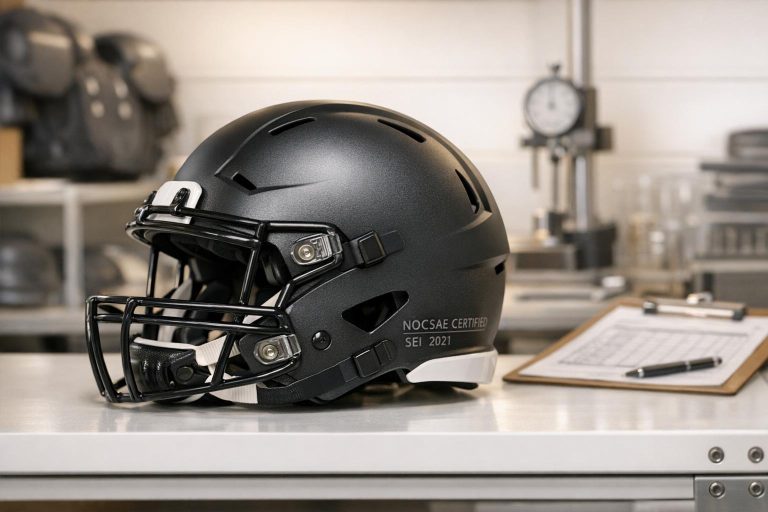
NOCSAE standards ensure sports helmets meet rigorous safety requirements to protect athletes from severe injuries. These standards, developed by the National Operating Committee on Standards for Athletic Equipment, are widely adopted by major organizations like the NFL, NCAA, and NFHS. Here’s what you need to know:
- Independent Certification: Compliance is verified by the Safety Equipment Institute (SEI) through unbiased, third-party testing.
- Sport-Specific Standards: Helmets are tailored for different sports, addressing unique risks like collisions in football or high-speed projectiles in baseball.
- Youth-Specific Focus: A new youth football helmet standard (ND006) was finalized in 2025, with implementation set for 2027, accounting for the unique needs of younger players.
- Testing Methods: Advanced tools like biofidelic headforms and metrics like the Severity Index (SI) ensure accurate impact assessments.
- Maintenance: Regular recertification and proper upkeep are critical to maintaining helmet safety.
While NOCSAE-certified helmets reduce the risk of severe head injuries, they cannot completely prevent concussions. Pairing helmets with proper coaching, rule enforcement, and injury protocols is key to player safety.
Do Baseball Helmets Expire? – The Baseball Xpert
How NOCSAE Creates Its Standards
How NOCSAE Creates and Certifies Helmet Safety Standards
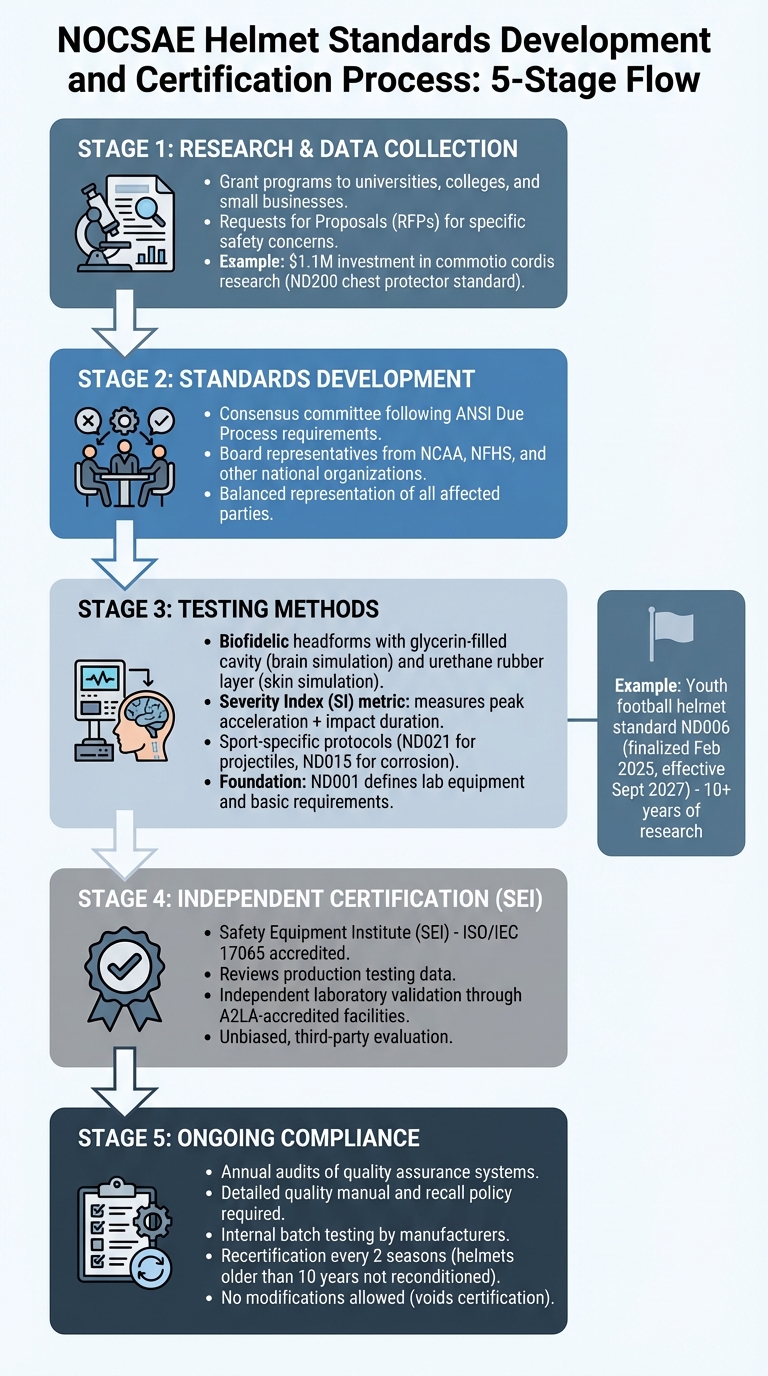
The process of developing standards at NOCSAE begins with focused scientific research and thorough data collection. To achieve this, NOCSAE funds research through grant programs awarded to universities, colleges, and small businesses across North America. Additionally, it issues Requests for Proposals (RFPs) to address specific safety concerns identified by its board.
The board is composed of representatives from national organizations like the NCAA and NFHS, ensuring the standards are aligned with practical safety needs across different levels of play. This structure encourages collaboration among researchers, equipment manufacturers, and sports governing bodies, laying the groundwork for detailed testing protocols.
For example, the ND200 standard for chest protectors emerged after a $1.1 million investment in research that pinpointed the physical cause of commotio cordis – a life-threatening heart rhythm disruption caused by chest impacts. Today, organizations such as USA Lacrosse, the NCAA, and the NFHS require chest protectors that meet this standard.
Standards are crafted by a consensus committee, adhering to ANSI Due Process requirements. This ensures that all materially affected parties have balanced representation in the decision-making process.
Testing Methods and Performance Metrics
NOCSAE employs advanced testing methods to ensure equipment safety, starting with the use of biofidelic headforms. These headforms simulate how a human head reacts to impacts, featuring a glycerin-filled cavity to replicate the brain and a urethane rubber layer to mimic skin. This design offers a more realistic assessment than traditional metallic headforms.
The main metric used in testing is the Severity Index (SI), which evaluates impact severity by integrating both peak acceleration and the duration of the impact.
"NOCSAE helmet standards are based on criteria that consider not only peak g’s but also the impact’s duration during the event. This is an accurate way to assess the severity of an impact." – NOCSAE
Testing protocols are customized based on the type of equipment and the sport it’s designed for. For instance:
- The ND021 standard evaluates protection against projectiles like baseballs.
- The ND015 standard assesses the corrosion resistance of metallic hardware.
Both rely on foundational testing methods outlined in ND001, which defines laboratory equipment and basic requirements.
Research is a continuous driver of NOCSAE’s work. In July 2025, the organization finalized the first-ever youth-specific football helmet standard (ND006). This standard was informed by research from Dr. Steve Rowson at Virginia Tech, who analyzed over 6,000 head impacts among youth players aged 10–14, and Dr. Blaine Hoshizaki at the University of Ottawa, who studied 60 youth games. Recognizing that younger players face unique risks, the standard uses a lighter pneumatic ram and adjusted impact thresholds. It is set to take effect on March 1, 2027.
"Younger players don’t run as fast or get hit as hard as older players, but they do fall to the ground more often and their heads are proportionately larger compared to their bodies. Adjusting the standard for these conditions will enable manufacturers to design helmets that focus on what youth players need." – Dr. Robert Cantu, Vice President and Chair of the NOCSAE Scientific Advisory Committee
Once equipment passes these rigorous tests, manufacturers must secure independent certification to confirm compliance.
Certification and Compliance Process
After meeting stringent testing standards, equipment enters the certification phase. Certification is handled by the Safety Equipment Institute (SEI), an independent organization accredited to ISO/IEC 17065. SEI reviews production testing data and conducts independent laboratory validations through facilities accredited by A2LA. This ensures an impartial evaluation of compliance.
To maintain their certification, manufacturers are required to:
- Undergo annual audits of their quality assurance and control systems.
- Keep a detailed quality manual and formal recall policy.
- Conduct internal batch testing to ensure ongoing compliance.
It’s crucial to keep equipment unaltered, as any modifications void SEI certification and compromise safety. For football helmets, used equipment must be recertified by NOCSAE-licensed reconditioners to ensure continued protection.
NOCSAE Standards by Sport
Helmets are designed with the specific demands of each sport in mind. For example, football helmets are built to handle intense collisions and falls, while baseball and softball helmets are crafted to protect against high-speed projectiles. These differences mean that testing methods and performance benchmarks vary, ensuring helmets meet the unique challenges of their respective sports.
Football Helmet Standards (ND002 and ND006)
Football helmet standards are divided based on age groups and levels of play. ND002 sets the performance requirements for helmets used at the high school level and beyond. This standard focuses on handling the severe impacts often experienced by older, larger, and faster players.
On the other hand, ND006, finalized on February 7, 2025, is specifically tailored for youth athletes. Backed by over a decade of research, this standard addresses the unique impact patterns faced by younger players.
ND006 incorporates a lighter pneumatic ram and a Generation III headform to replicate youth-specific impacts. It limits rotational acceleration to 5,000 rads/sec² and restricts the helmet’s total weight (including attachments) to 3.5 pounds. Although the standard officially takes effect on September 1, 2027, some helmets meeting these criteria are already available.
"We’ve known for some time that youth football players face different risks from those at or above the high school level. Building on scientific data and critical insights from research studies funded by NOCSAE, we were able to identify those risks and develop criteria for a standard to help protect against them." – Dr. Robert Cantu, MA, MD, FACS, FACSM, FAANS, NOCSAE Vice President
Baseball and Softball Helmet Standards
Baseball and softball helmets prioritize protection from high-speed projectiles rather than player-to-player collisions. The ND021 standard evaluates helmets for their ability to withstand these impacts .
Specific roles on the field call for tailored standards:
- ND022 applies to batter’s helmets.
- ND024 covers catcher’s helmets with faceguards.
- ND029 focuses on fielder headgear.
Each of these standards addresses the unique risks faced by players in their respective positions, such as the close-range impacts that catchers frequently encounter.
In addition, ND026 governs the recertification of used baseball and softball helmets, ensuring they remain safe after extended use. For added protection, ND072 sets requirements for face protectors that can be attached to certified helmets, providing batters with an extra layer of safety.
sbb-itb-4d95ad3
What NOCSAE Standards Cannot Do
Helmets certified by NOCSAE are designed to offer strong protection against severe head injuries, such as skull fractures and traumatic brain injuries. However, even a NOCSAE-certified helmet cannot guarantee complete protection from injuries or prevent concussions entirely. These standards were initially created with life-threatening injuries in mind. While they’ve been effective in reducing skull fractures, they were never intended to make helmets "concussion-proof."
"A helmet certified to a NOCSAE standard provides significant protection for serious head injuries, including concussions, but the NOCSAE helmet standard is not a concussion standard, and no helmet can prevent all concussions, even those certified to the NOCSAE standard." – NOCSAE
The performance of a helmet depends on more than just its certification. Proper maintenance and fit are critical for ensuring it functions as intended. If a helmet shifts during an impact, its ability to protect diminishes. To maintain effectiveness, helmets should fit securely, undergo regular inspections, and be cleaned gently with mild soap and water.
It’s also important to note that certification isn’t permanent. Manufacturers require helmets to be recertified every two seasons, and helmets older than 10 years are generally not reconditioned by NOCSAE-licensed facilities. Without regular reconditioning, structural issues could remain hidden, compromising safety.
Given these limitations, player safety requires a wider approach. While NOCSAE standards provide a solid foundation, they are only part of the equation. Proper coaching, strict rule enforcement, and immediate action when concussions are suspected are equally critical. Teaching safe techniques, such as proper blocking and tackling, along with enforcing rules against leading with the head, can significantly reduce risks. As Mike Oliver, Executive Director of NOCSAE, explains:
"Helmets which meet the NOCSAE standard are extremely effective at doing what they are designed to do, limiting linear accelerations… the effectiveness of helmets in protecting against concussions has become exaggerated, taking focus away from steps known to have a more immediate and much greater effect." – Mike Oliver, Executive Director, NOCSAE
Ultimately, helmets are just one piece of the puzzle in creating a safer environment for players. They are a crucial tool, but not the sole solution.
Conclusion
Since 1970, NOCSAE standards have played a critical role in athlete safety by setting rigorous, sport-specific helmet guidelines. These aren’t just suggestions – they’re mandatory rules enforced by major organizations like the NFL, NCAA, NFHS, USA Football, and USA Lacrosse. What sets NOCSAE apart is its requirement for independent third-party certification through the Safety Equipment Institute, ensuring unbiased oversight.
For teams and organizations, staying compliant means more than just buying certified helmets. It requires regular maintenance and recertification to keep the equipment safe throughout its lifespan. Partnering with NAERA-licensed reconditioners and confirming that equipment models are listed on the SEI website are essential steps in this process.
As standards continue to evolve, compliance is an ongoing effort. Key practices include checking for the permanent NOCSAE mark on helmets, ensuring proper fit and upkeep, and adhering to certification intervals based on elapsed time, not usage. The introduction of the youth-specific football helmet standard (ND006), set to take effect on September 1, 2027, highlights how these standards adapt to meet the unique needs of different age groups and sports.
While NOCSAE-certified helmets offer robust protection against severe head injuries, their effectiveness is amplified when paired with proper coaching, strict rule enforcement, and quick responses to injuries. Together, these measures create a comprehensive safety strategy, ensuring that the protective benefits of these standards are fully realized.
FAQs
What does the ND006 standard mean for youth football helmets?
The ND006 standard marks the first performance guideline tailored specifically for youth football helmets. It ensures that helmets are tested and produced to address the distinct head-impact risks faced by players younger than high school age. This standard places a strong emphasis on the safety of younger athletes and is set to become mandatory in 2027.
By addressing the unique needs of youth players, the ND006 standard takes an important step toward improving safety and fostering a more secure environment for young athletes in football.
How does NOCSAE ensure sports helmets meet safety standards?
NOCSAE guarantees that sports helmets meet strict safety standards by mandating certification through the Safety Equipment Institute (SEI), an independent third party accredited by ANSI. SEI takes several steps to ensure compliance, including conducting annual audits of manufacturers, reviewing production testing data, and performing independent lab tests on randomly chosen helmet samples.
This certification process is built to ensure impartiality and precision. Since the certifiers operate without any commercial ties to helmet manufacturers, the results remain unbiased. Through these rigorous measures, NOCSAE plays a vital role in enhancing athlete safety and building trust in helmet performance.
Why don’t NOCSAE-certified helmets completely prevent concussions?
NOCSAE-certified helmets aim to reduce the risk of specific head injuries by minimizing linear head acceleration during impacts. However, they aren’t designed to address rotational forces, which are a common cause of concussions. This limitation means that while these helmets enhance safety, they cannot fully eliminate the risk of concussions.
Other factors also play a role in concussion risks, such as helmets that don’t fit properly, poor player technique, and the inherently high-impact nature of many sports. While NOCSAE standards have significantly improved helmet safety, it’s important to understand that no helmet can offer complete protection against every type of head injury.