
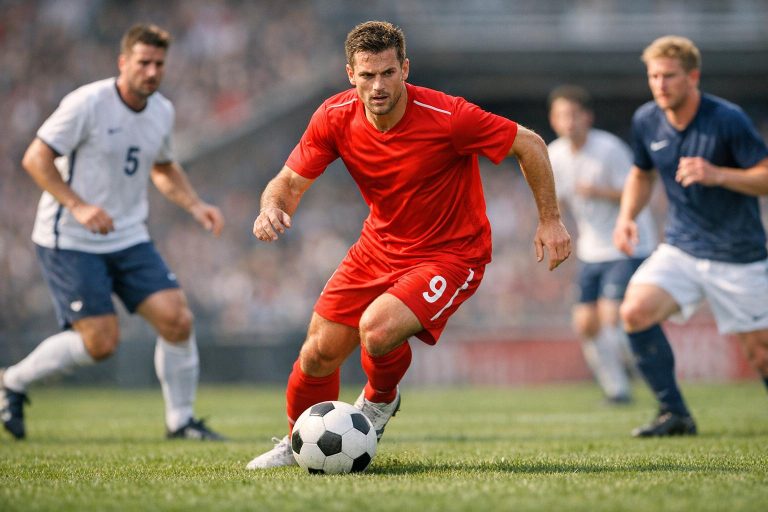
Wearing red uniforms in sports can influence both opponents’ perceptions and referees’ decisions. Research shows red is often associated with dominance, aggression, and power, which affects how athletes are viewed and how they perform. For example:
- Opponent Perception: Athletes in red are seen as more aggressive and dominant, leading to increased stress and reduced confidence in their opponents.
- Referee Bias: Studies reveal referees may unconsciously favor athletes in red, awarding higher scores in subjective sports like boxing or taekwondo.
- Physiological Effects: Wearing red has been linked to higher heart rates and increased pre-competition strength in athletes.
- Performance Outcomes: Historically, red uniforms have been linked to higher win rates in closely contested matches, though this advantage has diminished with the rise of electronic scoring systems.
While red doesn’t guarantee victory, its psychological effects can provide a subtle edge in competitive sports. For teams, incorporating red into uniform design can amplify confidence and intimidation, especially in high-stakes or contact-heavy competitions.
How Red Jerseys Impact Sports Performance: Win Rates and Psychological Effects
Why Red Triggers Aggression and Dominance Responses
Red as a Dominance Signal in Animals
In the animal world, red often signals dominance and strength. This connection is deeply rooted in biology, where red is linked to testosterone and serves as a marker of competitive advantage across various species.
For example, studies show that male Gouldian finches painted red win about 80% of their contests. Similarly, rhesus macaques tend to avoid humans wearing red, mandrills use red facial coloration to assert alpha status, and zebra finches with red leg bands gain access to more resources.
These examples highlight how red functions as a universal biological signal, communicating dominance, strength, and the ability to compete effectively for territory and mates. This natural phenomenon lays the groundwork for similar responses in human behavior.
How Humans Associate Red with Aggression and Power
Humans reflect this biological connection to red in ways that mirror the animal kingdom. Red is tied to testosterone levels and emotional states, rising during moments of anger and dropping during fear.
In a 2015 study conducted by Durham University, 100 participants were asked to evaluate men wearing red, blue, or gray T-shirts. The results? Men in red were consistently rated as more aggressive and dominant compared to those in blue (p = 0.005) or gray (p < 0.001).
"Men were rated as more aggressive and more dominant when presented in red than when presented in either blue or grey".
This response to red seems to be biologically ingrained rather than solely cultural. Research indicates that humans show an attentional bias toward red from infancy, pointing to an evolutionary predisposition. While cultural cues – like red stop signs or red error markings in school – may amplify these associations, the underlying foundation is biological.
Interestingly, wearing red doesn’t just influence how others perceive someone; it also affects self-perception. Studies from the University of Rochester reveal that wearing red can increase feelings of dominance and make opponents appear more threatening.
How Red Jerseys Affect Opponent Perception
How Opponents React to Red Uniforms
When athletes take the field in red uniforms, they spark a fascinating psychological reaction in their opponents. Studies reveal that seeing an opponent dressed in red amplifies the perception of their dominance and threat level.
"Viewing an opponent in red enhanced perceptions of the opponent’s relative dominance and threat." – Roger Feltman, University of Rochester
This response operates on multiple levels. Opponents facing athletes in red often experience heightened mental stress and reduced self-confidence – all without being consciously aware of it. These subtle shifts in perception can influence individual performance and even broader competitive outcomes.
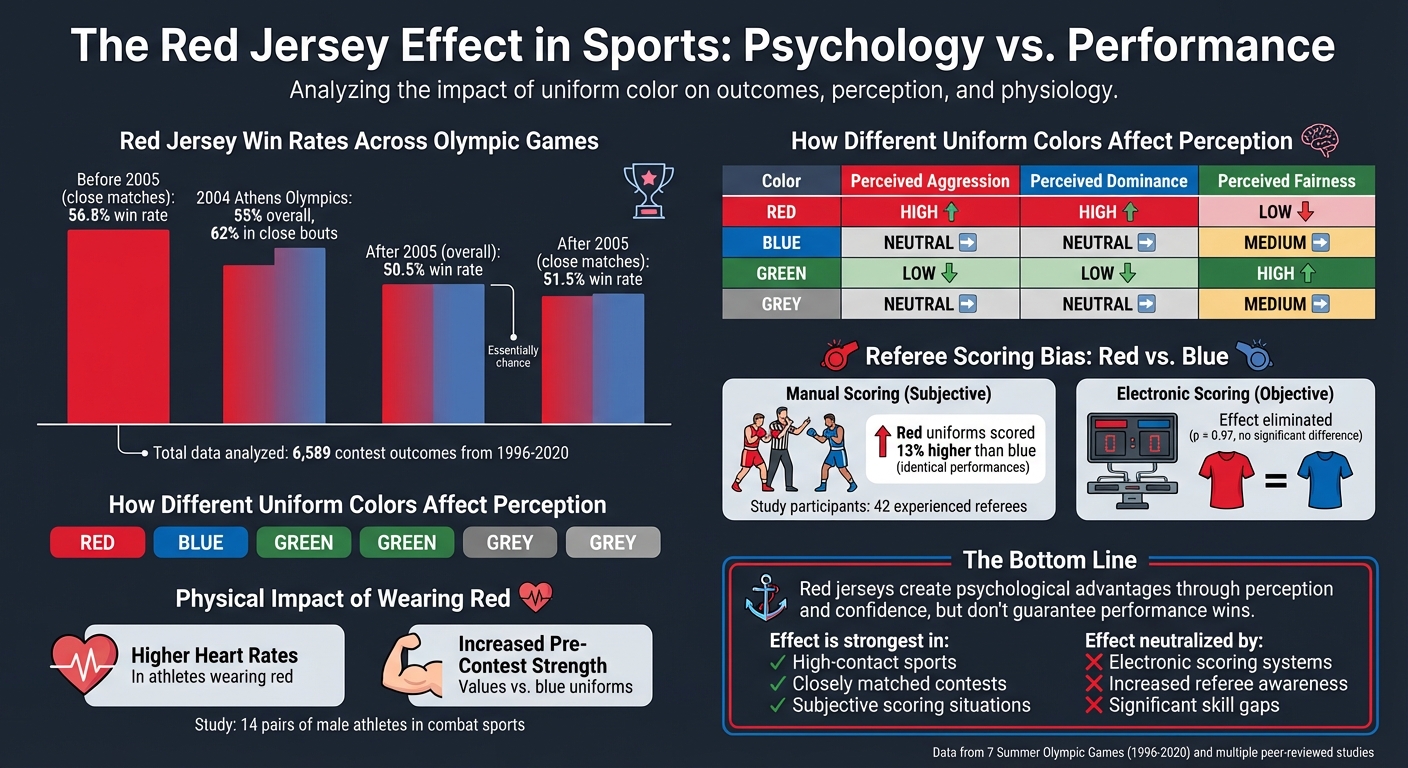
The effect of red is particularly noticeable in tightly contested matches. For example, in May 2005, researchers Russell A. Hill and Robert A. Barton from Durham University analyzed 438 matches in boxing, taekwondo, and wrestling during the 2004 Athens Olympics. Their findings? Athletes wearing red won 55% of the bouts. A later meta-analysis from December 2024, covering 6,589 contest outcomes across seven Summer Olympic Games (1996–2020), revealed a 56.8% win rate for competitors in red during close matches held before 2005.
The physiological impact of red is equally striking. In February 2013, Dennis Dreiskaemper and his team at the University of Muenster conducted a combat study with 14 pairs of male athletes. The results showed that athletes wearing red exhibited higher heart rates and greater pre-contest strength values, compared to when they wore blue.
Red vs. Other Uniform Colors
While red is uniquely associated with increased perceptions of aggression and dominance, other uniform colors elicit different reactions. Research consistently shows that red stands out as the most intimidating color when compared to blue, green, or grey.
In controlled experiments, athletes wearing red were judged as more likely to win in sports like boxing and wrestling than those in blue or green. On the other hand, athletes in green were often viewed as "fairer" and more sportsmanlike.
The contrast between red and other colors like blue or grey is particularly stark. For example, there’s no significant difference in perceived aggression between blue and grey uniforms. However, red creates a distinct psychological shift; the same facial expression is more likely to be interpreted as "angry" when paired with red attire compared to blue or grey.
| Uniform Color | Perceived Trait | Impact on Opponent |
|---|---|---|
| Red | High Aggression, High Dominance | Increased perception of threat and anger |
| Blue | Neutral Aggression | No significant difference from grey |
| Green | High Fairness | Perceived as more sportsmanlike than red |
| Grey | Neutral Aggression | No significant difference from blue |
The psychological edge of red is most pronounced in symmetrical contests, where opponents are evenly matched in skill and strength. In such cases, subtle factors like color perception can make all the difference. Interestingly, while both men and women perceive red as aggressive, male observers are particularly sensitive to red as a signal of dominance.
How Red Uniforms Influence Referee Decisions
Referee Bias in Scoring and Penalties
Research suggests that referees might unconsciously favor athletes wearing red, subtly influencing scoring decisions. A study conducted in August 2008 by Norbert Hagemann, Bernd Strauss, and Jan Leibing at the University of Münster revealed this bias. In their experiment, 42 seasoned taekwondo referees watched identical performances, but the competitors’ uniform colors were digitally altered. Athletes dressed in red consistently scored 13% higher than those in blue, despite their performances being exactly the same.
"Referees’ decisions tip the scales in evenly matched contests, but have less impact when one athlete clearly outperforms the other."
– Norbert Hagemann, Bernd Strauss, and Jan Leibing
This bias becomes most apparent in subjective sports like boxing, wrestling, and taekwondo, especially during closely contested matches or quick decision-making situations. However, the adoption of electronic scoring systems has significantly reduced this effect. A 2024 meta-analysis reviewed 6,589 matches from seven Summer Olympic Games (1996–2020) and nine World Boxing Championships (2005–2021). Before 2005, red-clad fighters won 56.8% of tight matches, but this dropped to 50.5% in modern competitions. This shift coincided with the introduction of electronic scoring tools, such as body and head protectors in taekwondo, implemented in 2012 and 2016.
This shift highlights how technology can counteract human biases, reducing the influence of color psychology on game outcomes. As scoring becomes more objective, the impact of uniform color fades, emphasizing the importance of fair play in modern sports.
How the Red Effect Varies Across Different Sports
The influence of red on referee decisions varies depending on the sport and its scoring system. In subjective sports, like combat disciplines, red often amplifies perceptions of aggression, boosting win probabilities. However, in sports with objective scoring systems, such as football or handball penalties, the color has little to no impact.
| Sport Category | Impact of Red on Referee/Judging | Scoring Nature |
|---|---|---|
| Combat Sports (Boxing, Wrestling) | High – red is linked to aggression and increased win chances | Subjective/Judgment-based |
| Taekwondo (Manual Scoring) | High – red-clad athletes gain about 13% more points | Subjective/Split-second |
| Taekwondo (Electronic Scoring) | Negligible – no notable win-rate difference between red and blue | Objective/Sensor-based |
| Team Sports (Football/Handball Penalties) | Low to none – no measurable advantage for red uniforms | Objective/Outcome-based |
Electronic scoring systems in taekwondo have effectively neutralized the red advantage. For instance, an analysis of 1,327 matches using electronic body and head protectors found no significant relationship between uniform color and match outcomes (p = 0.97). Similarly, studies on football and handball penalties showed that goalkeepers wearing red did not have an edge over those in blue when it came to saving shots.
"The introduction of the electronic helmet protector, in addition to the electronic body protector, made the scoring system more objective, decreasing the advantage of wearing red in winning matches."
– Gennaro Apollaro and Coral Falcó
Ultimately, the red effect seems to act as a deciding factor in closely matched contests. As technology reduces human judgment in scoring, this influence diminishes. These findings underscore the complex role of red in sports, shaping not only player dynamics but also officiating decisions, making it a strategic element in uniform design.
The Color Effect – Why Red Wins More Often
sbb-itb-4d95ad3
Does Wearing Red Actually Improve Performance?
The idea that red uniforms might enhance athletic performance has sparked plenty of debate, with studies showing mixed results depending on the sport, time frame, and the metrics used to measure performance. These findings add nuance to earlier research on how red influences opponent perception and referee decisions, highlighting its complex role in sports.
Studies Showing Red Improves Win Rates
Some early research suggested that wearing red could give athletes an edge. For example, during the 2004 Athens Olympics, athletes wearing red had a win rate of 55%, which climbed to 62% in closely contested bouts.
"Wearing red is consistently associated with a higher probability of winning." – Russell A. Hill and Robert A. Barton
The so-called "red effect" wasn’t limited to combat sports. In the Euro 2004 soccer tournament, teams that alternated between red and other colors performed noticeably better when wearing red kits. A long-term analysis of the English Football League (1947–2003) also revealed that teams with red home kits were more likely to win league championships than expected.
Interestingly, one study linked red uniforms to physiological changes, such as higher heart rates and increased pre-contest strength. This suggests red might influence more than just perception, potentially affecting physical performance as well.
However, these findings aren’t universal, and some studies cast doubt on the idea that red consistently boosts performance.
Studies That Found No Red Advantage
A more comprehensive meta-analysis painted a different picture. Researchers examined 6,589 contest outcomes from seven Summer Olympic Games (1996–2020) and nine World Boxing Championships (2005–2021). The results? Athletes wearing red had an overall win rate of 50.5% – essentially no better than chance. Even in close contests, the win rate for red was only slightly higher at 51.5% [6, 16]. Notably, before 2005, red-clad athletes won 56.8% of close matches, but this advantage disappeared as scoring systems became more objective.
"It is possible that knowledge of the effect, as well as rule changes in each of the sports, have reduced the chances of a small effect being manifested, leading to the disappearance of the red advantage in competition results." – Nature, Scientific Reports
The impact of red also varies across sports. Bjoern Krenn from the University of Vienna noted, "in taekwondo we did not find any significant impact of uniform color". Some researchers argue that perceived advantages for red could stem from unrelated factors, such as the competitor’s assigned corner or seating position. Moreover, the adoption of electronic scoring systems in taekwondo in 2012 and 2016, along with growing awareness of color biases among referees and athletes, seems to have eliminated any edge red uniforms might have once provided.
How Teams Can Use Color Psychology in Uniform Design
Understanding how uniform colors affect psychology can give teams an edge that goes beyond just looking good. While studies show mixed results on whether wearing red directly impacts win rates, its effect on perception – both for athletes and their opponents – makes it a powerful tool in uniform design.
Using Red Uniforms for Psychological Impact
Red works on two levels, creating a psychological advantage for both the wearer and their competition. Research suggests that red can increase the confidence of the athletes wearing it while making them appear more intimidating to opponents. This dual effect can enhance a team’s sense of dominance during competition.
Physiological responses also back up the power of red. Studies have linked the color to higher heart rates and increased pre-contest strength. This makes red an excellent choice for teams in high-stakes scenarios, particularly in sports like boxing, wrestling, or other contact-heavy competitions where aggression and dominance play a crucial role.
However, context matters. With advancements like electronic scoring systems and growing awareness of color biases among referees, any officiating-related advantages have diminished. Today, the real benefit of red lies in boosting confidence among players and subtly influencing how opponents perceive them.
These insights open the door for teams to use red strategically in their uniform designs.
Designing Red Jerseys with Wooter Apparel

Given red’s psychological influence, teams can take advantage of this effect with thoughtfully designed uniforms. Wooter Apparel (https://wooter.com) offers sublimated custom uniforms that integrate red dye directly into the fabric. This technique ensures the color stays vibrant season after season without fading, cracking, or peeling, maintaining a sharp and professional look.
Sublimation also keeps the jerseys lightweight and breathable, eliminating the bulk of heavy ink or embroidery. This is crucial for athletes in sports where speed and agility are essential. By wearing red, players can enjoy the psychological edge without sacrificing comfort or performance. Wooter Apparel provides custom design services that include unlimited logos, numbers, and player names – all at a single price point. Custom basketball jerseys, for example, start at just $16.99 per piece, making it affordable for teams to outfit their players in high-impact red uniforms.
Teams can collaborate with Wooter Apparel’s free design service to incorporate red into their uniforms. Whether used as the primary color for maximum effect or as an accent to tap into its dominance associations, red can be tailored to fit any team’s needs. The sublimation process also allows for intricate designs, gradients, and multiple shades of red – options that would be difficult or expensive with traditional screen printing methods.
Conclusion
Drawing insights from the research, teams now have a clearer understanding of how to approach uniform design strategically. While red jerseys have historically been associated with a psychological edge, the data reveals a more nuanced picture. For instance, an analysis of 6,589 bouts spanning 1996 to 2021 showed red-clad competitors winning only 50.5% of matches. This shift suggests that advancements like electronic scoring systems and heightened awareness among officials have helped neutralize color-based biases.
Today, the strength of red lies in its psychological influence rather than any direct performance advantage. Studies show that wearing red can enhance perceptions of dominance, making opponents view the wearer as more intimidating. Additionally, the color has been linked to physiological effects, such as increased heart rates and a boost in pre-competition strength.
Red tends to be most impactful in high-contact sports or tightly contested matchups, where even slight psychological advantages can sway the outcome. It grabs attention, conveys aggression, and instills confidence in players during pivotal moments – though it won’t bridge significant skill gaps on its own.
To make the most of red’s psychological benefits, teams should focus on its ability to enhance confidence and intimidate, rather than expecting automatic victories. By pairing red’s impact with cutting-edge design techniques – such as those provided by Wooter Apparel – teams can achieve both a visually striking look and a subtle competitive edge. With advanced sublimation technology ensuring vibrant, durable, and lightweight jerseys, teams can harness red’s psychological power while maintaining top athletic performance. When integrated thoughtfully into modern uniform design, red becomes a valuable component of a broader strategy for success.
FAQs
How does wearing red affect an athlete’s performance and opponent behavior?
Wearing red uniforms can influence both an athlete’s game and how their opponents perceive them. Research indicates that the color red can spark physical reactions like a faster heart rate and higher blood pressure. These changes can sharpen focus and provide a temporary boost in power, possibly due to red’s deep evolutionary ties to dominance and aggression.
Red doesn’t just affect the person wearing it – it also impacts their opponents. Studies reveal that athletes competing against someone in red often experience heightened stress, which can chip away at their confidence. For the athlete in red, the color is linked to feelings of dominance and assertiveness, potentially fueling more aggressive and strategic play. While its effect on overall win rates isn’t consistent, the psychological and physiological edge red provides makes it a standout choice in sports.
Why do referees sometimes favor athletes wearing red uniforms?
Referees might unknowingly lean toward athletes wearing red uniforms because red is often linked to dominance, power, and aggression. Research indicates that this psychological association can shape how referees view players, possibly swaying their calls or decisions in favor of those in red.
The boldness of red can also make athletes seem more confident and imposing, which could subtly influence an official’s judgment, especially in tense, high-stakes moments. While these effects aren’t intentional, they underscore the fascinating psychological role that colors play in sports.
Do red uniforms still give teams a competitive advantage in modern sports?
Red uniforms have long been associated with projecting dominance and intimidation, potentially influencing how opponents perceive and respond to a team. Research indicates that teams dressed in red may be viewed as more aggressive and assertive, which could subtly affect the dynamics of a game.
That said, in today’s world of advanced analytics and modern scoring systems, the impact of red uniforms on actual outcomes appears to be inconsistent and relatively small. While the color might boost confidence or create a slight psychological edge, factors like strategy, skill, and teamwork remain the true drivers of success on the field.