
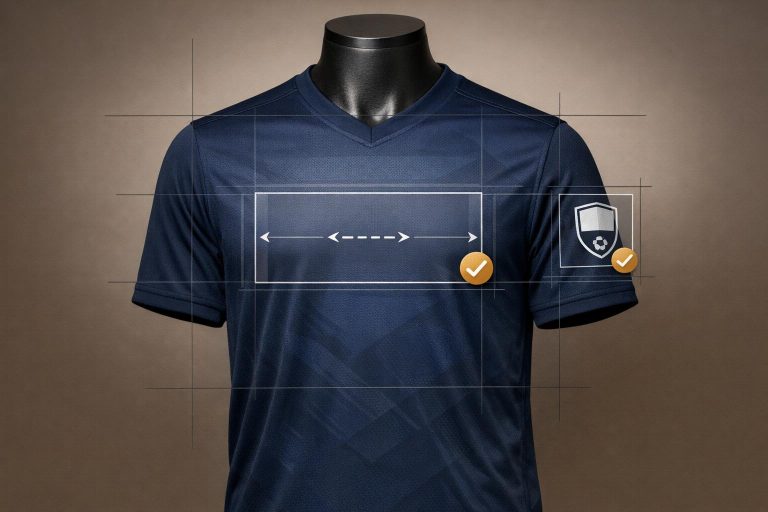
Creating custom team uniforms with sponsor logos isn’t just about design – it requires following specific legal and league rules. Missteps, like using logos without permission or ignoring regulations, can lead to lawsuits, contract issues, or disqualification. Here’s a quick breakdown of what you need to know:
- Sponsorship Agreements: Always get written approval for logo use, including size, placement, and design restrictions. Follow the sponsor’s brand guidelines to avoid legal challenges.
- League Rules: Uniform regulations vary by league. For example, NCAA rules currently allow only manufacturer logos but may permit additional sponsor logos starting August 1, 2026.
- Logo Placement & Size: Prime spots like the chest or sleeves maximize visibility. Logos should balance visibility with aesthetics – league rules often limit size (e.g., MLB sleeve logos are capped at 36 sq. inches).
- Printing Methods: Sublimation is ideal for durability and vibrant designs. It embeds logos into fabric, avoiding cracking or fading.
- Legal Checks: Verify trademark permissions and consult legal experts to ensure compliance and avoid disputes.
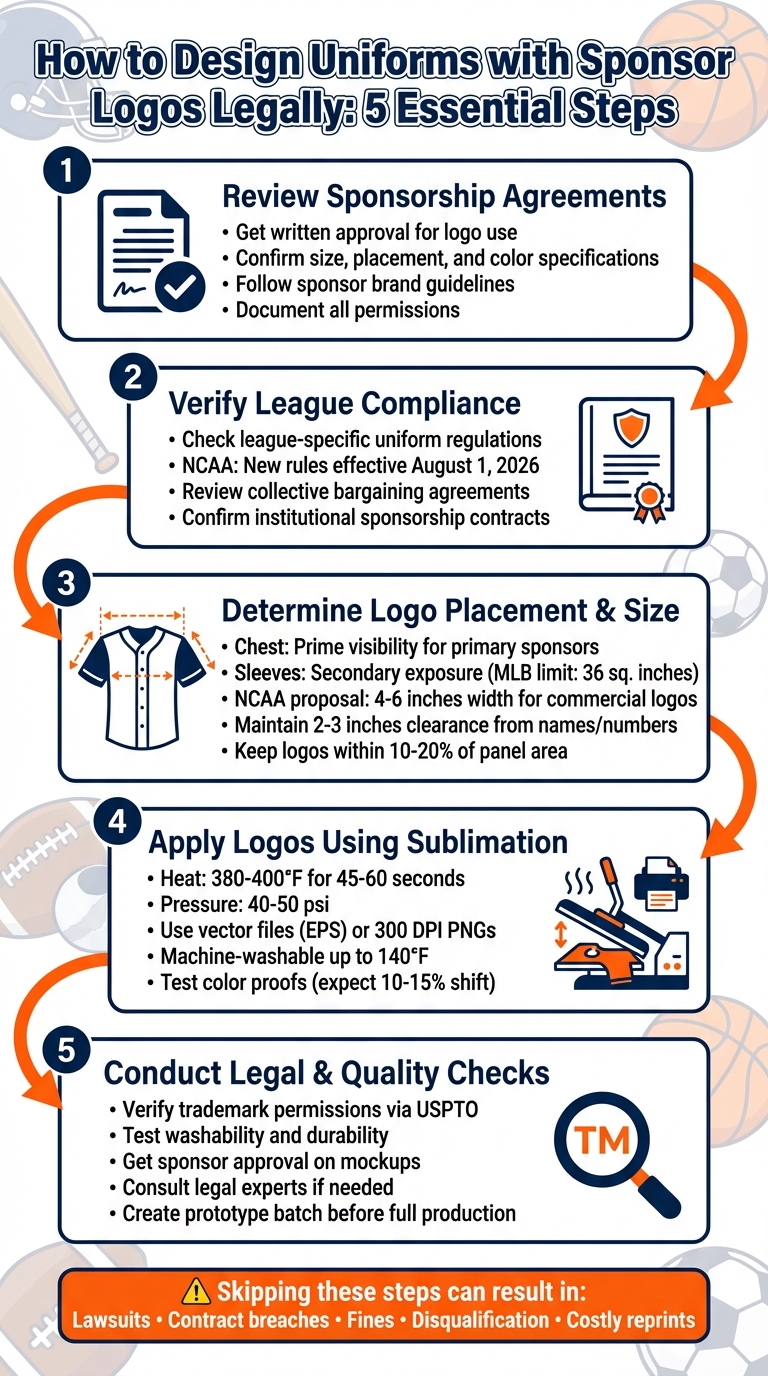
5-Step Legal Process for Adding Sponsor Logos to Sports Uniforms
Understanding Sponsorship Agreements and Legal Permissions
Before adding a sponsor’s logo to a uniform design, it’s important to navigate the legal rules surrounding its use. These rules stem from two key areas: the terms outlined in your sponsorship contract and the uniform regulations set by your league or event organizer. Overlooking either can lead to serious consequences, like trademark infringement lawsuits or breaches of contract. Below, we dive into the essential steps for reviewing sponsor logo terms and ensuring compliance with league rules.
Review Sponsor Logo Usage Terms
Every sponsorship agreement should include clear, written approval that outlines exactly how the sponsor’s logo can be used. This approval should specify details like logo size, placement, color variations, and any design restrictions. Without this documentation, you might face legal issues for unauthorized use. Missteps here can lead to significant legal challenges.
Sponsors often provide brand guidelines that dictate how their logo should appear. These guidelines typically cover acceptable colors, fonts, and contexts for usage. For example, they may require the logo to remain in its original color scheme or prohibit changes that could weaken its branding. If you’re considering modifications – such as adjustments for sublimation printing – make sure to confirm whether alterations are allowed or if the logo must remain exactly as provided.
Confirm Compliance with League or Event Rules
Sponsorship agreements also need to align with the uniform regulations set by your league or event. In many cases, league rules take precedence over sponsor preferences. Ignoring these rules could lead to fines, penalties, or even forfeited games. Carefully review the specific guidelines for your league, as they may impose restrictions on logo types or placements. For instance, the NCAA has proposed new uniform rules that could take effect in August 2026.
Professional leagues often have collective bargaining agreements with strict rules about logo size and placement. Similarly, high school sports overseen by the National Federation of State High School Associations (NFHS) follow state-specific guidelines. Before finalizing any uniform design, verify the regulations that apply to your level of competition. It’s also important to remember that uniform deals are typically arranged by schools or institutions, not individual athletes. Institutional sponsorship agreements may prohibit conflicting logos. For example, Marquette University enforces a ban on Adidas or Under Armour logos due to its existing contract with Nike.
sbb-itb-4d95ad3
Logo Placement and Sizing on Uniforms
Once you’ve addressed the legal and sponsorship guidelines, the next step is to focus on the placement and sizing of logos on your uniforms for maximum impact.
Prioritize Placement for Visibility
Choosing the right spot for a logo can make all the difference in sponsor exposure while keeping the uniform polished and professional. The chest area is prime real estate, offering the best visibility during broadcasts and action shots, making it ideal for primary sponsors. Sleeves are another great option, providing secondary exposure without compromising player comfort. Meanwhile, logos on the back can further boost visibility, especially during gameplay.
To avoid clutter, logos should be positioned at least 2–3 inches away from player names and numbers. For instance, Little League guidelines stipulate that custom logos must align with full league names without obstructing essential uniform elements. Similarly, the NCAA is considering allowing two commercial logos on jerseys during non-championship games, with sport-specific committees setting placement standards. Once you’ve identified the best spots, focus on sizing to ensure a cohesive and professional appearance.
Get the Sizing Right
Logo size needs to strike a balance between sponsor visibility and maintaining the uniform’s overall aesthetic. For example, MLB limits sleeve logos to 36 square inches – roughly a 6×6-inch area – to maintain proportionality. Meanwhile, the NCAA’s proposed rules suggest restricting additional commercial logos on jerseys to 4–6 inches in width.
For the front of a jersey, aim to keep logos within 10–20% of the panel’s area. On an adult XL jersey, this translates to approximately a 5×5-inch logo. Maintaining a 1:4 ratio between the logo width and the jersey width typically ensures the design doesn’t overpower team colors or numbers. Testing these ratios is key to finding the perfect balance. Using baseball jersey sizing kits can help ensure accurate measurements before production. Additionally, sublimation printing offers flexibility, allowing logos to scale between 4–8 inches without losing clarity or durability, even after repeated washes.
At Wooter Apparel, we use advanced sublimation techniques to ensure each sponsor logo is applied with precision and built to last, giving your uniforms a polished, professional finish.
Adding Logos to Custom Uniform Designs
Once you’ve decided on the placement and size of sponsor logos, the next step is integrating them into your uniforms in a way that ensures they look great and hold up under the demands of athletic competition. The method you choose will directly affect the durability and appearance of the logos.
Using Sublimation for Durable Logo Application
Dye sublimation is a reliable way to apply sponsor logos to team uniforms. This process uses heat to embed dye directly into polyester fabric fibers, making the logo a permanent part of the material instead of just sitting on the surface. Unlike screen printing, which can crack over time, or embroidery, which adds bulk and limits color choices, sublimation creates vibrant, full-color designs while keeping the fabric flexible and breathable.
Here’s how it works: create your design in a vector format, print it as a mirrored image on transfer paper, and heat-press it onto the fabric at 380–400°F for 45–60 seconds with 40–50 psi of pressure. This process ensures the logo is infused into the fabric. The result? A logo that’s machine-washable up to 140°F and stays vibrant even after repeated washes, helping you avoid frequent replacements.
For the best results, use vector files like EPS or high-resolution PNGs (300 DPI) with PMS color matching and a 0.25-inch bleed. It’s also a good idea to test color proofs on fabric swatches since heat transfer can cause a slight color shift – typically around 10–15%. Companies like Wooter Apparel excel at seamlessly integrating sponsor logos into various sports uniforms, including jerseys, shorts, and warmup gear for basketball, football, baseball, softball, and soccer, all while staying compliant with sponsorship agreements.
Once the logos are securely applied, it’s time to test their durability and ensure they meet all necessary standards.
Testing and Finalizing Uniform Designs
Before moving into full production, it’s crucial to test your designs. This step ensures the logos are durable, the colors are accurate, and the uniforms comply with sponsorship agreements and league regulations. Skipping this phase could lead to costly reprints or even legal issues. Effective testing can also help cut production costs by 20–30%.
Run tests for washability, abrasion resistance, UV exposure, and overall wear to ensure the logos hold up under real-world conditions. Once testing is complete, finalize your designs by securing sponsor approval on digital mockups, confirming trademark permissions, and double-checking compliance with league rules. For instance, keep an eye on updates like the NCAA’s proposed rule changes, which may allow additional commercial logos on uniforms starting August 1, 2026.
Before full-scale production, create a small batch of prototypes for final review by stakeholders. Document all approvals in writing to avoid misunderstandings and work with manufacturers experienced in sublimation to ensure compliance and quality.
Ensuring Compliance and Avoiding Legal Risks
After completing durability tests and getting your design approved, it’s crucial to confirm that every sponsor logo aligns with legal standards. Skipping this step can lead to legal disputes, forced redesigns, or even production delays. Make sure all sponsor logos comply with trademark and licensing requirements to avoid these pitfalls.
Verify Trademark and Licensing Permissions
Each sponsor logo must be legally authorized for use on athletic apparel. A trademark is essentially a word, phrase, symbol, or design that identifies and differentiates the source of goods from others.
Use tools provided by the USPTO (United States Patent and Trademark Office) to perform a thorough trademark search. This ensures that the sponsor’s registration covers apparel and checks for possible conflicts with existing trademarks. Keep in mind that trademark protection is tied to specific categories of "goods and services." Additionally, verify that the logo matches its officially registered design. Even small changes – like adjustments in color, size, or style – can create legal complications if they stray from the approved version.
Consult Legal Experts if Necessary
If you’re unsure after completing your initial review, consulting a legal expert can be invaluable. Complex sponsorship agreements and trademark laws often require professional insight. As Landry Legal advises:
Work With a Lawyer – Have an attorney review your designs before launch to reduce risk.
Legal professionals can help identify potential infringement risks, particularly those involving logos, team names, or protected phrases that may not be immediately obvious. For example, designs inspired by professional teams can lead to "likelihood of confusion" claims, even if they don’t feature official logos. Organizations like the NFL closely monitor online platforms, social media, and events for unlicensed merchandise, making it smart to seek legal advice before production begins. If you receive a cease-and-desist letter, Landry Legal recommends:
If you’ve received a cease-and-desist letter, or if you’re planning a sports-themed product launch, get legal advice before you sell.
Before starting the sublimation process, have your attorney conduct a final audit of all trademarked elements, including slogans and city-specific references. This last step can help you avoid expensive reprints and shield your organization from potential legal troubles.
Conclusion
Creating uniforms with sponsor logos requires careful attention to both legal guidelines and technical details. Proper logo placement – taking into account seams, armholes, and necklines – is crucial for protecting sponsor trademarks and presenting a polished brand image. Using sublimation printing is a smart choice, as it ensures logos remain vibrant and intact over time, safeguarding the sponsor’s identity.
For collegiate teams, adhering to NIL regulations is essential to stay within legal boundaries.
By focusing on accurate logo placement and reliable printing methods, you can produce uniforms that exude professionalism and strengthen relationships with sponsors. To avoid potential setbacks, consulting legal experts during the design process is always a wise move.
For fully customized and regulation-compliant uniforms, consider exploring custom soccer uniforms and other design services from Wooter Apparel.
FAQs
What should a sponsorship agreement include when adding logos to team uniforms?
A sponsorship agreement that involves adding logos to team uniforms needs to cover several essential details to ensure clarity and fairness for both parties. These include identifying the parties involved, specifying where the logo will be placed, its size, and the length of the agreement.
The contract should also address exclusivity rights, clearly outline payment terms, and ensure compliance with any rules set by the league or federation. Provisions for approval processes, intellectual property rights, and steps to follow in case of termination are equally important.
To prevent misunderstandings or conflicts, the agreement should include indemnification clauses and a well-defined dispute-resolution process. Covering these points thoroughly helps protect both sides and keeps the arrangement professional.
How can I design uniforms with sponsor logos that comply with league rules?
To make sure your team uniforms comply with league regulations, the first step is to carefully review the official rulebook for your league – whether it’s NFHS, NCAA, NBA, FIFA, or another organization. These rules will specify things like where logos can be placed, size restrictions, and any content that’s not allowed. For instance, basketball chest logos are usually restricted to 3–5 inches in width, while sleeve logos are typically between 1–3 inches wide.
Once you’ve reviewed the guidelines, position sponsor logos within the permitted areas, ensuring they meet the size requirements and don’t include any banned imagery. Before moving forward with production, submit your uniform design for league approval – many leagues require this certification before the season starts. Working with a seasoned manufacturer, such as Wooter Apparel, can make this process easier. They offer free custom design mock-ups and guarantee that all logos are correctly placed and follow league rules. Taking these steps and completing pre-production checks will help you avoid any compliance issues once the season begins.
What’s the best way to add sponsor logos to team uniforms for durability and visibility?
The sublimation printing process stands out as an excellent method for applying sponsor logos to team uniforms. This approach ensures logos remain vivid, easy to spot, and durable, even after repeated use and countless washes.
What sets sublimation apart is that the design integrates directly into the fabric. This means no peeling, cracking, or fading over time, making it a top-tier option for teams seeking polished, enduring results.