
Most uniform mistakes are not printing mistakes. They are spreadsheet mistakes.
Teams collect rosters in spreadsheets, share designs as PDFs, and confirm “final” details in WhatsApp threads. That setup makes confusion likely the moment anything changes.
A player changes size. Two athletes choose the same number. A coach approves one file, and an admin submits another. One small mismatch creates wrong names, wrong numbers, delays, and avoidable reprints.
UniformOS is a uniform ordering software built to replace that disconnected workflow. It brings uniform design, roster and sizing collection, approvals, and production handoff into one platform, so organizations can run repeatable uniform programs across seasons.
Most teams start uniform orders with the same three tools: a roster spreadsheet, a PDF mockup, and a WhatsApp group. It feels fast at the start. It becomes expensive once the order gets real.
A uniform order spreadsheet is rarely “one file.” It becomes multiple versions with different edits. One sheet has updated sizes. Another has corrected spellings. Someone changes jersey numbers but does not tell everyone. Teams submit the wrong roster even when everyone had good intentions.
Spreadsheets also do not enforce accuracy. They allow missing sizes, duplicated jersey numbers, and mixed youth and adult sizing. Small gaps become production mistakes that often require reprints.
PDFs work for showing a design, but they do not work for managing decisions. Teams send “final” mockups back and forth with comments and screenshots. When details change, like logo placement, numbering style, or color codes, teams create a new PDF and repeat the cycle.
Without a clear approval record, disagreements are normal. One person believes the design was approved. Another person thinks it was still in review.
WhatsApp is quick, but it is not structured. Decisions get buried under new messages. Key details appear as screenshots instead of locked specifications. When a new coach or admin joins the thread, they cannot see what changed or why.
That is why traditional uniform ordering feels fragile. The workflow depends on memory, not a system.
Wooter utilizes UniformOS because uniform ordering fails at the workflow level. The order lives across spreadsheets, PDFs, and message threads, so details drift and mistakes multiply.
UniformOS was built to solve repeat problems like these:
UniformOS software simplifies custom uniform ordering for sports organizations by replacing manual, disconnected processes with a centralized digital system. Instead of relying on emails, spreadsheets, and repeated revisions, teams can manage the uniform workflow in one place.
Teams can handle uniform design, player rosters, sizing, approvals, and production from a single platform. This software-first approach reduces errors, improves accuracy, and helps organizations scale uniform programs across seasons and teams.
UniformOS operates as a standalone platform powered by Wooter. It combines uniform management technology with apparel manufacturing expertise, so teams get a structured ordering system while still relying on consistent production and fulfillment.
UniformOS is not just a dashboard. It is a set of tools built around the steps teams repeat every season: design the uniform, collect player data, approve details, and move clean specifications into production.
Design uniforms with structured inputs for colors, logos, numbers, and names. Reduce miscommunication before production starts.
What this prevents:
Collect names, numbers, and sizes digitally in one roster. Catch duplicates and missing fields early.
What this prevents:
Keep specs, approvals, and timelines in one source of truth. Production works from the approved version.
What this prevents:
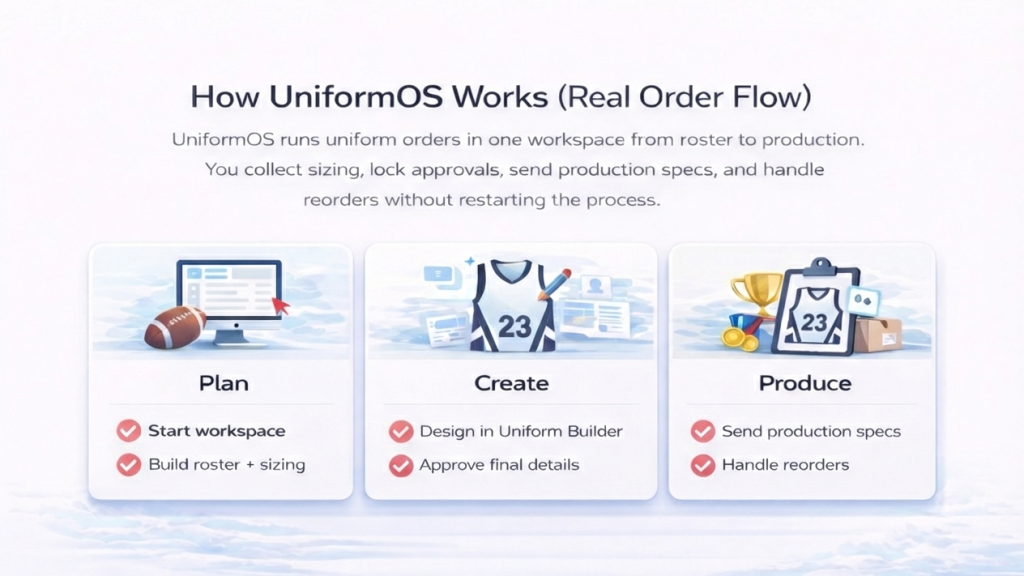
Here is the difference teams actually feel in practice.
Print shop: Multiple files floating around
UniformOS: One centralized order workspace
Print shop: Copy-paste errors and missing fields
UniformOS: Digital roster and sizing tools
Print shop: Buried in messages and email threads
UniformOS: Visible, traceable approvals
Print shop: Specs interpreted from screenshots
UniformOS: Locked specs through a portal
Print shop: Feels like starting over
UniformOS: Updates stay in the workflow
Quick answers to common UniformOS ordering questions.
It centralizes uniform design, rosters, sizing, approvals, and production handoff so teams do not rely on spreadsheets, PDFs, and message threads.
Version confusion, incomplete roster data, and unclear approvals create mistakes, even when everyone tries to be careful.
Spreadsheets allow missing sizes, duplicate numbers, and multiple versions circulating at once.
A structured roster system makes number conflicts visible early, before the order reaches production.
UniformOS supports reorders and updates without rebuilding the entire order from scratch.
A centralized platform keeps approvals visible and traceable, so teams know what version was approved and when.
Uniform ordering should run like a system, not a group chat. UniformOS keeps design, roster details, sizing, and approvals in one place so teams move faster and make fewer mistakes.
Send your roster and get a custom design built for your team. Then run the order through a workflow that stays stable, even when the roster changes mid-season.