
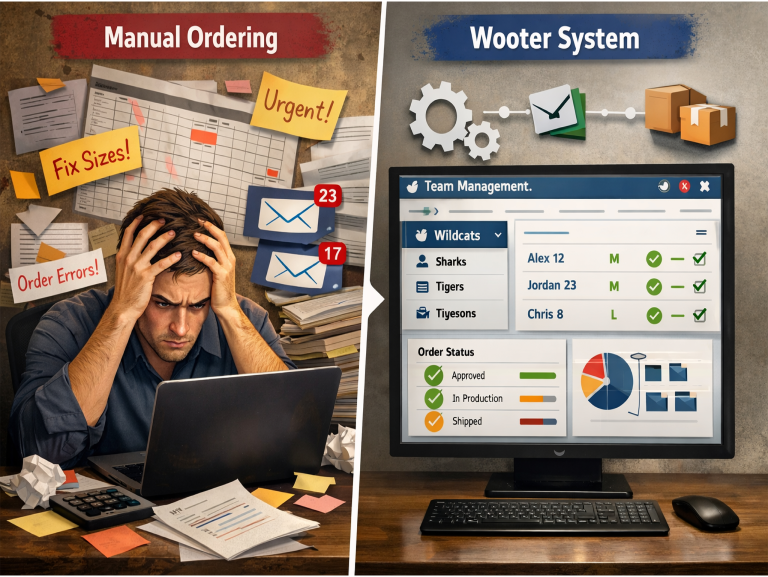
Running a sports league or multi-team organization is already demanding. You manage registrations, schedules, coaches, parents, players, payments, and logistics. Now add apparel ordering into the mix, and for many organizations, that’s where the real chaos begins.
If you’re still using spreadsheets, email chains, and manual tracking, you’re not alone. But you are likely dealing with unnecessary stress, delays, and costly mistakes.
This page breaks down the real difference between:
Manual Ordering = Spreadsheets + Headaches
Wooter = System + Automation
Let’s dive into why upgrading from manual processes to an integrated system like Wooter isn’t just convenient, it’s transformative.
The Reality of Manual Ordering
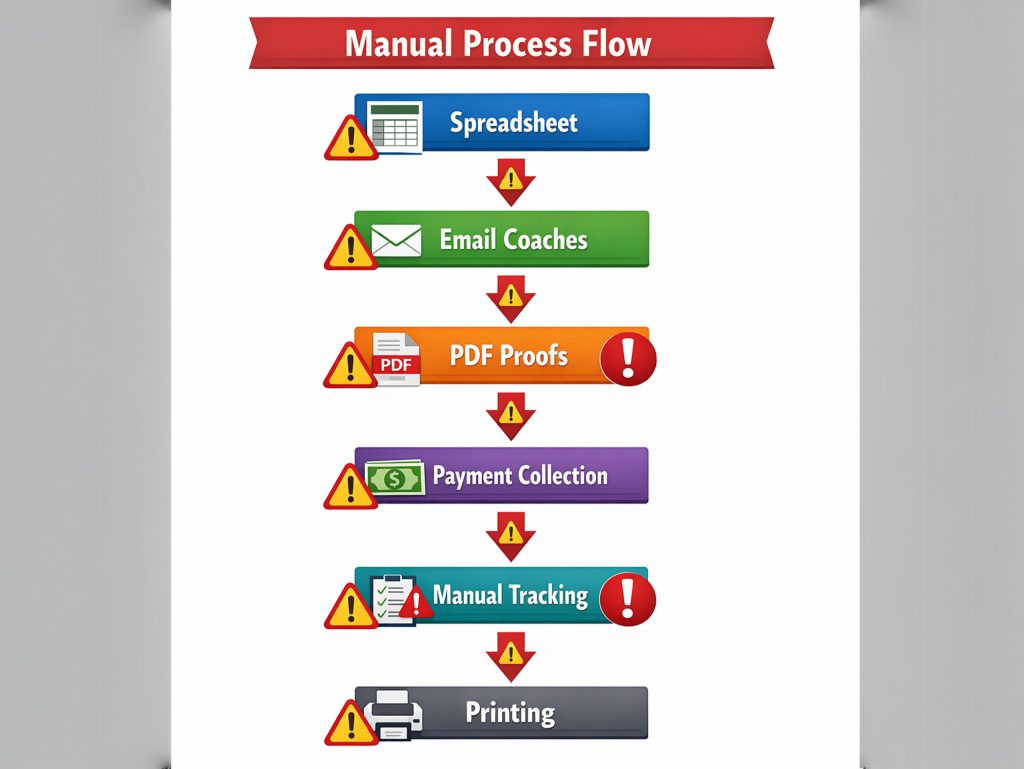
Manual ordering usually looks like this:
- Excel or Google Sheets for player sizes
- Email threads with coaches
- PDF proofs sent back and forth
- Venmo, Zelle, or cash payments
- Separate tracking sheets for reorders
- Handwritten notes for corrections
At first, it feels manageable. One team? Fine. Two teams? Still doable.
But once you scale beyond a handful of teams, the cracks begin to show.
1. Multi-Team Management: Chaos Multiplies Fast
Manual Process
When you’re managing multiple teams manually, you typically:
- Create one spreadsheet per team
- Copy and paste player names
- Double-check sizes manually
- Send individual proof emails
- Track payments separately
- Cross-reference everything before sending to print
This creates several risks:
❌ Duplicate names
❌ Wrong jersey numbers
❌ Misspelled player names
❌ Size mix-ups
❌ Missing payment confirmations
And because there’s no centralized system, everything depends on your ability to stay organized.
The more teams you add, the more spreadsheets multiply. What started as one file becomes 15 tabs across three documents, attached to four email threads. That’s not a system. That’s controlled chaos.
Wooter System
With Wooter, multi-team coordination is built into the platform.
Instead of scattered spreadsheets:
✅ Teams are structured inside one account
✅ Players are assigned digitally
✅ Sizes are validated
✅ Names and numbers are locked correctly
✅ Approvals are centralized
You’re not manually copying data, you’re managing through a dashboard.
One login. One system. Full visibility.
2. Errors and Corrections: Manual Processes Create Mistakes
Manual Process
Every time you copy data from one place to another, you introduce risk.
Manual ordering typically requires:
- Copying player data from registration
- Pasting into spreadsheet
- Sending to printer
- Reviewing proofs
- Correcting via email
- Resending corrections
Each step increases the chance of:
❌ Incorrect spelling
❌ Wrong jersey number
❌ Incorrect size
❌ Missed late additions
❌ Duplicate orders
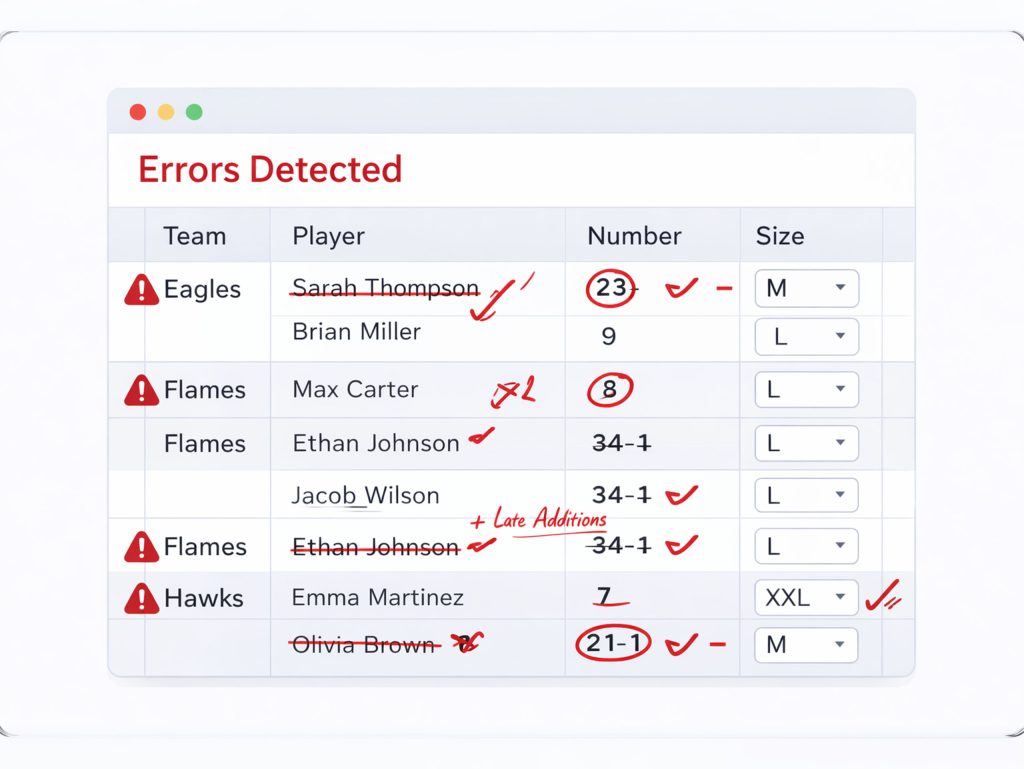
When mistakes happen, who fixes it?
Usually, you.
And reprinting jerseys mid-season because of manual errors is expensive and stressful.
Wooter System
Wooter reduces errors through structured workflows:
✔ Direct data imports
✔ Built-in validation
✔ Controlled approval processes
✔ Version tracking
✔ Stored order histories
Instead of relying on memory and email threads, the system tracks changes automatically.
Less human error. Fewer emergency reprints.
3. Reorders: The Manual Nightmare
Manual Process
Mid-season, a new player joins. Or someone loses a jersey. Or a size was wrong.
Now what?
You:
- Search through old emails
- Locate previous order file
- Check artwork version
- Confirm color codes
- Recreate proof
- Submit reorder manually
Sometimes files are missing. Sometimes artwork changed slightly. Sometimes colors don’t match exactly.
And if you didn’t document properly? You’re guessing.
Wooter System
Reorders inside Wooter are structured and stored.
✔ Previous designs saved
✔ Player data archived
✔ Exact color and print specs retained
✔ Easy reorder triggers
Instead of rebuilding from scratch, you’re extending an existing system.
That means consistency and speed.
4. Communication Overload
Manual Process
Manual ordering lives in inboxes.
Emails between:
- League directors
- Coaches
- Parents
- Print vendors
- Designers

Threads get long. Attachments get buried. People reply all unnecessarily. Some people miss emails completely.
You spend hours answering:
- “Did you get my size?”
- “Can I change my number?”
- “When will uniforms arrive?”
- “Did my payment go through?”
Communication becomes reactive.
Wooter System
Wooter centralizes communication.
✔ Structured approvals
✔ Status tracking
✔ Order visibility
✔ Automated updates
Instead of answering the same question 20 times, you direct everyone to one place.
The system becomes the communication hub, not your inbox.
5. Team Stores: Manual Collection vs Automation
Manual Process
If you want to sell fan gear or additional merchandise, manual systems require:
- Google Forms
- Paper order sheets
- Collecting payments individually
- Tracking sizes manually
- Summarizing totals
- Sending final list to printer
That’s hours of admin work.
And if one parent pays late? You chase them.
If someone forgets their size? You call them. It’s exhausting.
Wooter System
With Wooter, you can launch a structured team store.
Families:
✔ Browse online
✔ Select sizes
✔ Customize names
✔ Pay securely
✔ Track orders
You don’t collect forms. You don’t track cash. You don’t chase payments.
Automation handles it.
6. Fulfillment: Distribution Headaches
Manual Process
When bulk orders arrive, someone has to:
- Open boxes
- Separate jerseys by team
- Sort by player
- Label manually
- Distribute at practice
This often falls on volunteers or coaches.
Mistakes happen here, too:
❌ Wrong jersey handed to the wrong player
❌ Missing items
❌ Lost bags
Manual distribution adds another stress layer.
Wooter System
Wooter supports:
✔ Bulk team shipments
✔ Organized packaging
✔ Individual fulfillment
✔ Address validation
✔ Tracking information
Instead of unpacking chaos, deliveries are structured.
Distribution becomes predictable.
7. Time Cost: The Hidden Expense
Many organizations assume manual ordering is “free” because they’re not paying for software.
But what’s the real cost?
- 10–20 hours collecting sizes
- 5–10 hours managing corrections
- 3–5 hours coordinating reorders
- Hours answering repetitive questions
- Time distributing apparel
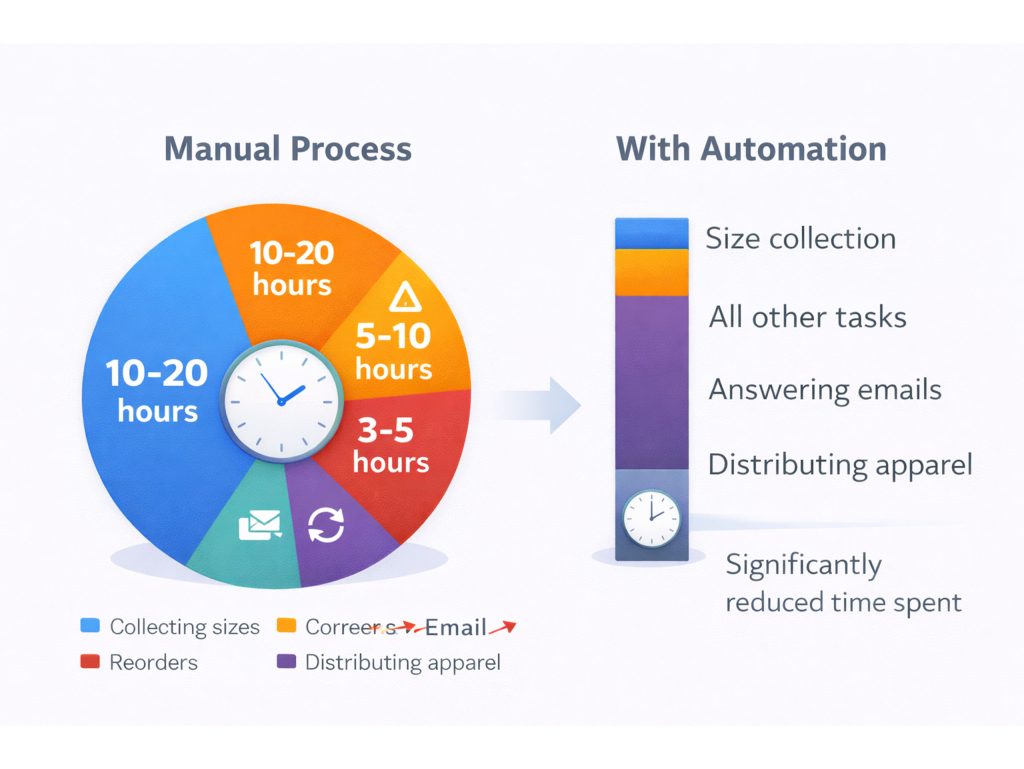
Multiply that by multiple seasons.
Manual systems consume leadership time, time that should be spent growing your league, improving player experience, or building sponsorships.
Wooter gives that time back.
8. Visibility and Reporting
Manual Process
Want to know:
- Total items ordered?
- Revenue from merchandise?
- Team-by-team breakdown?
- Historical order comparison?
You’ll be digging through spreadsheets and emails.
There’s no centralized analytics.
Wooter System
With structured dashboards:
✔ Track totals
✔ Monitor status
✔ View reports
✔ Compare seasons
✔ Access history
Visibility increases control. Control increases confidence.
Side-by-Side Comparison
| Category | Manual Ordering | Wooter System |
| Muti-Team Management | Spreadsheets per team | Centralized dashboard |
| Data Entry | Manual copy/paste | Structured imports |
| Error Risk | High | Reduced via validation |
| Reorders | Rebuilt from scratch | Stored and repeatable |
| Communication | Email chaos | Centralized tracking |
| Team Stores | Forms+manual payments | Automate ecommerce |
| Fulfillment | Manual sorting | Structured shipping |
| Reporting | Manual tracking | Built-in analytics |
| Scalability | Breaks under pressure | Designed to scale |
| Time Required | High | Optimized |
When Manual Might Work
Manual systems may be manageable if:
- You have 1–2 small teams
- Orders are simple (no customization)
- No reorders are expected
- No merchandise store needed
- No fulfillment complexity
But most growing leagues quickly exceed those limitations. What works for 20 jerseys does not work for 500.
The Bigger Picture: Professionalism
Beyond logistics, there’s perception.
Manual systems feel:
- Reactive
- Disorganized
- Volunteer-run
Automated systems feel:
- Professional
- Structured
- Reliable
- Scalable
Parents, sponsors, and partners notice the difference.
When apparel ordering feels smooth, it reflects positively on the entire organization.
The Psychological Difference
Manual = Stress.
You constantly worry:
- Did I miss something?
- Did I spell that right?
- Did everyone pay?
- Did the printer receive the file?
- Did we forget someone?
Wooter = Structure.
The system tracks. The dashboard confirms. The workflow guides.
That mental load disappears.
The Bottom Line
Spreadsheets are tools. They are not systems.
Manual ordering depends entirely on you remembering every detail, every update, every correction.
Wooter replaces memory-based management with structured automation.
Instead of:
Spreadsheets + Emails + Corrections + Stress
You get:
System + Automation + Visibility + Control
As your organization grows, manual ordering becomes a liability. Wooter becomes an advantage.

Final Thought
You can continue managing apparel the hard way, copying, pasting, checking, rechecking, emailing, correcting, sorting, and distributing.
Or you can implement a system designed to eliminate that friction.
Manual ordering might feel familiar.
But scalable automation is what allows leagues to grow confidently.