
Fall sports uniforms are more than just gear – they represent your team, boost confidence, and improve performance. Designing the right uniform means balancing sport-specific needs, functionality for unpredictable fall weather, and standout team branding. Here’s what you need to know:
- Key Features by Sport: Football, soccer, baseball, volleyball, and lacrosse uniforms have unique requirements, like durability, mobility, and moisture-wicking fabrics.
- Weather Considerations: Use fabrics like polyester blends for temperature control and avoid moisture-retaining materials like cotton.
- Design Tips: Bold colors for visibility, Pantone color matching for consistency, and sublimation printing for long-lasting logos and numbers.
- Production Timeline: Start 8–10 weeks ahead of the season to allow for design revisions and timely delivery.
Whether you’re designing for performance or style, early planning and attention to detail ensure your team is ready to get an instant quote on custom uniforms and hit the field with confidence.
CLO3D Tutorial: How to Design a Sports Jersey from Scratch

sbb-itb-4d95ad3
Fall Sports and Their Uniform Requirements
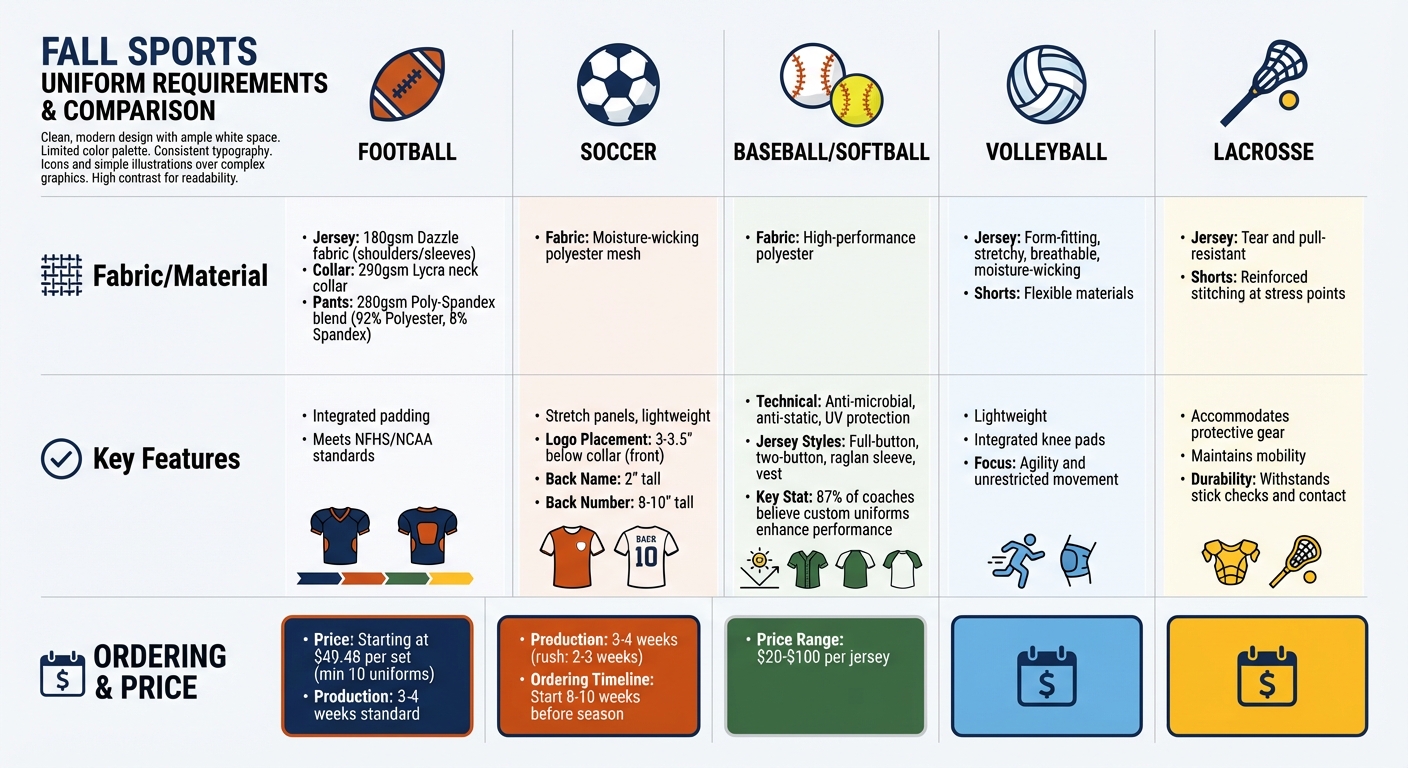
Fall Sports Uniform Requirements and Specifications Comparison Chart
Every fall sport has unique uniform needs designed to maximize both comfort and performance.
Football Uniform Requirements
Football uniforms are built to handle the physical demands of the game. Jerseys use 180gsm Dazzle fabric on the shoulders and sleeves, which helps resist tearing caused by turf burns and shoulder pad friction. The 290gsm Lycra neck collar is engineered to stretch over helmets and then snap back securely, preventing opponents from grabbing it during play. For the pants, a 280gsm Poly-Spandex blend (92% Polyester, 8% Spandex) provides flexibility for explosive movements while retaining its shape. Many pants also include integrated padding for added protection. These uniforms meet NFHS and NCAA standards for fit and sleeve length, and full sublimation ensures team branding – like names and numbers – stays vibrant even after repeated washing. Custom football uniform packages start at $49.48 per set, with a minimum order of 10 full uniforms.
Soccer Uniform Requirements
Soccer uniforms are designed for lightweight comfort and moisture control. They incorporate moisture-wicking fabrics and polyester mesh for ventilation, along with stretch panels that allow players to move freely. Sublimation printing ensures that logos and numbers remain vivid. Standard design guidelines place front logos 3–3.5 inches below the collar, back names at 2 inches tall, and back numbers between 8–10 inches tall. Production times typically range from 3–4 weeks, with rush orders available in 2–3 weeks. To ensure timely delivery and allow for design revisions, teams should start ordering 8–10 weeks before the season begins.
Baseball and Softball Uniform Requirements
Uniforms for baseball and softball are crafted from high-performance polyester, offering lightweight durability and moisture management. Additional technical features include anti-microbial treatments, anti-static properties, and UV protection, making them suitable for varying outdoor conditions. Teams can choose from several jersey styles, such as full-button, two-button, raglan sleeve, or vest designs, often paired with mesh inserts for added ventilation. Flexible pants are also standard, ensuring players can move freely. Seam-to-seam sublimation allows for unlimited color and graphic options without adding bulk. Interestingly, 87% of coaches believe custom uniforms enhance team performance. Custom jerseys range from $20 to $100, depending on materials and design complexity.
Volleyball Uniform Requirements
Volleyball uniforms focus on agility and comfort. Jerseys are form-fitting and made from stretchy, breathable, moisture-wicking fabrics, while shorts use flexible materials to allow unrestricted movement. Lightweight construction ensures players remain unhindered during play. For added protection, integrated knee pads are included without adding unnecessary bulk. Sublimation printing ensures logos and numbers remain sharp and vibrant.
Lacrosse Uniform Requirements
Lacrosse uniforms must withstand the sport’s intense physicality while allowing for ease of movement. Jerseys are made to resist tears and pulls caused by stick checks and contact, while shorts feature reinforced stitching at stress points to maintain durability and flexibility. These designs also accommodate protective gear without limiting mobility. Sublimation printing keeps logos and numbers vivid, even under the high demands of the game.
Next, we’ll dive into design strategies to tailor these features for the challenges of fall weather.
Design Considerations for Fall Weather
Fall weather can be unpredictable – cool mornings that warm up by noon, unexpected rain showers, and shorter daylight hours. Designing premium team uniforms for these conditions means balancing functionality with a sharp, cohesive team look. Here’s how to meet the demands of fall while keeping performance and style intact.
Color Selection for Visibility and Team Identity
In fall sports, bold, high-contrast colors are a must. Overcast skies or games that stretch into the evening make visibility a challenge, so dark jerseys with bright, contrasting numbers help players stand out to both officials and fans. For teams in colder regions, like the Midwest or Pacific Northwest, darker-colored road kits can provide an extra layer of warmth by absorbing sunlight. Meanwhile, home uniforms in lighter shades, such as white or light gray, can reflect sunlight during midday games when the sun breaks through.
Neon accents are trending, especially in basketball and youth sports. These vibrant details not only enhance visibility under artificial lighting but also make team photos pop on social media. The key is to use these accents strategically to maintain readability while preserving the team’s identity.
Fabric Selection for Temperature Control
Fall’s fluctuating temperatures call for fabrics that can adapt. Polyester and polyester-spandex blends are top choices for their durability, quick-drying properties, and ability to retain shape during intense play. Soccer players, for instance, who often cover 7 to 9 miles per game, benefit from microfiber polyester, which dries up to eight times faster than cotton and remains lightweight even when wet.
For colder conditions, heavier polyester knits can trap heat while still allowing for breathability. Another excellent option is merino wool, a natural fiber that regulates temperature effectively, keeping athletes warm in the cold and cool as they heat up. It also has antimicrobial properties, reducing odor during prolonged use. One fabric to avoid? Cotton. It retains moisture – up to 25 times its weight – which can lead to discomfort, chafing, or even hypothermia in colder games.
Team Branding and Pantone Color Matching
Once performance and weather needs are addressed, focus on branding. Consistency in team colors is vital, and the Pantone Matching System (PMS) ensures that colors remain uniform across different fabrics and printing methods. Before starting the design process, check with your school or organization’s branding coordinator to get the official color codes. This step ensures a polished and professional look.
"Providing the School’s Pantone colours is the best way to ensure accuracy… The system helps the designer create consistency in colours across decoration methods." – Cheeta Teamwear
For printing, sublimation is the preferred method for fall sports uniforms. This technique embeds the ink directly into the fabric, preventing logos and numbers from cracking, peeling, or fading – even after repeated wear and washing. If using performance fabrics, consider silicone transfers to prevent dye migration, which can dull or alter colors over time. Always run a test press to ensure the colors and adhesion meet your expectations before full production begins.
Design Process: Concept to Production
Designing a fall sports uniform is all about balancing team preferences, sport-specific needs, and the realities of production.
Step 1: Gather Team Input and Sport Requirements
Start by reviewing your league’s rulebook. For instance, football leagues often require specific jersey number sizes and placements, while soccer leagues might demand clear color contrasts between home and away uniforms. Overlooking these rules can lead to expensive redesigns or uniforms that don’t meet game-day standards.
Next, collaborate with coaches and stakeholders to establish the team’s core branding elements – such as primary colors, official logos, and required sponsor placements. This ensures the design stays consistent with the team’s identity. Once the basics are set, create two or three design mockups and let players vote on secondary details like font styles or sleeve patterns. This keeps the process inclusive without becoming chaotic.
Each sport has its own functional requirements. For example, football uniforms need to accommodate protective gear, while soccer kits should be lightweight and moisture-wicking to enhance agility. For younger athletes, prioritize durability and room for growth. High school and college teams, on the other hand, might lean toward performance fabrics and sleek, aerodynamic fits. To keep things organized, appoint a single design lead – often a coach or team manager – to act as the main point of contact with the manufacturer. This avoids confusion and ensures consistency throughout the process.
Once these foundational steps are complete, it’s time to move on to detailed design mockups.
Step 2: Create Design Sketches and Select Fonts
Designers typically use vector software like Adobe Illustrator to create scalable mockups.
"Vector graphics files store lines shapes and colors that make up an image as mathematical formulas… building the best quality image possible." – Wooter Apparel
Typography is just as important as the overall design. Player numbers and names need to be easily readable under various lighting conditions and from a distance. Designers usually provide a selection of clear, legible fonts, sometimes with outlined options to improve visibility. If your team has a specific font in mind, provide the font file or a link to it.
For team logos, vector files (like AI, EPS, or PDF) are ideal. If you only have raster images (such as JPEG or PNG), the designer may need to redraw them, which can add both time and cost. To keep colors consistent across fabrics, use the Pantone Matching System to specify exact shades.
With fonts and logos locked in, the next step is to refine patterns and design elements.
Step 3: Select Patterns and Design Elements
3D design tools are great for previewing patterns and color combinations. However, simplicity often wins – clean designs with one or two accent colors tend to age better than overly busy designs.
When placing logos, sponsor branding, and team names, artwork mockup templates can help ensure proper alignment before production begins. For high-movement sports like cross country, compact designs are better, as oversized graphics can hinder breathability and add unnecessary weight.
Choose decoration methods based on the size of your order and the complexity of the design. For example:
- Screen printing works well for bulk orders.
- Direct-to-film (DTF) printing is ideal for smaller runs.
- Silicone transfers are perfect for sublimated fabrics.
Always run a test press before moving into full production to catch any alignment or quality issues early.
Step 4: Determine Sizing and Fit Options
Before full production, get physical samples to confirm sizing accuracy. Use a professional size chart from the manufacturer to collect proper measurements, keeping in mind the differences between compression and relaxed fits.
Scaling design elements for youth athletes is especially important. For example, if a back name is 2 inches tall on an adult jersey, it should be scaled down to 1.75 inches for a youth jersey to maintain balance. Similarly, player numbers that look great on a men’s jersey might overwhelm a youth-sized uniform. Here are some general guidelines:
| Sport | Front Logo Placement | Back Name Height | Back Number Height |
|---|---|---|---|
| Soccer | 3–3.5" below collar | 2" (Youth: 1.75") | 8–10" (Youth: 6–8") |
| Football | 8–10" (Front Number) | 2.5" (Youth: 2") | 10–12" (Youth: 8–10") |
| Cross Country | 3–3.5" below collar | 2" (Youth: 1.75") | 6–8" (Optional) |
These adjustments ensure the uniforms are both functional and visually appealing. Once the design and sizing are finalized, production typically takes 2 to 5 weeks, depending on the season. To avoid delays, fall sports teams should plan to place orders by early July, ensuring delivery well before practices start in August. Using tools like T-squares, guides, or laser alignment during the decoration phase can help prevent common issues like misaligned names and numbers.
Material Selection and Production Methods
Choosing the right materials and production techniques is essential for fall sports uniforms to endure tough weather conditions and intense gameplay.
Durability, Moisture Management, and Safety Features
Polyester is a go-to fabric for team sports uniforms because it’s lightweight, resists shrinking, and effectively wicks away moisture. For sports with heavy contact, like football or baseball, nylon blends are ideal thanks to their superior abrasion resistance. Adding 15–25% spandex to fabric blends enhances stretch, allowing for unrestricted movement. Spandex fibers can stretch up to 5–6 times their original length and return to their shape, helping uniforms maintain their fit. Technical sports fabrics are built to last, enduring over 50,000 Martindale Abrasion Test cycles, compared to just 20,000 cycles for everyday clothing.
Fabric weight is another key factor for fall weather. Heavier fabrics (over 200 GSM) provide added durability and warmth for cooler, late-season games, while lighter fabrics (under 170 GSM) prioritize breathability for the warmer early fall months. Uniforms with mesh panels in areas prone to sweating – like underarms and the back – offer targeted ventilation without compromising the overall structure. These material choices align with earlier design strategies, ensuring that durability and performance are built into every uniform.
| Material/Feature | Primary Benefit | Best Use Case |
|---|---|---|
| Nylon Blends | High abrasion resistance | Sliding, contact sports, wrestling |
| Polyester (Interlock) | Durability & moisture wicking | Soccer, basketball, team jerseys |
| Spandex (15–25%) | 4-way stretch & recovery | Compression gear, cycling, leggings |
| High GSM (200+) | Robustness & warmth | Late-fall/cool weather uniforms |
| Low GSM (<170) | Breathability & lightness | Early-fall/warm weather uniforms |
Next, let’s dive into how sublimation printing keeps custom designs looking sharp through repeated use.
Sublimation Printing for Custom Designs
Sublimation printing embeds designs directly into polyester fabric. By using heat and pressure, the ink turns into gas and permeates the material, creating graphics that won’t peel, crack, or fade – even after numerous washes or exposure to outdoor elements. This method supports high-resolution images (300 DPI or higher), making it possible to include detailed logos, smooth gradients, and photorealistic designs. Sublimated prints can last anywhere from 2–10 years, depending on ink quality and care, making it a cost-effective option for teams planning to reuse uniforms over several seasons. However, it works best on white or light-colored polyester fabrics. For darker materials, a light base layer is needed to ensure colors remain vibrant.
With these material and printing techniques in place, teams can confidently move forward, knowing their uniforms are built to last.
Wooter Apparel Fall Uniform Packages and Pricing
Wooter Apparel’s fall uniform packages offer a blend of performance and affordability, with custom designs and high-quality materials. Each package includes sublimated uniforms featuring unlimited custom logos, colors, and player names/numbers. Production is completed in 3–4 weeks, contributing to the company’s impressive 4.9/5 rating from 1,366 reviews. Plus, there are no hidden fees – what you see is what you get.
Custom V-Neck Basketball Jerseys at $16.99/item
Starting at $16.99 per item for bulk orders of 1,000 or more, these jerseys are crafted from 180gsm mock mesh polyester, providing excellent breathability and moisture-wicking properties. This lightweight, antimicrobial fabric also features 4-way stretch, ensuring players can move freely during games. The full-color sublimation process guarantees durable and vibrant designs. Sizes range from Toddler (1T–5T) and Youth (YXS–YXL) to Men’s (up to M7XL) and Women’s (up to W5XL). For teams looking for even more versatility, check out the reversible jersey option.
Custom Reversible Basketball Jerseys at $24.99/item
Reversible jerseys are available at $24.99 per item for team orders of 251–500 units. These jerseys offer two unique designs – perfect for home and away games – on lightweight 140gsm polyester fabric. Teams can fully customize both sides with different colors, logos, and player details. This dual-design feature makes them a practical choice for programs that need flexibility across multiple games or practice sessions.
MVP Team Uniform Package at $199.99/package
The MVP Team Uniform Package is priced at $199.99 per package for bulk orders of 1,000 or more. It includes a reversible jersey, reversible shorts, a short-sleeve shooting shirt, a warmup jacket, warmup pants, and a team backpack. Designed to handle the challenges of fall weather, this package combines performance fabrics with adaptable designs, making it ideal for travel teams and elite programs.
Wooter Apparel also extends its MVP packages to other sports. Football packages range from $199.99 to $219.99, while soccer and baseball packages are priced between $199.99 and $229.99, depending on the order size. For teams working with limited budgets, the "Name Your Own Price" feature allows them to submit a target price or a competitor’s quote, giving Wooter Apparel the chance to offer a better deal.
Conclusion
Designing fall sports uniforms is all about finding the perfect mix of team identity, performance-focused materials, and practical functionality. Whether it’s football uniforms with protective padding or soccer kits made from lightweight, moisture-wicking fabrics, each sport comes with its own unique needs. Choosing the right colors for visibility, fabrics suited for the season, and durable construction ensures your team not only looks sharp but also performs at its peak.
Starting the process early is essential. Early planning allows enough time for delivery and preparation, as highlighted in the steps above. By consulting with coaches and players, you can address sport-specific needs and customize uniforms using professional design templates. Features like Pantone color matching and sublimation printing add a polished, professional touch to the final product.
Wooter Apparel simplifies this process with its four-step design workflow. From gathering team requirements to finalizing sizing, the platform makes it easy. Their Apparel Builder tool lets you make real-time design adjustments, giving you a clear vision of your uniforms before placing an order. With production taking just 3–4 weeks, starting the design process at least two weeks before the season begins ensures your team is ready on time.
When it comes to pricing, there’s flexibility to fit different budgets. You can opt for jerseys starting at $16.99 or go for the MVP package at $199.99. Get started today at https://wooter.com to elevate your team’s look and performance. With free custom design services and dedicated support, creating professional, high-quality uniforms has never been easier.
FAQs
What should I prioritize first when designing a fall sports uniform?
The process of designing a fall sports uniform starts with research. It’s essential to dive into the team’s needs, history, and the visual elements that define their identity. By thoroughly understanding these aspects, you can create a design that truly reflects the team’s spirit and aligns with their goals before jumping into concept creation or material selection.
How do I pick fabrics that handle cold, rain, and sweat?
When choosing fabrics for outdoor activities, focus on materials that handle moisture well and can stand up to the weather. In colder temperatures, thicker polyester knits or materials that retain heat are a solid choice. For rainy days, look for water-resistant or quick-drying fabrics, such as polyester blends.
Nylon and polyester are excellent all-around options – they’re durable, breathable, and wick moisture effectively, which helps manage sweat. On the other hand, steer clear of cotton. It absorbs moisture and can leave you feeling damp and uncomfortable, especially in wet or chilly environments.
What files and details do I need before placing a custom uniform order?
Before placing an order for custom uniforms, it’s important to have your design ideas prepared. This includes any artwork, logos, or specific visuals you’d like to feature. Be clear about the types of products you need – whether it’s jerseys, shorts, or warmup gear – and outline the design details you want.
Wooter Apparel makes the process easier by offering free templates, design assistance, and mockups. These tools allow you to fine-tune your design and approve it before production begins, ensuring the process goes smoothly.