
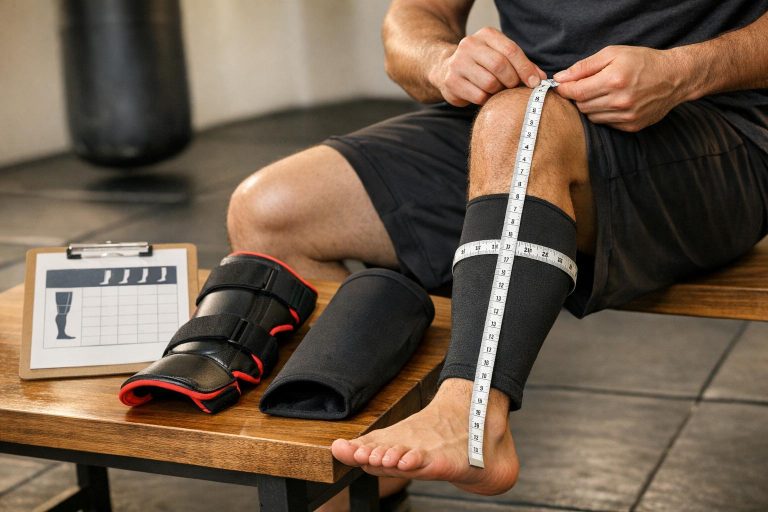
Finding the right shin guard size is essential for safety and performance in combat sports like MMA, Muay Thai, and kickboxing. Ill-fitting guards can lead to injuries, discomfort, or reduced mobility. Here’s what you need to know:
- Proper Fit: Shin guards should cover from just below the knee to the top of the foot without sliding, twisting, or restricting movement.
- Key Measurements: Measure shin length (kneecap to ankle bone), calf circumference, and foot length (if applicable for slip-on guards).
- Sizing Issues:
- Too Loose: Guards can shift, leaving areas unprotected.
- Too Tight: May restrict blood flow and limit motion.
- Too Small: Won’t provide adequate coverage.
- Slip-On vs. Strapped Guards:
- Slip-on guards rely on snug material fit but lack adjustability.
- Strapped guards allow for more adjustments but may interfere during grappling.
- Testing Fit: Move naturally and perform light kicks to ensure guards stay secure and comfortable.
Pro Tip: Always consult brand-specific sizing charts as sizes vary widely. If in doubt, prioritize shin length and consider sizing up for better coverage.
Properly fitted shin guards are a must for injury prevention and confident training. Follow these tips to find your ideal fit.
MUAYTHAI SHINGUARDS – Which size is for me?
sbb-itb-4d95ad3
Why Shin Guard Sizing Matters
When it comes to safety gear, getting the right fit is just as important as wearing the gear itself. Shin guards that fit properly not only protect you better but also help you perform at your best. A well-sized shin guard sits snugly against your shin, absorbing and spreading out the force of impacts.
Problems with Incorrect Sizing
Wearing shin guards that don’t fit right can lead to a host of issues, from discomfort to safety risks. Here’s how sizing problems can affect you:
- Loose Guards: If your shin guards are too loose, they can slide or rotate during movement. This leaves parts of your shin or foot exposed, increasing the risk of injury. Plus, they can create tripping hazards during kicks.
- Undersized Guards: Guards that are too small fail to cover the critical areas they’re meant to protect. For instance, smaller guards often come with smaller instep pads, leaving the bridge of your foot exposed and vulnerable to injury.
- Overly Tight Guards: Guards that are too tight can restrict blood flow, causing numbness and discomfort. They can also limit your range of motion, which is crucial for effective performance.
| Fit Issue | Primary Consequence | Impact on Athlete |
|---|---|---|
| Too Loose | Rotation/Sliding | Exposed shin/instep during strikes |
| Too Small | Incomplete Coverage | Higher risk of fractures and bruises |
| Too Tight | Restricted Circulation | Numbness, discomfort, and reduced mobility |
| Correct Fit | Locked-in Stability | Enhanced focus, mobility, and better protection |
Addressing these fit issues not only minimizes injury risks but also ensures you can focus on your performance without distractions.
Benefits of Correct Fit
When your shin guards fit just right, they feel like an extension of your body. This secure fit provides the freedom to move naturally, allowing your knees and toes to flex as needed without restriction.
"Gear that truly protects you lets you ‘train harder, longer’." – Trevor Wittman, 3X MMA Coach of the Year and ONX Founder
A properly fitted shin guard boosts your confidence, letting you throw kicks with full power and check strikes without worrying about the guard slipping out of place. For MMA athletes, this is especially important. Your shin guards need to stay secure through dynamic transitions – from striking to grappling – without snagging on your opponent’s gear during clinches or groundwork. A reliable fit means you can focus on your technique, not your equipment.
How to Measure for Shin Guards
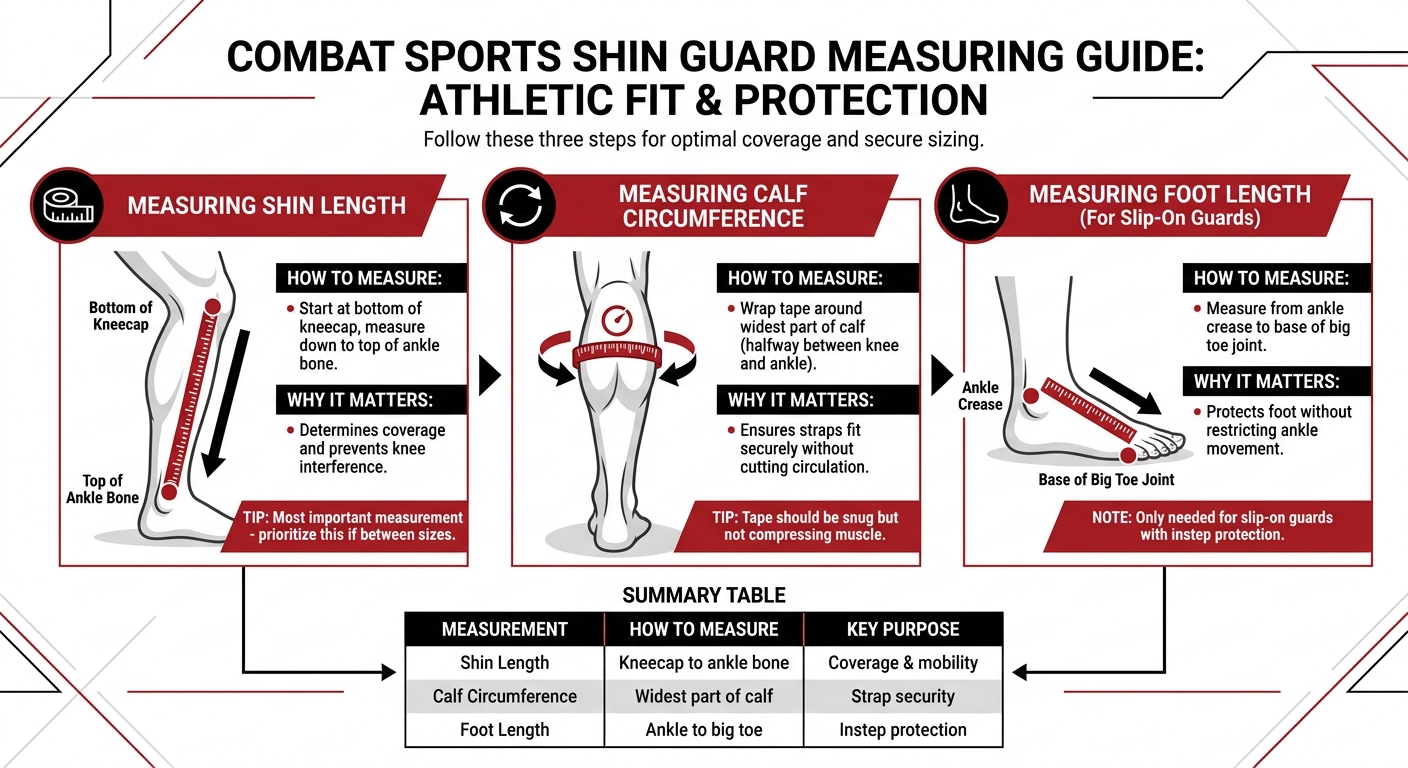
How to Measure and Size Combat Sport Shin Guards: Complete Guide
Getting the right fit for your shin guards is all about accurate measurements. You’ll need a flexible tape measure – and a helping hand can make things easier. Follow these steps to ensure your shin guards offer the protection and comfort you need.
Measuring Shin Length
Start by determining your shin length, as this is the most important measurement. Stand naturally and locate the bottom of your kneecap. Measure from this point down to the top of your ankle bone. This distance determines how well the guard will cover your shin and whether it might interfere with knee movement. If your measurement falls between sizes, focus on this length. A guard that’s too short leaves parts of your shin exposed, while one that’s too long can press against your kneecap during movement. Ideally, the top of the shin guard should rest just below your kneecap without touching it.
Measuring Calf Circumference
Next, measure your calf circumference to ensure the straps fit securely. Wrap the tape measure around the widest part of your calf – about halfway between your knee and ankle. The tape should be snug but not tight enough to compress the muscle. If your measurement is near the upper limit of a size range, consider sizing up to avoid overly tight straps. Straps that are too tight can cause discomfort or even numbness, while loose or bunched straps suggest the guard is too large for your leg.
Measuring Foot Length (If Needed)
For slip-on shin guards that include instep protection, you’ll also need to measure your foot length. Measure from the crease of your ankle to the base of your big toe. This ensures the guard covers your foot properly without restricting movement, similar to how custom MMA shorts are designed for full range of motion.
| Measurement Type | How to Measure | Why It Matters |
|---|---|---|
| Shin Length | Bottom of kneecap to top of ankle bone | Key for proper coverage and knee mobility |
| Calf Circumference | Around the widest part of the calf muscle | Ensures straps are secure without cutting circulation |
| Instep Length | Ankle crease to base of big toe joint | Protects foot without limiting ankle movement |
Reading Brand Size Charts
Now that you’ve got your measurements, it’s time to tackle brand-specific size charts. Here’s the catch: shin guard sizes aren’t consistent across brands. A "Large" from one company might feel more like a "Medium" from another. This variation makes it essential to review each brand’s chart before making a purchase.
Brand Size Chart Comparison
Each brand uses its own sizing approach. For instance, ONX bases its sizes solely on shin and foot length, aiming for what they call a "custom-sized" fit. On the other hand, Fudoshin factors in your total body height when determining size. Here’s a comparison of shin length measurements from these two brands:
| Size | ONX Shin Length | Fudoshin Knee-to-Ankle Length |
|---|---|---|
| Small | 12" | 13.4" (34 cm) |
| Medium | 13" | 15" (38 cm) |
| Large | 14" | 15.4" (39 cm) |
| X-Large | 15"+ | 16.5" (42 cm) |
For example, a Medium size measures 13" for ONX but 15" for Fudoshin, showing how much these charts can differ. This is why assuming a universal size just doesn’t work.
Handling Brand Differences
If your measurements fall between two sizes, start by prioritizing shin length, followed by calf circumference. When you’re on the border of two sizes, it’s usually better to go with the larger option. This ensures proper coverage and protection. As Trevor Wittman, founder of ONX Sports, explains:
"Properly sized shin pads keep you in the fight".
A larger guard allows you to adjust straps for a snug fit, but a guard that’s too short leaves parts of your leg unprotected – and there’s no fixing that. For those with muscular calves, sizing up is even more important to avoid straps digging into your skin.
Many online retailers offer flexible return policies, so ordering two sizes to try at home can save you from ending up with an ill-fitting pair.
Next, we’ll dive into how sizing differs for slip-on versus strapped models.
Slip-On vs. Strapped Shin Guards
Once you’ve mastered size charts and measurement techniques, it’s time to dive into style differences. The type of shin guard you pick – slip-on or strapped – can influence how you approach sizing. Each style secures itself differently, which means your sizing priorities will shift depending on the design.
Slip-on shin guards rely on stretchy materials and silicone grips inside to stay put and resist rotation. These are popular in MMA since they stay stable during grappling and won’t snag on clothing. However, they don’t offer much adjustability. If the sleeve is too loose, the guard might twist or shift, while a sleeve that’s too tight could restrict blood flow or limit movement.
Strapped shin guards, on the other hand, use Velcro closures to secure the padding. This makes them more adjustable, accommodating a range of calf sizes. They also tend to have thicker padding, making them ideal for heavy striking in sports like Muay Thai or kickboxing. The downside? Straps can get in the way during wrestling transitions.
Slip-On Shin Guard Sizing
For slip-on shin guards, calf circumference is the key measurement. The sleeve should fit snugly without cutting off circulation. A quick test: try the guard on and move around lightly – it shouldn’t shift, spin, or slide. Compression should feel firm but not restrictive. Since these guards rely entirely on material stretch, sizing accuracy is crucial. For example, Century Martial Arts’ cloth slip-on guards range from 10.375 inches (Small) to 12 inches (X-Large) in shin length.
While slip-on guards depend on material flexibility, strapped guards offer more room for adjustments.
Strapped Shin Guard Sizing
Strapped shin guards provide more flexibility in sizing thanks to their adjustable straps. While shin length is still a critical measurement, the straps allow for some wiggle room if your frame is slightly larger. For instance, ApexWolf’s Small size features a 13.5-inch shin length with 12-inch top straps, while their X-Large offers a 16-inch shin length with 15-inch top straps. If you’re between sizes, it’s better to size up and tighten the straps for a secure fit. A guard that’s too short leaves parts of your shin exposed, which is less than ideal.
For those with muscular calves, sizing up ensures the straps are long enough to close comfortably without digging into your skin. One quick check: if the Velcro overlaps too much or bunches up when fastened, the guard is likely too large.
Understanding these style-specific sizing tips sets the stage for testing and adjusting your shin guards to ensure they perform their best.
Testing and Adjusting Fit
Once your shin guards are strapped on, it’s time to perform the Kick Test. Throw a few light kicks and check if the guards twist, slide, or shift. If they do, they aren’t fitted correctly. Properly fitted shin guards should stay firmly in place, covering the area from just below your kneecap to the top of your foot without any noticeable gaps.
Take note of how the padding aligns with your shin bone. It should lay completely flat, while the instep guard should protect the bridge of your foot. Make sure you can flex your foot and bend your knee naturally. If the guard digs into your ankle or knee during these movements, adjustments are needed. As Trevor Wittman, Founder of ONX Sports, explains:
"Gear that truly protects you lets you ‘train harder, longer’".
How to Test Shin Guard Fit
Beyond the Kick Test, simulate real fight movements like sprawling, clinching, or bouncing on your toes. Throw checks and ensure the guards don’t interfere with your range of motion or cut off circulation – numb toes are a clear sign of improper fit. The guards should also stay snug during grappling without snagging on clothing.
For strapped guards, confirm the straps lie flat against your leg. If they bunch up when fastened, the guard may be too big, and you might need a smaller size. The padding should stay centered on your shin bone with no gaps, as any space reduces protection during impact. If adjustments are needed after testing, follow the steps below to fine-tune the fit.
Adjusting Straps and Padding
If your guards feel loose but cover the right length of your shin, tighten the straps while ensuring the padding stays flush against your leg. Athletes with larger calves may need to size up for straps that wrap comfortably without creating pressure points. If you notice pinching or discomfort, loosen the straps slightly to restore circulation.
High-quality shin guards often conform to your leg over time. If the guards still feel loose after adjusting the straps, try using compression sleeves or athletic tape to keep them stable. However, if the guards are too short, they won’t offer enough coverage, and no adjustment can fix that. In such cases, it’s better to size up and rely on the straps for a secure fit.
Conclusion
Finding the right fit for shin guards comes down to accurate leg measurements, understanding brand-specific sizing charts, and testing the fit during movement. One key measurement to focus on is the distance from the bottom of your kneecap to the top of your ankle bone. This ensures your shin is properly covered.
Remember, sizing isn’t consistent across brands – a "Large" in one might feel like a "Medium" in another. If you’re between sizes, it’s better to prioritize shin length and go for the larger size. A guard that’s too short won’t protect you adequately, and adjustable straps can help ensure a snug fit.
Once you’ve chosen your guards, make sure they stay in place during movement without twisting or sliding. If the straps bunch up instead of lying flat, the guard is likely too big.
When they fit just right, shin guards should feel like a natural part of your leg, giving you the confidence to train hard while keeping your shins safe.
FAQs
What if my measurements fall between two shin guard sizes?
If your measurements sit between two sizes, go with the larger one. A looser fit offers better comfort and freedom of movement while still giving you the protection you need. This ensures the shin guard stays in place during training or competition without limiting your mobility.
How do I choose between slip-on and strapped shin guards for my sport?
When deciding between slip-on and strapped shin guards, it’s all about the sport you play and what feels comfortable for you. Slip-on shin guards are simple to put on, fit snugly, and work well for activities like Muay Thai or kickboxing. On the other hand, strapped shin guards offer adjustable sizing and extra security, making them perfect for MMA or more high-impact sports. Think about the demands of your sport, how much mobility you need, and what feels best for you before making a choice.
How can I tell during training if my shin guards are too tight or too loose?
If your shin guards feel like they’re cutting off circulation or making it hard to move, they’re too tight. On the other hand, if they slip around or twist during kicks and checks, they’re too loose. The right fit should keep them secure and comfortable without causing any discomfort or limiting your movement. Pay attention to how they perform during training to make sure they stay in place.