
Women’s basketball teams are leading efforts to address inequities in sports, including pay gaps, revenue sharing, and working conditions. The 2026 WNBA Collective Bargaining Agreement (CBA) marked a major shift, increasing player salaries and revenue share. For example, the minimum salary jumped from $66,079 to over $300,000, and the team salary cap rose from $1.5 million to $7 million. Advocacy efforts have also gained visibility through bold actions like the 2025 WNBA All-Star Game protest, where players wore shirts demanding fair pay.
Key points:
- 2026 CBA Milestones: Revenue share increased to 20%, supermax salary reached $1.4 million, and average salaries grew to ~$600,000.
- Team Advocacy: WNBA teams like the Minnesota Lynx and Atlanta Dream have used their platforms for social justice and political change.
- College & International Impact: NCAA programs and global teams like Australia’s Opals are pushing for better funding, equity, and visibility.
Women’s basketball is reshaping its future through collective action, demonstrating the power of unity on and off the court.
The evolution of the WNBA social justice movement | The Undefeated
sbb-itb-4d95ad3
U.S. Women’s National Basketball Team: Leading the Push for Equality
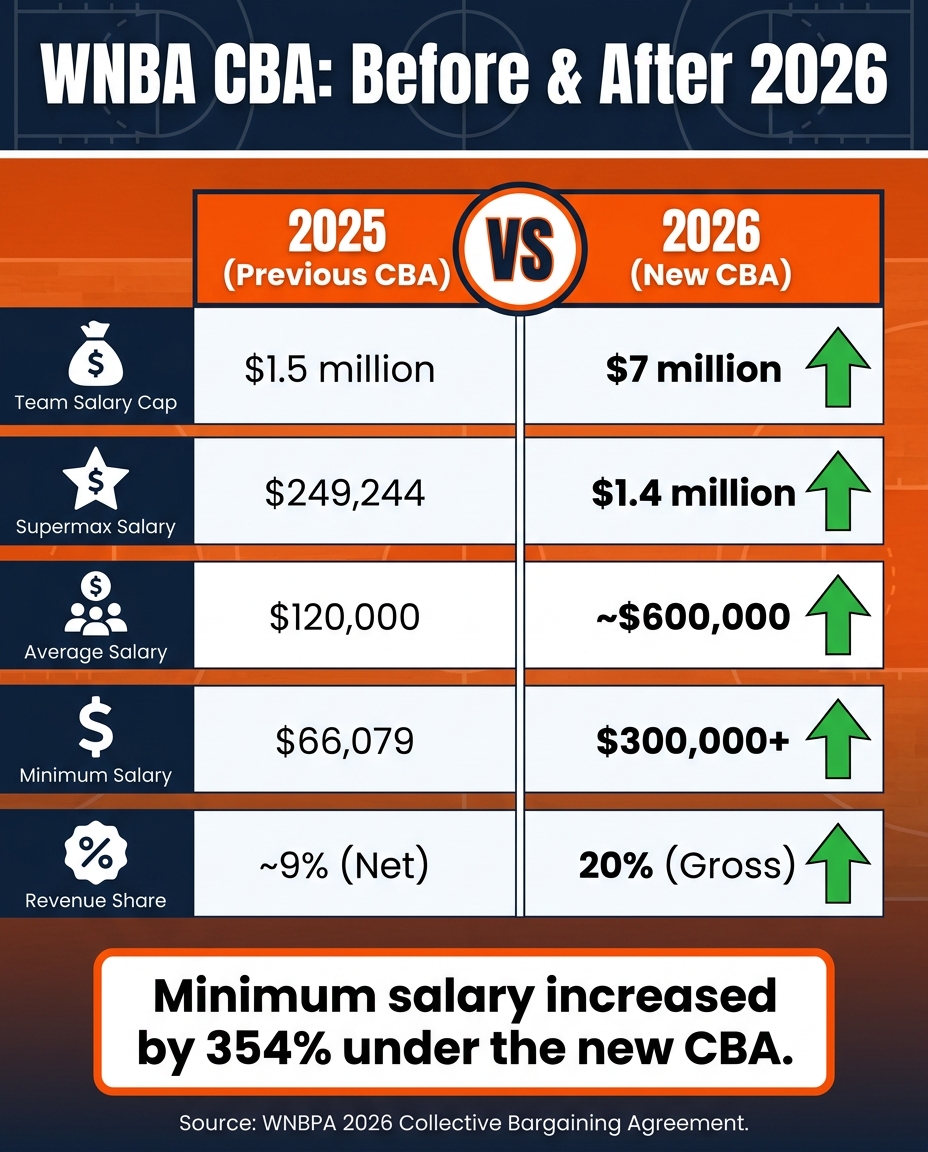
WNBA CBA 2025 vs 2026: Salary & Revenue Gains at a Glance
The U.S. Women’s National Basketball Team has consistently combined athletic dominance with a commitment to equity, becoming a powerful force for change. From achieving full funding in 1995 to securing a groundbreaking labor agreement in 2026, the team has used its platform to elevate both the sport and the broader conversation around women’s athletics.
Key Advocacy Milestones
The journey began after a disappointing bronze medal finish in 1994. USA Basketball responded by launching an 18-month residency program for the women’s team, providing full funding for training and travel in preparation for the Olympics. The results were staggering: the team went undefeated in 52 exhibition games across seven countries and went on to win gold at the 1996 Atlanta Olympics. As guard Dawn Staley reflected:
"We knew what was at stake. We knew there was a WNBA in waiting… It was all depending on how successful we were as a team."
That gold medal victory not only boosted the profile of women’s basketball but also played a pivotal role in the creation of the WNBA.
Fast forward to 2026, national team stars carried the same determination into labor negotiations. After 17 months and 100 hours of bargaining, the Women’s National Basketball Players Association (WNBPA) – led by Nneka Ogwumike, Breanna Stewart, and Alysha Clark – secured a landmark Collective Bargaining Agreement (CBA) with the WNBA. For the first time, player salaries were tied to a 20% share of gross league revenue.
| Metric | 2025 (Previous CBA) | 2026 (New CBA) |
|---|---|---|
| Team Salary Cap | $1.5 million | $7 million |
| Supermax Salary | $249,244 | $1.4 million |
| Average Salary | $120,000 | ~$600,000 |
| Minimum Salary | $66,079 | >$300,000 |
| Revenue Share | ~9% (Net) | 20% (Gross) |
The new agreement ushered in a dramatic shift, with the minimum salary surpassing $300,000. These changes not only redefined player compensation but also set the stage for future advancements in the league.
How Visibility Strengthens Their Message
The team’s success on and off the court has been amplified by their growing visibility. Record-breaking attendance in 2025 and a $2.2 billion media rights deal provided players with a compelling argument: their compensation should reflect the league’s booming commercial success. For instance, the Las Vegas Aces experienced a meteoric rise in valuation, jumping from $2 million in 2021 to an estimated $310 million by 2025 – a staggering 15,400% increase.
WNBPA Executive Director Terri Carmichael Jackson highlighted the shift:
"I think this can be summed up in two words: player empowerment … players coming to the table and standing on business and being reminded of the collective voice."
This agreement extended beyond salaries, addressing critical issues like guaranteed housing, family planning support, and improved travel accommodations. Nneka Ogwumike referred to these as "heart" issues that redefine what professionalism means in the league. Breanna Stewart summed up the broader impact:
"This deal is going to be transformational. It’s going to build and help create a system where everybody is getting exactly what they deserve and more."
WNBA Teams Pushing for Change Through Collective Action
While the national team and the WNBPA have set the stage for progress, individual WNBA franchises have taken those efforts to the court, turning advocacy into action. These team-led initiatives show how localized efforts can amplify the broader push for equality.
Teams That Have Made an Impact
The Minnesota Lynx were trailblazers in using their platform for social justice. Back in July 2016, team captains Rebekkah Brunson, Maya Moore, Seimone Augustus, and Lindsay Whalen made headlines by wearing black warm-up shirts and team hoodies that featured the names Philando Castile and Alton Sterling, along with the message "Change Starts With Us." Their protest was so striking that four off-duty police officers walked off their security posts during the game. Reflecting on this pivotal moment, Carley Knox, the Lynx’s President of Business Operations, said:
"We were the first [WNBA] team franchise to use that platform. We got some backlash. I am so incredibly proud of our franchise."
The Washington Mystics took a different stand in June 2019. Following a tragic shooting at a local elementary school, guards Natasha Cloud and Ariel Atkins led the team in a media blackout to focus attention on gun violence in Washington, D.C. Their advocacy didn’t detract from their performance – they won 17 of their last 19 regular-season games and went on to claim the 2019 WNBA Championship. This served as a powerful example of how players can balance activism with athletic excellence.
The Atlanta Dream made waves in 2020 with a politically charged move. In response to then-co-owner Kelly Loeffler’s criticism of the Black Lives Matter movement, players across the league donned custom basketball shirts featuring "Vote Warnock", a move widely credited with influencing the Georgia Senate race.
These examples highlight how teams can use their platforms to drive change, often creating ripple effects that extend beyond the court.
How Team Unity Drives Advocacy
The strength of WNBA advocacy lies in its unity and the visual power of collective action. Take the July 2025 All-Star Game demonstration, for instance, which garnered national attention and reaffirmed the league’s united stance.
This solidarity extends beyond symbolic gestures. Players like Breanna Stewart and Napheesa Collier launched Unrivaled, a 3-on-3 domestic league that not only offered players an alternative income stream but also pressured the WNBA to improve its compensation policies. Additionally, during the 2025–2026 CBA negotiations, 93% of WNBA players voted to authorize a strike if necessary, sending a clear message about their commitment to fair treatment. As Napheesa Collier explained:
"There is no league without the players… they’re the ones that have put in the blood, sweat and tears for the new money that’s coming in. And so, we feel we are owed a piece of the pie that we helped create."
These unified efforts showcase the power of collective action in advancing the league’s goals for equality and recognition.
College Women’s Basketball Programs Fighting for Equity
The push for fairness in sports didn’t start with professional leagues – it began on college campuses, where women’s basketball programs have long fought for equal treatment. From battling for resources to demanding recognition, these programs have been at the forefront of change.
Programs Leading the Way
In March 2021, Oregon’s Sedona Prince exposed glaring inequalities in the NCAA women’s tournament weight room. Her viral video sparked widespread outrage, leading to the Kaplan Report and a series of changes. The NCAA responded by increasing the women’s tournament budget by $14 million, extending the "March Madness" branding to include the women’s event, and expanding the tournament field to 68 teams, mirroring the men’s format.
South Carolina, under the leadership of Dawn Staley, has been a shining example of the sport’s potential. The 2024 national championship drew an impressive 18.9 million viewers. Yet, despite this success, the revenue generated – $6.9 million – still lagged behind the men’s $15.4 million. Similarly, Staley’s $4.25 million salary is nearly half of what the university’s football coach earns at $8.15 million.
UConn‘s women’s basketball program has also set a high bar. In 2024–25, the program brought in $8.5 million, including $4.2 million from ticket sales, outperforming many men’s programs. UConn allocates $34 million to basketball, surpassing its $20.5 million football budget. As ESPN broadcaster Holly Rowe noted:
"UConn’s dominance for so long forced other programs to raise their level of excellence."
These achievements highlight the growing commercial potential of women’s basketball. But while the on-court progress is evident, challenges tied to historical policies like Title IX remain significant.
Title IX and Its Role in College Advocacy
Since its passage in 1972, Title IX has been a cornerstone for women’s sports, ensuring equal scholarships, practice time, and facilities. Over the years, it has transformed women’s basketball from a sidelined activity into a competitive priority.
However, the financial landscape is evolving. Under the 2025–26 NCAA revenue-sharing model, women’s basketball programs receive only 8% of the pool (about $1.6 million per school), compared to 63.8% for football (approximately $13.1 million) and 20.9% for men’s basketball (roughly $4.3 million). Title IX was designed for a time when compliance was the focus, but today’s emphasis on revenue generation challenges its original intent.
UConn’s legendary coach Geno Auriemma expressed concerns about the current state of equity:
"It appears to me that at the big conferences level, I think Title IX legislation is probably over… when it comes time for funding and putting money into those programs that would make you believe that it’s the same, I don’t see that as much anymore."
Dawn Staley echoed this sentiment, emphasizing the need for continued focus:
"I just hope we don’t lose sight of those three sports that started the lawsuit… I hope that every school that is receiving the revenue sharing portion will definitely take women’s basketball seriously."
Beyond budgets, media rights present another hurdle. Experts estimate that if the women’s tournament were sold separately, its value could range from $81 million to $112 million annually. While the current ESPN deal values women’s basketball at around $65 million per year – a significant increase from previous agreements – existing long-term contracts with CBS/Turner, running through 2032, still prioritize the men’s tournament, limiting the women’s ability to fully realize its worth.
Title IX opened doors, but the focus now shifts to ensuring policies like name, image, and likeness (NIL) and revenue sharing continue to push for true equality in college sports.
International Women’s Basketball Teams Advocating for Equality
The push for equality in women’s basketball isn’t confined to American courts. Across the globe, teams are taking bold steps to challenge systemic barriers and reshape the landscape of women’s sports.
Teams Around the World Making a Difference
One standout example is the Australian Opals. On June 18, 2020, led by center Liz Cambage and coach Sandy Brondello, the team boycotted a practice session, demanding that Basketball Australia publicly commit to fighting racism and improving support for Black and Indigenous players. Their protest spurred immediate action from Basketball Australia.
"We as an Opals playing group stand in support of our Black and Indigenous players and will not be training until we see support and change from our sporting organisation." – Liz Cambage, Center, Australian Opals
This bold stance led to the creation of the RISE UP initiative, a campaign aimed at combating racism and discrimination. The players also advocated for the inclusion of Indigenous artwork and flags on national team uniforms, despite regulatory hurdles from FIBA.
Financial advocacy has also been a game-changer. In April 2025, the WNBL and the Australian Basketball Players Association finalized a four-year Collective Bargaining Agreement. This historic deal increased minimum wages by 104%, raising them from $23,000 to $46,952 (AU) by the 2028/29 season, achieving parity with the men’s NBL on a pro-rata basis. Former Opals captain Tess Madgen remarked:
"For too long, women who play sport professionally within Australia have been undervalued."
WNBL champion Bec Cole added:
"The wage increase is so great to see, because we have athletes who put in the time and hours and work just as hard as the men… but they’re taking on part-time jobs or studying because they can’t pay their way."
Historically, only three to five players out of a standard 12-person WNBL roster could dedicate themselves fully to basketball. Beyond pay, the new agreement introduced expanded support for mental health, career development, and contract protections for injured players.
Nigeria’s D’Tigress has also made waves. At the 2024 Olympics, they became the first African team to defeat the Australian Opals in a major tournament, breaking a 12-game streak. This victory highlighted the growing competitiveness of women’s basketball and underscored the need for equitable resources worldwide.
How International Advocacy Inspires U.S. Teams
These international efforts have a ripple effect, inspiring advocacy within the United States. The Opals’ collective action and the WNBL’s wage parity achievements have contributed to a global "solidarity mindset." According to Associate Professor Popi Sotiriadou:
"The structural shift to a revenue-sharing model that directly links player compensation to the commercial growth of the league is amazing. In essence, players are now economic co-owners."
This philosophy has influenced the 2026 WNBA Collective Bargaining Agreement, which raised the salary cap to $7 million and set a new minimum annual salary of $300,000 – up from $66,000. While U.S. advocacy often focuses on systemic racism, Australian efforts also address historical inequities involving Indigenous Australians and push for more diverse leadership. Together, these movements show that collective action can lead to meaningful progress.
Conclusion: The Lasting Impact of Women’s Basketball Advocacy
What Trailblazing Teams Have Achieved
Women’s basketball has seen remarkable strides in recent decades, with teams pushing the boundaries of what the sport can achieve. The 2026 CBA marked a major turning point, reshaping compensation and professional standards. Under this agreement, the team salary cap soared from $1.5 million to $7 million, the minimum salary climbed from $66,079 to $300,000, and the supermax reached an impressive $1.4 million. These numbers reflect a deep reassessment of the value placed on women’s basketball.
At the college level, the 2021 Kaplan Report triggered a wave of changes. The NCAA extended the "March Madness" branding to the women’s tournament, expanded the field to 68 teams, and increased the annual budget by $14 million. Additionally, a deal with ESPN boosted the valuation of women’s college basketball to $65 million per year – roughly ten times its previous worth. The 2024 national championship game attracted a record-breaking 18.9 million viewers, a milestone that would have seemed unlikely just a decade ago.
"This journey has been well worth it. It’s a deal that’s changing lives in real time and also for generations to come." – Nneka Ogwumike, President, WNBPA
Beyond financial gains, advocacy has improved professional standards across the board. Charter travel, access to nutritionists and massage therapists, and mandatory full 12-player rosters are now standard – raising the bar far beyond what were once seen as optional perks.
Powerful moments of unity have also defined this movement. From the "Pay Us What You Owe Us" warmup shirts to custom jerseys honoring Brittney Griner, collective action has turned individual demands into a shared mission. For teams looking to build on this sense of identity, purpose-driven apparel from providers like Wooter Apparel offers a practical way to align visually and symbolically. These achievements lay a strong foundation for the next chapter of advocacy.
What Lies Ahead for Women’s Basketball Advocacy
As these milestones pave the way forward, the future holds even more opportunities for progress. While the advancements are substantial, there’s still work to be done. Franchise valuations are skyrocketing – take the Las Vegas Aces, whose value jumped from $2 million in 2021 to an estimated $310 million by 2025 – but disparities persist, particularly in international leagues and lower levels of the sport.
The WNBA’s new revenue-sharing model has set a precedent for broader change. Sports reporter Lindsay Gibbs captured the moment perfectly:
"Women in sports are done fighting for crumbs and celebrating slivers of pies; they’re taking ownership of the bakeries."
To sustain this momentum, it’s essential to build on the surge in visibility brought by stars like Caitlin Clark and Paige Bueckers, whose popularity played a key role in the 2026 CBA negotiations. However, achieving long-term equity will require institutional reforms that stand the test of time. With global revenue from women’s professional sports projected to surpass $3 billion in 2026 – nearly half coming from sponsorships – the business case for continued investment is stronger than ever.
Ultimately, the teams that remain united, embrace visible solidarity through custom apparel and shared identity, and demand accountability will continue to lead the charge for meaningful progress in women’s basketball.
FAQs
How does the 2026 WNBA CBA impact players’ pay long-term?
The 2026 collective bargaining agreement brings a new revenue-sharing model, allocating 20% of the league’s gross revenue to players. Starting in 2026, team salary caps will be set at $7 million, with projections suggesting they could surpass $10 million by 2032. Maximum player salaries are anticipated to increase from $1.4 million to over $2.4 million, while average salaries are expected to climb from $583,000 to more than $1 million within that same timeframe.
What forms of team activism have actually led to policy change?
In women’s basketball, teams have been at the forefront of activism, pushing for policy changes through public advocacy and legal challenges. Social media campaigns, such as those highlighting disparities during the 2021 NCAA tournament, brought attention to gender inequities and led to reforms like revamped marketing strategies and financial incentives. Title IX lawsuits have ensured improved resources for female athletes, while players’ political efforts have even impacted U.S. Senate elections. Companies like Wooter Apparel back these athletes by providing custom, high-quality uniforms that honor their commitment to both advocacy and athletic excellence.
How can colleges close the gap in funding and media rights?
Colleges have several ways to tackle funding and media rights challenges, starting with promoting transparency and advocating for fairness. Universities should openly explain how revenue-sharing funds are calculated and distributed among different sports programs. This clarity can build trust and ensure equitable resource allocation.
Another step involves securing better media rights deals. Some leaders are pushing for the NCAA to negotiate separate media rights for the women’s tournament, which could bring in an estimated $81 million to $112 million annually. This move could significantly boost visibility and funding for women’s sports.
Additionally, schools can take advantage of the new tournament unit system. This system ties financial rewards to performance, offering schools a direct incentive to excel in competitions while benefiting financially from their success.