
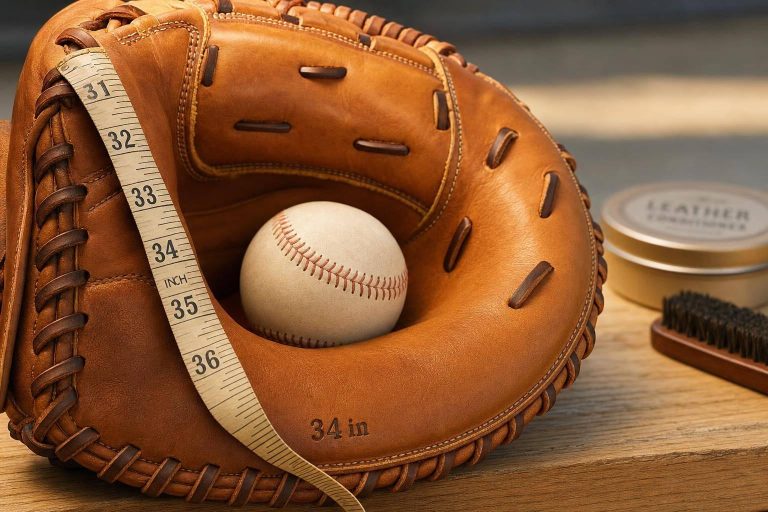
A catcher’s mitt is measured by circumference, not length, and most players will fit somewhere between 29.5" and 34". If I’m picking one, I look at age, hand size, pitch speed, pocket depth, padding, and leather type first.
Here’s the short version:
- Youth catchers usually need 29.5" to 32"
- Teen and adult catchers usually use 32.5" to 33.5"
- Softball mitts are often on the larger end with a deeper pocket
- Synthetic and pigskin mitts break in fast but wear out sooner
- Steerhide and kip last longer but can take 2 to 3+ months to break in
- A mitt should feel secure at the wrist, close without a fight, and hold shape through 80 to 100 pitches per game
- For care, I skip heat, clean it after use, condition it lightly, and store it with a ball in the pocket
If you only remember a few things, remember these: fit beats break-in, padding matters more as pitch speed goes up, and a flat or cracked mitt is near the end of its life. Most well-kept mitts last about 3 to 5 seasons.
ProTips: How to Choose a Catcher’s Mitt
sbb-itb-4d95ad3
Quick Comparison
| Area | What matters most | Simple rule |
|---|---|---|
| Size | Age, hand size, level | Younger players stay smaller; older players move to 32.5"+ |
| Fit | Wrist security, hand opening | If it shifts on impact, it’s too loose |
| Material | Break-in time, wear life | Softer = faster break-in; stiffer = more seasons |
| Ball security vs. transfer | Deeper pocket holds more cleanly; thinner profile gets the ball out faster | |
| Web/heel | Shape and closing feel | Stiffer web for impact control; more flex for younger players |
| Care | Shape retention | No oven, no microwave, no high heat |
So if I’m choosing a catcher’s mitt, I keep it simple: get the right size, make sure the wrist fit is snug, pick material based on level of play, and don’t ruin it with bad break-in habits.
Catcher’s Mitt Design and Rulebook Basics
How a Catcher’s Mitt Differs From Other Gloves
Now that sizing is clear, the next piece is how the mitt’s design affects control and whether it’s legal to use.
A catcher’s mitt is made for protection and ball security, not the kind of flexibility you get from a standard fielding glove. Regular gloves have separate finger stalls, which helps players move their fingers more freely. A catcher’s mitt is different. It keeps the fingers together inside one padded unit, which puts impact protection and ball security ahead of flexibility.
The closed web matters too. It helps hide pitch signals from the other team. While the mitt focuses on function, teams often coordinate their look with custom button-down baseball jerseys to complete the professional aesthetic. On top of that, the mitt has thick padding, usually foam or gel, to take the sting out of pitch after pitch. Because the whole hand works inside that single padded shape, fit is measured by circumference.
Key Parts of the Mitt and How Each Affects Grip
Each part of a catcher’s mitt has a job. Put them together, and they shape how the ball is caught, secured, and controlled.
| Part | Function |
|---|---|
| Palm padding | Absorbs pitch impact and protects the hand |
| Cradles and secures the ball | |
| Web | Supports pocket structure |
| Heel | Helps the mitt close cleanly |
| Laces | Hold the mitt together and help shape the pocket |
| Wrist opening | Controls wrist security |
There’s a balance here. You want protection, but you also want feel.
A snug wrist fit helps keep the mitt in place and supports hand stability without cutting off movement. Small detail, big difference.
Those parts shape how firmly the mitt receives the ball.
Baseball and Softball Size Rules You Need to Know
Once you get into design, the next limit is the rulebook.
Rulebooks measure catcher’s mitts by circumference, not length, and legal mitts range from 29.5 inches to 34 inches in circumference. For official play, the mitt must not have individual finger stalls, and it must have a closed web. Catchers also need to use a dedicated mitt, not a standard fielding glove.
Softball follows the same circumference rule, but the bigger ball calls for a roomier receiving shape.
Choosing the Right Size and Fit for Baseball and Softball Catchers
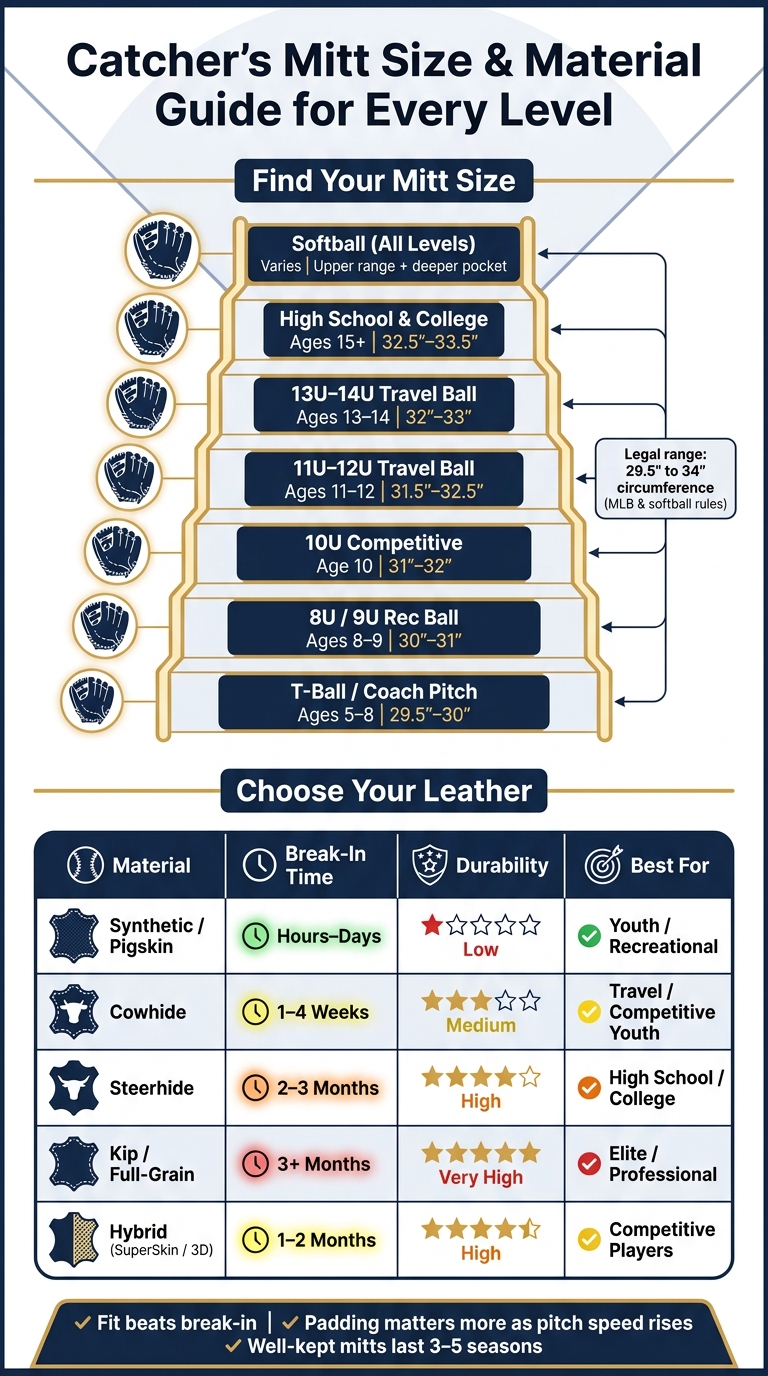
Catcher’s Mitt Size Guide by Age, Level & Material
Catcher’s Mitt Size Ranges by Age and Game Type
The right fit comes down to three things: the player’s age, hand size, and the speed of the pitches they catch. Once you know the legal size range, the next step is simple: match the mitt to the player in front of you.
For the youngest players in T-ball and coach pitch, usually ages 5–8, a 29.5"–30" mitt is the best place to start. At that age, control matters more than extra padding. A lighter mitt is easier for small hands to close, and that makes a big difference behind the plate.
When players move into 8U or 9U rec ball, a 30"–31" mitt tends to fit better and handle the jump in pitch speed.
Around ages 10–11, many players start moving into a leather mitt in the 31"–32" range. By 13U and up, hand size is usually much more settled, so a 32"–33.5" adult mitt makes sense for higher-velocity pitching.
Softball mitts usually sit at the upper end of the size range and have a deeper pocket to handle the larger ball.
How Fit Affects Grip Security, Transfer Speed, and Control
A mitt should close cleanly, stay steady on impact, and help the catcher move the ball out fast. Just picking the right size isn’t enough. Wrist opening and hand depth play a big part in how well the mitt secures the ball.
The two checkpoints that matter most are the hand opening and the wrist fit. If the wrist opening is too loose, the mitt can shift when the ball hits it. That movement can hurt receiving consistency in a hurry. Some mitts try to fix that issue directly. Rawlings‘ ContoUR fit, for example, is made for smaller hand openings and helps cut down on twisting for players with narrower hands.
A good rule here is simple: fit the player’s hand, not the player’s hopes. Buying the right size at the start matters, because break-in won’t fix a mitt that fits poorly.
Size Comparison Table: Youth vs. Adult and Baseball vs. Softball
The table below sums up the age- and level-based size ranges from the source material.
| Category | Recommended Mitt Size | Key Point |
|---|---|---|
| T-Ball / Coach Pitch (Ages 5–8) | 29.5"–30" | Ultra-lightweight; prioritizes control over padding |
| 8U / 9U Rec Ball | 30"–31" | Youth-specific and easier to close |
| 10U Competitive | 31"–32" | Leather becomes a smart upgrade |
| 11U / 12U Travel Ball | 31.5"–32.5" | Mid-range leather adds structure |
| 13U / 14U Travel Ball | 32"–33" | Moves toward adult sizing for higher-velocity pitching |
| High School and College (15+) | 32.5"–33.5" | Full adult premium build |
| Softball | Upper end of the range | Deeper pocket for the larger ball |
Materials, Construction, and Durability Specifications
Leather Types, Synthetic Panels, and Break-In Tradeoffs
After fit, material choice shapes almost everything about a mitt’s performance. It affects grip feel, break-in time, and how well the mitt holds up over a full season. In plain terms, the material changes how stiff the mitt feels on day one, how fast it starts playing the way you want, and how many seasons you can expect to get out of it.
Synthetic materials and pigskin leather are the usual starting point. They’re light, flexible, and often game-ready within hours or a few days. That’s a big plus for younger players who don’t want to spend weeks softening up a mitt. The downside is simple: they wear down faster with heavy use. Softer leathers also shorten break-in time and keep the upfront price lower for younger players.
Cowhide sits in the middle. It usually breaks in within one to four weeks and gives players a balance between comfort and long-term use. That makes it a good fit for travel ball or competitive youth players.
For high school, college, and other serious players, steerhide is the standard. It’s heavier and stiffer than cowhide, and it often takes two to three months of steady use to break in all the way. That extra time pays off with better shape retention and more protection against impact.
At the top end, kip leather and premium full-grain hides are the stiffest choices. They offer maximum durability, and the break-in period can stretch past three months.
Hybrid builds try to split the difference. Wilson’s SuperSkin, a microfiber/carbon blend used on the back of the mitt, lowers overall weight and helps with moisture resistance. The Rawlings REV1X pushes that idea further with 3D-printed synthetic backing paired with Heart of the Hide steerhide on the catching surface. The result is a lighter feel and faster break-in, while still keeping a durable leather catching surface.
Once the leather is set, the next parts matter just as much: lacing, padding, and the liner all play a big part in how well the mitt keeps its shape.
Lacing, Padding, and Wrist Liner Details That Matter
Durability isn’t just about leather. Laces, padding, and the wrist liner have a direct effect on how the mitt performs over the course of a season. Pitch after pitch, foul tip after foul tip, the internal build takes a beating. That’s what keeps a mitt usable deep into the schedule.
Leather lacing acts as the structural backbone of the mitt. If the laces stretch or start to fray, the pocket can lose shape and become tougher to control. Strong laces help keep the circular pocket tight and stop the mitt from getting floppy in the middle of the season.
Palm padding matters for comfort and hand protection. In many pro-level mitts, that padding is foam or gel. Its job is to absorb repeated impact from high-velocity pitches. Without enough padding, catchers can deal with bruising and soreness that builds over time.
Wrist liners don’t get much attention, but they’re worth a close look. Moisture-wicking liners help keep the hand dry during long games and doubleheaders. If your hand gets wet inside the mitt, grip security can slip. That’s an issue worth thinking about for players in humid areas or anyone catching back-to-back games.
Material and Construction Comparison Table
| Material / Feature | Break-In Time | Durability | Weight | Ideal User |
|---|---|---|---|---|
| Synthetic / Pigskin | Hours to days | Low | Very light | Youth / Recreational |
| Cowhide | 1–4 weeks | Medium | Moderate | Travel ball / Competitive youth |
| Steerhide | 2–3 months | High | Heavy | High school / College |
| Kip / Full-Grain | 3+ months | Very high | Moderate to heavy | Elite / Professional |
| Hybrid (SuperSkin / 3D Synthetic) | 1–2 months | High | Light | Competitive players |
Pocket, Web, and Grip Performance Features
Once the material and build are set, the next group of features changes how the mitt actually plays: pocket depth, web style, heel design, and closure. These details affect how the mitt receives the ball, holds it, and gets it out on the transfer.
Pocket Depth and Shape for Receiving and Ball Security
A catcher’s mitt uses a deep, circular pocket to handle high-velocity pitches. That pocket shape develops during break-in, and live bullpen work usually shapes it faster than hand stretching alone.
A deeper pocket gives you more ball security and a steadier receiving zone. On the other hand, a shallower or thinner pocket profile can speed up the transfer to the throwing hand, which matters for catchers who care most about a fast release. That tradeoff leads straight into the next decision: web shape and closure.
Closed Webs, Heel Design, and Closure Patterns
Catcher’s mitts usually come with closed or half-moon web styles, and that choice affects both stiffness and flexibility. A one-piece closed web gives the most stiffness and the most impact control. A half-moon web sits more in the middle, giving structure without making the mitt feel too rigid. A thinner toe pad can also help with framing and control.
Heel design plays a big role in how well the mitt keeps its shape over time. A raised heel ridge creates a hump at the base of the pocket that helps trap the ball. A hinged pad adds flex and makes the mitt easier to open and close, which is helpful for younger players or for newer mitts that still feel stiff. L-heel lacing on the pinky side affects the break point and changes how the heel forms as the mitt gets used.
Closure style is the last part of the equation. Power-close stitching helps smaller hands close the mitt more easily. It works well for beginners ages 5–10, but it can hold players back as they move up because it doesn’t have the natural closing action or shape retention needed for high-velocity play. Traditional leather closures take more hand strength, but they close more naturally and tend to keep their shape better.
Put simply, these features decide how fast the mitt closes and how well it secures the ball.
Pocket, Web, and Closure Feature Comparison Table
| Feature | Type | Main effect | Best For |
|---|---|---|---|
| Pocket Depth | Deep, circular | Maximum ball security and a stable receiving zone | Receiving high-velocity pitching |
| Shallow/thinner profile | Faster transfer to the throwing hand | Quick-release priorities | |
| Web Style | One-piece closed | Maximum stiffness and impact control | High-velocity pitching |
| Half-moon | Balances structure with flexibility | Framing and versatility | |
| Heel Design | Raised heel ridge | Traps the ball and improves grip stability | Ball security |
| Hinged pad | Increases flexibility and makes closing easier | Youth and newer mitts | |
| Closure Style | Power-close stitching | Helps smaller hands close the mitt | Beginners |
| Traditional leather | Natural closing action and better long-term shape | Competitive and adult players |
Break-In, Care, and Buying Priorities
Safe Break-In Methods and Routine Maintenance
Once the mitt fits well and closes the way it should, the next step is simple: break it in the right way and take care of it. That’s what helps it keep its shape over time.
The best way to break in a mitt is with regular catch sessions and bullpen reps. Just use it. Let the pocket form through steady work, not shortcuts. If you run into a stiff area that won’t loosen up, a glove mallet ($15–$25) can help mimic ball impact and shape the pocket. The goal is to work the leather little by little without putting too much stress on it.
One thing you should NOT do: use heat. Skip the microwave, oven, and direct sun. Heat above 170°F can damage tanned leather. That kind of fix might seem fast, but it can ruin the mitt.
After the pocket is set, basic upkeep goes a long way:
- Wipe the mitt clean after each use
- Apply conditioner lightly with a cloth
- Store it with a ball in the pocket
- Keep it in a dry, room-temperature spot
That routine helps the mitt stay game-ready instead of drying out, flattening, or losing its shape.
When to Repair, Relace, or Replace a Mitt
Most wear shows up in the laces and pocket first. Laces should be tightened during the first season and then about once a year after that. If they start to look brittle or frayed, relacing is a simple fix that can add more life to the mitt.
With solid care, a mitt can last 3 to 5 seasons of regular play. That’s a good run, especially if you stay on top of small repairs before they turn into bigger ones.
But there’s a point where repair won’t cut it. If the pocket won’t hold shape and stays flat, or if the leather starts to crack, it’s time for a new mitt. At that stage, relacing won’t fix the core issue.
For advanced players, timing matters. Start breaking in the next mitt months before the old one is done – not the week it finally gives out. That move can save a lot of frustration behind the plate.
Conclusion: The Specifications That Matter Most
Every spec in this guide ties back to four things: grip, durability, comfort, and fit for the player’s level. For younger players and beginners, the biggest factors are easy closure and a lighter build. For competitive high school and college catchers, steerhide quality and padding should move to the top of the list.
Cleaning, conditioning, and proper storage help protect that $ investment at every level. Get those basics right, and the mitt can keep performing season after season.
FAQs
How do I know if my catcher’s mitt is too loose?
Your catcher’s mitt is too loose if it doesn’t fit snugly while still letting your hand move with ease. When the fit is off, the mitt can slip or fail to hold the ball cleanly. That can hurt your control and make you feel less sure behind the plate.
If the mitt shifts around too much or feels loose and insecure when you catch, it’s probably too big or simply not fitted well for your hand.
Which mitt material is best for my level?
It depends on your age, experience, and how often you play.
For youth players and beginners, softer materials like synthetic leather or lighter tanned leather usually make more sense. They’re easier to break in, and that can help a lot with control early on.
For advanced, high school, and college players, higher-quality tanned leather is often the better pick. It tends to hold up longer, form a better pocket, and keep its shape over time.
When should I replace instead of relace my mitt?
Replace your catcher’s mitt when it stops holding its shape, loses durability, or doesn’t perform the way it should, even with proper care.
A well-kept mitt usually lasts 3 to 5 seasons of regular play. Once it gets badly worn, torn, or can’t catch and secure the ball well, it’s time for a new one.