
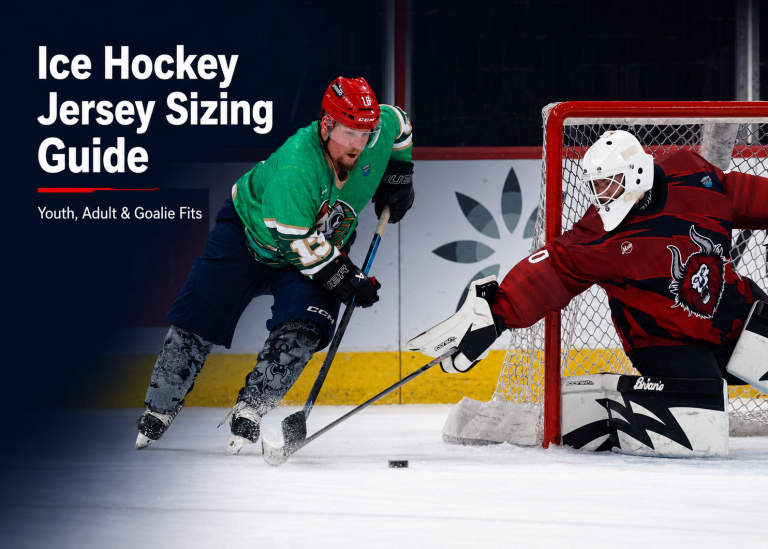
An ice hockey jersey can look like the right size in the locker room and feel completely wrong once the pads go on.
Too tight, and it can pull across the shoulders, restrict arm movement, and bunch around protective equipment. Too loose, and the sleeves or excess fabric may interfere with gloves and stick control.
Accurate sizing matters as participation continues to grow. According to USA Hockey’s membership statistics, the organization recorded 577,864 registered players during the 2024–25 season, up 2.37% from the previous year.
With more youth players, adults, and goalies joining teams, coaches and managers need a reliable way to size complete rosters before approving custom uniform orders.
That is why this ice hockey jersey sizing guide starts with equipment and garment measurements rather than everyday clothing size.
A youth jersey should not be selected by age alone. An adult game jersey should not be fitted like a casual fan jersey. A goalie should not simply order an oversized player jersey and expect the correct body and sleeve proportions.
The safest approach is to measure a jersey that already fits correctly over the player’s equipment and compare those dimensions with the manufacturer’s size chart.
This guide explains how to measure a hockey jersey, how youth, adult, player, and goalie fits differ, and what teams should confirm before ordering custom ice hockey jerseys.
Quick Answer: What Size Ice Hockey Jersey Should You Get?
Choose an ice hockey jersey using its chest width, body length, and sleeve measurements rather than relying only on the player’s age, height, or regular shirt size.
Lay a jersey that already fits correctly over the player’s equipment on a flat surface. Measure it and compare those dimensions with the size chart for the exact jersey style being ordered.
Skaters need enough room for unrestricted movement without excessive loose fabric. Goalies require different body and sleeve proportions to fit over a chest protector and larger arm equipment.
For team orders, confirm every player’s jersey style, cut, size, printed name, and number before custom production begins.
Which Ice Hockey Jersey Size Chart Should You Use?
There is no single ice hockey jersey size chart that works for every player and every jersey style.
The correct chart depends on the player’s age group, equipment, jersey cut, neckline, and product style.
Wooter provides separate sizing resources for:
- Custom V-neck hockey jerseys
- Custom laced hockey jerseys
- Custom V-neck hockey goalie jerseys
- Custom laced hockey goalie jerseys
Teams should use the chart attached to the exact jersey they intend to order rather than comparing measurements from another manufacturer or product style.
Choosing the Correct Chart
| Jersey Type | Best For | What to Check |
|---|---|---|
| Youth Player Cut | Youth forwards and defense players | Chest width, body length, sleeve length, and fit over pads |
| Adult Player Cut | Adult forwards and defense players | Shoulder room, arm movement, sleeve coverage, and body length |
| Youth Goalie Cut | Youth goaltenders | Chest-protector space, sleeve width, and movement |
| Adult Goalie Cut | Adult goaltenders | Full chest and arm protection, sleeve proportions, and body coverage |
A player-cut jersey is designed to fit over standard skater equipment.
A goalie-cut jersey uses different body and sleeve proportions to fit over a goalie’s chest protector and bulkier arm protection. Goalies should therefore use the appropriate goalie chart instead of ordering several sizes larger in a regular player jersey.
Garment Measurements vs Body Measurements
Hockey jersey charts may display finished-garment measurements rather than the player’s body measurements.
For example, chest width often refers to the jersey measured flat from one side to the other. It may not represent the player’s full chest circumference.
Comparing a body measurement directly with a flat garment measurement can result in the wrong size.
The most reliable method is to measure a similar hockey jersey that already fits correctly and compare garment measurements with garment measurements.
Sizing note: Use the chart for the exact V-neck, laced, player, or goalie jersey being ordered. Do not assume every hockey jersey uses identical measurements or proportions.
How to Measure an Ice Hockey Jersey Correctly?
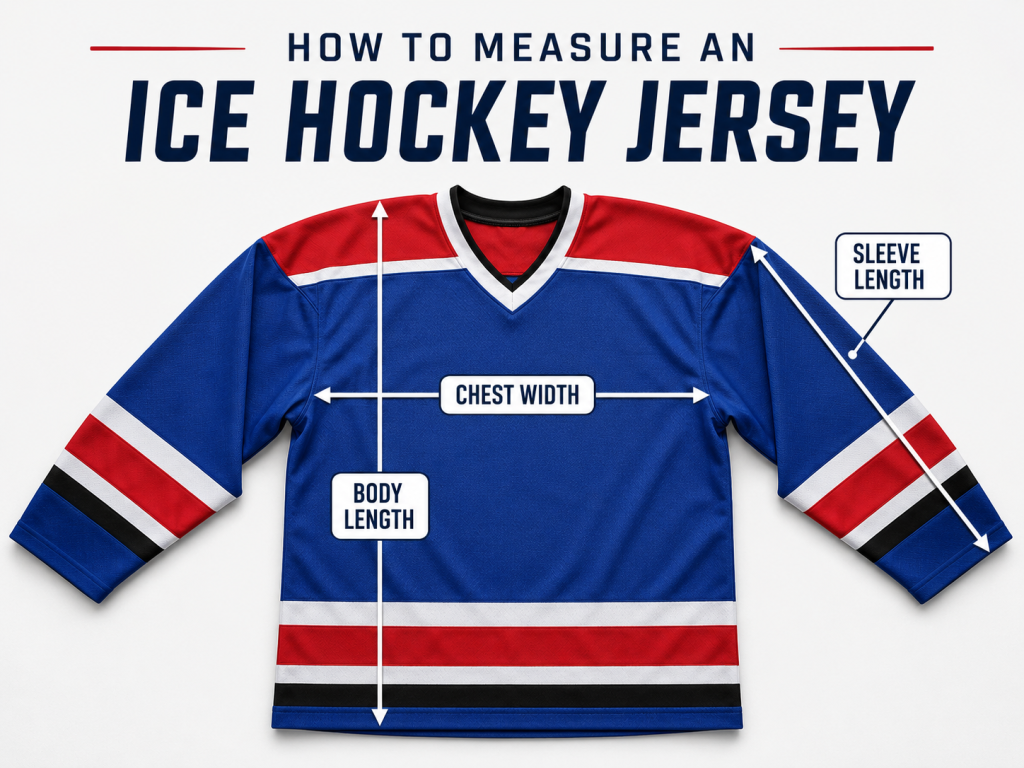
Lay a jersey that already fits properly on a flat surface and compare its dimensions with the manufacturer’s chart.
Before measuring, confirm that the jersey fits comfortably over the same shoulder pads, elbow pads, or goalie equipment the player will wear during games.
Smooth out major folds, but do not pull or stretch the material.
Measure the Chest Width
Measure straight across the chest from one armpit area to the other.
Check whether the manufacturer’s chart uses a flat chest width or full chest circumference. Do not automatically double the measurement unless the chart specifically asks for circumference.
A properly sized jersey should fit over the shoulder pads without pulling tightly across the chest.
Measure the Body Length
Measure from the highest shoulder point down to the bottom hem.
The jersey should remain long enough to provide coverage when the player bends forward into a skating position. A jersey that looks long enough while standing upright may ride up once the player leans forward or extends their arms.
Avoid excessive body length because extra fabric can bunch around hockey pants.
Measure the Sleeve Length
Follow the starting and ending points shown on the exact product chart.
Sleeve measurement methods can differ between manufacturers and jersey styles. Some measurements begin at the shoulder seam, while others may start near the neckline or center back.
The sleeves should cover the player’s arm protection without bunching inside the gloves or restricting wrist movement.
Compare With a Jersey That Fits Over Pads
Do not use a T-shirt, sweatshirt, or casual fan jersey as the only comparison.
Use an actual hockey jersey that the player has worn comfortably over full equipment. This gives a more realistic reference for chest space, sleeve movement, and body coverage.
When a player falls between sizes, consider the equipment, preferred fit, and remaining growth rather than choosing based only on the size label.
How Should an Ice Hockey Jersey Fit Over Pads?
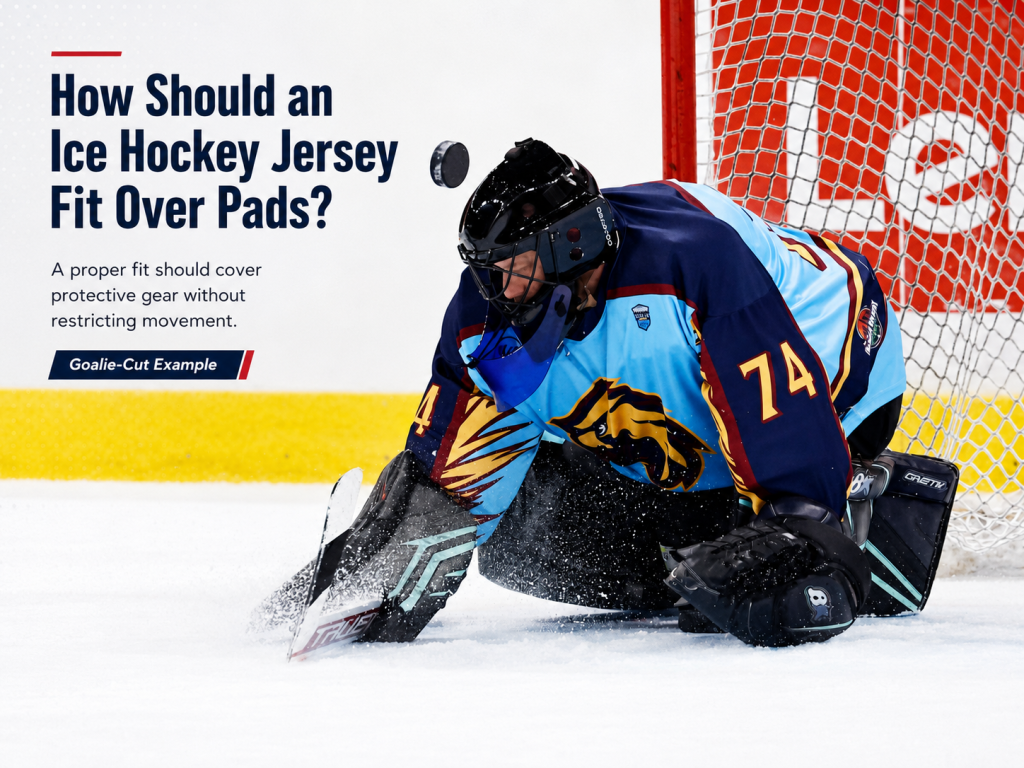
An ice hockey jersey should fit comfortably over shoulder and elbow pads without pulling across the chest or restricting arm movement.
The player should be able to raise, extend, and rotate both arms without the jersey tightening around the shoulders.
The sleeves should cover the protective equipment and meet the gloves without excessive bunching. The jersey body should also remain long enough when the player bends forward into a skating position.
A proper fit should provide:
- Comfortable space around the chest and shoulders
- Unrestricted arm and stick movement
- Sleeves that work with the player’s gloves
- Enough body length for coverage while skating
- Minimal loose fabric around the waist and arms
Players should test the jersey while wearing full equipment whenever possible.
Youth Ice Hockey Jersey Sizing
Youth ice hockey jerseys should be selected using garment measurements and pad fit, not age alone.
Two players of the same age can have different builds, shoulder-pad sizes, sleeve requirements, and growth patterns.
Some growth room can be useful, but ordering several sizes larger may leave too much material around the sleeves and waist. An oversized jersey can still interfere with skating, stick handling, and glove movement.
Coaches should confirm youth sizes after tryouts and before approving production, especially when uniforms are ordered several weeks before the season begins.
Adult Ice Hockey Jersey Sizing
Adult ice hockey jersey sizing depends on how the jersey will be worn.
A game jersey worn over full protective equipment needs more room than a fan jersey worn over a T-shirt or hoodie.
A practice jersey may have a slightly more relaxed fit, but it should not be so loose that the sleeves, waist, or body interfere with movement.
Adult players should check:
- Chest space over shoulder pads
- Sleeve coverage over elbow protection
- Freedom of movement through the shoulders
- Body length in a skating position
- Compatibility with gloves and hockey pants
Do not assume that an adult small will fit exactly like a youth extra-large. Youth and adult sizes can have different chest, sleeve, shoulder, and body proportions.
Player-Cut vs Goalie-Cut Ice Hockey Jerseys
A goalie-cut jersey is not simply a larger player jersey.
Its body and sleeves are shaped to fit over a goalie’s chest protector and bulkier arm equipment.
| Feature | Player Cut | Goalie Cut |
|---|---|---|
| Best For | Forwards and defense players | Goaltenders |
| Body Fit | Fits over standard skater pads | Wider for a goalie chest protector |
| Sleeves | Designed for skater arm protection | Roomier for goalie arm equipment |
| Sizing Method | Measure over full skater equipment | Measure over full goalie equipment |
| Common Mistake | Choosing excessive loose fabric | Ordering a larger player cut |
Ordering a much larger player jersey may create excessive body length while still failing to provide the correct sleeve width and proportions for a goalie.
Goalies should use a dedicated goalie chart and test the jersey over all protective equipment.
Common Ice Hockey Jersey Sizing Mistakes
Most sizing errors happen when teams rely on familiar size labels instead of actual garment measurements.
Avoid these common mistakes:
- Ordering from a normal T-shirt size
- Selecting youth jerseys by age alone
- Measuring without protective equipment
- Using a size chart from another manufacturer
- Assuming youth extra-large equals adult small
- Treating a goalie cut as an oversized player jersey
- Ignoring the chart’s sleeve-measurement method
- Approving production before every player confirms
- Forgetting jerseys for late additions or replacements
How to Collect Ice Hockey Jersey Sizes for a Team
Coaches and team managers should collect sizing and customization details in one roster sheet.
Use this process:
- Share the exact Wooter chart for the selected jersey style.
- Ask each player to measure a current jersey that fits over their pads.
- Record the jersey style, cut, and size.
- Collect each player’s printed name and number in the same form.
- Separate youth, adult, player, and goalie requirements.
- Flag uncertain sizes before approving the artwork.
- Reconfirm the completed roster before production begins.
A simple roster can include:
| Player | Jersey Cut | Size | Printed Name | Number | Confirmed |
|---|---|---|---|---|---|
Add or duplicate rows as needed for the full roster. Confirm all spelling, sizes, cuts, and numbers before production.
Teams may also consider ordering one or two spare player jerseys when the budget allows. Spare jerseys can help with late roster additions, damaged uniforms, or temporary replacements.
Get More Confidence Before Ordering
Compare Wooter size charts and ask about sample sizing options before finalizing your custom hockey jersey roster.
How Wooter Helps Teams Order the Right Ice Hockey Jerseys?
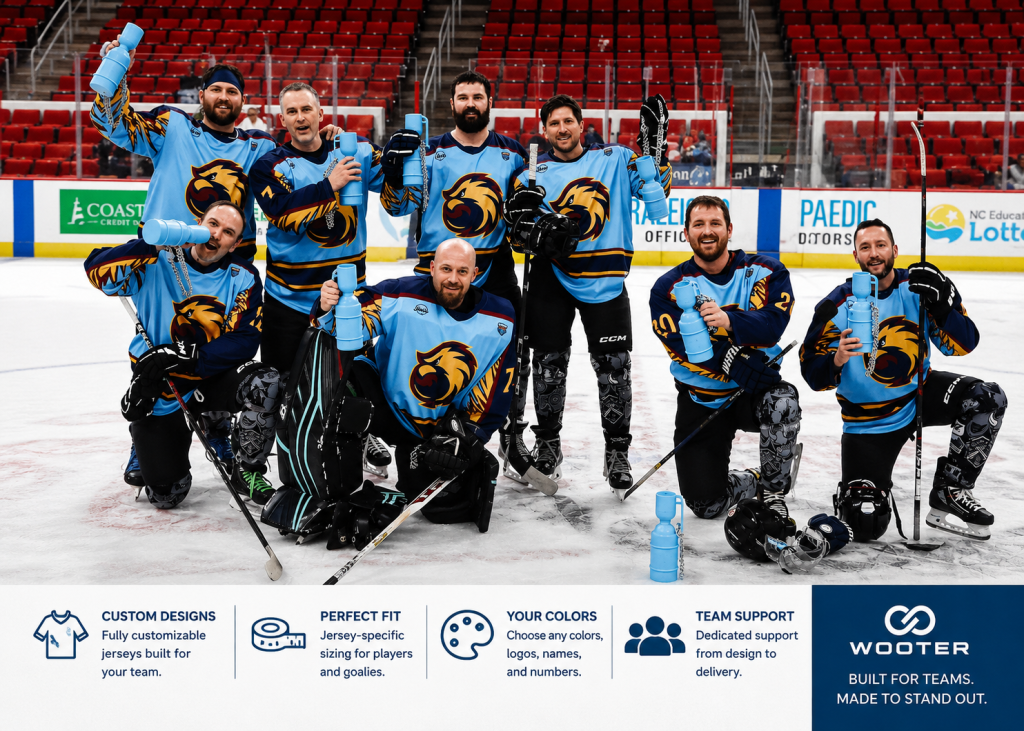
Wooter helps teams move from initial sizing decisions to a complete custom jersey order.
Jersey-Specific Sizing Resources
Teams can review sizing information for different youth, adult, player, and goalie jersey styles.
Using the chart for the exact product helps prevent errors caused by comparing different cuts, necklines, or manufacturers.
Free Custom Design Support
Teams can create custom ice hockey jerseys using their own colors, logos, names, numbers, and design details.
Wooter also offers design consultation to help teams turn an idea, logo, or color scheme into a complete uniform concept.
Coaches can browse ice hockey jersey designs for inspiration before finalizing their team look.
Support for Full-Team Orders
A team order involves more than choosing a jersey design.
Coaches must also organize sizes, cuts, names, numbers, goalie requirements, and final roster details. Reviewing those details before approval can help prevent avoidable production mistakes.
Wooter’s ordering process allows teams to coordinate customization and roster information before production begins.
Frequently Asked Questions About Ice Hockey Jersey Sizing
What size ice hockey jersey should I get?
Measure the chest width, body length, and sleeves of a jersey that already fits correctly over your pads. Compare those measurements with the size chart for the exact jersey style rather than relying only on your regular shirt size.
Should I size up for an ice hockey jersey?
Do not automatically size up. Hockey jerseys are designed to fit over protective equipment, but sizing varies by manufacturer and cut. Compare a properly fitting jersey with the exact product chart before choosing a larger size.
Do ice hockey jerseys run big?
Hockey jerseys often appear larger than everyday shirts because they must fit over protective equipment. However, game jerseys, fan jerseys, player cuts, and goalie cuts can all use different dimensions and proportions.
How should a hockey jersey fit over shoulder pads?
The jersey should slide comfortably over the shoulder pads without pulling across the chest. The player should be able to raise and rotate their arms freely, while the sleeves should work with the gloves without excessive bunching.
What is a goalie-cut hockey jersey?
A goalie-cut jersey has a wider body and roomier sleeves to accommodate a chest protector and larger arm equipment. Its proportions differ from a standard player jersey, so goalies should use a dedicated goalie sizing chart.
Is youth extra-large the same as adult small?
Not necessarily. Youth and adult sizes may use different chest, sleeve, shoulder, and body proportions even when some measurements appear similar. Compare both charts rather than assuming the labels are interchangeable.
Should teams order spare hockey jerseys?
One or two spare player jerseys can help with late roster additions, damaged jerseys, or temporary replacements. Teams should choose commonly used sizes and leave the name area blank when practical.
Get the Right Ice Hockey Jersey Size Before You Order
Correct ice hockey jersey sizing starts with the player’s equipment, a properly fitting comparison jersey, and the chart for the exact product being ordered.
Measure the garment flat, confirm how each dimension is taken, separate player and goalie cuts, and review every roster entry before custom production begins.
Get design support for your team colors, logo, player names, numbers, and complete roster.