
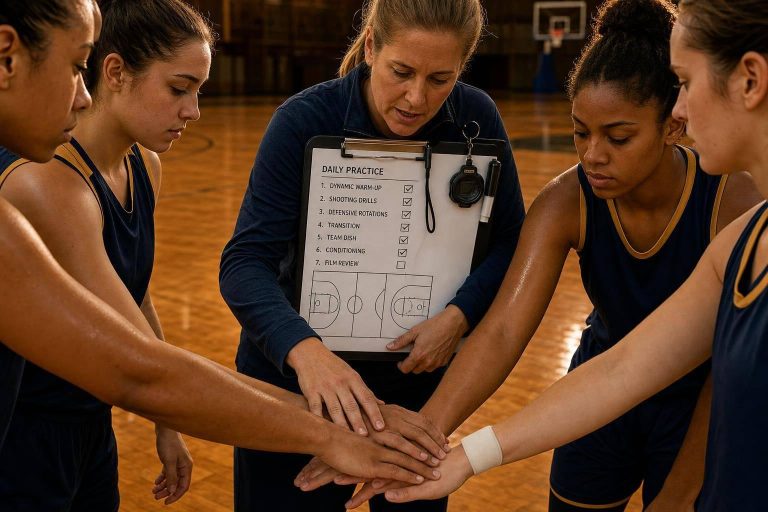
The big lesson is simple: winning programs don’t rely on talent alone. I see the same pattern across UConn, South Carolina, Tennessee, Stanford, Iowa, Michigan, and UCLA: they set clear rules, drill them every day, teach players to hold each other to the standard, and shape game plans around the roster they have.
Here’s the short version:
- Set non-negotiables early. UConn built its run to 12 national titles on daily accountability.
- Make habits visible. Tennessee tied discipline to small routines like being 5 minutes early.
- Let players police the team. South Carolina turned peer accountability into part of its edge during a 38-0 title season.
- Run game-like practice. Iowa uses timed segments and shot work based on shots the team will actually get in games.
- Track the little things. Michigan scores hustle plays, not just points.
- Build your system around your roster. South Carolina changed its offense when its personnel changed.
- Use clear, direct communication. Coaches like Dawn Staley, Geno Auriemma, and Cori Close each prove there’s more than one way to lead.
- Keep the standard the same, even when the style changes.
If I had to boil the full article down to one coaching rule, it would be this: don’t copy a famous team’s whole system – copy its daily habits, clear standards, and teaching discipline. That’s the part most teams can use right away.

Elite Women’s Basketball Programs: Culture, Habits & Results
High-Energy Drills & Decision-Making for Defense & Rebounding – with Kim Barnes Arico!
sbb-itb-4d95ad3
Quick Comparison
| Team/Coach | Main lesson | Daily example | On-court result |
|---|---|---|---|
| UConn / Geno Auriemma | Accountability every day | Hard practice pressure, no exceptions | 12 titles |
| South Carolina / Dawn Staley | Truth and player ownership | Veterans correct issues fast | 38-0 season, 3 titles since 2017 |
| Tennessee / Pat Summitt | Discipline and team-first play | Early arrival, repeat team rituals | 8 titles |
| Stanford / Tara VanDerveer | Prep and detail | Film study, sharp skill feedback | 1,203 wins in January 2024 |
| Iowa / Lisa Bluder | Practice must match the game | Timed segments, game-shot reps | Better shot quality and game rhythm |
| Michigan | Train decision-making and effort | 16-pass drill, hustle tracking | Better movement and buy-in |
| UCLA / Cori Close | Reset after mistakes | “Mind Gym” approach, zone use | Held South Carolina to 29% shooting in the 2026 title game |
In the rest of this piece, I focus on the parts you can use now: standards, practice setup, player development, game choices, and team buy-in. These lessons apply whether you are refining your strategy or outfitting your squad in custom pro basketball jerseys.
How Elite Women’s Basketball Programs Build Culture
Program Identity and Non-Negotiables
Elite programs don’t leave culture to chance. They set clear rules, repeat them daily, and attach consequences when players fall short. The starting point is simple: take coaching values and turn them into behaviors that happen every day.
Geno Auriemma built UConn around accountability and excellence. His standard comes down to playing smart, playing hard, and being a good teammate. And he doesn’t make exceptions.
"We were going to run it like it was a Catholic high school basketball program where everyone is accountable every day." – Geno Auriemma, Head Coach, UConn
At UConn, that standard wasn’t just talk. Freshmen who didn’t compete at the level required were moved from the main locker room to the visitor locker room without amenities. The message was plain. Meet the standard, or feel the result. That same mindset shows up off the court too: UConn has a 100% graduation rate among four-year student-athletes.
At South Carolina, Dawn Staley puts truth at the center of the program. Players are taught to take blunt feedback, sit with it, and use it to improve.
"The ultimate confidence builder is truth. Sometimes you have to condition everybody around you to handle the truth." – Dawn Staley, Head Coach, South Carolina
Pat Summitt built Tennessee around the Definite Dozen, with discipline, hard work, and team-first thinking at the core. Those ideas weren’t left on a wall somewhere. They showed up in daily standards, and teammates were expected to call each other up when someone slipped.
How Culture Shows Up in Daily Routines
Culture lives in small habits. That’s where you can see whether a program means what it says.
At Tennessee, players had to arrive five minutes early to every event. The team also used a foot-touching huddle ritual during team moments and the national anthem to reinforce connection. These habits may sound small, but that’s the point. Small routines make the standard visible.
At UConn, the Taurasi Drill pushes that same idea in practice. It’s a one-on-one defensive drill where a player stays in until she gets a stop. If she doesn’t, she has to deal with a fresh offensive player right away. No break, no escape. Just focus and effort, over and over.
South Carolina leans hard on player-led accountability. Veteran players are expected to deal with anything that looks, sounds, or feels off without waiting for a coach to handle it. That changes the whole feel of a team. Standards stop being top-down only. They become shared.
Across all four programs, values are enforced every day, not posted and ignored. That’s where culture gets real: in the way practice runs, how players talk to each other, and what happens when someone misses the mark.
Culture Pillars Across Iconic Teams: A Comparison
The clearest way to see the contrast is to look at how each program turns values into daily habits.
| Program | Core Value | Daily Standard | Performance Impact |
|---|---|---|---|
| UConn (Auriemma) | Accountability & excellence | Taurasi Drill; freshmen moved to visitor locker room for failing to compete | 12 national championships |
| South Carolina (Staley) | Truth & peer-led standards | Veterans self-police; blunt critiques in film and practice | 3 national titles since 2017 |
| Tennessee (Summitt) | Discipline & connectedness | Definite Dozen principles; punctuality; foot-touching huddle ritual | 8 national championships; 100% graduation rate for all 122 eligible players |
| Stanford (VanDerveer) | Disciplined preparation | Detailed film breakdown; fundamental critiques and basketball drills in every session | 1,000+ career wins |
What stands out here isn’t just what each program values. It’s how those values get turned into repeated actions. That’s where culture stops being a slogan and starts shaping practice.
Practice Design and Player Development Methods That Win
How to Structure Practice Like a Game
Top programs don’t just "run practice." They give every minute a job.
Iowa is a good example. The program uses a strict time-blocked plan with set windows for defense, full-court scrimmage, rebounding, and film review, so no area of player growth gets skipped. They also run segments against the scoreboard clock. That matters because players get used to playing with time pressure instead of only hearing about it in games.
"I don’t have shooting drills just for the sake of shooting; my shooting drills are designed specifically for the type of shots we get in games." – Lisa Bluder, Head Coach, University of Iowa
That’s the big idea: practice should look and feel like the game you’ll actually play.
Each drill should push players to make reads at game speed. Michigan’s 16-pass drill does exactly that. The team has to complete 16 passes in the half-court before taking a shot, which forces steady off-ball movement and better decisions under pressure. UCLA builds the same kind of pressure response in a different way. Its "Mind Gym" method trains players to reset right after a mistake, so one rough possession doesn’t spill into the next.
Skill Work, Film, and Tracking Progress
Game-like reps are only part of the job. Film and tracking help players lock in what they just worked on.
Elite staffs fix small issues early, before they turn into habits. Dawn Staley uses film to spot details like footwork, positioning, and how a player reads broken plays. Over a long season, those little things stack up.
"Watching film, breaking down film, little nuances that create edges that can win you a basketball game… If you take care of the small details, the big things don’t get out of hand." – Dawn Staley, Head Coach, South Carolina
Player growth also shouldn’t be boxed into one role. UConn puts a lot of weight on multi-role development, training players to help in more than one area of the box score instead of staying tied to a single spot. In plain terms, a player shouldn’t think, I’m only a shooter or I’m only a post. The best teams build lineups where players can do more than one thing.
Effort should be tracked in a way players can see. Michigan does this by marking hustle plays with stickers on lockers and naming a weekly "Practice Points Queen", who wears a pink jersey. Loose balls, charges, and jump balls stop feeling optional when the program tracks them like made shots or assists, often using custom game basketballs to maintain a professional feel.
Practice Format Options by Team Level: A Comparison
Different teams need different practice setups. What works for a college roster in midseason may not fit a youth club team with limited gym time. The best format depends on your roster, your practice window, and where you are in the season.
| Format | Primary Focus | Best Use Case | Limits |
|---|---|---|---|
| Drill-Heavy (Iowa Style) | Fundamental mastery and strict time-blocking for each skill | High school and college preseason | Can feel repetitive |
| Small-Sided Games (Michigan Style) | Decision-making in 3-on-3 or 4-on-4 with specific constraints | Youth / Club | High engagement, less 5-on-5 flow |
| Scrimmage-Heavy (UConn Style) | High-intensity 5-on-5 that simulates game-day pressure | Elite club and college midseason | Higher injury risk; needs strong basketball IQ |
Once practice habits are in place, the next move is turning them into offensive and defensive choices.
Game Strategy Lessons From Championship Teams
Offensive and Defensive Systems Worth Borrowing
Once practice starts to feel like a game, the next test is simple: does your system still hold up when the pressure hits?
A lot of coaches make the same mistake. They see a top team and try to copy the whole thing. That usually backfires. The smarter move is to borrow the parts that fit your roster.
Take UConn’s offense. In 2025–26, the Huskies shot 65.7% from the paint – the best mark in the nation – and posted a +37.8 scoring margin per game. That kind of output comes from spacing, motion, and players who can read the floor on the fly. But there’s a catch. If your group can’t process those reads fast enough, the same system can turn into a turnover machine.
South Carolina wins in a different way. Their identity starts with defense and rebounding, and Lisa Boyer said that standard is a decision. In 2026, the Gamecocks averaged 42.5 rebounds per game, which put them in the national top 10, and 47 points per game in the paint, good for second in Division I. At the same time, Dawn Staley showed she wasn’t glued to one offensive style. When the roster lacked post depth and leaned more on versatile guards and mobile bigs, she shifted to a faster, perimeter-based attack. The lesson is plain: keep your defensive standard steady, then shape the offense around the players you have.
UCLA offered a similar example in the 2026 National Championship. Cori Close used a 2-3 zone that held South Carolina to 29% field goal shooting, the lowest postseason mark of Dawn Staley’s career. The zone packed the paint and pushed South Carolina into outside shots. If your team doesn’t have the length to guard elite post players one-on-one, a zone can help level the floor.
In-Game Decisions That Change Outcomes
The game plan doesn’t stop after tip-off. What a coach does during the game – lineups, timeouts, halftime messaging – can swing the result just as much as the system on the whiteboard.
In the April 2026 Final Four, South Carolina went into halftime trailing UConn 26–24. Staley responded with a direct, fiery message that pushed her team back to its identity. The shift showed up right away. The Gamecocks opened the third quarter on a 16-4 run and then held UConn to only 4 points in the final 6:37, finishing off a 62–48 win. That matters even more when you remember who they were facing: UConn came in as the nation’s top shooting team at 52%, and South Carolina held them to 31.1%. The halftime move wasn’t about drawing up something fancy. It was about getting the team back to itself.
"You got to get under their skin a little bit because you got to jolt ’em out of the state that they’re in to get them back to who they are." – Dawn Staley, Head Coach, South Carolina
Substitution timing matters too, and a lot of coaches don’t use it well enough. In that same Final Four game, Staley kept All-American point guard Raven Johnson on the bench for a long stretch in the fourth quarter because the reserve unit was rolling, and she wanted Johnson fresh for the closing minutes. That’s not always an easy call. Still, riding the hot group instead of defaulting to the star is often the move that wins games.
Then there’s matchup creativity. Staley put 5’9" guard Raven Johnson on 6’2" National Player of the Year Sarah Strong, choosing pressure and disruption over size-for-size defense. The idea travels well to any level: don’t just match bodies – take away the thing that makes the other team’s best player comfortable.
Signature Team Strategies Side by Side: A Comparison
| Program | Core Style | Key Strengths | Limits |
|---|---|---|---|
| UConn | Spacing, motion, and disruptive pressure | 65.7% paint efficiency; 15.8 steals/game | Needs high basketball IQ; can struggle when teams take away catch-and-shoot looks and force weaker shots |
| South Carolina | Physical post play and effort defense | 42.5 rebounds/game; 47 points per game in the paint | Can run into trouble when post depth is thin or when games get stuck in a slow half-court pace |
| UCLA | Interior dominance and zone defense | Elite rim protection; 2-3 zone cuts down paint efficiency | Leans heavily on size and rebounding margin |
| Tennessee (Classic) | Two-big post play and full-court press | Physical play on the blocks; high-pressure defense | Can be exposed by elite ball-handling and triangle spacing |
| Stanford (Classic) | Read-and-react execution | Disciplined, plan-based play; experienced rosters | Can get outrun by aggressive, athletic defensive teams |
The system can shift. The standard can’t. The next step is getting players to buy into that standard.
Leadership, Team Buy-In, and Applying These Lessons to Your Program
Communication and Motivation Styles That Work With Modern Athletes
Systems don’t work unless players buy in. And buy-in starts with the way a coach talks, teaches, and sets the tone.
Dawn Staley says it as clearly as anyone:
"The ultimate confidence builder is truth. Sometimes you have to condition everybody around you to handle the truth when you yourself have been conditioned to handle truth." – Dawn Staley, Head Coach, South Carolina
That kind of honesty can set the standard fast. But it’s not the only way to connect.
Cori Close uses a small language shift that changes how players see the work. She moves practice talk from “have to” to “get to,” turning it from a burden into a chance to improve. Becky Hammon takes a more personal route. She uses music, stories, and metaphors to reach players, and she even gave each player a plant to care for as a symbol of growth. That approach stuck with A’ja Wilson:
"It’s not just her basketball mind, it’s because she can form relationships and bonds. That’s when you see winning cultures is when your leader is so poured into you." – A’ja Wilson, Forward, Las Vegas Aces
There isn’t one perfect leadership style. The best fit depends on who’s in your locker room.
| Leadership Style | Key Proponent | Best Use Case |
|---|---|---|
| Authoritative / Standards-Based | Geno Auriemma (UConn) | Setting non-negotiable expectations from day one |
| Direct / Truth-Based | Dawn Staley (South Carolina) | Veteran teams that need player-led accountability |
| Transformational / Identity-Based | Cori Close (UCLA) | Developing younger players through confidence and resilience |
| Relational / Creative | Becky Hammon (Las Vegas Aces) | Modern athletes who respond to personal connection and storytelling |
A young roster may need more confidence-building and teaching. An older group may need blunt feedback and ownership. Either way, players can tell when a coach means what they say.
Turning Big-Program Habits Into a Season Plan
Top programs don’t build culture with one big speech. They build it through habits that show up all year.
Pre-season is the time to set the standard. Create a team pact: a short document signed by every player and coach. Keep it simple. Spell out your values, how you’ll communicate, and the goals you’re chasing. Then put it where people will see it – in the office, locker room, and practice gym.
In-season, teach players how to reset after mistakes. That’s a skill, not just a mindset. Film sessions should back up your standard with direct feedback, clear teaching, and no mixed signals.
In tournament play, trust matters more than ever. This is the moment to lean on player-led accountability instead of trying to control every possession from the sideline.
Off-season is a good time to give younger players real minutes. Yes, mistakes will happen. That’s part of it. Those reps speed up growth faster than any drill can.
Using Team Apparel to Reinforce Identity and Key Takeaways
What players wear sends a message. Matching jerseys, custom long sleeve t-shirts, and practice gear remind the group that they’re part of something bigger than one role, one stat line, or one player’s mood that day.
Wooter Apparel helps programs strengthen that shared identity with fully sublimated uniforms, warmups, accessories, and free custom design support.
The lessons here are pretty simple: set clear standards, practice with purpose, match your approach to your roster, communicate with honesty and care, and build a shared identity that players can see and feel every day. You don’t need a Division I budget to do that. You need consistency.
FAQs
How do I set non-negotiables for my team?
Start by defining clear values that fit your program’s identity. Then stick to them every day. Talent matters, but it can’t outweigh standards.
- Be fair, firm, and consistent.
- Put character and values first in recruiting.
- Lead by example and expect the team to hold itself accountable.
- Use honest, open communication to deal with behavior issues.
That daily standard sets the tone. Players notice what a coach lets slide, and they notice what a coach stands on. If the rules shift based on who scores the most points, the whole thing starts to crack.
This is why recruiting matters so much. Skill can help you win games, but character shapes the locker room. A player who buys into the program can lift everyone around them. A player who doesn’t can drag the group in the other direction.
The same goes for communication. Say what needs to be said, say it early, and say it straight. That doesn’t mean being harsh for the sake of it. It means being clear, honest, and steady so people know where they stand.
What practice changes improve game performance fastest?
The fastest gains usually come from small practice tweaks that match what a team already does well, while keeping that hard-nosed defensive effort in place.
Coaches often zero in on a few key habits: helping players read defenses, play with pace and space, move the ball, and shift defensive looks – like a zone or a box-and-one – to deal with a given opponent.
How can I adapt a system to fit my roster?
Look at what your players do well, then shape your system around that. Don’t force a fixed style if it doesn’t fit the group you have. Small moves – like changing the lineup or adjusting your defense – can line up better with your team’s energy, bench depth, and the matchup in front of you.
When you make changes, frame them as help, not punishment. Be clear about each player’s role, keep the same standard for everyone, and lean on your staff to fill in the gaps so you can stay focused on leading the team.