
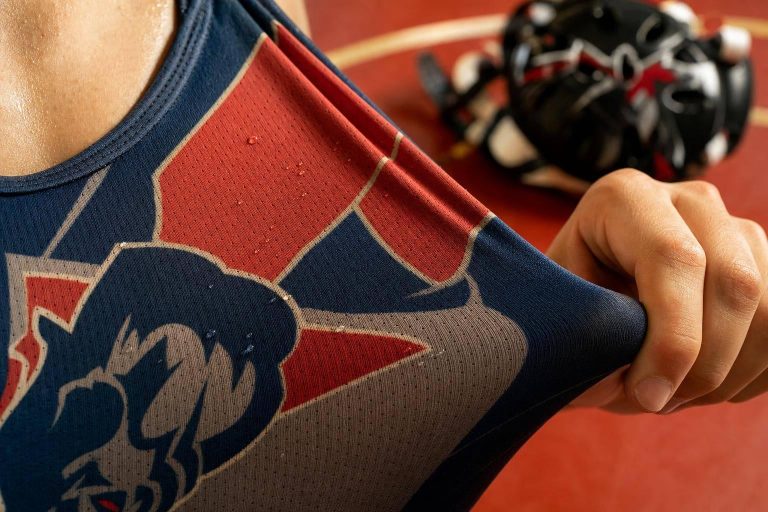
If you want wrestling gear that keeps its color, stretch, and fit through a full season, sublimation is usually the better pick.
I’d sum it up like this: sublimation puts dye into polyester fabric, while screen prints and heat transfers sit on top of it. That one difference helps cut down on cracking, peeling, fading, stiffness, and show-through on close-fit gear like singlets and branded headgear.
Here’s the short version:
- Sublimated singlets stretch better with 4-way stretch fabric
- Graphics last longer through mat contact and repeat washing
- Breathability stays better because there’s no heavy surface layer
- Names, numbers, and logos stay more consistent across reorders
- Competition singlets should usually be around 220–240 GSM to help with opacity rules
For most school programs, I’d look at three things first:
- Does the design need full coverage, gradients, or all-over graphics?
- Does the gear need to hold up through heavy friction and frequent washing?
- Do you need repeat orders that match past uniforms closely?
If the answer is yes, sublimation fits that job well.
| Feature | Sublimation | Screen Print / Heat Transfer |
|---|---|---|
| Color placement | In the fabric | On the fabric |
| Stretch performance | Moves with the material | Can crack or show strain |
| Feel | Smooth | Can feel heavier or stiffer |
| Wash wear | Holds up better | More wear over time |
| Design range | Full-color, all-over | More limited |
The main point is simple: wrestling gear gets pulled, rubbed, and washed hard, so decoration that becomes part of the fabric tends to last better than decoration that sits on the surface.
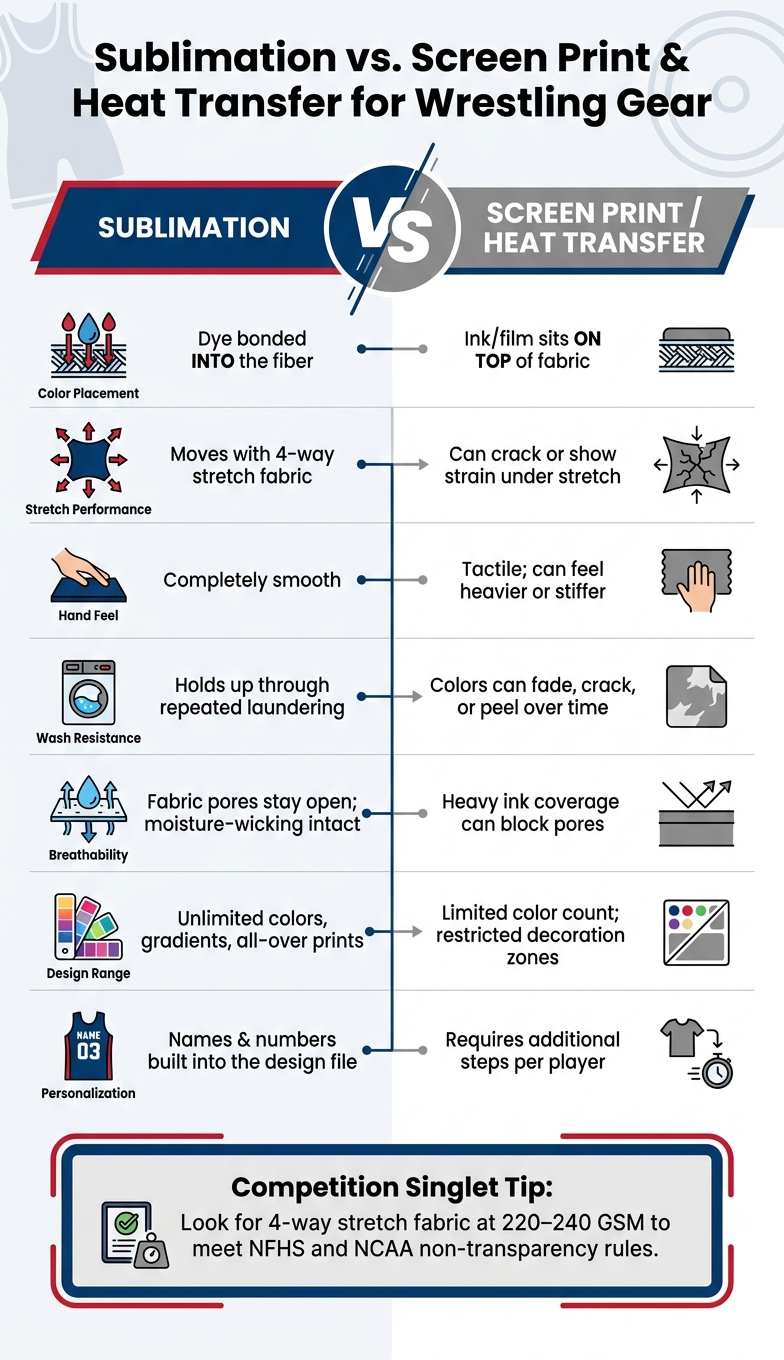
Sublimation vs. Screen Print & Heat Transfer for Wrestling Gear
2 Different Types of Wrestling Singlets
sbb-itb-4d95ad3
Common problems with wrestling gear decoration
Wrestling decoration starts to fail when the graphic sits on top of the fabric instead of becoming part of it. That’s how screen printing and heat transfers work. They add ink or a film layer to the surface of the material.
At first, that can look fine. But wrestling gear goes through a lot: repeated matches, hard mat contact, and frequent washing. Over time, that top layer begins to wear down. You start to see fading, cracking around the edges of logos or numbers, and peeling as the gear gets older. That cuts the life of the uniform and hurts how the team looks. And on close-fit wrestling gear, those issues tend to show up fast.
There’s another problem too. Surface prints can block the pores of performance fabrics, which can reduce breathability and moisture-wicking. If the ink coverage is heavy, the singlet can also feel stiff instead of flexible and easy to move in.
Layout options can be limited as well. Screen printing usually works best on certain panels, so full-coverage designs, gradients, and all-over patterns are much harder to pull off. That’s exactly where sublimation changes the game.
Why close-fit gear wears out surface decoration faster
Competition singlets are made to stretch in every direction. That constant pull puts a lot of stress on any decoration that doesn’t stretch at the same rate. When a surface-printed singlet stretches during a sprawl or a hard tie, the ink layer may not keep up. That mismatch leads to cracking, and it gets worse the more the gear is used.
Stretch can also cause grinning, where the base fabric shows through and the colors start to look faded. For school programs, that can be a big issue. The same problem shows up with headgear any time branding needs to flex with the gear.
Headgear deals with nonstop friction around the ear cups and straps, so surface-applied branding like heat transfers can wear down fast. Embroidery can be a problem too. It adds stiffness to spots that need to flex, and the raised stitching can feel bulky during long wear.
How sublimation fixes these problems
The big difference comes down to where the color lives. With sublimation, heat and pressure turn dye into gas and bond it into polyester fibers instead of leaving it on top of the fabric. That means there’s no surface layer to wear out. No cracking. No peeling. No flaking. That matters most for gear that gets pulled, stretched, and washed over and over.
Full sublimation on wrestling singlets
Polyester singlets are a strong match for sublimation. The dye bonds right into the fibers without blocking the fabric’s pores, so moisture-wicking and breathability stay intact. You still get decoration, but without the heavy, coated feel that can make gear less comfortable.
Just as important, the fabric stays light and flexible. Since the design becomes part of the material, it moves with four-way stretch instead of fighting against it. Logos, patterns, names, and numbers stay crisp through hard wear and repeated washing. The same idea applies to headgear too, where constant rubbing can wear down anything that sits on the surface.
Sublimation for custom headgear
Headgear needs that same kind of toughness, and in some ways even more. It deals with direct abrasion at the ear cups and straps almost every match. With sublimated headgear, logos and colors stay in place because the color is built into the material, not laid on top of it.
That helps team colors and branding stay consistent with the rest of the uniform, even as the gear flexes, takes contact, and gets put through match after match.
Design precision, branding, and long-term value
After durability, the next big draw of sublimation is precision. It helps wrestling programs keep gear consistent across seasons and reorders. Every piece can match the same colors, names, and logos because names, numbers, logos, and patterns are built into the artwork from the start. That means each item comes out with the same color, sharpness, and placement. There’s no extra step to add player names later, and no risk of color, font, or placement mismatches.
Color accuracy matters a lot for school programs. Using Pantone (PMS) codes keeps team colors steady from one reorder to the next. Saved artwork files make it easier for future orders to match the original colors, fonts, and logo placement. Design support also keeps logos, names, and numbers aligned in one layout. On close-fit wrestling gear, that matters even more, because even small placement or color mistakes stand out fast.
Clean graphics that resist cracking, peeling, and fading
Because the dye goes into the fiber, sublimation holds fine details better than surface printing, especially on singlets and headgear that need to stay clear and easy to read during heavy contact. Sharp edges, small text, and complex gradients stay clean, even in tight spaces like headgear straps or side panels. That’s a big deal for school branding, where a mascot or wordmark has to look right at any size.
Mat friction, repeated matches, and frequent laundering put graphics to the test. Sublimated graphics don’t crack under that wear because there’s no top layer to break apart. The design moves with the fabric instead of fighting against it.
Sublimation vs. surface-print methods
For wrestling programs, the differences show up most clearly in a few core areas:
| Feature | Sublimation | Surface-Print (Screen/Heat Transfer) |
|---|---|---|
| Hand Feel | Completely smooth; part of the fiber | Tactile; sits on top of the material |
| Design Range | Unlimited colors, gradients, and all-over prints | Limited color count; specific decoration zones |
| Personalization | Names and numbers built into the design file | Requires additional steps per player |
| Wash Resistance | Resists fading from frequent laundering | Colors can dull or bleed with heavy washing |
The difference in hand feel and design range is a bigger deal in wrestling than it might seem at first. Surface prints add a physical layer on top of the fabric, which can make the material feel stiffer and cut into the four-way stretch that singlets rely on. Sublimation skips that problem entirely.
Best uses for sublimation in wrestling and key takeaways
Sublimation works best for wrestling gear that has to handle constant stretching, body contact, and repeated washing. Singlets are the clearest case, and matching headgear can benefit as well. If your program needs gear that still looks uniform after heavy use, sublimation is usually the safest pick.
There’s another big reason programs lean this way: the artwork is stored digitally. So when it’s time to place another order, you can match the original colors, logo placement, and patterns with precision. That matters a lot for school districts running varsity, JV, and youth programs at the same time, where uniform drift across sets can become a headache. At that point, the choice is less about looks alone and more about brand consistency and compliance.
When sublimation is the right choice for your program
Choose sublimation when your program needs:
- Exact team colors
- Full-coverage designs
- Multi-season durability
If you want repeatable colors, more room in design, and gear that holds up over time, sublimation is the clear fit.
One practical detail matters here. When ordering, ask for 4-way stretch fabric and confirm that the fabric weight is high enough – typically 220–240 GSM for competition-grade singlets – to help the garment stay opaque and meet NFHS and NCAA non-transparency rules. That step can help prevent opacity issues at weigh-ins.
FAQs
Does sublimation only work on polyester?
No. Sublimation works best with polyester fibers, but you don’t need 100 percent polyester.
It also works well on polyester-rich performance blends, including fabrics with Lycra or spandex. That means you can still get bright, permanent designs while keeping the stretch, moisture-wicking, and durability wrestling gear needs.
Will sublimated wrestling gear meet opacity rules?
Sublimated wrestling gear can meet opacity rules, but that comes down more to the base fabric than the printing method itself.
Sublimation colors the fibers without adding extra weight or texture. So the fabric keeps the same level of opacity as the polyester-spandex or polyester-lycra blend it’s made from. If you’re ordering from Wooter Apparel, pick a fabric weight that fits your competition’s rules.
How easy are matching reorders later?
Matching reorders are simple with Wooter Apparel. Once your custom design is finalized, it’s saved digitally, which helps keep your team’s look the same over time.
Because the design stays on file and sublimation needs very little setup, future reorders, including smaller runs, are easy to place.