
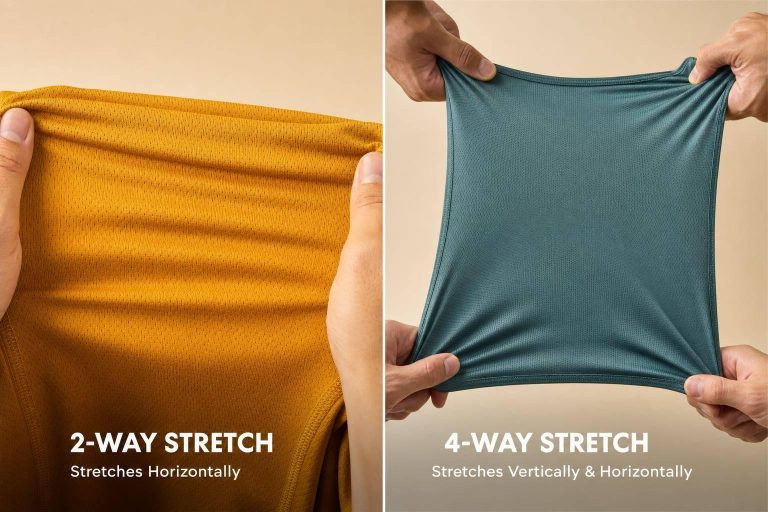
If you want more freedom of movement, pick 4-way stretch. If you want more shape and firmness, pick 2-way stretch. That’s the short answer.
When I compare these two fabric types, I look at four things first:
- stretch direction
- range of motion
- fit and snap-back
- best sport use
Here’s the main takeaway in plain English:
- 4-way stretch moves side to side and up and down
- 2-way stretch usually moves in one main direction, often across the body
- 4-way stretch fits sports with cuts, jumps, twists, and full-body movement
- 2-way stretch fits garments that need more shape, firmness, and wear strength
- In both cases, I’d look for fabric recovery of 90%+ after stretch so the uniform doesn’t turn loose over time
If you’re buying team uniforms, this choice affects how the gear feels during play. A basketball jersey, soccer kit, or compression layer often does better with 4-way stretch. Baseball or softball pants often do better with 2-way stretch because they need to keep their form and handle rough contact with dirt or turf.
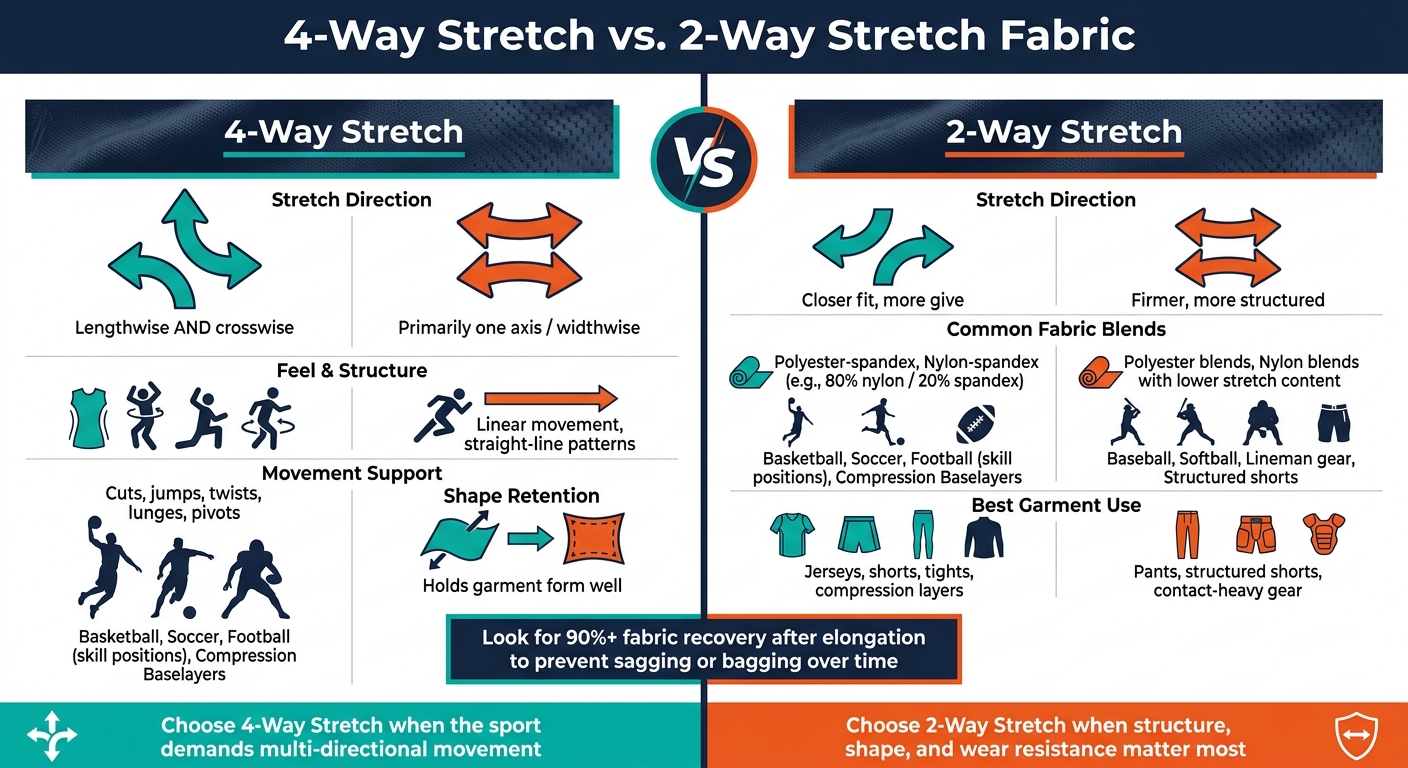
4-Way Stretch vs. 2-Way Stretch Fabric: Key Differences for Sports Uniforms
2-Way vs. 4-Way Stretch Fabric | Indie Source

sbb-itb-4d95ad3
Quick Comparison
| Point | 4-Way Stretch | 2-Way Stretch |
|---|---|---|
| Stretch direction | Lengthwise and crosswise | Usually one main axis |
| Feel | Closer fit, more give | Firmer, more structured |
| Movement | Better for cuts, jumps, twists, and lunges | Better for simpler movement patterns |
| Shape after wear | Good snap-back in strong blends | Holds garment form well |
| Best use | Jerseys, shorts, baselayers, compression gear | Pants, structured shorts, contact-heavy gear |
| Common fabric blends | Polyester-spandex, nylon-spandex | Polyester blends, nylon blends with lower stretch |
| Good sport matches | Basketball, soccer, football skill positions | Baseball, softball, some lineman gear |
My simple rule: if the sport asks the athlete to move in many directions, I’d lean toward 4-way stretch. If the garment needs to stay shaped and take more abuse, I’d lean toward 2-way stretch.
The rest of this article breaks down how that choice affects comfort, fit, wear, and sport-by-sport use. If you’re ready to start designing, you can get an instant quote for your team.
4-Way Stretch vs. 2-Way Stretch: How Each Fabric Works
4-Way Stretch Fabric
4-way stretch fabric moves in both directions: lengthwise and widthwise. That built-in give usually comes from a knit or weave made with polyester or nylon blended with elastane. The result is a fabric that stretches easily and snaps back into shape. The tradeoff is simple: you get more freedom to move, but less structure than you do with 2-way fabrics.
That’s why 4-way stretch is often used for game jerseys, shorts, tights, and compression layers. When an athlete needs fabric to move with the body in more than one direction, this type makes a lot of sense.
2-Way Stretch Fabric
2-way stretch fabric gives mostly across the body, while the length stays more firm. That one-direction stretch helps team uniforms keep their shape and look cleaner on the field or court.
And that’s the whole idea. If a garment needs to keep a set shape, like structured jerseys or shorts, this kind of fabric does that job well. It keeps its form, but it doesn’t handle deep, multi-direction movement as easily as 4-way stretch. Pull it across the body and it gives. Pull it lengthwise and it resists. You notice that difference pretty fast during play.
The split between the two is pretty straightforward: 4-way stretch leans toward motion, while 2-way stretch leans toward structure. That difference affects mobility, fit, and durability.
Key Differences: Mobility, Fit, Durability, and Game Use
Movement and Range of Motion
The biggest gap shows up once athletes start moving side to side, rotating, landing, and changing levels.
4-way stretch moves with the body in multiple directions. That means it can track with jumps, pivots, and lateral slides with less drag from the fabric itself. In a defensive stance or during a hard cut, the material moves with the athlete instead of pushing back.
2-way stretch works differently. Since it only gives in one direction, it can create a stiff one-direction pull when a player widens their stance, plants a foot to change direction, or drops into a deep lunge. When fabric pulls back on cuts, reaches, or lunges, movement feels slower and less comfortable.
Fit, Recovery, and Long-Term Wear
4-way stretch fabrics recover shape after repeated movement, which helps them keep a close, body-hugging fit without as much sagging or bunching during play. For athletes, that usually means the uniform stays put better through a game.
2-way stretch keeps its shape in another way. It feels more structured and less clingy, so it works well for garments that need a cleaner look and a more defined silhouette. The tradeoff is simple: it doesn’t rebound from multi-direction stress as well.
Durability and Structure by Garment Type
Here’s a quick side-by-side look at how the two fabrics compare for custom football uniforms and other team gear:
| Feature | 4-Way Stretch | 2-Way Stretch |
|---|---|---|
| Stretch Direction | Lengthwise, crosswise, and diagonal | Primarily widthwise (one axis) |
| Mobility | Multi-plane movement (pivoting, jumping, sliding) | Best for single-direction or linear movement |
| Fit & Recovery | Body-hugging; high rebound; less sagging | More structured; less clingy; stable shape |
| Structural Support | Flexible; follows body contours | Better shape retention; more structure |
| Durability | Resists pilling and tearing in quality blends | High wear resistance; easier to construct |
When structure and wear resistance matter most, 2-way stretch tends to hold up well because of its tighter, more stable build. 4-way stretch, especially in nylon-spandex blends, performs well in high-flex zones and resists pilling over time. That push and pull between flexibility and structure is what shapes which sports each fabric suits best.
Those differences matter most when a sport’s movement demands line up with the right fabric.
Which Stretch Type Works Best for Basketball, Soccer, Football, Baseball, and Softball?
The best stretch type usually comes down to how the sport moves. Sports built around sharp cuts, twisting, jumping, and full-body reach tend to work better with 4-way stretch. Sports or garments that deal with more straight-line movement, repeated contact, or sliding often do better with 2-way stretch.
Sports That Work Better with 4-Way Stretch
Basketball, soccer, and football wide receivers and defensive backs are the clearest fit for 4-way stretch. These sports ask athletes to move in every direction, often in a split second.
A basketball player drops into a defensive stance, shuffles side to side, then springs upward. A soccer midfielder in custom soccer jerseys changes direction at full speed and drives into deep strides. A wide receiver or defensive back cuts hard, twists, and reaches for the ball. In each case, fabric that stretches in just one direction can start to feel tight or limiting.
Compression baselayers across all sports also fit this group. They’re made to feel like a second skin, so stretch in more than one direction matters. For custom basketball jerseys and shorts, polyester-spandex or nylon-spandex blends work well because they offer strong stretch and recovery.
Sports with lower lateral and vertical demand usually need structure more than maximum give.
Sports and Garments That Work Better with 2-Way Stretch
Baseball and softball pants are the strongest example of where 2-way stretch makes more sense. These pants need to keep their shape, handle wear from turf or dirt, and bounce back cleanly after slides. That’s where 2-way stretch stands out. Its more stable build helps the garment keep structure during repeated contact.
| Sport / Garment | Recommended Stretch | Why It Fits |
|---|---|---|
| Basketball Jerseys & Shorts | 4-Way Stretch | Lateral slides, crossovers, vertical jumps |
| Soccer Kits | 4-Way Stretch | High-speed direction changes, deep leg extensions |
| Football skill positions | 4-Way Stretch | Sudden acceleration, deceleration, twisting |
| Baseball/Softball Pants | 2-Way Stretch | Durability for sliding, shape retention, structure |
| Compression Baselayers | 4-Way Stretch | Full-range muscle support without restriction |
Linemen also tend to do better with more structured fabrics. With repeated contact on every play, durability often matters more than maximum stretch. That balance between mobility and structure is what should guide your fabric choice for a custom uniform.
Once the sport is clear, the next step is matching the stretch type to the exact uniform you’re ordering.
How to Choose the Right Fabric for a Custom Team Uniform
What to Check Before You Order
Once you’ve matched the stretch type to the sport, take a close look at the fabric before you place the order.
Start with how the athletes need to move. Go with 4-way stretch when the sport involves motion in multiple directions. Pick 2-way stretch when you want more structure and a more controlled shape.
Check the fabric blend first. A common setup is polyester or nylon with elastane. An 80% nylon / 20% spandex blend is a common benchmark for high-elasticity gear. If you plan to use sublimation, polyester is usually the better pick because it delivers clean prints and dries fast.
Then test the fabric itself, both in your hands and on athletes. Pull the swatch side to side, then top to bottom. If it stretches and rebounds in both directions, you’re looking at 4-way stretch. If it gives in one direction but fights you in the other, it’s 2-way stretch. That simple check can tell you a lot.
But don’t stop there. Put sample pieces through live drills. This is where small problems show up fast: grabbing, ride-up, or movement that feels tight at the wrong moment.
After you check stretch and recovery, match the fabric to the playing conditions and the level of contact. For hot gyms or summer outdoor leagues, look for 4-way stretch body fabrics with mesh panels at the underarms or side seams. Mesh panels improve airflow in hot conditions. For rougher outdoor play, nylon-spandex usually holds up better against abrasion.
If money is tight, don’t spread high-stretch fabric across every inch of the uniform. Put it where it matters most:
- crotch gussets
- side panels
- underarms
That move can cut cost while still giving athletes better motion and sweat control where they need it most.
Conclusion: 4-Way Stretch for Mobility, 2-Way Stretch for Structure
Pick the fabric that fits both the movement of the sport and the wear the uniform needs to handle. Use 4-way stretch for mobility in game jerseys, shorts, and compression layers for sports built around cuts, jumps, and quick direction changes. Use 2-way stretch when structure, shape control, and wear resistance matter more.
High-quality stretch fabrics in either group should recover above 90% after elongation. In plain English, that means the fabric snaps back instead of turning baggy or losing shape over time.
FAQs
How can I tell if a fabric is 4-way or 2-way stretch?
Check how the fabric stretches when you put it under tension. 2-way stretch fabric extends in just one direction, either lengthwise or crosswise. 4-way stretch fabric, on the other hand, stretches both horizontally and vertically.
To test it, pull the fabric evenly in both the warp (lengthwise) and weft (crosswise) directions. If it gives along both axes, it’s 4-way stretch.
Is 4-way stretch always better for sports uniforms?
Not always. 4-way stretch works best for sports that demand free movement in every direction, like basketball, soccer, and gymnastics.
But that doesn’t mean it’s the top pick for every uniform. The right fabric also needs to fit the sport itself, including toughness for contact sports like football and the right level of breathability.
What fabric blend offers the best stretch and recovery?
Spandex (also called Lycra or elastane) is the go-to fabric for stretch and recovery. In athletic wear, blends usually hit the sweet spot.
Polyester-spandex blends offer flexibility, shape retention, and moisture control. Nylon-spandex blends are often picked for durability and abrasion resistance. For flexible, resilient custom uniforms, blends with 10% to 20% spandex are commonly preferred.