
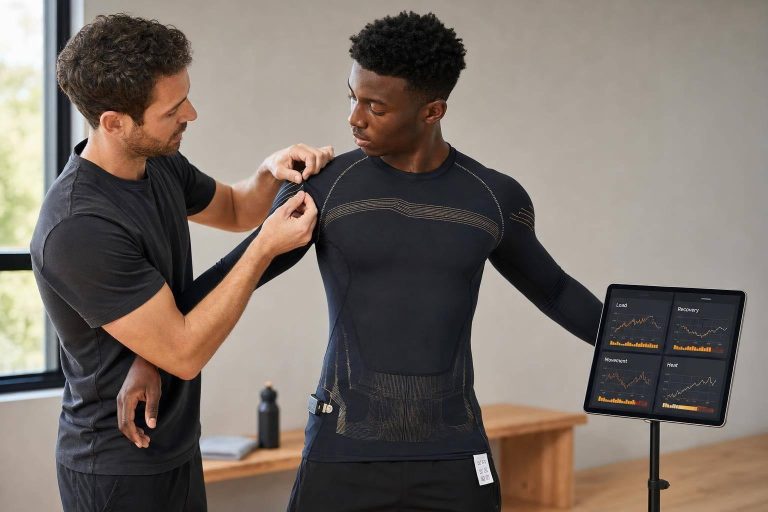
If I had to sum it up in one line: smart fabrics can help a team track load, recovery, movement, and heat stress through the clothing itself – but only if the fit, data process, and care routine are tight.
If you’re a coach, trainer, equipment manager, or team organizer, here’s the short version:
- Smart fabrics put sensors inside shirts, shorts, tights, or base layers
- They can track heart rate, breathing, skin temperature, sweat, motion, muscle activity, and impacts
- They work best for preseason baselines, practice load tracking, return-to-play checks, and selective game-day use
- The biggest issues are usually fit, placement, washing, battery upkeep, privacy rules, and cost
- For many teams, the best starting point is a small pilot, often in rehab or with high-minute players
This matters because the data is only useful when staff can act on it. A shirt that shows HRV drops, uneven landing force, or heavy collision volume can help shape practice, recovery, and return-to-play calls. But a loose garment, bad sensor contact, or poor laundry habits can make that same data noisy fast.
Here’s the simple breakdown I’d keep in mind:
- What it does: tracks internal load and external load in one garment
- What teams get: less extra gear, more steady readings during movement, and a way to compare players over time
- What teams need: snug fit, clear consent, one staff owner, clean upload steps, and steady garment care
- Where it helps most: conditioning, heat planning, rehab progress, and contact-load review
- What can go wrong: loose panels, damaged conductive areas, dead batteries, too much data, and unclear staff roles
Athletes Are Wearing These Magical Clothes Now #SmartFabrics
sbb-itb-4d95ad3
Quick Comparison
| Area | Smart Fabrics | Standard Wearables |
|---|---|---|
| Setup | Built into the garment | Added as separate devices |
| Comfort | Less gear on the body | Can shift or rub |
| Data during movement | Often more steady if fit is right | Can vary if straps move |
| Best team use | Base layers, rehab, practice load | Fast add-on use |
| Main drawback | Fit, washing, and upkeep matter more | Less uniform across athletes |
My takeaway: don’t treat smart fabric like just another uniform item. Treat it like a data tool that happens to be wearable. If you do that, you’ll have a much better shot at getting clean information your staff can use.
What These Sensors Measure and Why Teams Use Them
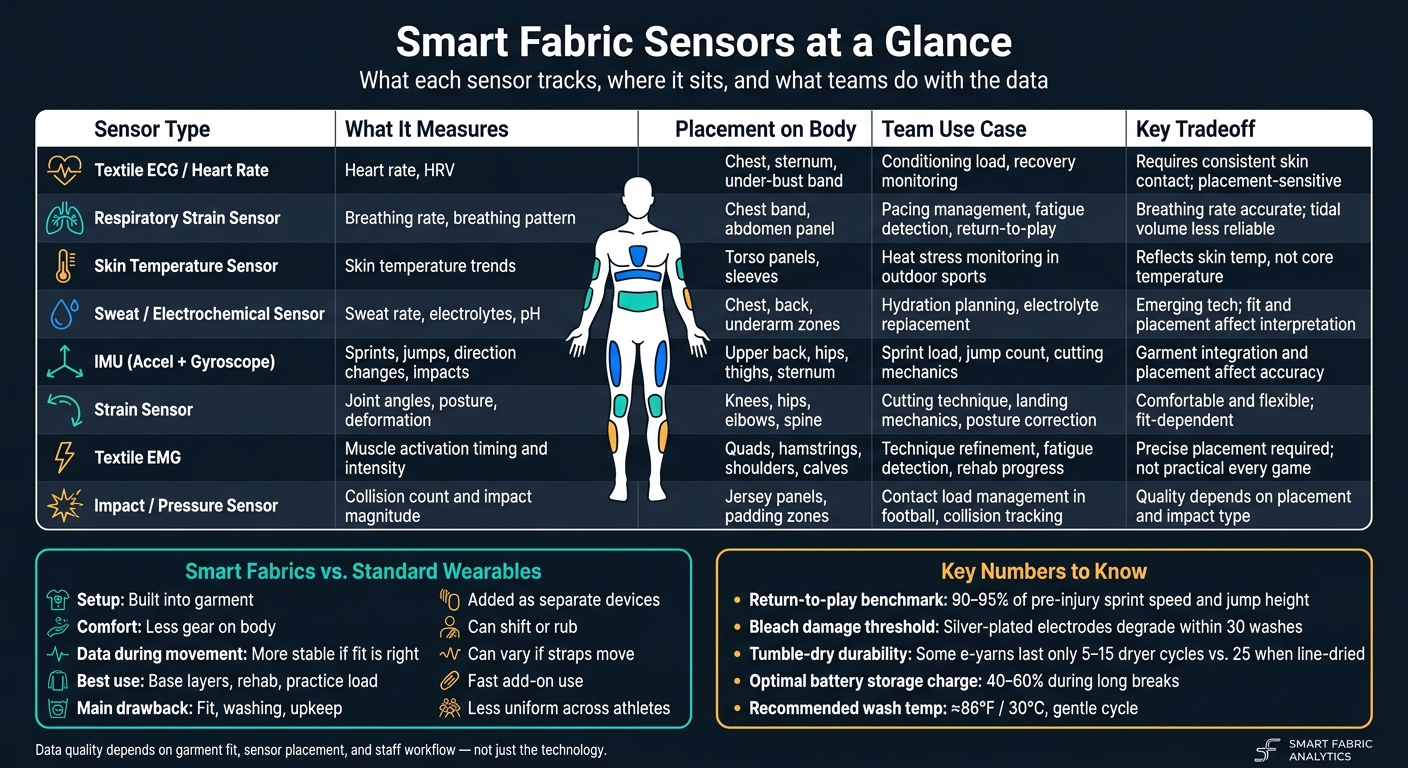
Smart Fabrics vs. Standard Wearables: Sensor Types, Metrics & Team Use Cases
These garments track two kinds of load: internal load and external load. Internal load is what the body is going through. External load is what the athlete is physically doing. Put those two together, and coaches plus athletic trainers get a much sharper read on practice and game demands. That helps with conditioning, workload, recovery, and injury-risk management.
Heart Rate, Breathing, Temperature, and Sweat Data
Teams use heart-rate data to watch conditioning and recovery. Textile ECG and heart-rate sensors rely on conductive fibers or textile electrodes built into compression shirts or vests to detect the heart’s electrical activity or pulse at the skin. From that signal, staff can track session average heart rate, peak heart rate, time in high-intensity zones, and heart-rate variability (HRV). Those numbers help coaches see whether practice intensity lines up with the plan.
If HRV drops while resting heart rate stays high for several days, that can point to fatigue or poor recovery building up. In plain English, the athlete may not be bouncing back well. Staff can then shorten practice, cut high-intensity intervals, or scale back strength work before that strain snowballs.
Breathing sensors add another layer. These are usually strain sensors or optical fiber sensors placed around the chest or abdomen, where they measure respiratory rate and breathing patterns by picking up how the torso expands and contracts. Paired textile sensors can improve breathing-rate accuracy. For a team, a sharp jump in breathing rate without a matching jump in movement load is a useful clue. It can mean the drill is hitting athletes harder than expected, so coaches may need to change intensity or tweak work-to-rest ratios.
Skin temperature sensors and sweat sensors round out the physiological side. Temperature sensors track skin temperature trends, which matter most in outdoor sports like football, soccer, baseball, and softball when conditions are warm. Sweat sensors use electrochemical or impedance-based sensing elements to measure sweat rate and electrolyte concentration. That can help spot athletes who lose more sodium and may need a more targeted electrolyte plan. In hot weather, these readings can guide hydration breaks, pacing, and recovery windows.
The same garments also collect movement and impact data.
Motion, Muscle Activity, and Impact Tracking
Teams use motion data to measure physical output across a session. An IMU (inertial measurement unit) combines an accelerometer, a gyroscope, and sometimes a magnetometer in a small module built into tights, shorts, or a shirt. The accelerometer measures linear acceleration. The gyroscope measures rotation speed. Together, they can track sprint count, peak acceleration, jump count, landing load, and direction changes.
Strain sensors are flexible sensors built right into the fabric. They change their electrical properties when stretched or bent, which makes them useful for tracking joint angles, posture, and cutting mechanics. Coaches can use that data to spot movement patterns that put more stress on joints. For example, a basketball trainer might use landing-load data to flag an athlete who keeps taking more force on one leg. That’s the kind of pattern that can hint at injury risk before anyone says, "Something feels off."
Textile EMG uses conductive textile electrodes placed over muscle groups like the quads, hamstrings, or shoulders to measure electrical activity during contractions. It shows which muscles are turning on, how hard they’re working, and for how long. Late in practice, a drop in hamstring activation can be a fatigue signal worth paying attention to. Textile EMG tends to work better in controlled drills than in live games, where keeping sensor fit consistent is tougher.
In contact sports, accelerometer-based impact sensors sewn into jersey panels or padding zones can record collision count and impact magnitude. In football, that lets programs track whether certain players are taking on impact volumes above team standards and compare exposure across practices and games.
Sensor Types, Placement, Metrics, and Tradeoffs: Comparison Table
| Sensor Type | What It Measures | Typical Placement | Team-Sport Use Case | Key Tradeoffs |
|---|---|---|---|---|
| Textile ECG / Heart Rate | Heart rate, HRV | Chest, sternum, under-bust band | Conditioning load, recovery monitoring | Good accuracy; requires skin contact; placement matters |
| Respiratory Strain Sensor | Breathing rate, breathing pattern | Chest band, abdomen panel | Pacing management, fatigue detection, return-to-play | Good rate accuracy; tidal volume is less reliable; placement-sensitive |
| Skin Temperature Sensor | Skin temperature trends | Torso panels, sleeves | Heat stress monitoring in outdoor sports | Reflects skin temperature, not core temperature |
| Sweat / Electrochemical Sensor | Sweat rate, electrolytes, pH | Chest, back, underarm zones | Hydration planning, electrolyte replacement | Emerging tech; interpretation depends on fit and placement |
| IMU (Accelerometer + Gyroscope) | Sprints, jumps, direction changes, impacts | Upper back, hips, thighs, sternum | Sprint load, jump count, cutting mechanics | Placement affects accuracy; garment integration matters |
| Strain Sensor | Joint angles, posture, deformation | Knees, hips, elbows, spine | Cutting technique, landing mechanics, posture correction | Flexible and comfortable; fit-dependent |
| Textile EMG | Muscle activation timing and intensity | Quads, hamstrings, shoulders, calves | Technique refinement, fatigue detection, rehab progress | Highly informative; requires precise placement; not practical every game |
| Impact / Pressure Sensor | Collision count and impact magnitude | Jersey panels, padding zones | Contact load management in football, collision tracking | Useful for safety protocols; measurement quality depends on placement and impact type |
In day-to-day use, the data is only as helpful as the garment fit, sensor placement, and the staff’s ability to make a call from it right away.
How Teams Can Use Smart Fabrics in Training, Games, and Uniform Planning
Once a team knows what the sensors track, the next step is simple: figure out when the data is worth using.
Smart garments only matter if they help answer a question staff can’t answer well on their own. That usually means using them at specific points in the athlete cycle: preseason, practice, game day, and rehab. The goal isn’t to add tech for the sake of it. It’s to get better information without messing up uniforms or slowing down the day-to-day routine.
Use Cases for Practices, Games, and Rehabilitation
Preseason is the best place to start. Teams can collect baseline data from standardized tests using sensor-enabled compression shirts or base layers. That baseline becomes the reference point for the rest of the season.
During regular practices, the data helps coaches adjust workload for each player instead of treating the whole roster the same way. In small-sided games and scrimmages, smart garments can measure high-speed efforts and direction changes, which helps staff match conditioning to the demands of each position.
Game-day use tends to be more selective. Instead of outfitting the full roster, teams often focus on starters, high-minute players, or athletes coming back from injury. After the game, that data can shape the next week’s work: pull back intensity for players with heavy minutes and add extra work for players who barely saw the field.
Rehab is often where these garments prove their worth fastest. Athletic trainers can use motion sensors in shorts or tights to track stride symmetry, deceleration forces, and jump landings during controlled drills. Then they can compare those numbers to pre-injury baselines. That gives staff something concrete to work from. For example, using return-to-play markers like 90% to 95% of pre-injury sprint speed and jump height with symmetrical impact forces gives the decision more structure instead of leaning only on how ready the athlete feels. A lot of U.S. programs with tighter budgets start here, especially for higher-risk injuries like ACL tears or hamstring strains, where the extra data can matter most.
Fit, Placement, and Data Workflow Requirements
Those gains depend on two things: clean fit and a repeatable process.
Sensor accuracy depends a lot on how the garment sits on the body. Most sensors need steady skin contact and very little fabric movement to produce usable signals. The fit should feel like compression wear: snug in the sensor areas, but not so tight that it limits breathing or range of motion.
Placement matters too. Teams should match sensor location to the movement they want to track:
- Torso for heart rate and breathing
- Hips and thighs for sprint mechanics
- Lower legs for foot strike
- Shoulders or upper back for contact and rotation
If a team works with a custom uniform provider like Wooter Apparel, it’s smart to plan this early. Jerseys and shorts should layer over smart base layers without seams, tight bands, or heat-trapping material sitting on top of sensor zones.
The data process also needs to stay simple and repeatable. A fixed workflow helps: consent, assignment, sensor check, capture, upload, staff review, and secure storage. Written consent should spell out what gets collected, who can see it, and how it will be stored. That matters even more for youth and college athletes, where team and school privacy rules come into play. Role-based access can keep health-risk alerts limited to medical staff, while coaches get short load summaries instead of raw data dumps. It also helps to assign one staff lead and use a standard checklist for setup and upload. Otherwise, data has a way of piling up and going nowhere.
Benefits vs. Implementation Challenges: Comparison Table
| Area | Benefit | Challenge |
|---|---|---|
| Monitoring | Continuous data without extra straps | Sensors require consistent skin contact; loose fit degrades signal quality |
| Training decisions | Individualized load management based on objective data | Large data volumes can overwhelm staff without clear workflows and assigned roles |
| Rehabilitation | Objective progression criteria using pre-injury baselines | Requires pre-injury data to be meaningful; limited value without a baseline |
| Game-day use | Real-time load and impact tracking for starters and returning players | Uniform regulations may limit visible electronics; selective deployment requires planning |
| Data management | Cloud dashboards and mobile apps make metrics accessible to coaches and medical staff | Requires role-based access controls, encrypted storage, and clear retention policies |
| Hardware | Sensors embedded in garments athletes already wear improve compliance | Batteries need regular charging; firmware updates and occasional calibration add upkeep |
| Cost | Phased rollouts and pilot programs allow budget-conscious entry | Upfront costs for garments, sensor modules, software subscriptions, and training are significant |
Care, Washing, and Long-Term Maintenance for Sensor-Enabled Apparel
Once a team starts depending on sensor data, garment care stops being a side task. It becomes part of performance management. Poor care can hurt both data quality and garment life.
The good news: the basics are simple. Remove electronics, wash cold, dry gently, and store everything only when it’s fully dry.
How to Wash and Dry Smart Garments Without Damaging Sensors
Always remove detachable electronics before washing. That includes battery packs, sensor hubs, recording devices, and snap-on modules. Store each item in a labeled, dry container so nothing gets mixed up or left damp.
Skip bleach. It can be rough on conductive textiles, and bleaching agents can damage silver-plated textile electrodes within 30 washes. Fabric softener is also a bad bet. It can leave residue behind, which gets in the way of conductivity and clean skin contact.
Turn garments inside out before washing to cut down on abrasion on conductive surfaces. If you’re using a top-loading machine – which is still common in many U.S. facilities – put your performance crew neck in a mesh laundry bag for extra protection.
For drying, air dry flat or on a hanger whenever you can. Dryers tend to do more damage than washing by itself. Research on e-yarns found that some copper-wire designs made it through 25 machine washes when line dried, but only 5 to 15 cycles when tumble-dried. If the manufacturer says low-heat drying is okay, keep the cycle short and stay away from high heat.
Only put modules and batteries back in after the garment is completely dry. That helps prevent corrosion and short circuits.
What to Inspect After Repeated Use
Sensor garments tend to wear out in familiar ways. Once you know the weak spots, checks get a lot easier.
The most common issues are loose or peeling conductive zones and stretched panels around the chest, waist, or thighs. Printed or woven circuits can start to crack or pull away from the fabric. Stretch in key areas can also shift sensor placement just enough to throw off signal quality. Check these spots weekly and after hard use.
Watch for residue buildup or discoloration around electrode areas too. Body oils and detergent deposits can increase skin impedance and lead to noisy data. Also inspect connectors closely. Bent snaps, frayed cables, and corroded ports can create reliability problems and safety concerns, especially in youth or school settings.
In many cases, failing sensors show up in the data before the damage is easy to see. Frequent dropouts, heart rate spikes that make no sense, or readings that swing all over the place from one session to the next often point to physical wear – not software trouble. Sensor sensitivity can drop after repeated washing.
A simple Pass / Monitor / Replace system during weekly reviews keeps the work under control. It also helps equipment staff decide what needs attention before a game or tournament.
Maintenance Checklist Table for Equipment Staff
Use the checklist below to keep care routines steady across staff and athletes.
| Frequency | Task |
|---|---|
| After each use | Power off and remove all detachable modules, hubs, and batteries; lay garments flat or hang to air dry – never store damp in a closed bag; wipe sensor modules dry with a soft cloth and check for cracks or corrosion around charging ports; ask athletes about discomfort, app alerts, or connectivity issues during use |
| Weekly | Cold wash (≈86°F / 30°C), gentle cycle, mild liquid detergent – no bleach or fabric softener; inspect conductive zones and seams under good lighting for micro-cracks or peeling; check elastic recovery – garments should still fit snugly at all sensor contact points; review data logs and flag units with dropouts or inconsistent readings; score each garment: Pass / Monitor / Replace |
| Monthly | Test battery performance and replace aging units that no longer hold a full charge; re-label garments and modules to keep size and ownership tracking accurate; audit inventory for heavily worn items and plan replacements before peak competition periods; update care documentation based on new manufacturer guidance or recurring failure patterns; log all reported issues with usage history and photos to support warranty claims if needed |
Store clean, fully dry garments in a cool, dry place – not in hot spots like car trunks. Fold them loosely or hang them instead of rolling them tight, since that puts extra stress on sensor zones and elastic bands over time. Keep detachable modules in padded, labeled containers away from metal objects, and store batteries at 40% to 60% charge during long breaks.
Smart Fabrics and Custom Uniform Design: Key Takeaways for Teams
Once a team decides to use sensor-enabled apparel, small uniform choices start to matter a lot more. Fabric choice, panel layout, seam placement, and fit all affect how the system performs. Smart fabrics don’t just sit on the body. They need to stay in contact with it, move with it, and keep working through repeated wear and washing. In plain terms, the fabric, seams, and fit are part of the data setup, not just the uniform.
Start with fabric. Smart garments tend to perform best in breathable 4-way stretch knits, usually polyester/spandex or polyamide/elastane. Why? Because those materials help keep sensors close to the body during hard movement. That steady stretch can also help teams get more stable readings when they’re tracking heart rate or respiration across a full practice.
Place seams away from sensor zones. Sensor areas should stay flat, smooth, and free of seams. Move seams toward the shoulders, side panels, or outer thighs, where they won’t press on a module or interfere with electrode contact. Flatlock or bonded seams are a better pick than standard overlock stitching around sensor regions because they cut down on bulk and chafing, especially when athletes wear the garments under pads or other gear. Warmups should layer over that base without shifting sensor contact.
Aim for semi-compression. The fit should be snug enough to keep sensor contact in place, but not so tight that it limits movement. For warmups and outer layers, slightly roomier cuts with stretch inserts at the shoulders and knees help them layer cleanly over the sensor base layer.
For custom jerseys, shorts, warmups, and base layers, Wooter Apparel can map panel layouts and seam configurations around sensor zones. Share sensor locations, the level of compression you want, and roster sizing by position so sublimation, seams, and reinforcements support both fit and data capture.
FAQs
How accurate are smart fabric sensors?
Smart fabric sensors can be very accurate for tracking athletic performance. Some biomechanical sensors record muscle activity with lab-level precision at 250 Hz. IMU motion sensors can hit 95% accuracy for gait and motion analysis. ECG electrodes reach 92% for heart rate monitoring, and hydration sensors come in at 88% for performance alerts.
That said, sports aren’t a calm lab setting. Hard workouts, sweat, and fast movement can throw some sensors off. Optical heart rate monitors, in particular, tend to be more affected, which can make their readings less reliable.
Which athletes should use smart garments first?
Teams should begin with athletes in high-risk positions or players who’ve dealt with injuries before. They’re the ones most likely to gain from real-time tracking of physiological strain, impact forces, and movement mechanics.
There’s another upside too. Starting with this group gives teams a clear way to judge data quality and see how players respond to the process before rolling it out to the rest of the roster.
How long do smart sensor garments last?
It depends on the part and how the garment is worn.
High-performance fabrics are made to keep 90% of their function through 50 wash cycles. Embedded NFC tags usually keep their data for at least 10 years, and some specialized chips can last up to 50 years.
Care matters, too. Washing in cold or warm water with a mild detergent can help protect the tech. If the garment has detachable wireless modules, taking them out before washing can also help it last longer.