
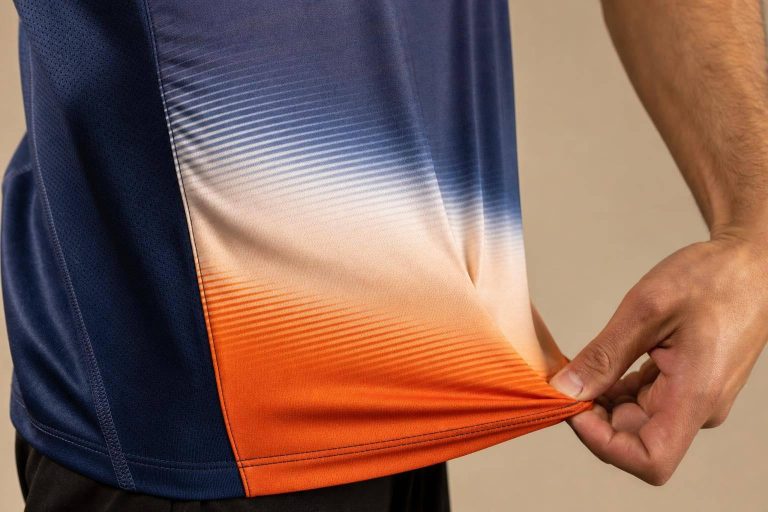
The short answer: I’d choose microfiber when I want a team uniform that feels light, dries fast, and prints well – but I’d still check GSM, knit, stretch, airflow, and reorder consistency before I buy.
A lot of uniform problems come down to fabric choice. If the fabric is too heavy, players feel hotter. If it traps sweat, it can cling and rub. If the knit is wrong for the sport, the jersey may wear out too fast. For most teams, the best path is simple:
- Pick lighter microfiber (about 120–150 GSM) for hot-weather and high-movement sports
- Use heavier fabric (about 180–220 GSM) for contact-heavy gear
- Choose mesh or open knits for more airflow
- Choose interlock or tighter knits for smoother printing and more structure
- Look for OMMC scores of 0.6+ and strong air-permeability numbers
- Test a sample for dry time, snagging, color hold, and fit after washing
- Save the exact specs so reorders match later
Microfiber often feels softer than standard polyester and can move sweat off the skin faster. But it can also snag more easily if the yarn is too fine or the knit is too open. That’s why I’d never pick based on feel alone.
Quick Comparison
| Fabric | Best For | Main Strength | Main Tradeoff |
|---|---|---|---|
| Microfiber | Game uniforms, sublimated teamwear | Light feel, fast dry, soft hand | Can pill or snag more easily |
| Standard polyester knit | General sportswear | Good wear life, solid print results | May feel less soft |
| Polyester mesh | Hot gyms, hot weather | More airflow | Less smooth surface |
| Nylon blends | Slide-heavy or abrasion-heavy gear | Stronger against friction | Often dries slower than polyester |
If I were ordering for a team, I’d treat microfiber as a performance option – not a catch-all fix. The right pick depends on sport, weather, fit, print method, and how often I expect to reorder.
What Microfiber Does in a Team Uniform
In most team uniforms, microfiber is polyester spun into much finer filaments. Those tiny fibers create more surface area and small channels that move sweat off the skin and spread it across the fabric, so it dries fast.
That’s why a microfiber jersey often feels lighter and more comfortable during play. And when athletes are running, cutting, jumping, or taking contact, that small shift in how a fabric handles sweat can make a big difference. The main gap shows up in three places: moisture, rubbing, and day-to-day wear.
Microfiber vs. Standard Polyester
Microfiber and standard polyester are both synthetic fabrics, but they don’t feel the same once you put them on. Standard polyester is durable and hydrophobic, which means it resists taking in water. The downside is that sweat can stay closer to the skin. Microfiber can wick sweat faster than standard polyester, which helps moisture evaporate sooner.
It also tends to feel softer and smoother. That matters at the shoulders, underarms, and waist, where stiffer jerseys can rub during constant movement. In sports like basketball or soccer, where players are always in motion and skin contact is common, that softer feel can be a big plus.
There is a tradeoff, though. Because the fibers are finer, microfiber can pill or snag more easily than coarser polyester.
Common Microfiber Constructions Used in Sportswear
Sportswear brands use a few common microfiber constructions: interlock knits, micro eyelet mesh or bird’s-eye mesh, and light double knits.
Interlock knit microfiber has a smooth, flat surface on both sides of the fabric. It tends to resist snags and gives sublimated logos a clean, even base.
Micro eyelet mesh or bird’s-eye mesh has a small open-hole pattern that lets air pass through the fabric more directly. That makes it a smart pick for hot, humid weather or high-intensity sports.
Light double knits have more structure than mesh but still allow good airflow. You’ll often see them in warmup jackets and practice tops.
Polyester microfiber also works well for sublimation because it holds color well. Each construction has its own strengths, depending on the sport, the weather, and the time of year.
sbb-itb-4d95ad3
Match Microfiber Specs to Your Sport, Climate, and Season
Choose Fabric Weight and Knit by Sport
Now that you know the main microfiber constructions, the next step is matching them to how the sport is actually played. GSM, knit, and stretch work together to shape how a uniform feels and performs.
Lightweight game jerseys usually fall in the 120–140 GSM range for soccer and flag football. Basketball and volleyball often land around 130–150 GSM, usually in an interlock or small-hole mesh knit. Practice tops tend to sit at 150–170 GSM, which gives you a solid middle ground between airflow and wear resistance. For contact sports like tackle football and lacrosse, 180–220 GSM gives the fabric more body so it can deal with grabs and friction better.
Knit matters too. Open knits help with heat, while tighter knits add structure and coverage. For baseball and softball, a tighter knit is usually the better fit, with jerseys around 150–170 GSM and pants around 180–220 GSM.
Adjust Fabric Choice for Heat, Humidity, Indoor Play, and Cooler Conditions
Climate should have a direct say in your fabric choice. If your team plays in hot, humid weather, go with 120–140 GSM open-knit microfiber and add mesh zones at the back and underarms. That setup helps cut down cling and helps the fabric dry faster.
Dry heat calls for a slightly different move. In that case, 130–150 GSM microfiber with strong moisture control usually works better. For indoor sports or cooler fall weather, a slightly heavier microfiber can give the uniform more body and shape while still handling sweat well. Indoor teams can usually wear mid-weight smooth interlock without much trouble, since gym climate control does a lot of the heavy lifting.
When Stretch and Blends Matter
Once you’ve narrowed down weight and knit, look at the cut. Does the garment need to move with the athlete, or can it stay more structured?
Polyester microfiber is a common pick because it moves sweat well, holds sublimated color, and keeps costs in check for game jerseys and standard-cut shorts in most sports.
Stretch blends matter more when athletes are sprinting, cutting, lunging, or diving. A blend of 92–97% polyester with 3–8% elastane adds four-way stretch, so the fabric moves with the body instead of fighting it. That’s a big deal for compression-style gear, women’s fitted cuts, and padded position pieces. Nylon-polyester microfiber blends can also add more abrasion resistance and a softer feel for sliding shorts, football pants, or training tights.
A blend makes the most sense when:
- The uniform has a fitted cut
- The sport involves a lot of explosive movement
- The player wears compression layers
With weight, knit, and stretch narrowed down, compare breathability and durability sample by sample.
Compare Breathability, Comfort, and Durability Before You Order
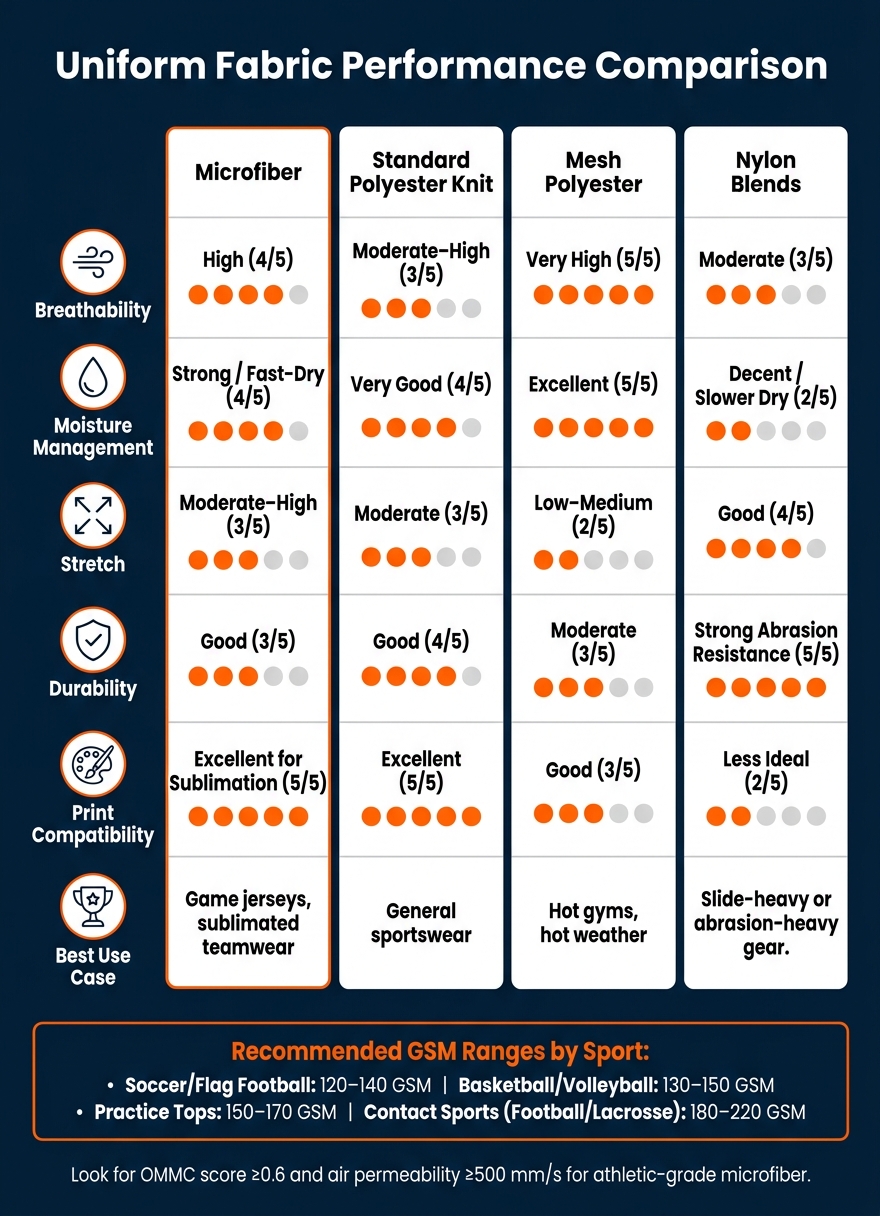
Microfiber vs. Other Uniform Fabrics: Performance Comparison Guide
Check Breathability and Moisture Management in Measurable Terms
Once you’ve settled on weight, knit, and stretch, it’s time to test how the fabric handles air, sweat, and repeat wear before you place an order. This part matters more than a lot of buyers think.
Breathability means air can move through the fabric. Moisture management means sweat moves off the skin and dries fast. Those are not the same thing. A fabric can do well in one area and fall short in the other, which is exactly how teams end up with uniforms that look fine on paper but feel rough in play.
When you review spec sheets, check for air permeability data and moisture-wicking treatments. For game-use fabrics, ventilation panels are often aimed at ≥150 cm³/cm²/s at 100 Pa, and knitted sports fabrics often fall in the 500–800 mm/s range. If you see values under 200 mm/s, that can be a red flag for athletic use. For moisture handling, a solid benchmark is an Overall Moisture Management Capacity (OMMC) score of 0.6 or higher.
If you can get a sample, do a few simple checks yourself.
- Hold the swatch over a vent or fan and feel how much air comes through.
- Put a small drop of water on the inside surface and watch what happens. Good wicking microfiber should pull moisture outward within seconds instead of letting it sit there in beads.
- Hang the damp swatch at room temperature and check it every 5–10 minutes to get a sense of dry time.
These quick tests give you a clearer picture of whether the spec sheet lines up with what you’ll get in the real world.
After that, move on to how the fabric handles repeated contact.
Balance Stretch, Snag Resistance, and Color Retention
Use the lowest stretch level that still gives players enough freedom to move. More elastane can help with flexibility, but tighter-knit microfiber with less stretch often holds up better against abrasion and shape loss in contact-heavy or slide-heavy sports.
Color hold is tied closely to construction too. Smoother, tighter knits usually give you cleaner, sharper graphics than open mesh. Before you order, wash a printed sample three to five times in warm water with regular detergent, then tumble dry it. If the colors stay in place and the edges still look crisp, that’s a good sign the fabric can handle a season of repeat washing.
Comparison Table: Microfiber vs. Other Common Uniform Fabrics
| Fabric | Breathability | Moisture Management | Stretch | Durability | Print Compatibility | Care Requirements |
|---|---|---|---|---|---|---|
| Microfiber | High when engineered as fine-filament or open-knit performance fabric | Strong wicking and fast-dry potential | Moderate to high depending on blend | Good, especially in polyester-based constructions | Strong for sublimation when polyester-based | Cold wash, mild detergent, no softener preferred |
| Standard polyester knit | Moderate to high; depends heavily on knit and panel design | Very good; commonly preferred for activewear | Moderate | Good shape retention and wash durability | Excellent for sublimation and team graphics | Low-heat or air-dry recommended |
| Mesh polyester | Very high because of open structure | Excellent for airflow and sweat evaporation | Usually low to medium unless blended | Good, but can be less snag-resistant than denser knits | Good for sublimation on polyester mesh | Similar polyester care; avoid harsh agitation |
| Nylon blends | Moderate; can trap more heat despite being lightweight | Decent, but typically slower to dry than polyester microfiber | Good mechanical stretch, but recovery varies | Strong abrasion resistance; may show wear under heavy friction | Less ideal for full sublimation | Cold wash; avoid high heat |
Use these tradeoffs to trim down your sample list before you place the full order.
How to Select the Right Microfiber for a Custom Team Order
A Simple Fabric Selection Checklist
Once you’ve narrowed down the fabric, put those specs into a clear order sheet. Before you approve anything, confirm the main details for the microfiber you picked: fiber content like 100% polyester microfiber or a polyester-spandex blend, GSM, knit type, stretch direction and percentage, performance finishes like moisture-wicking or antimicrobial treatments, and sublimation compatibility.
Then check that the fabric matches your decoration method. Sublimation works best on high-polyester fabric because the dye needs that surface to bond the right way. It’s also smart to record care instructions right next to the spec sheet. Keep everything in one shared order sheet before final approval. That way, you’re not guessing later when it’s time to reorder.
Plan for Sublimation, Reorders, and Team Branding
A good spec sheet doesn’t just help with the first order. It helps every reorder stay on track.
Fully sublimated microfiber places graphics right into the fabric, which helps keep artwork vivid without adding extra weight. But if you want reorders to stay consistent, fabric specs alone aren’t enough. Save your Pantone color codes, logo files with placement diagrams, font names, vendor product codes, and front, back, and side photos taken under normal lighting. Add notes about size charts and the fits your team chose, too.
When those details live in one place, future reorders are much easier to match.
Apply These Fabric Checks When Ordering From Wooter Apparel
Teams ordering custom basketball, football, baseball, softball, or soccer uniforms from Wooter Apparel can use this same checklist when choosing fully sublimated jerseys, shorts, warmups, and accessories.
Ask for the product specs and check them against your list. Then request swatches or sample garments before you commit to a full run. Use Wooter Apparel’s design support to confirm print placement and coverage. After the design is approved, save Wooter’s mockups, color references, and care notes with your internal spec sheet.
Use that same process for every new uniform run so fit, color, and performance stay in line.
Conclusion: Focus on Performance, Fit, and Order Consistency
Microfiber is a light synthetic fabric built for play. It pulls sweat away from the skin and stands up to heavy use. Compared with standard polyester or cotton, it moves moisture faster, which helps uniforms feel cooler and less sticky during hard practices and games. The right fabric weight and knit should match your sport, your climate, and the time of year.
Once you narrow down your fabric choice, put it to the test on the field or court. Have players wear samples through a full practice, then look for the stuff that shows up in actual use: heat buildup, clinginess, and chafing. After washing, check for shrinkage, fading, and any loss of softness. On paper, a fabric can look great. In use, it may tell a different story.
After testing, lock in the final spec sheet and get a quote and document the exact fabric and print specs. Sublimated microfiber uniforms can retain over 95% of their color after 50 repeat wash cycles, but that only holds if reorders use the same fabric and print specs. If that record is missing, even small shifts in fabric weight or construction can change fit, color, and on-field feel from one season to the next.
The best microfiber performs well, fits right, and stays consistent on every reorder.
FAQs
How do I know if microfiber is right for my sport?
Microfiber works well for sports that call for breathability, sweat control, and a light feel. It helps sweat dry fast, so your uniform stays drier and doesn’t feel as heavy during hard play.
It makes the most sense for fast-paced sports with lots of movement, or for games in hot weather, when staying cool, mobile, and locked in matters most.
What microfiber specs matter most before ordering?
Before you order custom team uniforms from Wooter Apparel, pay close attention to the microfiber details that affect how the gear feels and holds up on the field.
Focus on:
- Moisture management for strong wicking
- Fabric weight (GSM): 100–140 GSM for lightweight, high-intensity play; 180+ GSM for cooler conditions
- Knit structure, such as polar eyelet or interlock
- Durability through repeated washing, plus UPF for outdoor use
These specs can make a big difference. A jersey might look great at first glance, but if it traps sweat, feels too heavy, or starts wearing out after a few washes, you’ll notice fast.
How can I keep reorders consistent each season?
Choose high-quality, polyester-based microfiber that can handle season after season. With Wooter Apparel’s sublimation process, the dye bonds directly to the fabric, which helps logos and designs stay sharp without cracking or peeling.
Wooter Apparel’s on-demand production also makes it easier to match your exact reorder needs. For the best long-term results, wash uniforms in cold water and let them air dry.