
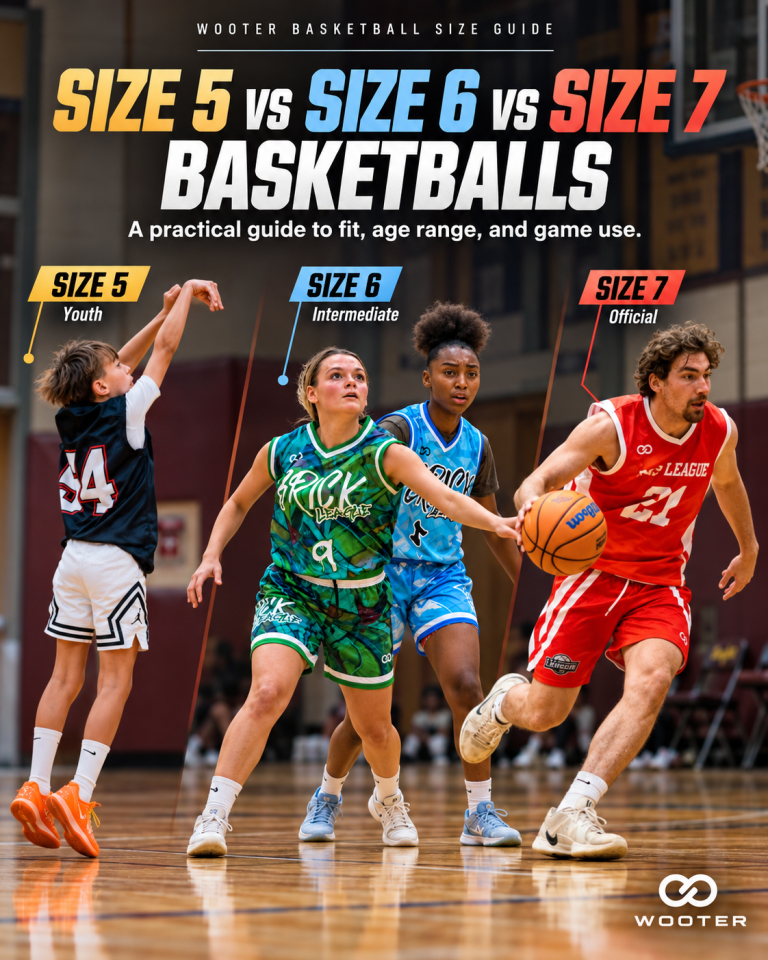
A basketball can be too big even when a player is strong enough to lift it.
That matters.
Give a young player a ball that is too large and clean shooting form becomes harder. Ball control gets tougher. Passing can feel awkward. The player starts fighting the equipment instead of learning the game.
The solution is simple: match the basketball size to the player.
As a quick U.S. youth guideline, ages 7 to 8 use Size 5, ages 9 to 11 use Size 6, and from ages 12 to 14, girls generally use Size 6 while boys move to Size 7. USA Basketball and the NBA recommend smaller basketballs for younger players because they better match hand size and developing skill levels.
Here is the full basketball size by age breakdown, including Size 5 vs Size 6 vs Size 7, youth recommendations, circumference, weight, and what parents and coaches should check before ordering.
Basketball Size Chart by Age
Need the quick answer? Start here.
| Player Age / Group | Basketball Size | Approx. Circumference | Typical Use |
|---|---|---|---|
| Ages 7 to 8 | Size 5 | 27.5 in | Boys and girls youth basketball |
| Ages 9 to 11 | Size 6 | 28.5 in | Boys and girls youth basketball |
| Girls ages 12 to 14 | Size 6 | 28.5 in | Girls youth basketball |
| Boys ages 12 to 14 | Size 7 | 29.5 in | Boys youth basketball |
| High school girls | Size 6 | 28.5 in | Girls basketball |
| High school boys | Size 7 | 29.5 in | Boys basketball |
These recommendations follow USA Basketball and NBA youth guidelines. The organizations recommend smaller balls for younger players because they are better suited to children’s hand size and developing skills.
Important: treat this basketball size chart as a starting point. Your league or tournament rules should always come first.
Ball Size Is Only One Part of Sizing a Basketball Team
Choosing a Size 5, 6, or 7 basketball solves one sizing problem.
It does not tell you what jersey or shorts size a player needs.
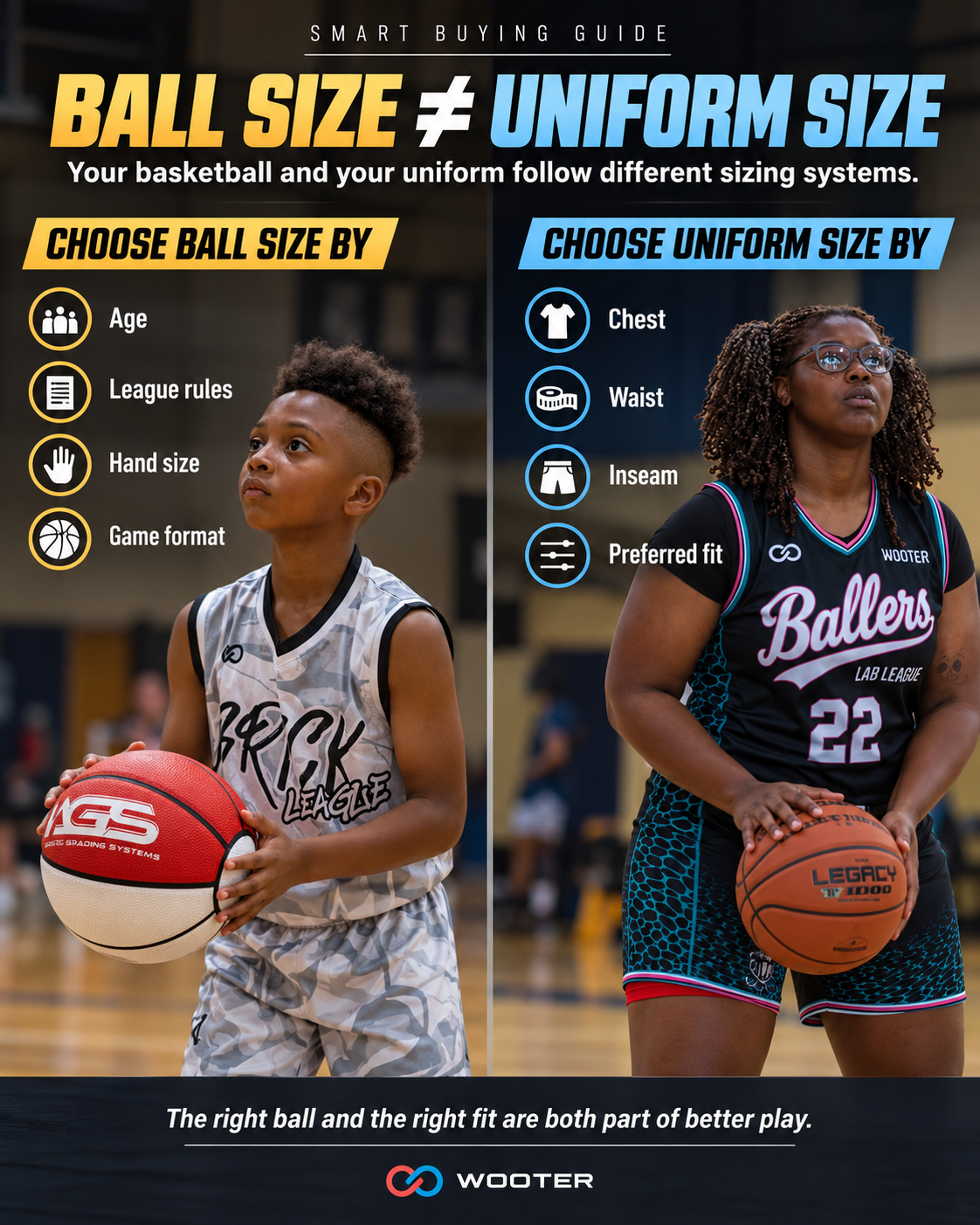
Basketball apparel should be sized separately. Jerseys depend mainly on upper-body measurements such as chest, shoulders, and length. Shorts rely more heavily on waist, hips, and inseam. The same player can need a different size top and bottom.
If you are sizing an entire roster, Wooter’s Jersey Sizing vs. Shorts Sizing guide explains how to check both pieces separately before placing the order.
Once those sizes are confirmed, Wooter’s custom basketball uniform package combines a matching jersey and shorts and supports youth, girls’, women’s, and men’s sizing.
Now, back to the ball.
Size 5 vs Size 6 vs Size 7 Basketball: Quick Comparison
The difference between basketball sizes can look small on paper.
Your hands notice it immediately.
| Ball Size | Circumference | FIBA Weight Range | Common Use |
|---|---|---|---|
| Size 5 | 685 to 700 mm | 465 to 495 g | Mini and younger youth basketball |
| Size 6 | 715 to 730 mm | 510 to 550 g | Girls, women, and some youth groups |
| Size 7 | 750 to 770 mm | 580 to 620 g | Older boys and men's basketball |
FIBA’s basketball equipment rules specify Size 7 for men’s competition, Size 6 for women’s competition, and Size 5 or lightweight Size 5 for mini basketball.
So the goal is not to buy the biggest basketball a player can physically handle.
It is to use the ball that fits their stage of play.
What Size Basketball Should a 10-Year-Old Use?
A 10-year-old generally uses a Size 6 basketball, which measures about 28.5 inches in circumference, under USA Basketball and NBA youth guidelines.
That recommendation applies to both boys and girls in the 9 to 11 age group.
Why not move straight to Size 7?
Because bigger is not automatically better for development.
USA Basketball specifically recommends smaller balls for younger players because they provide better control and are more appropriate for developing skills.
The equipment should help the player build good habits, not make every dribble and shot harder than it needs to be.
What Size Basketball Should a 12-Year-Old Use?
At age 12, the answer changes depending on the player group.
Under USA Basketball guidance:
12-year-old girls generally use Size 6, 28.5 inches.
12-year-old boys generally use Size 7, 29.5 inches.
That is why a search for “basketball size for 12 year old” can produce conflicting answers.
Age matters, but competition category matters too.
If the player competes for a school, club, recreational league, or tournament team, confirm that organization’s rules before buying balls for the season.
Size 5 Basketball: Who Is It For?
A Size 5 basketball is approximately 27.5 inches in circumference.
USA Basketball recommends Size 5 for boys and girls ages 7 to 8.
This is not simply a mini novelty basketball. It is a legitimate youth size designed to put a more manageable ball in younger hands while players build fundamentals such as dribbling, passing, catching, shooting, and ball control.
Wooter’s custom basketball lineup also includes Size 5 alongside Sizes 6 and 7, allowing youth programs to keep their team equipment consistent while choosing the right ball for the age group.
Size 6 Basketball: Who Is It For?
A Size 6 basketball measures about 28.5 inches in circumference.
USA Basketball recommends it for boys and girls ages 9 to 11. Girls continue with Size 6 from ages 12 to 14 and through the high school segment under its youth guidelines.
Size 6 is also not just a youth ball.
FIBA specifies Size 6 for women’s competition, with a circumference of 715 to 730 mm and weight of 510 to 550 grams.
So Size 6 sits at an important crossover point between youth development and regulation women’s basketball.
Size 7 Basketball: Who Is It For?
A Size 7 basketball is approximately 29.5 inches in circumference.
Under USA Basketball guidance, boys move to Size 7 at ages 12 to 14 and continue with it through the high school segment.
FIBA uses Size 7 for men’s competition. Its equipment rules specify a circumference of 750 to 770 mm and weight of 580 to 620 grams.
It is the largest of the three standard sizes in this guide.
That does not make Size 7 the “best” basketball.
It simply makes it the correct regulation size for specific player groups and competitions.
Size 6 vs Size 7 Basketball: What Actually Changes?
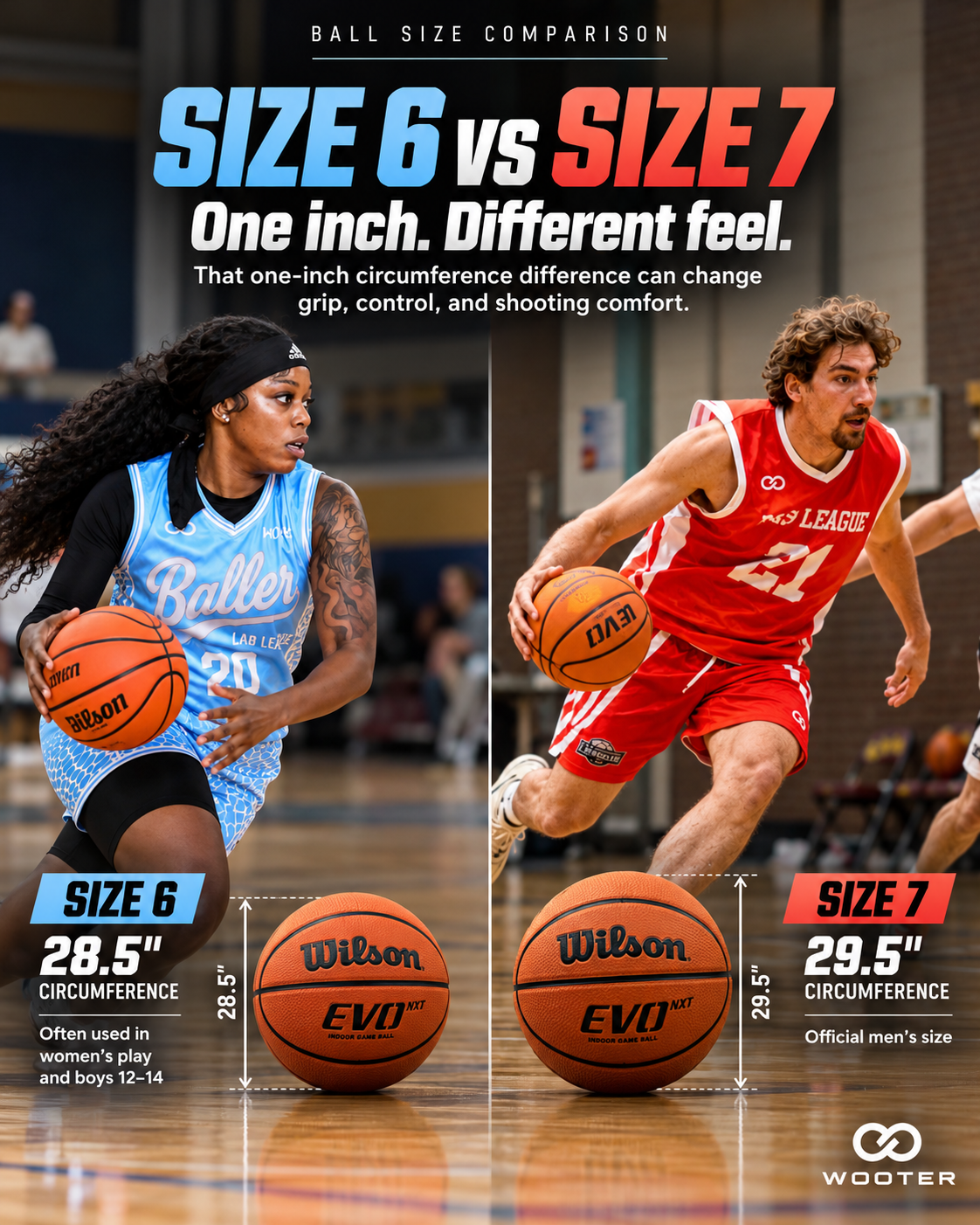
One inch of circumference does not sound dramatic.
Add the extra weight and larger surface area, and it becomes much easier to feel.
Size 6: smaller and lighter.
Size 7: larger and heavier.
Under FIBA specifications, Size 6 weighs 510 to 550 grams while Size 7 weighs 580 to 620 grams.
That difference matters most in younger hands.
A player should not move to a bigger basketball just because it seems more advanced.
Use the ball designed for the player’s competition and stage of development.
Sizing a Whole Team, Not Just the Ball?
Size 6 vs Size 7 Basketball: What Actually Changes?
One inch of circumference does not sound dramatic.
Add the extra weight and larger surface area, and it becomes much easier to feel.
Size 6: smaller and lighter.
Size 7: larger and heavier.
Under FIBA specifications, Size 6 weighs 510 to 550 grams while Size 7 weighs 580 to 620 grams.
That difference matters most in younger hands.
A player should not move to a bigger basketball just because it seems more advanced.
Use the ball designed for the player’s competition and stage of development.
Size 5 vs Size 6 Basketball: When Should Players Move Up?
USA Basketball recommends Size 5 at ages 7 to 8, followed by Size 6 for both boys and girls at ages 9 to 11.
That progression lets the equipment grow with the player.
There is no prize for moving up early.
If the league still uses Size 5, practicing exclusively with a larger ball can also create a mismatch between training and game conditions.
Match the practice ball to the competition whenever possible.
What Size Basketball Is Used in 3x3?
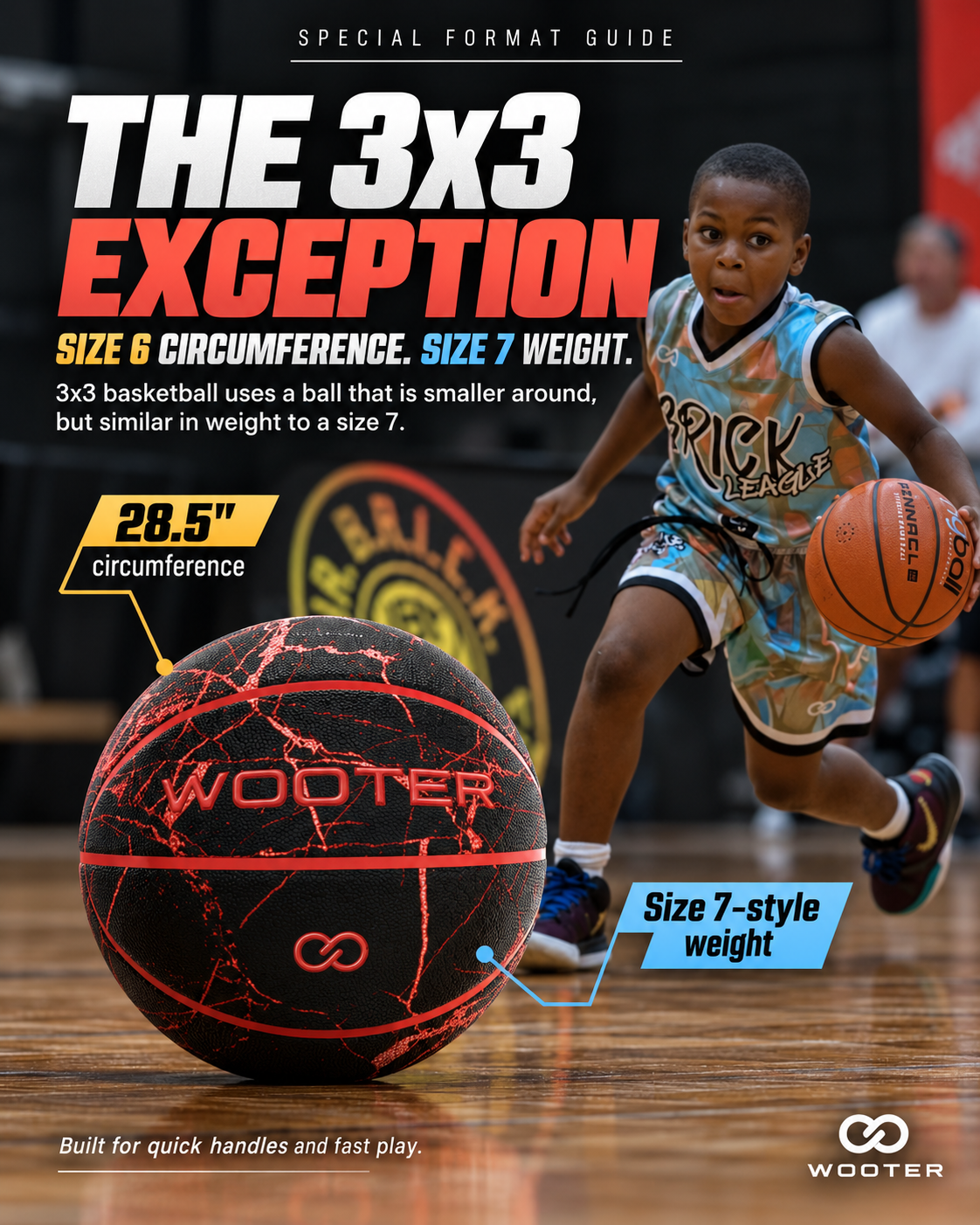
3×3 basketball is the exception worth knowing.
The official FIBA 3×3 basketball uses a Size 6 circumference with the weight of a Size 7 basketball.
USA Basketball’s current 3×3 guidelines also use that standard for older play while recommending age-appropriate modifications for younger players.
So if your program plays both traditional 5-on-5 basketball and 3×3, do not assume the ball requirements are identical.
Check the format first.
Why the Right Youth Basketball Size Matters
Young players already have enough to think about.
Footwork. Balance. Eyes up. Elbow position. Passing angles. Defensive stance.
Basketball should not become another problem.
USA Basketball says smaller balls are recommended for younger players because they better match children’s hand size and developing skill level, allowing greater control and success.
The principle is simple:
Match the equipment to the player first. Then build the skill.
How to Choose Basketball Sizes for a Team
Ordering for one player is easy.
Ordering for an entire program requires a system.
- Check the league rules.
Confirm the required basketball size before ordering. - Separate your age groups.
A youth club serving several divisions may need more than one ball size. - Check boys’ and girls’ standards where applicable.
The standard recommendation separates from age 12 onward. - Match practice balls to game balls.
Players should not spend every training session adapting to a different ball size from the one used in competition. - Size the uniform separately.
Do not assume a player’s age determines their jersey and shorts size. Use actual garment measurements. - Test uncertain apparel sizes before ordering for the roster.
Wooter offers basketball shorts sizing kits that allow teams to check fit before committing to the full order. - Check shorts length as well as waist size.
Two correctly sized pairs can still feel completely different if their inseams are different. For that decision, see 5-Inch vs 7-Inch vs 9-Inch Basketball Shorts guide.
That creates one sizing process for the whole team instead of treating the ball, jersey, and shorts as unrelated decisions.
FAQs About Basketball Sizes
What basketball size should I use?
Basketball size depends on age, competition category, and league rules. USA Basketball recommends Size 5 for ages 7 to 8, Size 6 for boys and girls ages 9 to 11, then Size 6 for girls and Size 7 for boys from ages 12 to 14 and through high school.
What size basketball does a 10-year-old use?
A 10-year-old generally uses a Size 6 basketball, 28.5 inches, under USA Basketball youth guidelines.
What size basketball does a 12-year-old use?
Is Size 6 or Size 7 the official basketball size?
What age uses a Size 5 basketball?
USA Basketball recommends Size 5, approximately 27.5 inches, for boys and girls ages 7 to 8.
Is a Size 7 basketball too big for a child?
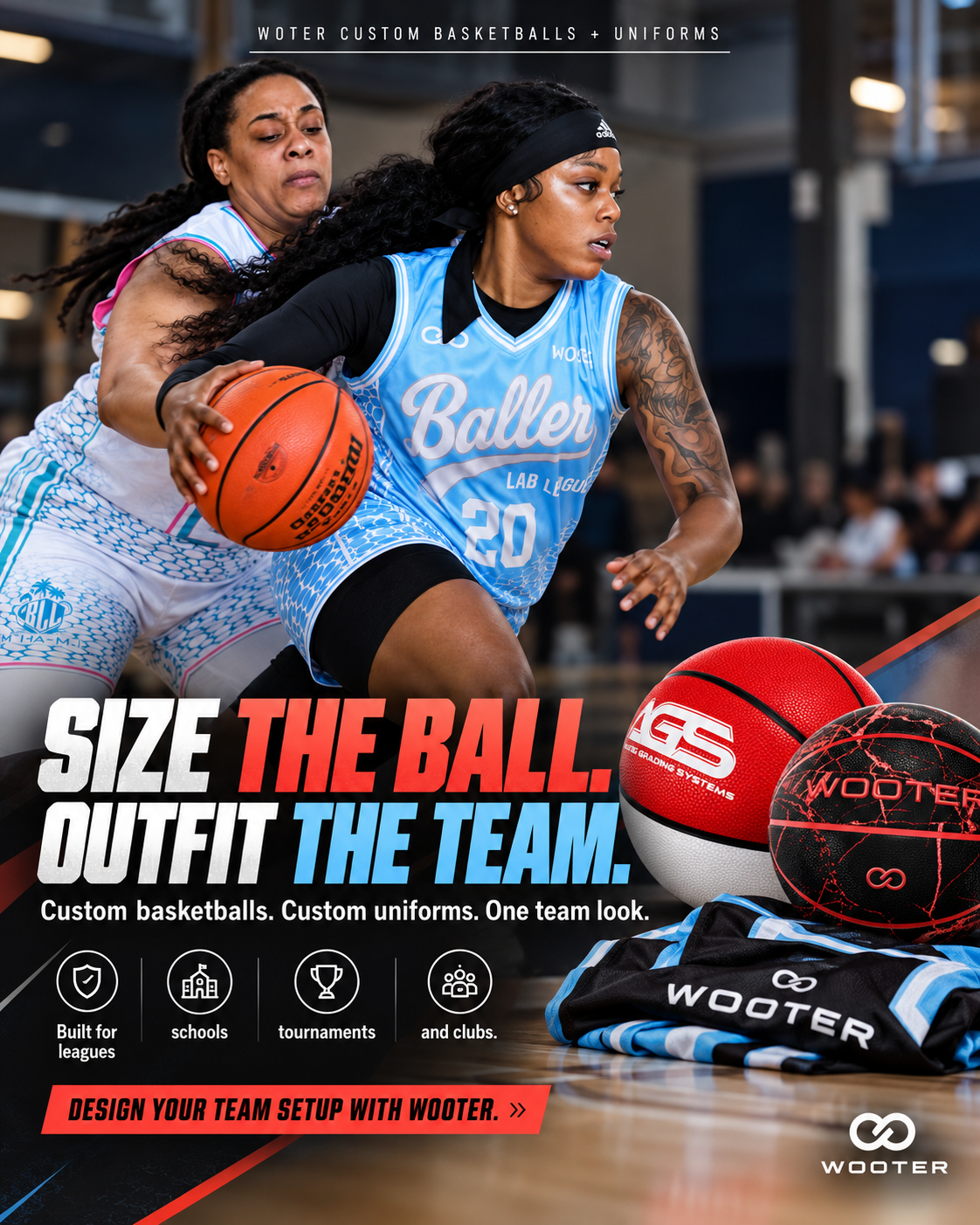
Got the Ball Size? Now Outfit the Team.
Basketball development is built on repetition.
Dribble after dribble. Pass after pass. Shot after shot.
The right ball gives players equipment suited to their stage of play.
The right uniform should do the same for the roster.
Once you know which Size 5, 6, or 7 basketball your program needs, complete the team setup with properly fitted jerseys and shorts, consistent colors, logos, names, and numbers.
Wooter’s Custom Basketball Uniform Package combines the jersey and matching shorts into one coordinated team design.
And if your program also needs branded equipment, Wooter offers both Custom Game Basketballs and Fully Custom Game Basketballs in multiple sizes.