
Finding the right baseball jersey fit is about more than just appearance – it directly impacts performance, comfort, and team unity. Here’s a quick breakdown of what you need to know:
- Fit Types: Choose between loose athletic fit (relaxed for layering), performance fit (slim for agility), or pro fit (tailored for precision).
- Measurements: Use a flexible tape measure to record chest, waist, and, for women, hip sizes. Account for layering by adding an inch if needed.
- Sizing Tips: Check whether size charts reflect body or garment dimensions. When in doubt, size up for comfort or layering.
- Material: Polyester is the go-to for moisture-wicking and durability. For hot weather, mesh options improve airflow.
- Position-Specific Needs: Pitchers benefit from extra shoulder room, while catchers need space for protective gear.
For custom jerseys, accurate measurements are critical since returns aren’t typically an option. Brands like Wooter Apparel offer sizing kits and detailed charts to ensure a proper fit. Whether you’re a youth player or in an adult league, the right jersey can boost both performance and confidence.
What Size Baseball Jersey Should I Get? – The Baseball Xpert
How to Measure for the Right Fit
Getting the perfect jersey fit starts with accurate measurements. A flexible tape measure is your best tool for this. If possible, enlist someone to help for more precise results. The tape should rest snugly against your body – neither too tight nor too loose. These measurements will guide you in selecting the ideal size using the tips below.
Key Measurements to Take
Start with your chest or bust. Measure around the widest part of your chest. For your waist, wrap the tape around the narrowest section of your torso – usually where your body naturally bends when you lean side to side. If you’re using a women’s size chart, you’ll also need to measure your hips at the fullest part. Record all measurements in inches for consistency. Keep in mind that actual garment dimensions may vary by about ±5% due to manufacturing tolerances.
If you already own a jersey that fits well, use those dimensions as a reference. Compare them to size charts that list garment measurements instead of body measurements.
Accounting for Layering and Fit Preferences
Planning to wear an undershirt or compression gear under your jersey? Take your measurements while wearing those layers, or add about an inch to your chest measurement. This ensures the jersey won’t feel restrictive, especially if you’re adding padding or playing in colder conditions.
If your measurements fall between two sizes, it’s generally better to size up when layering is involved. Stretchy fabrics can accommodate extra bulk, and sizing up prevents the jersey from feeling overly snug during play .
How to Use Size Charts
Size charts can vary – they might reflect body measurements or the dimensions of the finished garment. Wooter Apparel, for example, provides the exact measurements of their finished jerseys. As they explain:
"Most of our sizing charts give the exact measurements of our custom uniforms and apparel – not the measurements of the player".
When choosing a size, match your measurements to the specific chart for the jersey type you’re ordering. Categories like Authentic, Replica, Youth, Women’s, and Men’s jerseys all have different dimensions. If you like a looser fit, stick with your measured size. For a more fitted, performance-driven look, modern fabrics often allow you to size down.
One note: Wooter Apparel jerseys tend to run slightly larger than average. For example, players who usually wear an XL might find that a Large offers a more athletic fit. By following these steps, you can confidently navigate size charts and pick a jersey style that suits your needs on and off the field.
Baseball Jersey Fit Styles Explained
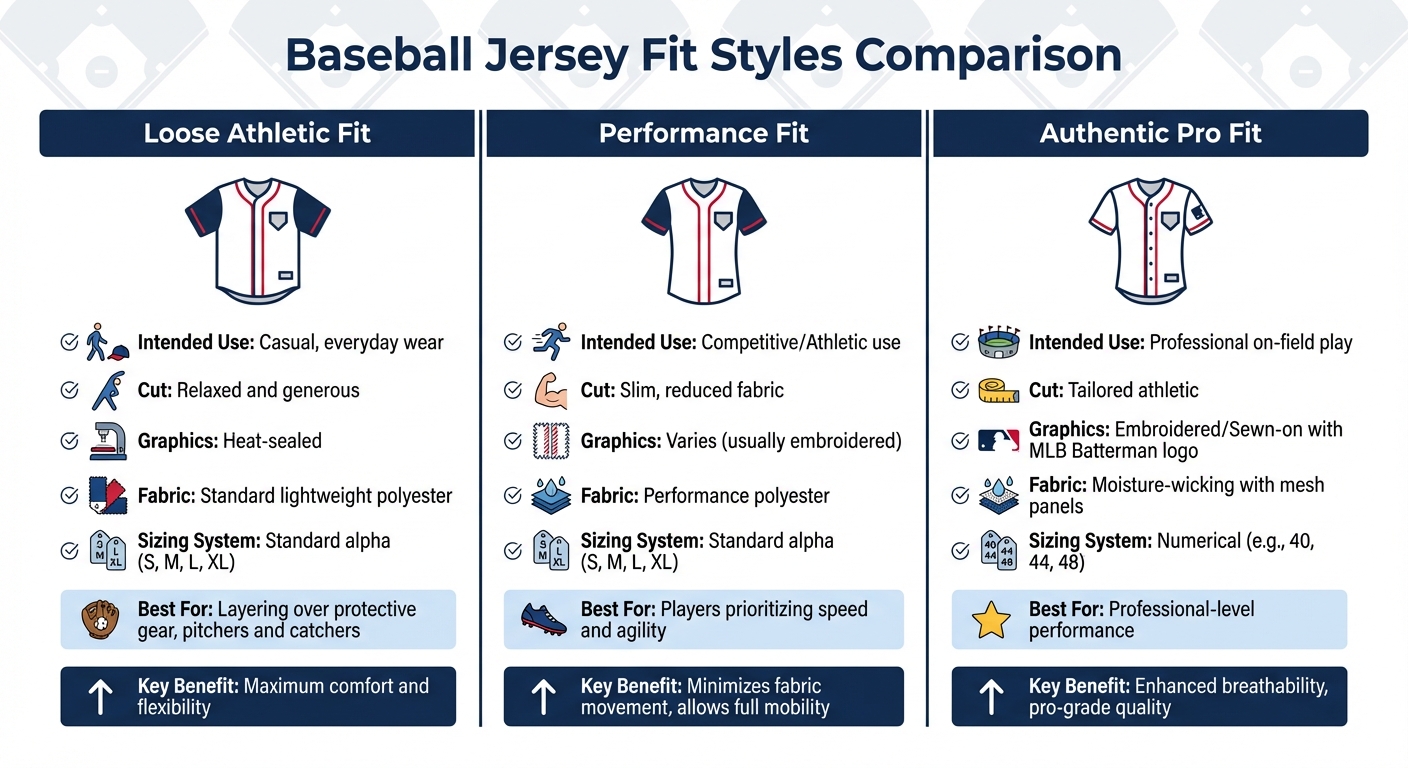
Baseball Jersey Fit Styles Comparison Chart
Baseball jerseys are available in three distinct fit styles, each designed to cater to different needs for performance and comfort. Choosing the right fit can make a big difference in how you feel and perform on the field. Here’s a closer look at the options:
Loose Athletic Fit is all about comfort and flexibility. This relaxed style is perfect for layering over protective gear, thanks to its roomy cut. It offers plenty of space for arm movement and equipment like chest protectors, making it a favorite among pitchers and catchers. These jerseys generally come in standard alpha sizes (S, M, L, XL) and often feature heat-sealed graphics instead of embroidered details.
Performance Fit is designed for players who prioritize speed and agility. With a slim, athletic profile, this fit minimizes fabric movement while keeping you cool during intense gameplay. It allows for full mobility, making it ideal for competitive players. If you’re between sizes, the performance fabric’s stretchiness often lets you size down without losing comfort or range of motion.
Authentic Pro Fit mimics the jerseys worn by professionals. These are tailored for a close, athletic fit and are built with moisture-wicking fabric and mesh panels for enhanced breathability. Authentic jerseys stand out with embroidered graphics, team patches, and the official MLB Batterman logo. They use a numerical sizing system (e.g., 40, 44, 48) for a more precise fit.
| Feature | Authentic Pro Fit | Performance Fit | Loose Athletic Fit |
|---|---|---|---|
| Intended Use | Professional on-field play | Competitive/Athletic use | Casual, everyday wear |
| Cut | Tailored athletic | Slim, reduced fabric | Relaxed and generous |
| Graphics | Embroidered/Sewn-on | Varies (usually embroidered) | Heat-sealed |
| Fabric | Moisture-wicking with mesh | Performance polyester | Standard lightweight polyester |
| Sizing System | Numerical (e.g., 40, 44, 48) | Standard alpha (S, M, L, XL) | Standard alpha (S, M, L, XL) |
sbb-itb-4d95ad3
Choosing the Right Size and Material
Sizing for Different Age Groups and Genders
When selecting jersey sizes, it’s important to factor in age and gender. Youth jerseys typically range from XS to XL, while older teens transitioning to adult sizes may need extra attention to chest width and body length measurements to find the right fit.
For men’s sizing, chest and waist measurements are key. An adult small generally fits chest sizes of 34-36 inches, while a 2XL accommodates 50-52 inches. Women’s jerseys, on the other hand, are tailored with bust, waist, and hip measurements in mind. For instance, a women’s medium fits a bust of 36.5-37.5 inches, a waist of 29.5-30.5 inches, and hips measuring 39.5-40.5 inches. These gender-specific designs provide a more precise fit than unisex jerseys.
Material Selection for Comfort and Performance
The choice of material greatly impacts both comfort and performance. Polyester stands out for being lightweight, moisture-wicking, and resistant to shrinking. For added durability, double-knit polyester is ideal, especially for players who frequently slide, though it may compromise breathability. On the other hand, mesh fabrics like Polymesh are perfect for hot weather, offering excellent airflow. To preserve the material’s quality, wash jerseys in cold water on a gentle cycle and air dry them.
Once you’ve decided on the material, think about how fit preferences can vary by position. Custom baseball jerseys from Wooter Apparel are designed to align with these material and fit considerations.
Fit Considerations by Position
Different positions on the field call for specific fits. Pitchers require a slightly looser fit, especially around the shoulders and chest, to allow for a full range of motion during their throwing delivery. This extra room ensures that their movements aren’t restricted by the fabric.
For catchers, a looser fit is essential to accommodate protective gear and any additional layers, like undershirts. When taking measurements for catchers – or any position – wear the gear or compression clothing you’ll use during games to ensure accurate sizing. Across all positions, sleeve length should stop just above the elbow to maintain freedom of movement for throwing and batting.
Custom Baseball Jerseys: Getting the Right Fit
Why Accurate Measurements Matter
When it comes to ordering custom baseball jerseys, nailing the measurements on the first try is essential. Unlike store-bought options, custom uniforms are tailored specifically for your team, meaning returns or exchanges aren’t an option if the sizing is off. It’s wise to allow for a small margin to account for manufacturing tolerances.
Sizing charts can be tricky if you’re not familiar with how they work. Most of them reflect the dimensions of the finished jersey – not your body measurements. To ensure the best fit, grab a jersey you already own that fits well, lay it flat, and take measurements. Then, match those numbers to the sizing chart provided by the manufacturer.
Wooter Apparel, a trusted name in custom sportswear, boasts a 4.9-star rating from 1,239 reviews and an impressive 5.0-star rating for baseball uniforms based on 94 reviews. Customers often highlight the "true to fit" sizing and the quality of the moisture-wicking fabrics.
Customization Options for Fit
Once you’ve got the measurements down, it’s time to explore customization options that can fine-tune the fit to suit your team’s preferences. Wooter Apparel offers various jersey styles, including full-button, 2-button, V-neck, crew neck, and sleeveless designs. Each style impacts how the jersey feels and moves, with features like raglan sleeves providing better arm mobility.
The sublimation process used for creating these jerseys ensures every seam, armhole, and neckline is crafted with precision for a comfortable fit. Made from 100% breathable polyester – like the durable 260gsm interlock fabric – the jerseys offer flexibility with a slight stretch. To avoid any sizing mishaps, you can order a physical sizing kit for $125.00 to test out sizes and styles before committing to a full team order.
When to Size Up
Sometimes, going up a size makes more sense depending on your preferences. If you like a relaxed, looser fit instead of a snug, performance-oriented look, ordering a size up is a smart move.
"In general, our uniforms run a bit bigger than average. We don’t usually have any complaints with our sizing, so if you are a Large, you should be fine with ordering a Large." – Wooter Apparel
For players who fall at the upper end of a size range, sizing up can prevent a too-tight fit. For instance, if you’re 5’6", which is the maximum height for a Small (5’4"–5’6"), you might prefer the added length of a Medium (5’6"–5’8"). Thanks to the fabric’s slight stretch, players between sizes often find the smaller size works well. However, if you’re not a fan of a fitted look, sticking to your usual size or going up one is the safer choice.
Conclusion
Wearing a well-fitted baseball jersey isn’t just about looking good – it’s about feeling confident and performing at your best. A jersey that allows for full, unrestricted movement can make a real difference on the field.
Getting the right fit starts with accurate measurements. Double-checking your jersey’s dimensions against the size chart can save you from making costly mistakes, especially when ordering custom gear.
Equally important is the choice of material. Opting for high-quality, moisture-wicking polyester with a bit of stretch ensures the jersey stays breathable and comfortable, even during intense games.
Don’t overlook position-specific needs. For example, catchers may need extra room to accommodate protective gear, while pitchers benefit from jerseys that allow maximum arm mobility. These small adjustments can make a big impact, ensuring every player’s uniform balances style with function.
For teams seeking professional-grade uniforms that combine performance and affordability, Wooter Apparel offers a winning solution.
FAQs
How can I choose the best-fitting baseball jersey for my position?
Finding the right baseball jersey fit isn’t just about style – it’s about functionality for your position on the field. Pitchers often need jerseys with a looser fit around the chest and shoulders to ensure their arm movements aren’t restricted. Catchers, on the other hand, require a more relaxed fit at the waist to comfortably accommodate their gear. For infielders, a slim, tapered fit works best, as it stays close to the body, allowing for quick pivots and throws. Meanwhile, outfielders and designated hitters might prefer jerseys with slightly longer sleeves for added sun protection, paired with breathable, moisture-wicking fabrics to stay cool during those intense sprints.
To ensure the perfect fit, take precise measurements of the player’s chest, waist, shoulder width, and sleeve length using a flexible tape measure. Compare these numbers to Wooter Apparel’s size chart, which offers fit styles tailored for different positions. For even greater precision, Wooter provides a sizing kit to help you nail down the right size. Made with moisture-wicking polyester blends, these jerseys are designed to keep players comfortable and performing at their best while looking sharp on game day.
What measurements do I need for a custom baseball jersey?
To get the perfect fit for your custom baseball jersey, focus on four essential measurements: chest, waist, sleeve length, and shoulder width. These measurements ensure your jersey feels comfortable and performs well while you’re on the field.
For the best accuracy, use a soft measuring tape and measure over light clothing or undergarments. This approach helps you achieve a fit that’s just right – not too snug, not too loose – so you can stay focused on your game.
Why is polyester the best material for baseball jerseys?
Polyester is the top choice for baseball jerseys, and it’s easy to see why. This material is both durable and lightweight, making it ideal for the demands of intense games. Plus, it’s moisture-wicking, which means it pulls sweat away from the body, helping players stay cool and dry when the action heats up.
Another big advantage? Polyester resists both odors and fading, making it a solid option for long-term use. Its smooth texture also works beautifully with sublimated designs, ensuring bold, vibrant colors that stay intact without peeling or cracking. For a mix of performance and style, polyester hits it out of the park.