
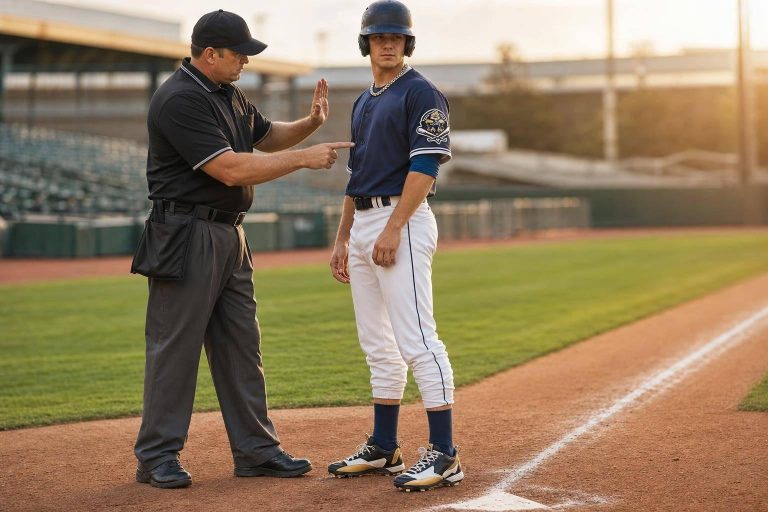
A player can be kept out of a game for a uniform mistake. In most cases, the problem is one of five things: undershirts and sleeves, logos and patches, team colors and numbers, accessories, or pants and footwear.
If I wanted the short version, it would be this:
- Match visible undershirts and sleeves
- Keep logos and patches within league limits
- Make sure numbers are the right size and not duplicated
- Remove distracting arm gear, especially for pitchers
- Check pants length, socks, and cleat type before first pitch
A few rule points stand out right away:
- NFHS back numbers must be at least 8 inches
- NCAA and pro rules allow 6-inch back numbers
- NFHS limits manufacturer logos to 2.25 square inches
- Memorial patches under NFHS cannot be more than 4 square inches
- Two players on the same team cannot wear the same number
Pitchers need the closest look. White or gray exposed sleeves can be a problem, and arm items that distract the batter can lead to a fix-it order from the umpire.
The Players Weekend Uniform Violated MLB Rules
sbb-itb-4d95ad3
Quick Comparison
| Violation area | Common problem | Main risk |
|---|---|---|
| Undershirts and sleeves | Mismatched color, frayed sleeves, white/gray on pitchers | Player may have to change before playing |
| Logos and patches | Logo too big, patch not approved, reflective trim | Uniform can be ruled illegal |
| Colors and numbers | Wrong number size, duplicate numbers, mismatched jerseys | Player may be held out |
| Accessories | Distracting wristbands, jewelry, illegal sleeve color | Umpire can order removal |
| Pants and footwear | Pants at the knee, bad spikes, mismatched socks | Player may not enter until fixed |
The main point is simple: most uniform issues are easy to catch before game time if I check the roster, sleeves, logos, numbers, and lower-body gear in one last team review.
Why Baseball Uniform Compliance Gets Overlooked
A big reason teams miss compliance is simple: they mix old and new gear in the same season. Maybe the jerseys came from one run, the pants from another, and the hats or socks got replaced later. On paper, that sounds fine. On the field, it can look off.
Small changes in fabric shade, trim, or material texture can make a uniform set look uneven. Older pieces can also get frayed, torn, or worn down. That’s where trouble starts. What seems minor in the equipment room can stand out fast on game day, especially in sleeves, logos, numbers, and accessories.
Accessories are another trouble spot. Sleeves, wristbands, and similar add-ons often cause rule issues because the limits can be tighter than teams expect. A white compression sleeve or a wristband with a logo may break league rules on sleeve color or logo size. Under NFHS rules, manufacturer logos are limited to one per item and cannot exceed 2.25 square inches, and pitchers face stricter limits on exposed undershirt sleeves and compression sleeves.
Team-issued gear can create problems too. The rules don’t always match from one league to another. OBR and NFHS differ on details like number size. NFHS requires back numbers to be at least 8 inches high, while OBR allows 6 inches. So a jersey that passes in one league might not be legal in another. That kind of mismatch trips up teams all the time.
Custom button-down baseball jerseys can run into the same issue. A design may look sharp in a mockup but still fail on game day. NFHS requires jersey numbers to be in a plain Arabic style with a solid contrasting color, and helmet surfaces must be non-glare. Since rules change by league and state, it’s smart to check them before placing an order. You can also get a custom quote to ensure your design meets all league requirements.
The misses teams make most often tend to land in the same places:
- Undershirts
- Sleeves
- Logos
- Numbers
- Accessories
- Pants
1. Improper Undershirts and Compression Sleeves
Undershirt color and sleeve condition cause more uniform issues than almost anything else, and pitchers usually get hit first.
Most early problems come from what’s showing under the jersey. A sleeve peeking out in the wrong color, a torn edge, or mismatched lengths can turn into a stoppage fast.
Typical Rule Trigger
The usual trigger is simple: mismatched undershirt colors or damaged sleeves. MLB Rule 3.03(b) says any exposed undershirt must be one solid team color. Frayed, slit, or ragged sleeves break NFHS, NCAA, and MLB rules, and players also can’t wear mismatched sleeve lengths.
This sounds minor, but umpires notice it right away. If one player has a clean dark sleeve and another has a cut or uneven one, that’s enough to draw attention.
Who Is Most Affected
Pitchers deal with the tightest limits. White or gray undersleeves are not allowed for them, and NFHS says below-the-elbow compression sleeves must be solid black or another solid dark color. In NCAA play, pitchers also have to fully cover compression sleeves with an undershirt.
Position players get a bit more room, but not much. They still need to match the team’s selected solid color.
Because pitchers are judged under tighter visibility rules, even a small sleeve problem can stop play in a hurry.
Game-Day Penalty Risk
Under MLB and OBR rules:
"No player whose uniform does not conform to that of his teammates shall be permitted to participate in a game."
If the issue isn’t fixed after an umpire’s warning, the player can be ejected.
Prevention Step
A fast pregame sleeve check can save a lot of hassle. Coaches should confirm:
- Every player is wearing the same solid color
- No pitcher has white or gray showing
- No sleeves are frayed, slit, or uneven
Check the sleeves, color, and fit before anyone takes the field.
2. Noncompliant Logos, Patches, and Decorations
Logos, patches, and other jersey add-ons can make a uniform illegal before the first pitch. It’s not just about the jersey color or cut. Once the base uniform clears inspection, the next thing to check is everything printed, stitched, or attached to it.
Typical Rule Trigger
The most common issues are oversized manufacturer logos, unapproved patches, and commercial ads. NFHS also allows only one logo per item. Memorial or commemorative patches need state association approval, must appear in the same spot on all jerseys, and can’t be larger than 4 square inches.
There’s another easy-to-miss problem: reflective trim, hardware, or decorations are not allowed. And under MLB Rule 3.03(g), no part of the uniform can include a pattern that imitates or suggests the shape of a baseball.
Who Is Most Affected
Any player wearing an oversized logo, an unapproved patch, or a banned decoration is out of compliance.
Game-Day Penalty Risk
Under MLB rules, a player whose uniform does not match the rest of the team’s uniform standard is not allowed to participate. If the issue isn’t fixed, the umpire can eject that player.
In high school baseball, repeated violations can come back on the head coach. That can mean being restricted to the bench or being ejected.
Prevention Step
A little checking up front can save a mess later.
- Measure the manufacturer’s logo on a sample crew neck baseball jersey before placing a full team order.
- If you want a memorial or special-occasion patch, get state association approval first, then confirm the patch size and placement before the season starts.
- Review every jersey logo, patch, and number before ordering.
Once the jersey graphics clear inspection, the next step is team colors and numbers.
3. Inconsistent Team Colors and Numbering
Color and number mix-ups sound small, but they can cause trouble on game day. Every player on a team has to wear uniforms that match in color, trim, and style. If undershirts are exposed, those need to match the team color too.
Typical Rule Trigger
Jersey numbers on the back must use plain Arabic numerals in a solid color that stands out from the shirt. Size matters here as well. The minimum number height is 8 inches for high school under NFHS and 6 inches for NCAA and MLB. NFHS rules allow a border around the number, but it can’t be more than 1/4 inch wide. And one more thing: two players on the same team can’t wear the same number.
Who Is Most Affected
This doesn’t stop with players. Coaches are covered too. In NCAA play:
"The uniforms of all participating players and coaches of the team shall be of the same color and style." – NCAA Rule 1, Section 14
That means base coaches’ jackets or windshirts have to match each other and fit the team’s colors. In college baseball, the visiting team also has the job of wearing a jersey color that contrasts with the home team.
Once a team sets its uniform standard, umpires usually look for the simple stuff first: does every jersey match, and does every number look right?
Game-Day Penalty Risk
If a player’s uniform doesn’t match, that player can be held out until the issue is fixed. If the team keeps ignoring the rule, ejection is on the table.
Prevention Step
A lot of numbering mistakes come from messy roster tracking. The fix is simple: put one person in charge of a master roster spreadsheet and have them check every number for font style, contrast, placement, and uniqueness before production. It also helps to order 1 to 2 extra uniforms in common sizes for late roster changes.
Once colors and numbers are set, accessories and undergarments usually become the next place where teams slip up.
4. Illegal or Distracting Accessories and Undergarments
Once custom button down jerseys and numbers are handled, the next set of problems usually comes from accessories and anything visible under the uniform. That catches a lot of players off guard. Sometimes the issue isn’t the uniform itself. It’s what sticks out from under it.
Pitchers deal with the tightest rules here, but any player can get flagged for gear that draws too much attention.
Typical Rule Trigger
Pitchers can’t show white or gray undersleeves below the elbow. If a pitcher wears a compression sleeve below the elbow, it has to be solid black or another solid dark color.
"A pitcher shall not wear any item on his hands, wrists or arms which may be distracting to the batter." – NFHS Rule 1-4-2
That can include wristbands, jewelry, or other arm items if an umpire believes they could distract the batter.
Who Is Most Affected
Pitchers are the group most likely to run into these arm-accessory limits. They may also wear a jacket over the jersey on the field, but only while running the bases.
Game-Day Penalty Risk
In most cases, the umpire will call for a correction first. If the issue isn’t fixed, the player can be removed.
Prevention Step
The easiest fix is a pregame check. Look at:
- Sleeves
- Wristwear
- Jewelry
- Any visible logo size
Do that before first pitch to catch problems early.
5. Noncompliant Pants, Socks, and General Wear Standards
After sleeves and accessories, the lower half is often where teams get tripped up. And it happens more than many players think. On game day, pants length, sock match, cleats, and even button-down baseball jersey material can all lead to problems.
Typical Rule Trigger
The most common issue is pants that stop at or above the knee. Under NFHS rules, that’s not allowed:
"Team uniform pants are to extend below the knee. Pants that end at the knee or above, including shorts, are not legal." – NFHS
It’s not just about length. Buttons can also cause trouble. Glass and polished metal buttons are prohibited. Footwear is another easy one to miss. Shoes with track- or golf-style metal spikes are not allowed either.
Who Is Most Affected
A mismatch in pants, socks, or cleats can stand out fast. High school teams also need to watch lower-body logo limits on pants and socks.
Game-Day Penalty Risk
Noncompliant pants, socks, or footwear can keep a player out until the issue is fixed.
Prevention Step
A quick head-to-toe check before first pitch can save a lot of hassle. Start at the pants and work down to the cleats. Check that socks match across the roster, pants fall below the knee, and no one is wearing gear with an oversized logo on pants or socks.
It also helps to set these rules early when placing the team order:
- Pant length
- Sock color
- Cleat type
The exact standards still change by league level.
How Compliance Rules Differ by League Level
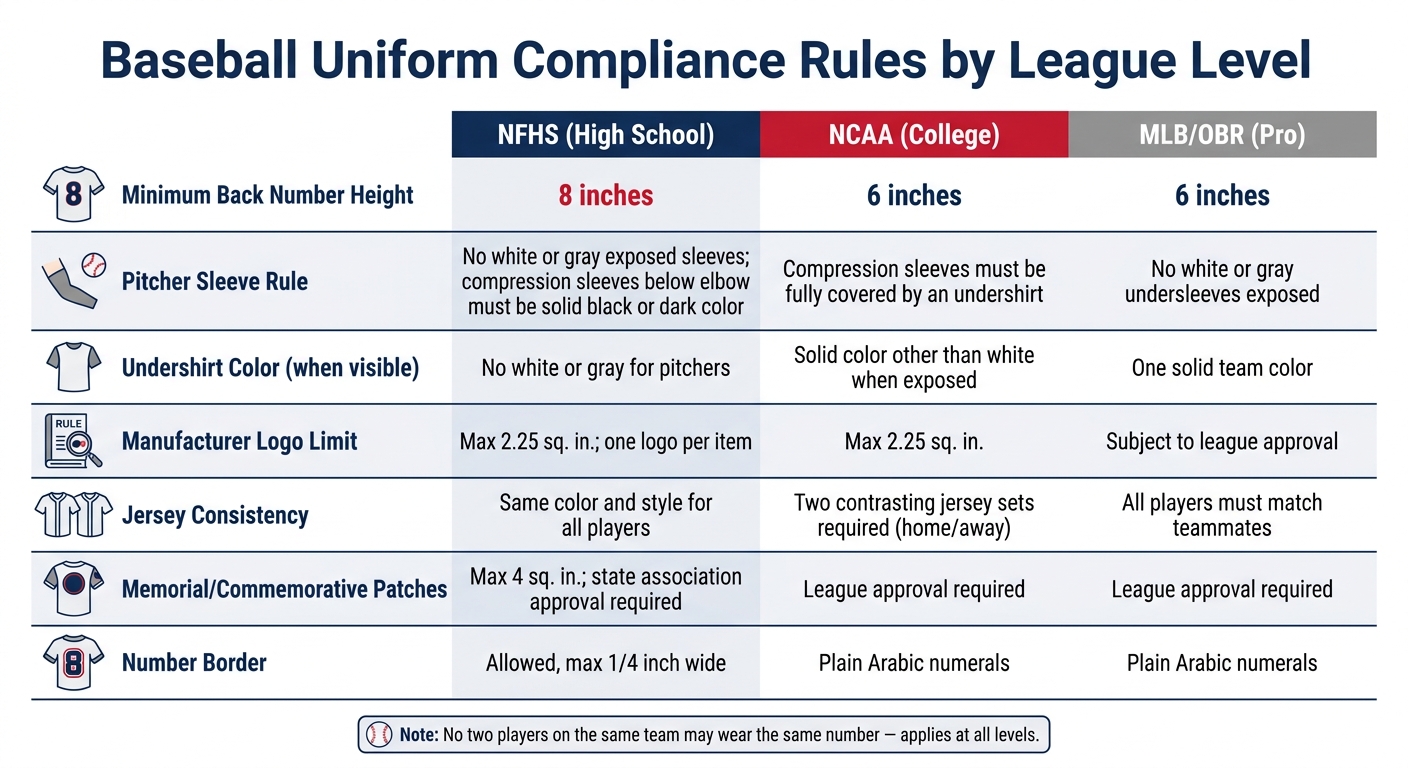
Baseball Uniform Rules by League Level: NFHS vs NCAA vs MLB
League rules change by level, and this is where teams often slip up: they place an order first, then check the rulebook later.
Youth leagues usually care most about safety gear and banning pointed metal spikes.
NFHS (high school) has tighter uniform rules. Back numbers must be in a solid contrasting color. Pitcher sleeves are limited. And manufacturer logos can’t be larger than 2.25 square inches per item. Jersey text is also restricted to player names, school names, or mascots. Slogans and mottoes above the number aren’t allowed.
NCAA (college) has its own set of rules. Teams need two sets of contrasting jerseys, one for home and one for away. Pitchers also have to cover compression sleeves with an undershirt.
Here’s a side-by-side look at the main differences:
| Rule | NFHS (High School) | NCAA (College) |
|---|---|---|
| Min. back number height | 8 inches | 6 inches |
| Pitcher sleeve rule | No white or gray exposed sleeves; dark compression sleeves only | Compression sleeves must be covered by an undershirt |
| Undershirt color when visible | No white or gray for pitchers | Solid color other than white when exposed |
| Jersey consistency | Same color and style for all players | Two sets of contrasting jerseys required |
| Manufacturer logo limit | Max 2.25 sq. in.; one per item | Max 2.25 sq. in. |
Once you know the league standard, ordering custom 2-button baseball jerseys gets a lot simpler. Check the rulebook before you buy anything so the final set matches league requirements.
Ordering and Planning Tips to Avoid Repeat Violations
Once your league standard is set, put everything on one written order sheet before production starts. This sheet should spell out the team’s undershirt color, sleeve rules, and number format, so every choice begins from the same source.
Before you place the order, compare the mockup with league rules. Check that the numbers, logos, and any patches match what the rulebook calls for at your level before the full set goes into production.
It also helps to use one vendor for jerseys, pants, socks, and belts. That keeps color and trim in line across the full set. Wooter Apparel offers custom baseball uniforms built to team specs across the full uniform set.
A little extra planning can save a lot of hassle later. Order 1 to 2 extra uniforms in common sizes to handle late roster changes.
Then carry that same spec sheet into your pregame uniform check, so the standards you ordered are the same ones you enforce on game day.
Game-Day Uniform Checklist for Coaches and Players
Treat the order sheet like your last pregame uniform check. Do that before first pitch, and a lot of problems get fixed before an umpire ever spots them.
Start with your pitcher. Look for exposed white or gray sleeves, plus any arm gear that could distract a hitter. In NFHS play, compression sleeves below the elbow must be solid black or another solid dark color. In NCAA play, they must be covered by an undershirt.
Then make a fast team-wide sweep. Exposed undershirts need to match the team color, often worn under V-neck baseball jerseys. Back numbers must be plain Arabic numerals in a contrasting color. They also need to meet the size rule: 8 inches in high school and 6 inches in college/pro play. And no two players can wear the same number.
Once the big stuff is covered, check the small things umpires tend to catch right away:
| Check | What to Look For |
|---|---|
| Patches and logos | Make sure all stitched or printed marks match the approved design; one manufacturer logo per item, with a maximum size of 2.25 square inches |
| Jersey and socks | Sleeves must be the same length, not ragged or frayed; socks must be the same solid color across the roster |
| Footwear | No track spikes or pointed metal spikes like golf shoes |
Coaches need to check their gear too: helmet, game jersey or matching jacket, zipped or buttoned. In college and pro play, base coaches must wear the game jersey or a matching jacket and a helmet.
Use this checklist every game to keep the team legal from first pitch.
Conclusion
Most baseball uniform violations come down to small details that slip through before game day. And those details matter. A nonconforming uniform can keep a player from entering the game.
This isn’t just about looks. Uniform compliance affects player eligibility. If a uniform doesn’t meet the rules, that player may not take the field until the issue is fixed.
League standards can change from one level to another, so check the rules before you place an order. Once those standards are clear, build them into the design before production starts. Wooter Apparel can help work league requirements into custom uniform designs from day one.
The best approach is simple: set standards early, keep uniforms consistent in color, trim, and style, and fix problems before game day. Uniform compliance starts with the order sheet, moves through the roster, and finishes with a clean game-day check.
FAQs
What happens if a player’s uniform is illegal?
If a player’s uniform doesn’t meet league rules, or it doesn’t match the rest of the team, that player may not be allowed to take part.
Some violations go further than that. An illegal bat or banned uniform item can lead to the player being called out. In some cases, the head coach may also be limited to the bench or thrown out of the game.
Do baseball uniform rules change by league?
Yes. Baseball uniform rules vary by league.
Most leagues share the same basics: matching team colors, visible numbers, and a consistent look across the roster. But once you get past that, the details can change.
Design rules, sponsor logos, patches, and player names often depend on the league. One group may allow a lot of freedom. Another may have tight rules on what’s allowed and where it can appear.
For example, high school leagues often follow stricter NFHS standards. Travel ball, on the other hand, may give teams more room to choose their own style.
Before you order uniforms, check your league or tournament handbook. It can save you from a last-minute headache.
What should coaches check before first pitch?
Before the first pitch, coaches should make sure every player is in an identical uniform that meets the rules.
That means checking for contrasting back numbers that are at least 6 inches tall, making sure any exposed undershirts match, and spotting banned items like glass buttons or polished metal. Coaches should also confirm that players aren’t wearing forbidden spikes or any unauthorized attachments.
For pitchers, there’s one more thing to watch: they shouldn’t wear white or gray sleeves if those sleeves could distract the batter.