
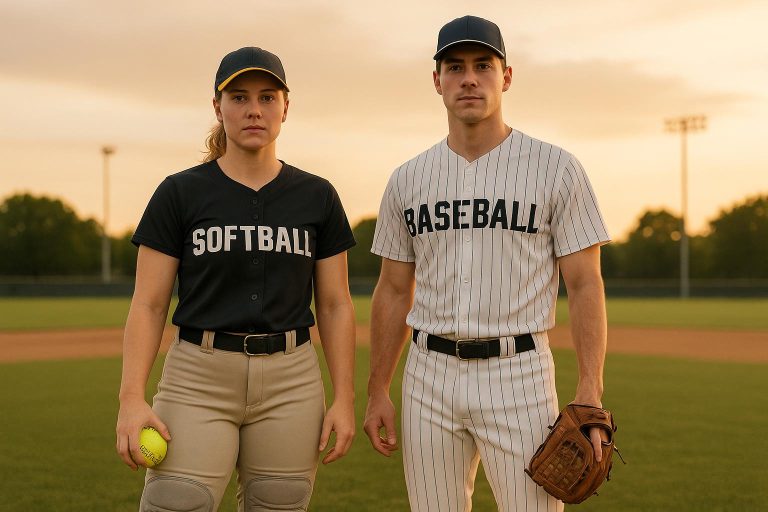
Baseball and softball uniforms have evolved differently due to sport-specific needs and historical gender norms. Baseball requires full-length pants for all players, while softball allows teams to choose between shorts or pants, as long as the team matches. Historically, softball uniforms for women prioritized appearance over functionality, often leaving players with less protection. Today, safety and performance are becoming more important, with many players opting for pants for better coverage during slides and dives.
Key Takeaways:
- Baseball Uniforms: Standardized across genders; includes jerseys, full-length pants, cleats, and caps.
- Softball Uniforms: Teams can choose between shorts or pants, but skirts and shorts historically dominated for women.
- Safety Concerns: Pants provide better protection for sliding and diving compared to shorts.
- Gender Disparities: Women’s uniforms often have less coverage, raising safety and comfort issues.
Quick Comparison:
| Aspect | Baseball | Softball |
|---|---|---|
| Pants vs. Shorts | Full-length pants required | Teams can choose; must match across players |
| Gender-Specific Rules | Minimal variation across genders | Women’s uniforms often have less material |
| Protective Gear | Standard baseball equipment | Includes kneepads and sliding shorts |
The shift toward pants in softball reflects a growing focus on safety and professionalism, addressing historical challenges in uniform design.
History of Gender-Based Uniform Standards
Early League Uniform Requirements
The history of gender-based uniform standards in sports reflects a mix of practicality and societal expectations. Women had been playing baseball in the United States long before gaining the right to vote, yet their uniforms often mirrored the gender norms of the time.
In the 1930s and 1940s, women’s amateur and semi-professional softball teams typically wore practical attire like satin shirts, shorts, long pants, or even traditional baseball uniforms. These options provided freedom of movement and protection during play. However, when Philip Wrigley, owner of the Chicago Cubs, launched the All-American Girls’ Professional Baseball League (AAGPBL) in 1942 during World War II, the league introduced strict uniform rules that prioritized femininity over functionality. Players were required to wear pastel-colored belted tunic dresses with short, flared skirts, paired with darker shorts underneath. Designed partly by Mrs. Wrigley, these uniforms featured a front button closure and space for a circular team logo, with skirts hemmed no shorter than six inches above the knee. While visually appealing, these uniforms offered little protection for players sliding or diving during games.
The AAGPBL also enforced a strict code of conduct alongside its uniform requirements. Female players were required to wear lipstick, avoid smoking or drinking in public, and adhere to behavior deemed suitable for the "feminine sex". Unlike male players, they were expected to maintain a polished, traditional image both on and off the field.
In 1973, Little League was legally required to allow girls to play baseball. However, instead of integrating the sport, the organization created a separate softball division for girls in 1974. This decision solidified the gender divide in sports, with baseball remaining a boys’ sport and softball designated for girls. It also led to the development of distinct uniform codes that often emphasized femininity, such as shorter skirts and more revealing designs. These early standards laid the groundwork for ongoing debates about uniform policies and their balance between practicality and gendered expectations.
How Social Expectations Shaped Uniform Design
Social pressures played a significant role in shaping the design of early women’s sports uniforms. League owners, aware of societal perceptions that female athletes were "masculine" or "unladylike", deliberately prioritized appearance over functionality. Short skirts and revealing cuts were chosen to enhance visual appeal for audiences, even if it compromised athletic performance. These decisions were influenced by sports organizations, largely governed by Westernized white males, who enforced rules that emphasized femininity for female athletes .
Uniforms became a way to reassure audiences that women could remain "ladylike" while competing. This focus on appearance forced female athletes to navigate a difficult choice: adhere to these strict norms or prioritize functionality and protection. Male athletes, by contrast, faced no such restrictions. Over time, this emphasis on visual appeal over practicality created lasting patterns in sports, where dress codes often feminized or even sexualized women’s appearances. These regulations were typically imposed by coaches or athletic associations, leaving players with little say in their own attire .
The effects of these early decisions linger today. When more practical softball pants became available, they quickly gained popularity among female players. Around age 12, many girls began transitioning from shorts to pants, viewing them as more professional and protective. This shift reflects a growing awareness of the need for uniforms that balance professionalism, safety, and practicality – an evolution rooted in the historical struggles over gendered uniform standards.
Baseball Uniform Regulations Today
Required Uniform Components
Baseball uniforms today stick to a consistent design across professional, collegiate, and high school levels. Players wear jerseys that display team logos – serving as a key identifier – paired with pants that reach the ankles. Cleats are essential for traction on the field, while caps provide shade and help with sun protection. This uniform structure forms the foundation of modern baseball attire.
Gender-Based Rules and Differences
Over time, baseball uniforms have shifted from gender-specific designs to a more standardized approach. Male and female athletes now wear the same core pieces: jerseys, pants, cleats, and caps. Earlier gender-specific designs have been phased out, and the introduction of universal standards ensures equality. Legal rulings, supported by Title IX and the Equal Protection Clause, emphasize the importance of providing identical equipment and opportunities for all players.
With the rise in female participation, uniform designs have been adjusted to offer better fits and coverage tailored to their needs. Modern standards focus on protection, comfort, and practicality, enabling athletes to perform at their best without distractions.
Little League Softball Rules for 2025 Season

Softball Uniform Regulations Today
Softball uniforms, much like their baseball counterparts, have undergone significant changes over the years to improve both safety and performance.
The Shift from Skirts to Pants
In the early days of softball, particularly during the 1930s and 1940s, women’s teams often wore satin shirts paired with shorts, long pants, or even traditional baseball uniforms. Back then, the focus leaned more toward aesthetics than practicality or safety.
While these early uniforms were visually appealing, they fell short in terms of functionality. Skirts and short shorts left players vulnerable to injuries during slides or dives and offered minimal protection against the sun. The shift to tailored softball pants was a turning point. By the time players reached their early teens, many transitioned from shorts to pants, which were seen as a more professional and safer choice. Pants provided better coverage and reduced the risk of scrapes and bruises during intense gameplay.
This transition set the stage for the modern uniform standards we see today, which aim to balance team identity with player safety.
Gender-Based Uniform Guidelines
Today’s softball uniform rules focus on safety and performance while ensuring a unified team appearance. Teams are not required to choose between shorts or pants, but they must stick to a consistent style across all players. A standard uniform typically includes a team jersey, high socks, kneepads, sliding shorts, and either shorts or pants. At higher levels of competition, pants are often the preferred choice due to their practicality and added protection.
However, gender-based disparities in uniform design remain an issue. Female athletes frequently receive uniforms with less coverage compared to their male counterparts. This stems from traditional design choices that prioritize appearance over functionality. Modern women’s uniforms must account for anatomical and performance needs, ensuring comfort, range of motion, and proper support during play.
The lessons learned from earlier uniform designs continue to shape today’s focus on protection and functionality. Uniform details, such as material and fit, are typically decided by coaches or athletic associations, leaving little room for individual players to customize their gear.
Custom providers like Wooter Apparel help teams navigate these regulations by offering fully sublimated, high-quality uniforms. With options for both shorts and pants, they allow teams to maintain a cohesive look while addressing the specific needs of female athletes, blending style with practicality.
sbb-itb-4d95ad3
Baseball vs. Softball Uniform Rules Compared
Baseball and softball share some common roots, but they’re officially recognized as separate sports by both the International Olympic Committee and the United States Olympic Committee. This distinction goes beyond just field dimensions or game mechanics – it also influences how uniform regulations are created and enforced. Over time, historical design choices have shaped modern standards, balancing tradition with player safety.
Side-by-Side Comparison Table
To understand the differences in uniform standards, let’s take a closer look at how each sport approaches player attire. The table below highlights key regulatory distinctions:
| Uniform Aspect | Baseball | Softball |
|---|---|---|
| Standard Components | Jersey, full-length pants, socks, cleats | Jersey, high socks, kneepads, sliding shorts, shorts or pants |
| Pants vs. Shorts | Full-length pants required for all players | Teams can choose shorts or pants; entire team must match |
| Gender-Specific Rules | Minimal variation; female players wear the same uniforms as males when on men’s teams (per Title IX) | Female players often receive uniforms with less material and more revealing designs |
| Field Dimensions | 90-foot base paths, longer outfield fences | 60-foot base paths, shorter outfield fences |
| Playing Surface | Grass infield with raised pitcher’s mound | Flat dirt infield |
| Protective Gear | Standard baseball equipment | Includes kneepads as part of the standard uniform |
| Uniform Flexibility | Consistent standards across all levels | More flexibility in choosing between shorts and pants |
One of the most noticeable differences is baseball’s requirement for full-length pants, while softball allows teams to choose between shorts or pants, provided the entire team matches. Softball uniforms also include kneepads as a standard feature due to the frequent sliding on dirt infields, which contrasts with baseball’s grass infield. However, gender-based disparities are more apparent in softball, where female players often receive uniforms with less coverage, raising concerns about safety and comfort.
How Uniform Rules Affect Player Performance
Uniform design directly impacts how players perform on the field. In softball, where players frequently slide and dive on the shorter 60-foot base paths, leg protection is crucial. Shorts offer minimal coverage, leaving players more susceptible to scrapes, cuts, and even sunburn during intense gameplay.
On the other hand, pants provide better protection and allow players to focus on the game without worrying about injuries or exposure. This added comfort can boost confidence, enabling athletes to play more aggressively and effectively. Baseball players benefit from this consistency, as full-length pants are standard across all levels of play, ensuring equal protection for every player. With larger field dimensions – 90-foot base paths compared to softball’s 60-foot paths – baseball uniforms prioritize durability and visibility for long-distance play.
The type of playing surface also plays a role. Baseball’s grass infield and raised pitcher’s mound create different sliding dynamics compared to softball’s flat dirt infield. Softball players, who slide more frequently and with unique techniques, rely heavily on leg protection to avoid injuries.
For teams aiming to balance safety and team identity, companies like Wooter Apparel offer customized uniforms tailored to each sport’s specific needs. Their fully sublimated designs allow softball teams to choose pants while maintaining a cohesive and professional appearance.
Ultimately, the differences in uniform regulations reflect the unique challenges and traditions of each sport. Baseball’s standards are more uniform across gender lines, while softball continues to grapple with balancing traditional aesthetics and the demands of modern gameplay.
How Custom Uniform Providers Update Standards
The athletic apparel world has been reshaped by athlete feedback and a growing emphasis on safety. Custom uniform providers have stepped up to modernize designs, moving away from outdated standards that once prioritized looks over functionality. This shift has paved the way for uniforms that balance performance and style, meeting the practical needs of today’s athletes.
Take softball pants, for example. When retailers began producing pants specifically designed for girls and women, the response was immediate. Players gravitated toward these pants for their added protection and polished, professional appearance. This change highlights how providers can directly address athlete needs, instead of sticking to outdated norms.
Customization Options Available
Building on this momentum, today’s uniform providers offer a wide range of customization options. They focus on creating designs tailored to the specific needs of female athletes, recognizing that their fit and functional requirements differ from those of male players.
One standout example is Wooter Apparel, which specializes in fully sublimated, high-quality custom uniforms for baseball and softball. Their process allows teams to personalize every detail – designs, colors, and patterns – while ensuring a great fit that aligns with league standards and player preferences. With an impressive 4.9-star rating from 1,238 reviews, Wooter’s approach clearly resonates. As one satisfied customer, Emily W., shared:
"Great quality for our softball jerseys and loved the design choices ❤️."
Customization goes far beyond just picking colors. Teams can choose between shorts and pants in matching designs, giving players the freedom to prioritize comfort and safety. This is especially important given the documented safety concerns – like the risks of minimal leg coverage during slides and dives. Many providers also offer complete uniform packages, including jerseys, warmup gear, and accessories, allowing teams to build a unified look without compromising on safety or comfort.
Combining Performance with Appearance
Custom uniforms are bridging the gap between performance and appearance, addressing long-standing issues in gender-specific design. For instance, pants provide essential protection during slides, reduce sun exposure, and offer a more polished, professional look – all without sacrificing functionality. Fully sublimated designs ensure vibrant colors and detailed patterns remain intact, whether players choose shorts or pants, maintaining strong team branding.
This approach also tackles deeper issues, such as the problematic history of revealing uniforms that have contributed to safety concerns and the sexualization of female athletes. By offering a variety of uniform components, custom providers empower teams to make choices based on comfort, safety, and professionalism – not outdated aesthetic standards. The growing preference for pants among female softball players, particularly those aged 12 and older, reflects this shift in priorities.
Custom uniform providers are also taking a hands-on approach, educating teams about the practical benefits of different options and collaborating to design uniforms that meet both regulatory standards and player needs. This consultative process ensures uniforms enhance performance, allowing athletes to focus entirely on their game. Ultimately, this movement toward customizable, performance-driven apparel underscores a critical shift: athletic uniforms should serve the athletes themselves, not outdated ideas of how they should look on the field.
Conclusion
The evolution of softball uniforms highlights a clear shift from the aesthetic, gender-specific designs of the past to modern standards that focus on performance and safety. Today’s game prioritizes protection and professionalism, with pants often replacing shorts to reduce injuries and enhance on-field performance. Despite these changes, the unique demands of the sport – such as field size and pitching styles – continue to influence uniform choices.
This ongoing transformation has sparked innovation in uniform design. Companies like Wooter Apparel (https://wooter.com) are at the forefront, offering fully sublimated, customizable uniforms that align with the sport’s safety and performance demands. By providing options for both shorts and pants, they allow teams to choose what best suits their needs, balancing functionality, comfort, and protection.
Female athletes deserve the same high-performance gear as their male counterparts. With current softball rules emphasizing team uniformity, there’s a growing opportunity for coaches, parents, and players to make thoughtful decisions about what works best for their teams. Moving beyond outdated norms or peer influence, these choices ensure that athletes have the freedom to select uniforms that prioritize both safety and performance. This empowerment not only supports individual players but also continues to shape the future of the sport.
FAQs
Why do softball and baseball uniforms have different rules for men and women?
Softball and baseball uniforms often showcase the influence of traditional gender norms and the historical evolution of each sport. For instance, women’s softball uniforms have frequently included shorts or skirts, while men’s baseball uniforms have consistently featured pants. These distinctions trace back to the early days of both sports, where societal expectations played a significant role in shaping athletic wear.
Today, many leagues and teams are shifting toward uniforms that emphasize inclusivity and performance. Companies like Wooter Apparel now provide custom designs that balance style with functionality, giving teams the freedom to move beyond outdated standards and choose uniforms that truly meet their players’ needs.
How have gender norms shaped the design of softball uniforms over time?
Gender norms have long influenced the design of softball uniforms. In the early days, women’s uniforms were created with modesty as the main focus, often featuring skirts or dresses that emphasized appearance rather than functionality. These designs reflected societal expectations of the time but were far from ideal for athletic performance.
As softball became more competitive and welcoming to a broader range of players, the focus shifted to practicality. Uniforms evolved to meet the physical demands of the sport, prioritizing comfort and mobility without sacrificing style.
Today’s softball uniforms strike a balance between performance and aesthetics. They are crafted to support athletes with features that enhance comfort and functionality while maintaining a polished, professional look. Companies like Wooter Apparel specialize in creating custom designs that meet these modern needs, helping teams perform at their best while looking sharp on the field.
Why might softball players choose pants instead of shorts for better safety and performance?
Softball players often choose pants over shorts because they offer better protection and support during games. Pants act as a barrier against scrapes, cuts, and bruises, especially when sliding into bases or diving for a ball – situations where safety becomes a priority. Plus, they provide extra coverage, which is especially helpful on cooler days or when playing on rough surfaces.
When it comes to performance, pants allow players to focus on their game without the distraction of potential injuries or discomfort. Many modern options, like those from Wooter Apparel, are designed with both durability and flexibility in mind, allowing athletes to move freely while staying safe.