
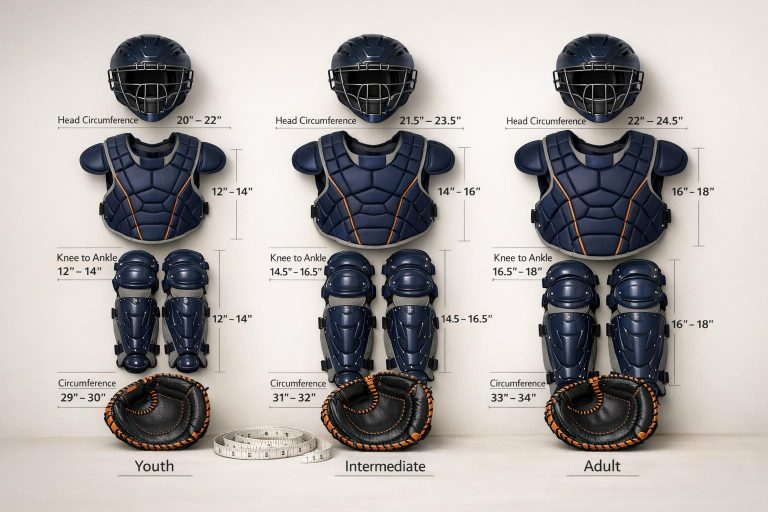
When it comes to catcher gear, proper sizing is critical for safety and performance. Here’s what you need to know:
- Youth gear is for players aged 5–12, designed with lightweight materials and smaller sizes, including mitts under 32 inches in circumference.
- Adult gear fits players 16 and older, offering heavier padding and larger sizes, with mitts ranging from 32 to 35 inches.
- Intermediate gear bridges the gap for players aged 12–16, featuring lighter adult-level padding.
Key Measurements:
- Helmet: Measure head circumference (1 inch above eyebrows).
- Chest Protector: Measure from sternum to navel.
- Leg Guards: Measure kneecap to ankle bone.
- Mitt: Measure circumference around the palm.
Properly fitted gear prevents injuries like sternum exposure or knee misalignment and ensures catchers remain agile during play. Always prioritize fit over size adjustments for growth. If you’re unsure, opt for slightly larger chest protectors and leg guards but a snug helmet. Misfitted gear can compromise safety and confidence, especially for young players transitioning to faster-paced games.
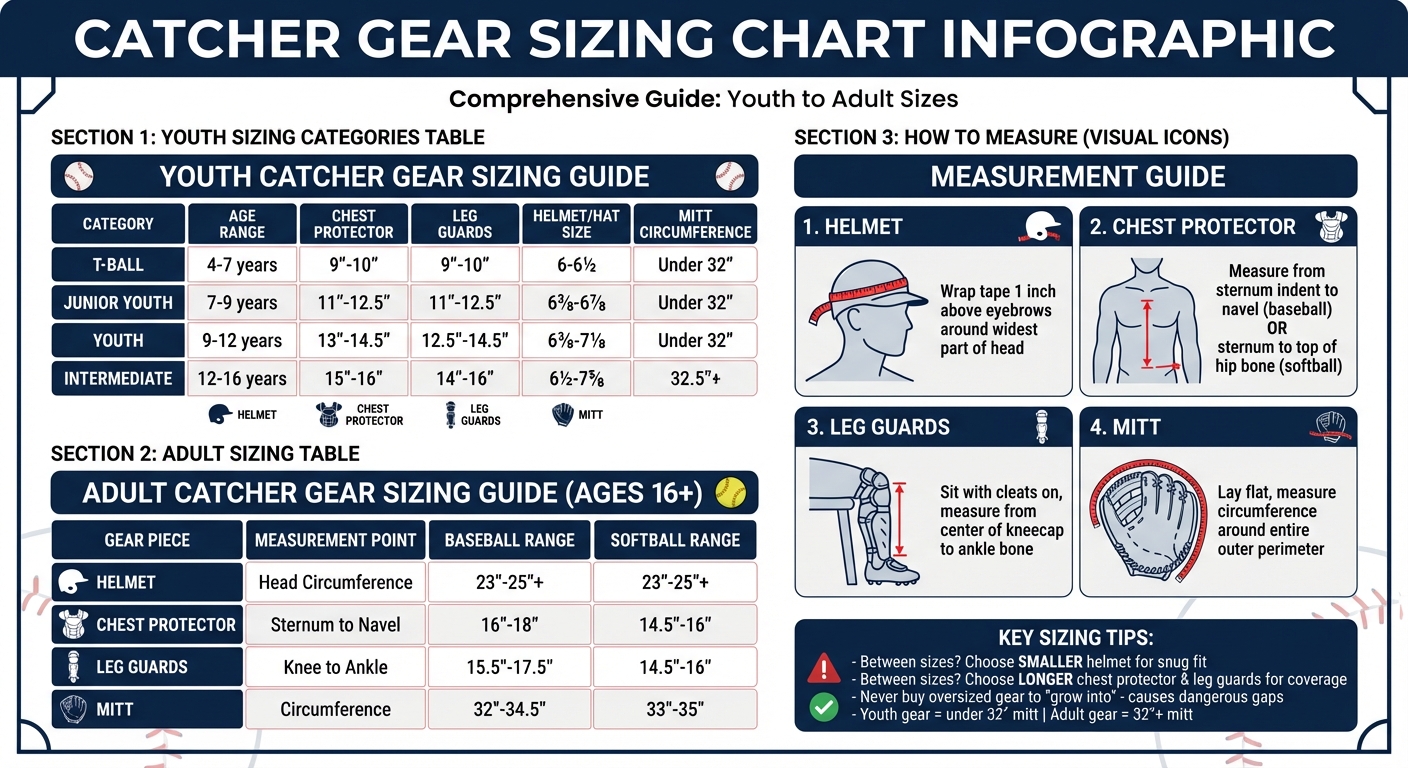
Complete Catcher Gear Sizing Chart: Youth to Adult Measurements
How to Size a Catcher’s Chest Protector | Baseball Monkey

sbb-itb-4d95ad3
How to Measure for Catcher Gear
To get the right fit for catcher gear, start with a flexible cloth tape measure. If you don’t have one, a piece of string and a ruler will work just as well. For mitts, lay the glove flat on a surface and follow the steps below for accurate sizing.
Head Circumference for Helmets
Wrap the measuring tape around the head, positioning it about an inch above the eyebrows. This ensures you capture the widest part of the head. For example, if the head circumference is 21⅞ inches, a medium helmet would be the right choice. Avoid oversized helmets – they tend to shift during play, leaving the head, face, and ears vulnerable.
Chest Protector Length
For baseball players, measure from the indent at the top of the sternum down to the navel or waistline. Fastpitch softball players should measure from the top of the hip bone (aligned with the midline) up to the sternum’s indent. If the measurement falls between sizes, go with the longer option to ensure proper coverage. Once the chest protector is sorted, move on to measuring leg guards.
Leg Guard Length
Have the player sit down while wearing cleats and baseball pants. Measure from the center of the kneecap to the ankle bone for a precise fit. For instance, a 13-inch measurement would typically correspond to junior-sized leg guards. Proper leg guard sizing is crucial for full lower-body protection.
Catcher’s Mitt Circumference
Catcher’s mitts are measured differently from standard fielding gloves. Instead of length, you’ll measure the circumference around the entire perimeter. Lay the mitt flat, spread it open as much as possible, and press it palm-down on a flat surface. Then, wrap the measuring tape around the outer edge to find the total circumference. For example, an 11-year-old baseball player might need a mitt sized between 30 and 34.5 inches, depending on their hand size and league specifications.
Youth Catcher Gear Sizing Guide
Youth Sizing Categories
Youth catcher gear is measured in inches to accommodate the varying growth rates of young players. T-ball gear is crafted for the youngest players (ages 4–7), focusing on lightweight materials and basic protection. Junior Youth gear is designed for players aged 7–9, while Youth gear suits those aged 9–12, offering better padding and coverage for higher-speed impacts as players develop. Intermediate gear, for ages 12–16, bridges the gap to adult equipment with features like advanced padding, moisture-wicking liners, and reinforced protection for competitive games. These categories help define the typical measurements listed below.
Youth catcher gear up to the Youth category generally has a gender-neutral fit. However, softball-specific chest protectors may include design adjustments, such as breaks in the chest area, to better accommodate female athletes.
Common Youth Gear Measurements
Below is a breakdown of standard measurements for each youth gear category:
| Category | Typical Age Range | Chest Protector Length | Leg Guard Length | Helmet/Hat Size |
|---|---|---|---|---|
| T-Ball | 4–7 years | 9"–10" | 9"–10" | 6–6½ |
| Junior Youth | 7–9 years | 11"–12.5" | 11"–12.5" | 6⅜–6⅞ |
| Youth | 9–12 years | 13"–14.5" | 12.5"–14.5" | 6⅜–7⅛ |
| Intermediate | 12–16 years | 15"–16" | 14"–16" | 6½–7⅝ |
Catcher’s mitts, unlike other gear, are measured by circumference. For players aged 12 and under, mitts typically measure 32 inches or smaller. Older players, aged 13 and up, generally use mitts that are 32.5 inches or larger. Baseball chest protectors are bulkier compared to softball versions, which are tailored for underhand pitching. Additionally, baseball players often prefer triple knee-cap shields for better protection against downward-angled pitches, while softball players usually opt for double-knee caps.
Adjusting Youth Gear for Proper Fit
Once you’ve matched a player’s measurements to the appropriate size category, fine-tune the gear for the best fit and performance on the field. Avoid buying oversized gear, as it can shift during play and expose the catcher to potential injuries. As the SportsDepot Buying Guide explains:
"Catcher’s gear has to fit properly, when the gear is too big it can move around and expose the catcher and subsequently result in injury".
Chest protectors should cover the sternum and collarbone. Tighten the top strap to prevent the protector from riding up into the player’s chin when squatting. Adjust the shoulder caps (often called "Robby Flaps") using Velcro to shield the throwing shoulder while maintaining full range of motion. This range of motion is further supported by wearing flexible game jerseys that don’t bunch under the protector. Look for straps in "I" or "X" configurations, as these allow independent adjustment of the shoulder and belly sections, improving ball control.
For leg guards, always fit them over the player’s baseball or softball pants (secured with durable uniform belts) to ensure the straps feel comfortable and the ankle plates rest properly on the shoe tongues. Many leg guards include internal knee caps attached with Velcro, which can be repositioned to align perfectly with the player’s knees. This ensures both comfort and protection during play.
Adult Catcher Gear Sizing Guide
Adult Sizing Parameters
Adult catcher gear is specifically designed for players aged 16 and older. For instance, when sizing a catcher’s helmet, measure around the widest part of the head – roughly an inch above the eyebrows. Typical head circumferences for adult helmets range from 23 inches to over 25 inches, corresponding to U.S. hat sizes 7⅜ to 8+. Chest protectors should be measured from the top of the sternum (just below the base of the neck) to the navel or waistline. For leg guards, measure from the center of the kneecap to the top of the ankle bone while seated.
| Gear Piece | Measurement Point | Adult Baseball Range | Adult Softball Range |
|---|---|---|---|
| Helmet | Head Circumference | 23" – 25"+ | 23" – 25"+ |
| Chest Protector | Sternum to Navel | 16" – 18" | 14.5" – 16" |
| Leg Guards | Knee to Ankle | 15.5" – 17.5" | 14.5" – 16" |
| Catcher’s Mitt | Circumference | 32" – 34.5" | 33" – 35" |
If your measurements fall between sizes, it’s generally better to choose the longer chest protector and leg guards for added coverage, and opt for a smaller helmet to ensure a snug, secure fit. These sizing guidelines highlight the differences between baseball and softball equipment, which are explored further below.
Baseball vs. Softball Adult Gear
Softball chest protectors are tailored for female players, featuring a break in the chest padding to accommodate the body’s shape. They also typically lack a removable groin protector. Baseball chest protectors, on the other hand, are longer and provide more uniform coverage, measuring between 16 and 18 inches, compared to softball versions that range from 14.5 to 16 inches.
Leg guards for softball are contoured to fit the shape of a woman’s leg and usually measure 14.5 to 16 inches, while baseball leg guards can extend up to 17.5 inches. Additionally, softball catcher’s mitts are slightly larger, with circumferences between 33 and 35 inches, compared to baseball mitts that measure 32 to 34.5 inches. When measuring for a softball chest protector, it’s recommended to measure from the sternum indent to the top of the hip bone rather than all the way to the navel.
Refining Fit for Adult Players
Getting the right measurements is just the first step – fine-tuning the fit of your gear is key for both protection and comfort. Adult players often need to mix and match sizes for different gear components to suit their body proportions. For example, adjust the top strap of the chest protector to shield the collarbone while ensuring it stays in place during play. Shoulder caps and knee caps, typically secured with Velcro or snaps, can be repositioned to align with your body for better mobility.
Leg guards should be adjusted so that the ankle plates rest directly on the tongue of your cleats, providing both flexibility and protection. If you’re playing recreationally or for extended periods, consider adding "Knee Savers" to the leg guard straps. These can help redistribute weight and reduce stress on your knees. Always test leg guards while wearing your game-day baseball or softball pants to confirm they fit comfortably.
Transitioning from Youth to Adult Gear
Signs a Player Has Outgrown Youth Gear
When gear starts leaving noticeable gaps or no longer provides full coverage, it’s a clear sign that it’s too small. For example, a chest protector should stretch from the sternum to the belly button. If it rides up into the chin when squatting or leaves large gaps at the waist, it’s time for a replacement. Similarly, leg guards should fully cover the ankle bone and keep the knee centered in the knee cap – if they don’t, they’ve been outgrown.
A helmet that feels too tight or loose, or a hat size over 7, also indicates the need for larger equipment. As players grow and pitch speeds increase, having properly fitted gear becomes even more important. Around ages 11–12, youth-model mitts often lack the padding and durability needed to handle higher pitch velocities. Tom Scalisi, Founder of RBI Gear, explains:
"As pitchers get stronger, those youth gloves won’t hold up, making an adult glove a necessity".
Ill-fitting gear doesn’t just compromise protection – it can also reduce responsiveness during play.
Choosing Between Intermediate and Adult Sizes
Intermediate gear, often labeled as "Senior", is designed for players aged 12–15 who have outgrown youth sizes but aren’t quite ready for full adult equipment. This gear offers adult-level padding in a lighter design, helping to reduce fatigue. Generally, players transition to intermediate sizes when their chest protector measures about 15.5 inches and their leg guards around 15 inches.
Adult gear is typically recommended for players aged 16 and older with fully developed builds. When measurements for chest protectors or leg guards fall between sizes, it’s best to go with the longer option to ensure proper coverage of the collarbone and ankles. However, for helmets, choosing the smaller size when in between measurements ensures a snug fit. Players with unique body proportions may need to mix and match sizes, such as pairing an adult helmet with intermediate leg guards, instead of relying on pre-packaged sets. Once the right size is chosen, adjusting straps and positioning ensures a secure and effective fit.
Adjustment Tips for Transitioning Players
Proper adjustments are key to making sure gear fits well and stays in place. Avoid buying oversized equipment with the idea that the player will "grow into it", as loose gear can shift and compromise safety. Instead, focus on strap adjustments. Look for straps that form an "X" or "I" shape, as these provide better alignment with the body.
Many transition-level pieces come with Velcro-attached shoulder and knee caps that can be repositioned to match the player’s joints. Adjust the chest protector’s top strap to prevent it from riding up into the chin while squatting, and tighten the side straps to keep the pad centered during movement. For leg guards, ensure the ankle plates rest directly on the cleats’ tongue. If straps are too long after tightening, secure the excess to maintain a snug fit. Always test new gear while wearing game pants and cleats to confirm comfort and functionality during play.
Conclusion
Summary of Sizing Guidelines
Getting the right gear size is key for catchers to stay safe and perform well. Helmets should fit snugly, measured by the head’s circumference about an inch above the eyebrows. For chest protectors, measure from the top of the sternum to the navel, ensuring they sit correctly to shield the throat and collarbone. Leg guards need to be measured while seated, from the middle of the kneecap to the ankle bone. As for catcher’s mitts, these are sized by circumference (usually between 30 and 35 inches), and they should fit tightly enough for quick transfers and precise framing.
If measurements fall between sizes, go smaller for helmets to ensure a secure fit, but opt for longer chest protectors and leg guards to avoid leaving vulnerable areas exposed. Oversized gear can lead to dangerous gaps, especially around the chest and throat, where a ball might sneak through. On the other hand, gear that’s too tight can limit mobility, making it harder to squat, throw, or block pitches effectively. With gear costs ranging widely, proper sizing ensures you get the most out of your investment.
Once the sizing is sorted, you can focus on refining the overall look for a polished, professional appearance.
Gear and Custom Uniforms
After ensuring protective gear fits perfectly, combining it with custom team uniforms completes the package. Matching the colors of chest protectors, leg guards, and mitts can even be practical – contrast between the chest protector and the inside of the mitt helps pitchers spot their target more easily. Always test leg guards while wearing baseball pants to ensure the straps fit properly in game-like conditions. A well-fitted uniform not only enhances protection but also improves functionality on the field.
For custom uniforms, Wooter Apparel (https://wooter.com) offers a variety of options, including full-button jerseys, tapered pants, and moisture-wicking shirts designed to integrate seamlessly with protective gear. Their fully sublimated designs allow teams to maintain a cohesive identity while ensuring base layers don’t interfere with gear straps or restrict movement for catchers working behind the plate.
FAQs
Can I mix sizes across helmet, chest protector, and leg guards?
Yes, you can combine different sizes for the helmet, chest protector, and leg guards. However, getting the right fit is essential for both safety and performance. Since sizing can differ between brands, always check the manufacturer’s specific guidelines to make sure your gear fits properly.
What should I do if my measurements fall between two sizes?
If your measurements land between two sizes, it’s usually a good idea to choose the larger size for a more comfortable fit. This is particularly crucial when it comes to catcher’s helmets and gear, as the right fit ensures both proper protection and freedom of movement during the game.
How do I know it’s time to move from youth to intermediate or adult gear?
When your child starts outgrowing youth-sized equipment, it’s time to consider upgrading to intermediate or adult gear. This often happens during growth spurts or as their physical development requires better protection and a more precise fit. Pay attention to their size, age, and any league-specific requirements to ensure their gear not only fits well but also meets safety standards. Properly fitting equipment is key to keeping them safe and comfortable as they play.