
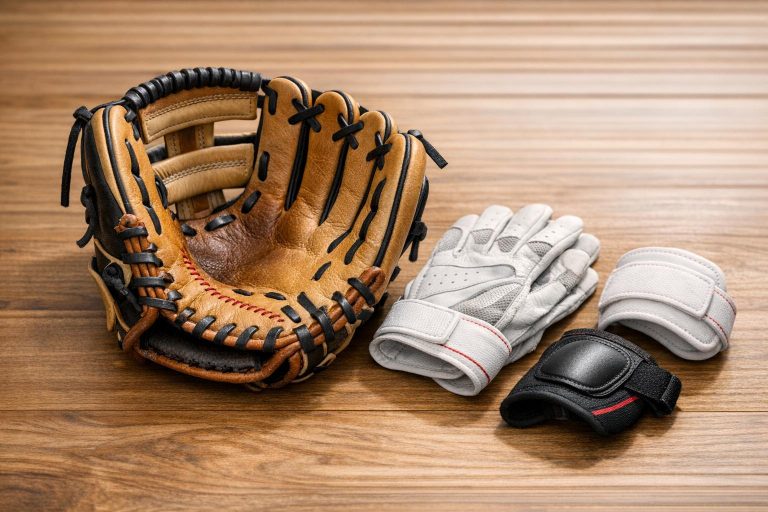
Selecting the right infielder glove isn’t just about comfort or looks – it’s about ensuring it works well with your protective gear. A poorly paired glove can lead to slower plays, reduced control, and even injuries. Here’s what you need to know:
- Infielder Gloves Overview: Designed for speed and precision, baseball gloves typically range from 11–11.75 inches, while softball gloves are slightly larger (12–13 inches). They feature shallow pockets for quick ball transfers and open web patterns (like I-Web or H-Web) to keep dirt out.
- Gear Compatibility: Gloves must fit comfortably over batting gloves, wrist guards, or thumb protection without restricting movement. Tight finger stalls or wrist openings can hinder performance.
- Size and Fit: Youth baseball players usually need gloves between 10.25″–11.5″, while adults use 11.25″–12″. For softball, fastpitch gloves are 11.5″–12″, and slowpitch gloves are 12″–13″. Middle infielders prefer smaller gloves for quick plays, while third basemen opt for larger gloves for hard-hit balls.
- Protective Gear Adjustments: Inner gloves, thumb guards, and wrist padding can alter fit. Test gloves with all your gear to ensure proper closure, flexibility, and comfort.
- Web Patterns and Pocket Depth: I-Webs and H-Webs are popular among infielders for quick ball retrieval and visibility. Shallow pockets aid faster transfers, while deeper pockets are better for handling harder hits.
Testing your glove with full game gear and adjusting for position-specific needs ensures optimal performance. Don’t forget to check wrist and thumb fit, as well as overall comfort during play.
Complete glove buying guide! How to choose the right infield glove!
Infielder Glove Basics
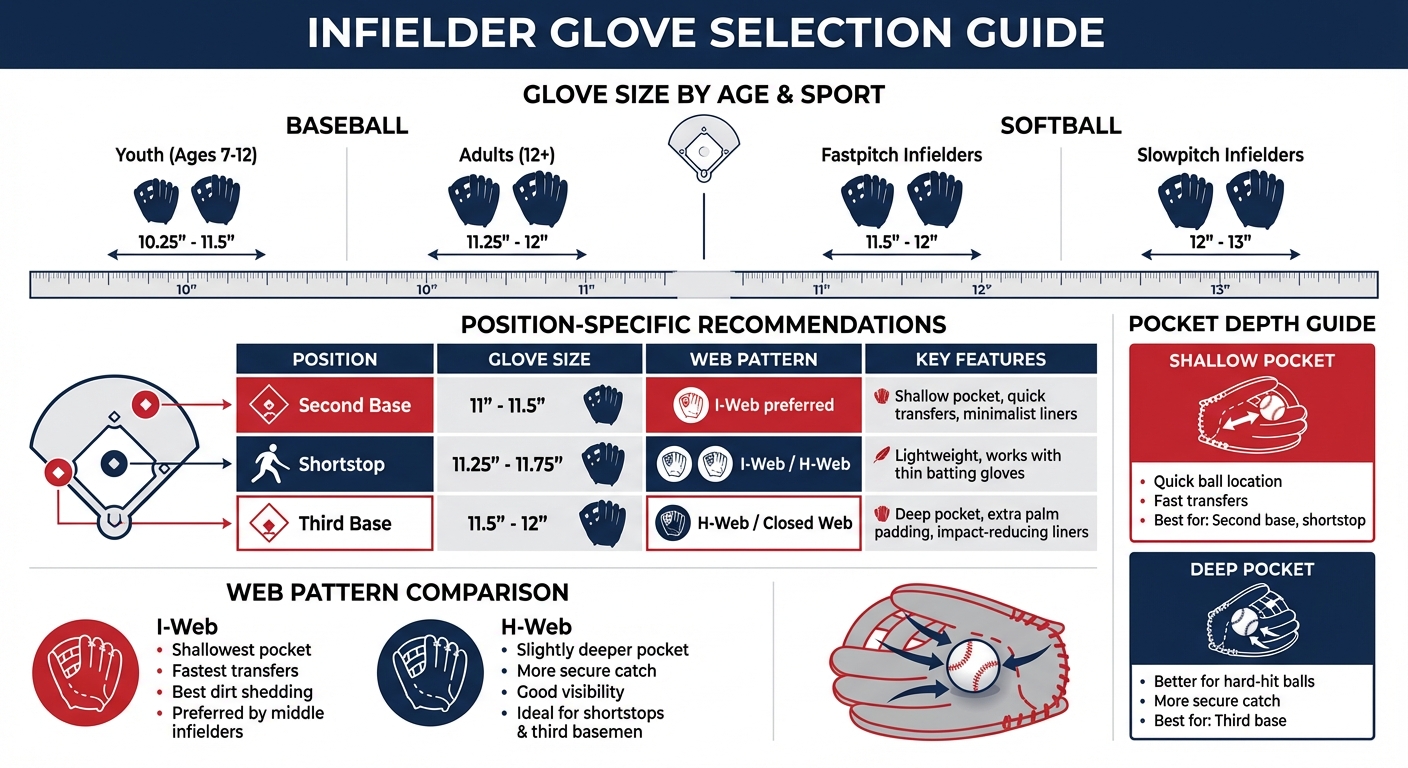
Infielder Glove Size Guide by Position and Age
Selecting the Right Size and Fit
Picking the right glove size is key to ensuring it fits well and performs as expected. Gloves are measured from the base of the heel to the tip of the index finger. For baseball, youth players (ages 7–12) typically use gloves ranging from 10.25″ to 11.5″. Once players hit 12 and older, they usually need gloves between 11.25″ and 12″. Softball requires slightly larger gloves – adult fastpitch infielders often go for 11.5″ to 12″, while slowpitch infielders might need gloves sized 12″ to 13″.
Your position on the field also influences your choice. Middle infielders, like shortstops and second basemen, benefit from smaller gloves (11″ to 11.5″) that allow for quicker ball transfers. Third basemen, however, often prefer larger gloves (11.75″ to 12″) to handle those blazing hits at the "hot corner". A common misstep, especially for younger players, is choosing a glove that’s too big, which can make it harder to close properly.
Pay attention to the wrist openings and finger stalls as well. Players with smaller hands might find models like Wilson’s "Pedroia Fit" or Rawlings’ "Contour Fit" more comfortable, as they offer a snugger fit. If you use an inner glove, make sure it doesn’t compromise the wrist fit. Many infielders also favor open-back designs for added breathability and flexibility. Getting the size and fit right ensures your glove complements your game, not hinders it.
Next, let’s explore how web patterns can enhance your glove’s performance.
Common Web Patterns for Infielders
The webbing of a glove isn’t just for looks – it plays a big role in how you field and transfer the ball. For middle infielders, I-Webs are a top choice. They create the shallowest pocket possible, which speeds up ball transfers. The single leather strip forming the "I" shape also helps dirt fall away easily.
H-Webs, with their two vertical strips, offer a slightly deeper and more secure pocket than I-Webs. This design is ideal for shortstops and third basemen who need to handle harder-hit grounders while still maintaining quick transfers. As svsports.com explains:
"Most infielders prefer open webs because the gloves tend to be more flexible. These infielders also find it easier to retrieve a ball from an open web glove."
Open webs also improve visibility, letting players track grounders or pop flies through the webbing while shielding their eyes from the sun. On the other hand, closed webs are less common among middle infielders because they can slow down transfers. However, some third basemen opt for them to add structure when catching high-velocity hits.
Now, let’s dig into how pocket depth affects transfer speed.
Pocket Depth and Transfer Speed
The depth of your glove’s pocket can make or break your speed when transferring the ball. A shallow pocket is ideal for quick transfers, as it lets you locate the ball and its seams almost instantly. BaseballMonkey sums it up well:
"A smaller glove and shallower pocket allow the infielder to field the ball and quickly transfer it to their throwing hand in order to make a strong throw and record an out."
Third basemen often lean toward gloves with deeper pockets to better handle hard-hit balls, while middle infielders stick with shallow pockets to execute quick plays like double plays. The ball should ideally land in the pocket just below the webbing – not in the palm – for maximum control and speed. If you plan to use an inner glove or liner, be sure to test how it affects the pocket depth and your feel for the ball.
Pairing Gloves with Protective Gear
Fitting Gloves with Inner Gloves and Liners
Adding batting gloves or padded liners can change how your glove fits. These extra layers increase the size of your hand, which might limit movement if the finger stalls are too snug. It’s important to ensure there’s enough space to comfortably close the glove while still maintaining a good feel for the ball.
If you’re planning to use thick liners, go for a Standard Fit glove instead of a "Tapered" or "Pedroia Fit" model. The latter designs have narrower finger stalls and tighter wrist openings, which can feel overly restrictive with additional layers. Always test the glove while wearing your batting glove to make sure your fingers fully extend through the stalls and that the glove closes smoothly without cutting off circulation.
While premium leather gloves take longer to break in, they eventually mold to the shape of your hand – even with a batting glove – better than synthetic materials.
Adjusting for Thumb and Wrist Protection
Thumb and wrist guards add bulk, so your glove needs to accommodate these extras. Look for gloves with adjustable closures like Velcro, D-ring, or buckles for flexibility. As BaseballMonkey points out:
"Recently, the popularity of extra wrist padding has grown, especially at the corner infield positions."
Yang Andrew offers guidance on thumb fit:
"The thumb of the glove should fit comfortably around your thumb without excessive looseness or tightness. There should be enough room for movement, but not so much that the thumb is swimming inside the glove."
Middle infielders often prefer open-back designs for better wrist flexibility during quick plays, while closed-back gloves with finger holes provide more wrist support when using protective wrist gear. Velcro straps are generally the easiest to adjust over guards or tape, while laced closures offer a sturdier, more permanent fit but are less convenient for quick adjustments.
These considerations help prepare your glove for the specific needs of your position.
Gear Needs by Position
Your position on the field influences the type of gear and glove features you’ll need. For example, second basemen typically use gloves sized between 11″ and 11.5″ for quick transfers, often paired with minimalist liners to maintain speed.
Shortstops, on the other hand, usually prefer gloves ranging from 11.25″ to 11.75″, balancing a lightweight feel with enough room for thin batting gloves.
Third basemen face harder-hit balls and require slightly larger gloves (11.5″ to 12″) with deeper pockets and extra palm padding. Gloves with "Double Palm" construction are ideal here, as they help absorb the impact of high-velocity hits while maintaining the glove’s shape. The larger internal space also makes it easier to fit impact-reducing liners.
| Infield Position | Recommended Glove Size | Priority Gear Feature | Compatibility Focus |
|---|---|---|---|
| Second Base | 11″ – 11.5″ | Shallow Pocket | Minimalist liners for quick transfers |
| Shortstop | 11.25″ – 11.75″ | I-Web / H-Web | Lightweight feel; works with thin batting gloves |
| Third Base | 11.5″ – 12″ | Extra Palm Padding | Deep pocket; fits impact-reducing liners |
Always test the fit of your glove while wearing the exact batting gloves, thumb guards, or wrist straps you’ll use during games. This ensures you can close the glove easily and maintain full control.
sbb-itb-4d95ad3
Testing Glove Fit with Full Game Gear
Preparing for a Fit Test
Once you’ve chosen a glove and paired it with your gear, it’s time to test everything under actual game conditions. Gather all your full-game equipment – batting gloves, wrist guards, thumb protection, and any athletic tape you typically wear. These extras can add bulk and change how the glove fits, affecting both its closure and your control over it.
Set aside 15–20 minutes for this test. You’ll need a ball and enough space to practice fielding movements. To make the test realistic, ask a teammate or coach to hit ground balls to you. This approach gives you a better sense of how the glove performs in action, rather than just standing still and trying it on.
Checking Fit, Control, and Comfort
Start with the basics: can you easily close the glove? Wilson Sporting Goods puts it simply:
"Function can be boiled down to this: can a player easily and successfully squeeze the glove closed? If a player cannot close a glove, the player should try another glove size."
With all your protective gear on, try closing the glove repeatedly. If it requires too much effort, the finger stalls may be too tight for your setup. A glove that strains your hand now will only cause more issues during a game.
Next, test how secure the glove feels on your wrist. Put it on with all your gear, let your arm hang naturally, and adjust the closures. The glove should stay in place even during quick movements. If it feels loose or like it might slide off, the hand opening may be too large.
For infielders, transfer drills are essential. Field a ball and transfer it from the glove to your throwing hand several times. Baseball Monkey highlights the importance of this:
"A smaller glove and shallower pocket allow the infielder to field the ball and quickly transfer it to their throwing hand in order to make a strong throw and record an out".
Your gear shouldn’t interfere with this motion. If the ball gets stuck in the pocket or your fingers feel restricted during the transfer, the glove may not be compatible with your setup.
Pay close attention to how the finger stalls feel, especially around your pinky and middle fingers. Any numbness or tingling could mean the glove is too tight, restricting circulation. This issue can worsen with inner gloves or taping, so it’s better to address it now instead of during a game.
Finally, check whether your protective gear affects visibility through the glove’s webbing.
Checking Pocket Depth and Visibility
The depth of the glove’s pocket plays a big role in how quickly you can retrieve the ball. With your gear on, catch several balls and see if the pocket is shallow enough for quick transfers. The ball should stay near the surface, making it easy to grab, rather than sinking too deep where it slows you down.
While in your fielding stance, make sure the webbing doesn’t block your view of the ball. Infielders often prefer gloves with open webbing, like I-webs or H-webs, for this exact reason. Academy Sports + Outdoors explains:
"Infielders wear gloves with mostly open webbing. This allows them to see the ball when fielding and quickly move it from the glove to their throwing hand".
Also, ensure your wrist guards or other gear don’t shift the glove’s position or block your view through the webbing.
If you’re testing a glove for third base, where balls are hit harder, confirm that the deeper pocket still provides enough visibility and doesn’t trap the ball unnecessarily. Check that your protective gear doesn’t disrupt this balance or shift during play.
Matching Gloves with Team Uniforms and Accessories
Matching Glove Colors with Team Uniforms
Your infielder glove isn’t just about performance – it’s also a key part of your team’s visual identity. The right glove colors can enhance your overall look, blending style with functionality.
Custom glove builders offer endless options for personalizing your glove. You can select colors for every detail – webbing, outer shell, palm shell, laces, stitching, and welting. Jonathan Malo from Baseball360 emphasizes that glove colors should complement team uniforms. Instead of matching the entire glove, focus on accent colors. For example, a navy glove with orange laces pairs well with navy jerseys featuring orange trim.
Adding embroidered logos or numbers can further reinforce team identity. Place your team logo on the thumb or pinky, or add your player number for a personalized touch. As Baseball Monkey points out:
"These personalized touches also allow players to express their individuality, with many drawing inspiration from cultural heritage, favorite colors, or even meaningful symbols."
. Infielders often opt for brighter colors and bold patterns, while pitchers tend to stick with neutral tones and simpler designs like closed webs.
Even the color of your glove can influence your mindset on the field. Red can convey dominance, blue promotes calmness, and black exudes authority. Choose a color scheme that not only matches your uniform but also energizes and motivates you.
Once you’ve nailed your glove design, it’s time to think about customizing your uniforms and accessories to complete your look.
Customizing Accessories and Uniforms with Wooter Apparel

Take your team’s style to the next level with Wooter Apparel, which offers custom baseball uniforms and accessories at competitive prices. Their sublimated jerseys start at just $24.99, ensuring vibrant, long-lasting designs that stand up to the demands of the game.
Wooter’s in-house graphic design team provides free consultations to ensure your logos, colors, and designs are perfectly aligned across all your gear – jerseys, caps, gloves, and even bat bags. Accessories like backpacks and bat bags are also customizable, starting at $34.99 and $39.99 respectively.
With over 2,000 five-star reviews and a 4.8/5 rating, Wooter Apparel is known for its excellent communication, precise color matching, and speedy 2–3 week turnaround. They ship worldwide and have even been recognized by Entrepreneur Magazine as one of their "100 Brilliant Companies". This makes them a reliable choice for teams looking to create a unified and professional appearance on and off the field.
Conclusion
Regular Gear and Glove Compatibility Checks
It’s a good idea to reevaluate your glove and gear at the start of every season. For younger players, hands grow quickly, and for everyone, wear and tear – like stretched Velcro or frayed laces – can impact performance over time.
When testing your glove’s fit, make sure to wear all your protective gear, including batting gloves or liners. A glove that fits well is crucial for both comfort and performance. Look out for signs like stinging during catches or loose fasteners that might change the glove’s shape. Also, keep in mind that new accessories, such as wrist guards or thicker batting gloves, can alter how your glove fits.
Your glove should feel like a natural extension of your hand. As SV Sports puts it:
"Your glove is broken in when you can open and close it just as easily as you open and close your hand – that’s when the glove becomes your hand’s extension."
– SV Sports
Once you’ve ensured your glove fits seamlessly with your protective gear, you’ll be ready to bring all the pieces together for a well-rounded setup.
Building a Complete Setup
After confirming that your glove and gear are compatible, double-check that your glove’s size, pocket depth, and padding meet the demands of your game. A properly sized glove not only makes catching more secure but also gives you better control over the ball. Meanwhile, the right padding protects your hand and wrist from hard impacts.
Once your glove and gear are fine-tuned, complete your setup with custom uniforms from Wooter Apparel to achieve a polished, professional appearance.
FAQs
How can I make sure my infielder glove fits well with my protective gear?
To make sure your infielder glove works perfectly with your protective gear, start by picking the right size. For high school players and adults, gloves usually fall in the 10.5" to 11.5" range. Younger players might need smaller gloves, typically between 9" and 10", depending on their age and hand size. A good fit should feel snug but still allow your fingers to move freely without slipping off.
When trying out a glove, wear the same protective gear you’ll use during games – like chest protectors, sliding shorts, or shin guards. This lets you check if the glove’s pocket depth or webbing interferes with your gear. If the glove feels awkward or too tight, you might need one with a slightly deeper pocket or a thinner webbing design to ensure everything works together smoothly.
Don’t forget to adjust the laces and wrist strap for a secure fit, and take time to break in the glove while wearing your gear. For a truly personalized fit, you can explore custom glove options from brands like Wooter Apparel, which offer designs tailored to your exact measurements and equipment setup. A properly fitted glove means better comfort, performance, and seamless coordination with your gear.
What’s the difference between I-Web and H-Web patterns in infielder gloves?
Infielder gloves often come in I-Web and H-Web patterns, each suited to different positions and playing styles.
I-Web gloves are designed with an open, "I"-shaped webbing. This structure allows for quicker ball transfers and improved airflow, making them a go-to choice for middle infielders like shortstops and second basemen. These players rely on speed and precision, especially during fast plays like double plays.
On the other hand, H-Web gloves feature a semi-closed design with a deeper pocket and added support. This makes them a favorite for third basemen or anyone fielding hard-hit balls, as the design provides enhanced ball security and stability.
Choosing between the two comes down to your role on the field. If quick transitions are your priority, the I-Web is a solid pick. For those who need extra pocket depth and sturdiness, the H-Web is the way to go.
Why should you test an infielder glove while wearing full game gear?
Testing an infielder glove while wearing your full game gear is an important step to ensure it fits well and works smoothly with the rest of your equipment. A properly fitting glove stays secure during plays, allows for easy hand movement, and prevents slipping or discomfort that could cause missed catches or even injuries.
Trying the glove with your complete uniform can reveal potential problems, like a chest protector that limits your reach or a tight belt that restricts wrist movement. This process ensures the glove’s pocket, webbing, and padding perform as they should during quick pivots, throws, or dives. A good fit lets you focus entirely on the game, much like how a comfortable uniform can enhance both your comfort and performance.