
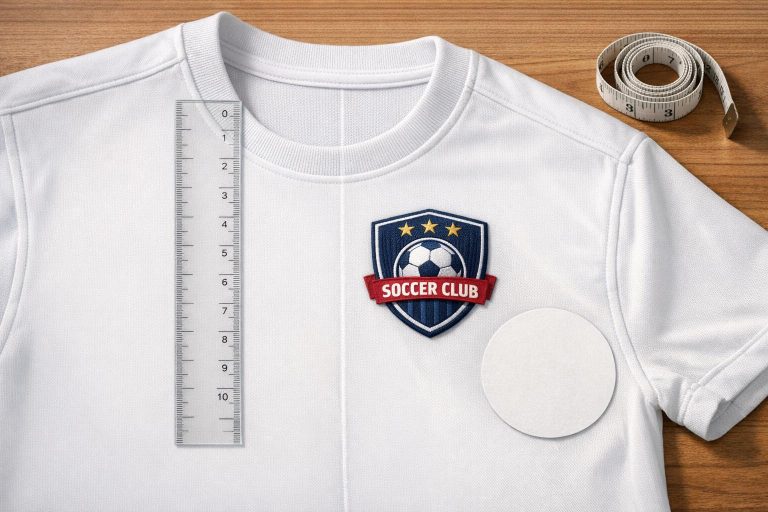
- Left Chest Is Standard: The left chest is the most common spot, symbolizing pride and meeting most league requirements.
- League Rules Matter: Organizations like NCAA, NFHS, and US Youth Soccer have strict size and placement guidelines. For example, NCAA limits logos to 2.25 square inches.
- Alternative Placements: If the left chest is unavailable, consider the upper sleeve or upper back, but always check your league’s rules.
- Design Tips: Use high-contrast colors and scale crests properly for youth and adult jerseys. Avoid overcrowding designs or overlapping numbers and logos.
Key takeaway: Follow your league’s regulations, test designs on different v-neck soccer jerseys and sizes, utilize soccer jersey sizing kits for accuracy, and prioritize clear, compliant placement to avoid game-day issues.
This guide breaks down everything from placement options to common mistakes, helping your team look sharp and stay compliant.
Where to Place Team Crests on Soccer Uniforms
Left Chest Placement for Jerseys
The left chest has long been the go-to spot for team crests. Whether you are designing custom long sleeve jerseys or short sleeve options, placement remains consistent. Positioned over the heart, it’s a powerful symbol of team pride. It’s also the most noticeable area when players are photographed or filmed, making it a prime location for visibility and recognition.
From a rules perspective, this placement often meets NCAA and NFHS standards. Crests designed as a parallelogram or similar shapes can fit within the 2.25 square inch logo limit, ensuring they don’t interfere with player numbers or manufacturer trademarks. This keeps the jersey design clean and compliant.
Other Placement Options
If the left chest is unavailable or reserved for something like a sponsor logo, there are other spots to consider. The upper sleeve is a popular alternative, offering a subtle yet visible placement. This works particularly well when the chest area is already dedicated to sponsorship branding.
Another option is the back of the jersey, though it’s less common for match uniforms. Teams sometimes use this area – specifically the upper back between the shoulder blades – for secondary branding or on warmup and training gear. While these placements can add variety, they’re best used to complement the traditional chest crest rather than replace it entirely. Any alternative placement should still align with league regulations and reflect the team’s identity.
sbb-itb-4d95ad3
Logo Placement 101: Tips to make the Perfect Shirt!
League and Organization Rules for Crest Placement
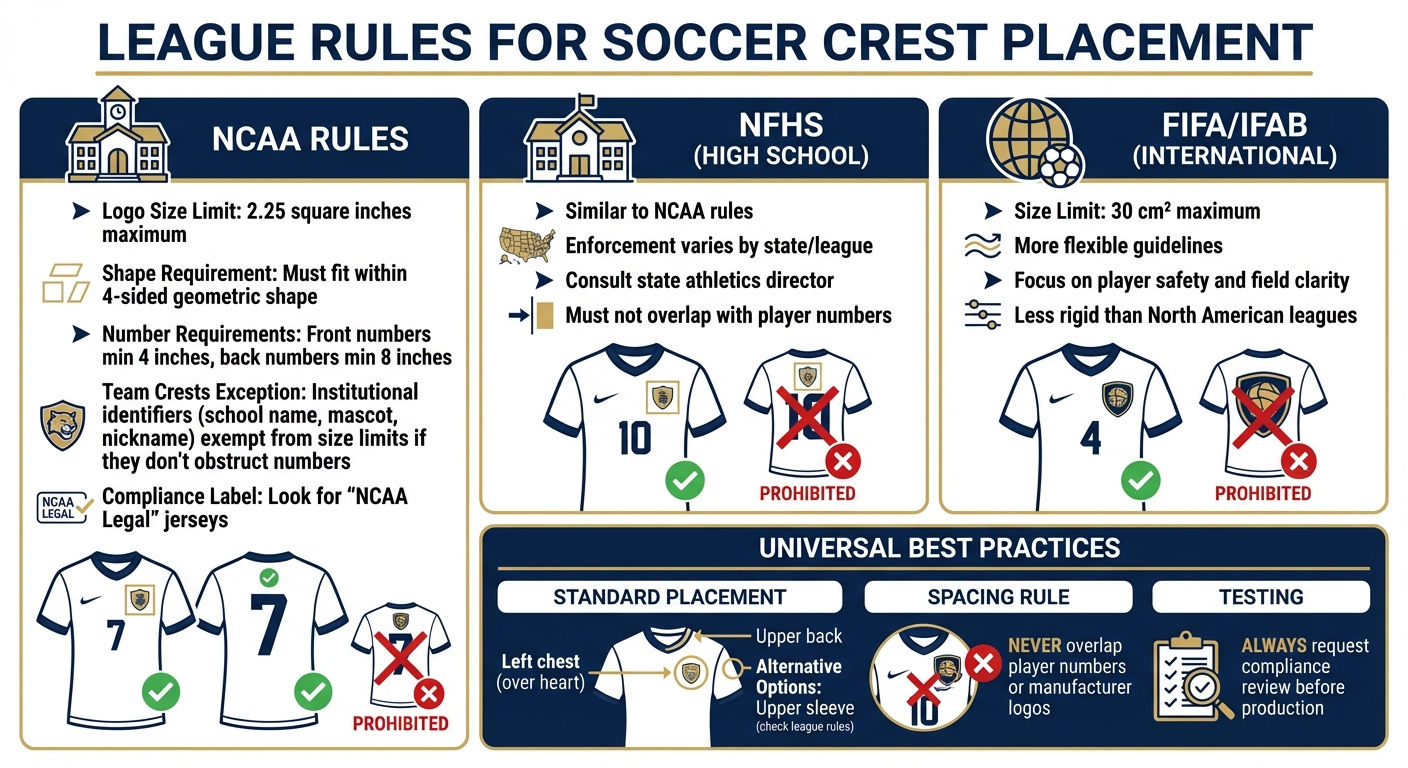
Soccer Crest Placement Rules by League: NCAA, NFHS, FIFA Size and Position Guidelines
FIFA and IFAB Requirements
FIFA and IFAB set global standards for soccer uniforms, focusing on player safety and ensuring clarity on the field. Their guidelines are flexible, emphasizing practicality over rigid size constraints. This approach allows for more creativity in crest placement compared to the stricter rules seen in American collegiate and high school leagues.
On the other hand, North American organizations enforce tighter regulations that significantly influence uniform design.
NCAA, NFHS, and US Youth Soccer Rules
The NCAA enforces detailed rules regarding uniform design. According to the 2016–2017 NCAA Soccer Rules and Interpretations Publication, any manufacturer logo, distributor trademark, or commemorative patch must fit within a four-sided geometric shape – like a square, rectangle, or parallelogram – that does not exceed 2.25 square inches.
"An institution’s uniform… may contain only a single manufacturer’s or distributor’s logo or trademark on the outside of the apparel… The logo or trademark must be contained within a four-sided geometrical figure… that does not exceed 2¼-square inches." – 2016–2017 NCAA Soccer Rules and Interpretations Publication
Player numbers are another key focus of NCAA rules. Numbers must be clearly visible, with front numbers measuring at least 4 inches and back numbers 8 inches. Crests cannot interfere with these measurements. This means many international jersey designs – like Adidas triple stripes on sleeves or large chest logos – don’t meet NCAA standards, as they either exceed size limits or are classified as additional trademarks.
Team crests, however, are treated differently. When they serve as institutional identifiers (e.g., representing a school’s name, mascot, or nickname), they are not subject to the same size restrictions, as long as they don’t obstruct player numbers.
For NFHS (National Federation of State High School Associations) and US Youth Soccer, similar rules apply, though enforcement may vary by state or league. Before purchasing custom long sleeve soccer jerseys for collegiate play, it’s essential to consult your school’s athletics director, as NCAA bylaws can change each season. When shopping, look for jerseys labeled "NCAA Legal" to ensure compliance with the 2.25-square-inch rule.
Understanding these regulations helps guide practical design decisions for creating compliant team crests.
How to Design Crests for Soccer Uniforms
Color and Contrast for Better Visibility
A well-designed crest should stand out clearly against the jersey, even from a distance. To achieve this, focus on color contrast. For dark navy jerseys, use light or bright colors like white, gold, or vibrant shades in your crest. On lighter jerseys, opt for deeper tones such as black, navy, or rich red. The goal is to balance contrast with a design that complements the rest of the uniform.
Stick to simple, bold elements – limit your crest to 2–3 key features like local landmarks, flags (no larger than 2 x 3 inches), or historical icons. Pair these with clean sans-serif fonts for easy readability. Avoid overcrowding the design; clean and recognizable shapes make it easier for fans to identify your crest from the stands. High-contrast colors not only enhance visibility but also ensure compliance with FIFA’s 30 cm² size limit for international matches.
Before finalizing, test your crest on different jersey colors to confirm it remains visible and doesn’t clash with other design elements.
Sizing Crests for Youth and Adult Jerseys
Scaling your crest correctly is essential for maintaining its appearance across youth and adult jerseys. Avoid resizing errors, like applying adult-sized crests to youth jerseys, which can result in oversized, distorted designs that violate NFHS rules. Instead, ensure your crest’s proportions remain consistent across all sizes.
To achieve this, use vector-based designs that scale without losing quality. Create mockups to preview how your crest will look on various jersey sizes, such as youth small, adult medium, and adult extra-large. This helps you identify any potential issues before production. If you’re working with Wooter Apparel’s fully sublimated custom soccer jerseys, you can request digital mockups to see exactly how your crest will appear on different sizes, ensuring a polished, professional look.
Crest Placement Mistakes to Avoid
When designing team uniforms, getting the crest placement right is just as important as creating a standout design. Missteps here can lead to visual clutter, rule violations, or even disqualification. Let’s look at some common mistakes and how to avoid them.
Avoiding Overlap with Numbers and Logos
One frequent mistake is positioning the crest too close to player numbers or manufacturer logos. The crest should never touch or obscure any part of the jersey number – whether it’s on the front or back. Overlapping not only makes the uniform look messy but could also violate governing body rules. To avoid this, measure the placement of the numbers first, then position the crest with enough space to keep everything clear and easy to read.
Manufacturer logos also need proper spacing from the crest. Overlapping these elements can disrupt the uniform’s visual flow and might even breach sponsorship agreements. A smart way to prevent this is by creating a mockup of personalized raglan crew neck jerseys, including the crest, numbers, manufacturer logo, and sponsor patches, to spot any potential conflicts before production begins.
Staying Within Allowed Placement Areas
Placing crests outside the approved zones can result in uniform disqualification. Always consult your league’s specific size and placement guidelines to ensure compliance. Different leagues may have varying rules, so it’s essential to confirm which governing body’s standards apply to your team.
Avoid experimenting with placements on sleeves, the lower back, or the sides of jerseys unless explicitly permitted by your league. The traditional left chest placement is almost always a safe bet and aligns with most regulations. If there’s any doubt, request a compliance review before production to sidestep costly reprints or penalties on game day.
Summary of Crest Placement Best Practices
Getting crest placement right boils down to three main principles: follow your league’s rules, design for visibility, and avoid visual conflicts. Start by checking your league’s specific guidelines – whether it’s FIFA, NCAA, NFHS, or US Youth Soccer. Each organization has its own rules for crest size and placement, but the left chest is usually the safest and most universally accepted spot.
When designing your crest, aim for high contrast between the crest colors and the jersey fabric so it stands out clearly during games. For youth jerseys, use smaller crests to maintain proper proportions and visual balance.
To avoid common mistakes, take the time to verify spacing standards. Rushed designs often lead to errors like overlapping numbers or logos. Keep crests away from unauthorized areas, such as sleeves or the lower back, unless explicitly permitted by your league.
Before finalizing your design, request a compliance review to avoid expensive reprints or issues on game day. Share your league’s requirements with your uniform provider, like Wooter Apparel, to ensure the crests meet all regulations while showcasing your team’s identity.