
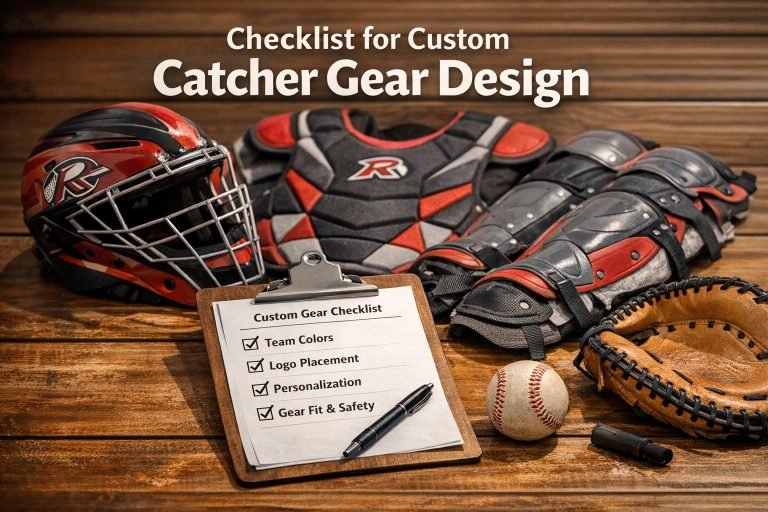
Custom catcher gear is all about safety, performance, and team identity. Properly fitted gear not only protects players but also improves agility and focus during games. Here’s a quick breakdown:
- Safety First: Ensure all gear meets NOCSAE and SEI certification standards. Helmets, chest protectors, and leg guards must comply with league regulations.
- Fit Matters: Ill-fitting gear can compromise protection and slow players down. Use sizing kits to get the right fit for helmets, chest protectors, and leg guards.
- Customization Options: Personalize gear with team colors, logos, and sublimated designs for a professional, unified look.
- Comfort and Materials: Lightweight, durable materials with moisture-wicking liners reduce fatigue. Accessories like knee savers and thumb guards enhance comfort.
- Branding Details: Use vector logos and Pantone colors for consistent designs across all gear.
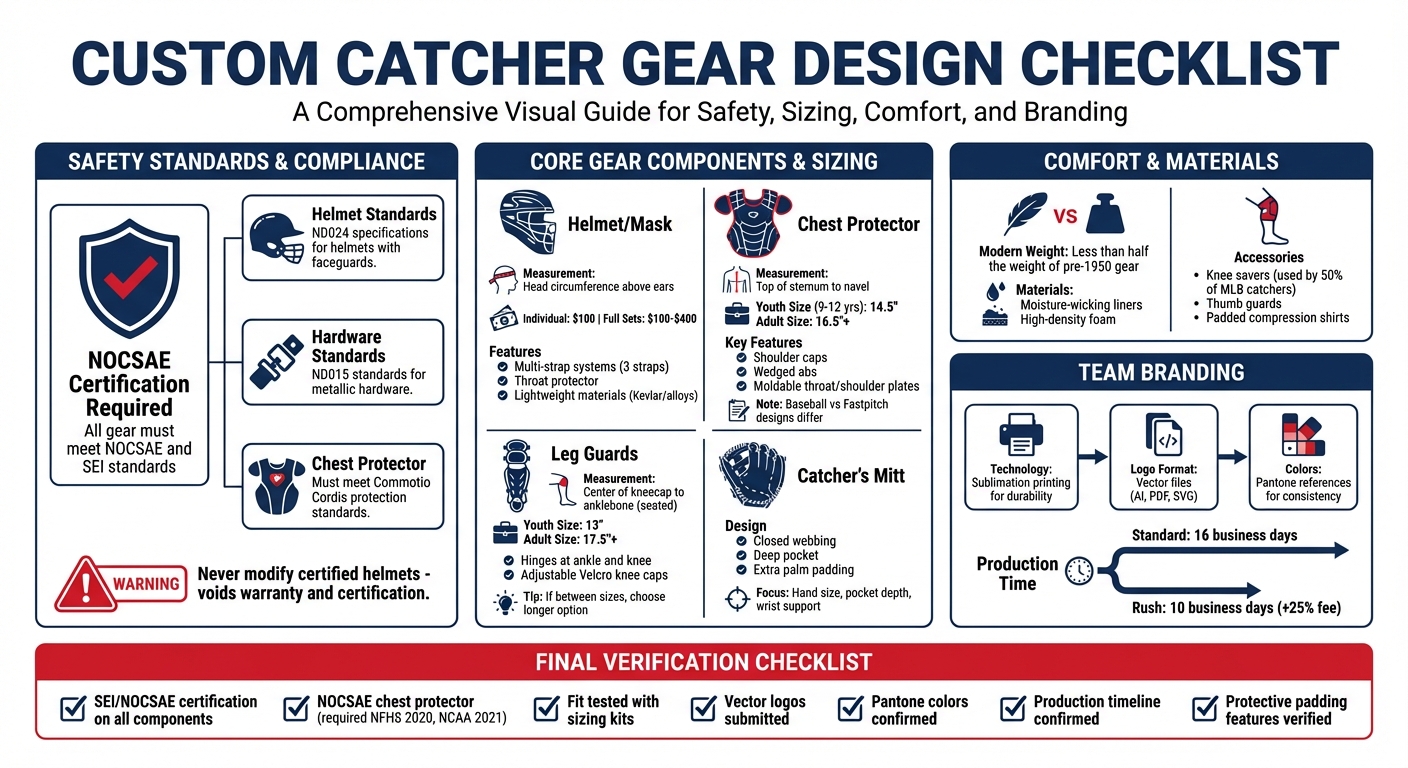
Custom Catcher Gear Design Checklist: Safety, Fit, and Customization Guide
Twins Extras: Jeffers gets custom City Connect mask
Safety Standards and Compliance
When it comes to catcher gear, safety is non-negotiable. All equipment must meet NOCSAE and SEI certification requirements. These certifications ensure the gear has undergone rigorous impact testing, providing players with reliable protection during high-speed impacts. This commitment to safety is at the core of every piece of custom catcher gear.
Verify NOCSAE Certification
Each component of catcher gear must comply with NOCSAE’s testing protocols. For example, helmets with faceguards must meet ND024 specifications, while metallic hardware is tested under ND015 standards. To stay up-to-date, consult the NOCSAE Standards Library for the latest documentation and requirements. During the design process, make sure every element aligns with current NOCSAE protocols to guarantee compliance.
A critical note: Avoid modifying certified helmets. Little League emphasizes:
Altering the helmet in any form, including painting or adding decals may void the helmet warranty and/or NOCSAE certification.
At Wooter Apparel, we ensure our customization process adheres to all certification standards, so teams can enjoy personalized designs without compromising safety.
Check Protective Padding Requirements
Chest protectors are a crucial piece of safety gear and must meet NOCSAE standards for Commotio Cordis protection. Look for chest protectors that feature high-density foam, moldable throat and shoulder plates, and designs that maximize impact absorption. To confirm compliance, always check for both the SEI Certified mark and the NOCSAE logo on the chest protectors. These marks signify that the equipment meets the latest safety standards, providing peace of mind for players and teams alike.
Core Gear Components and Customization
Once safety standards are met, it’s time to fine-tune each piece of gear for the perfect balance of protection, comfort, and style. From helmets to mitts, every item offers opportunities for customization that reflect both the team’s identity and the player’s needs.
Catcher’s Helmet and Mask
For head protection, there are two main options: the traditional two-piece mask and the one-piece hockey-style helmet. The two-piece mask offers an unobstructed view and can be quickly removed to field foul balls, while the hockey-style helmet provides better coverage for the head and ears, making it a common choice in youth leagues.
A proper fit is essential. The helmet’s high-density foam should make full contact with the head to absorb impacts and maintain clear vision. To find the right size, measure the head’s circumference just above the ears. If the measurement falls between sizes, opt for the smaller one for a snug fit.
Look for multi-strap systems (typically three straps on traditional masks) for adjustable placement and tightness. Hockey-style helmets often include adjustable chin pads for a more tailored fit. Premium helmets use lightweight materials like Kevlar or advanced alloys to reduce fatigue while maintaining protection. Don’t forget to add a throat protector that hangs loosely from the mask’s bottom bar to shield the neck while allowing free head movement. Individual helmets cost about $100, while full gear sets range from $100 to $400.
Chest Protector
For high school players, chest protectors must meet NOCSAE standards to minimize the risk of commotio cordis. To find the correct size, measure from the top of the sternum to the navel. Youth sizes (ages 9–12) are typically around 14.5", while adult sizes start at 16.5".
Baseball Monkey highlights a common mistake when buying:
A common mistake people make when purchasing catcher’s gear is when parents buy their kids larger gear thinking they’ll get more use out of it because they can grow into it. Catcher’s gear needs to fit the right way because when gear is too big, it can move around during play and expose certain areas of the body that should be protected.
Chest protectors often feature shoulder caps that attach with Velcro or snaps, offering extra protection and mobility for the throwing shoulder. For fastpitch softball, chest protectors are designed with a "break" in the padding to better fit female players, while baseball models are flatter. Custom designs might include wedged abs or flat chest panels, which help catchers control blocked balls. Adjust the top straps so the protector sits high enough to cover the collarbone without riding up into the chin when crouching.
Leg Guards
To size leg guards, measure from the center of the kneecap to the anklebone (or the cleat lace knot) while seated. If the measurement falls between sizes, go with the longer option. Sizes range from 13" for youth to 17.5" for adults.
Leg guards combine a hard outer shell with soft inner padding. Look for models with hinges at the ankle and knee to allow full mobility during plays. Fastpitch leg guards are specifically shaped to better fit a woman’s leg compared to standard baseball designs.
When fitting leg guards, wear baseball or softball pants to ensure the straps and padding feel game-ready. The ankle plates should rest comfortably on the cleat tongue, providing full coverage without restricting movement. Adjustable Velcro knee caps and elastic straps create a secure fit that prevents shifting during action. For players with high game volume or previous knee injuries, consider adding wedge-shaped foam "knee savers" to the back straps. These reduce joint strain and pressure during crouching.
Once leg protection is sorted, finish the setup with a customized catcher’s mitt that balances performance and team spirit.
Catcher’s Mitt
The catcher’s mitt is the final piece of the puzzle, designed for precision and durability. Customization here focuses on closed webbing for reliable ball control, padding depth to absorb high-speed impacts, and a pocket tailored for catching rather than fielding. Unlike other gloves, catcher’s mitts feature extra palm padding and a deeper pocket to handle fast pitches.
When customizing, consider the player’s hand size, preferred pocket depth, and whether extra wrist support is needed for blocking low balls. A well-fitted mitt should integrate seamlessly with the rest of the gear, offering flexibility for quick transfers to the throwing hand while maintaining durability and comfort during play.
sbb-itb-4d95ad3
Comfort, Material, and Fit
The performance of catcher gear hinges on two key factors: the quality of materials and how well the gear fits. Top-tier equipment uses advanced, energy-absorbing materials to provide lightweight protection, helping players stay agile and reducing fatigue during intense games and practices. These aspects are just as crucial as safety and team branding when designing custom gear, ensuring it meets both performance standards and reinforces team identity. Here’s a closer look at the elements that make a difference.
Lightweight and Durable Materials
Modern chest protectors are a game-changer compared to their pre-1950 counterparts, weighing less than half as much. Many high-end models now feature moisture-wicking liners, which help regulate body temperature during hot games. This keeps players dry, comfortable, and focused on the action.
Comfort Accessories
Comfort-focused add-ons can take gear performance to the next level. For instance, knee savers – foam blocks attached to leg guard straps – help redistribute weight and ease knee strain, a feature used by about 50% of MLB catchers. Another popular accessory is the thumb guard, a plastic splint worn inside the mitt to protect against bruising from hard pitches. Some players even wear padded compression shirts under their chest protectors for added insulation and impact absorption.
Fit Testing Process
Proper fit is non-negotiable for catcher gear. When testing, wear the equipment with baseball pants to ensure the straps feel secure and allow natural movement. Chest protector straps should prevent the gear from riding up into the chin during a squat, while leg guard straps need to be snug without cutting off circulation. As All-Star Sporting Goods highlights:
"A proper fit means better mobility, safer coverage, and less adjusting mid-inning".
Simulated practice sessions can help confirm that Velcro components, like shoulder and knee caps, stay centered and don’t shift during play. Avoid oversized gear, even if it seems practical for "growing room." Ill-fitting equipment can slow players down and increase the risk of injury if it moves out of place.
When it comes to catcher gear, the right materials and a precise fit don’t just enhance performance – they also contribute to a polished, professional team look.
Team Branding and Design
Customizing catcher gear with team branding turns it into a powerful symbol of team pride and professionalism. It’s a way to visually showcase your team’s identity while maintaining a polished, unified look.
Sublimated Designs for Team Identity
Sublimation printing offers a unique way to personalize every inch of catcher gear with team colors, logos, and patterns. This technique embeds designs directly into the fabric, ensuring they hold up through endless games and washes. As Wooter Apparel puts it:
"Sublimation printing is the best printing technology available right now… your designs are brought to life".
Your team logo becomes the centerpiece of the design. To achieve sharp, scalable prints, submit logos in vector formats like AI, PDF, or SVG. For precise color matching, Pantone references are essential, providing consistency across all gear. Wooter Apparel emphasizes this point:
"Pantone is a global standard that ensures we’re all speaking the same language when we talk about color, allowing us to do a better job of producing the colors that you ordered."
Typography also plays a key role. Bold block fonts suit intense sports environments, while script fonts lend a timeless baseball feel. Adding outlines to team names or player numbers helps them stand out against the gear’s background.
Every detail matters. From colors to logos to fonts, a cohesive design ensures all elements of the gear work together to reflect the team’s identity.
Matching Catcher Gear with Uniforms
Coordinating catcher gear with team uniforms strengthens the overall visual impact. Using the same Pantone color references across all gear and apparel ensures a seamless look. High-contrast designs, such as white text on dark backgrounds or dark text on light ones, improve visibility and readability, even from a distance.
For teams planning custom gear, the standard production time for sublimated designs is about 16 business days. Need it faster? Rush orders are available in as little as 10 business days for an additional 25% fee. This flexibility allows teams to prepare for the season opener while accommodating last-minute needs.
Final Checklist for Custom Catcher Gear
Before you place your order, double-check that everything meets the necessary safety standards, fits properly, and aligns with your branding needs. Make sure all components carry the SEI/NOCSAE certification. Keep in mind, NOCSAE-certified chest protectors are required for NFHS baseball (starting January 1, 2020) and NCAA baseball (starting January 1, 2021).
To avoid costly sizing errors, test the fit of your gear using refundable sizing kits. This ensures both comfort and proper dimensions. Wooter Apparel’s custom gear has earned a stellar 4.9/5 star rating from over 1,200 reviews, with users frequently highlighting its quality and comfort.
When it comes to branding, make sure your team’s logos are submitted in vector formats and use Pantone color references to maintain a polished, cohesive look across all gear. Also, confirm production timelines: standard orders take 16 business days, while rush orders can be completed in 10 business days for an additional 25% fee.
Lastly, inspect the protective padding. Look for features like moldable shoulder and throat plates, as well as wedged abs to improve blocking performance. Ensure that all customizations reflect your team’s identity and meet league regulations.
FAQs
Why are NOCSAE and SEI certifications important for catcher gear?
When it comes to catcher gear, NOCSAE and SEI certifications play a key role in ensuring safety and reliability. These certifications mean the equipment has undergone thorough, independent testing to meet strict safety and performance standards.
Choosing certified gear isn’t just about following guidelines – it’s about confidence. Athletes can step onto the field knowing their equipment is built to minimize injury risks while standing up to the demands of the game.
How do I make sure custom catcher gear fits correctly?
To get the best fit for your custom catcher gear, start by measuring key areas: helmet size, chest circumference, and waist. Use a flexible measuring tape for accuracy. Once you have your measurements, compare them to the sizing guide provided by the manufacturer to find the right gear size. Remember, comfort and ease of movement are just as important as the fit – properly adjusted gear ensures both safety and top performance.
What makes sublimation printing ideal for branding custom catcher gear?
Sublimation printing is an excellent choice for custom catcher gear because it produces bright, durable designs that resist cracking, peeling, or fading. This means your team’s branding will look sharp and professional, even after heavy use on the field.
What makes sublimation unique is how the design becomes part of the fabric itself. This process allows for limitless color choices and detailed designs that truly pop. It’s a dependable way to combine standout visuals with the durability and comfort athletes need.