
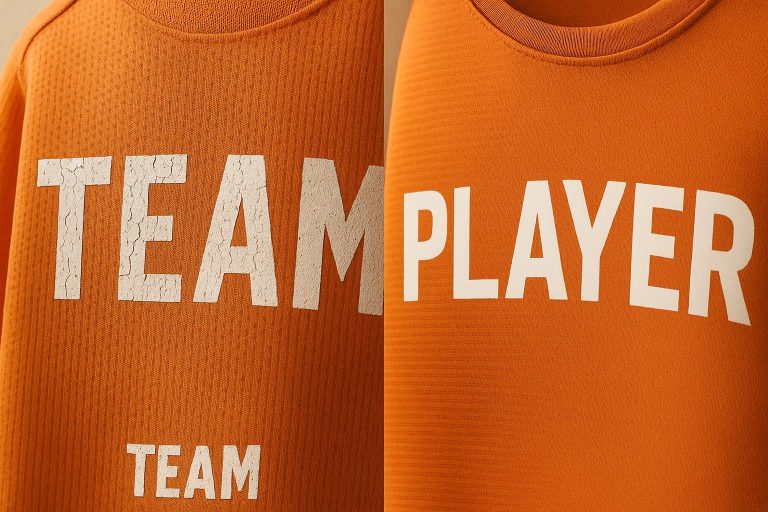
When it comes to team uniforms, durability is a major concern. Heat-transfer and sublimation are two popular methods for applying fonts, but they differ significantly in how they hold up over time. Here’s the key takeaway:
- Heat-transfer fonts sit on top of the fabric, making them prone to cracking, peeling, and fading after about 30–50 washes. They work on various fabrics, including cotton and blends, and are suitable for simpler designs or short-term use.
- Sublimated fonts bond directly into polyester fibers, ensuring they don’t crack, peel, or fade. They last as long as the fabric itself and are ideal for intricate designs and long-term use. However, they only work on light-colored polyester fabrics.
Quick Comparison:
| Method | Durability (Washes) | Fabric Compatibility | Design Complexity | Cost |
|---|---|---|---|---|
| Heat-Transfer | 30–50 | Cotton, polyester, blends | Simple | Lower |
| Sublimation | Fabric lifespan | Polyester only | Complex | Higher |
If you need cost-effective, short-term solutions, heat-transfer is a good choice. For long-lasting, professional-quality uniforms, sublimation is the way to go.
How Each Method Works
Heat-Transfer Font Application Process
Heat-transfer fonts involve placing a design directly onto the fabric’s surface. The process begins by either cutting or printing the font design onto heat-transfer vinyl or specialized transfer paper. Once the design is prepared, it’s carefully positioned on the garment in the desired location.
Next, the garment and transfer material are placed in a heat press, where controlled heat and pressure are applied. Typical settings range between 300-330°F for about 10-15 seconds, depending on the material. The heat activates the adhesive backing on the transfer material, allowing it to bond securely to the fabric’s surface.
After the heat press cycle is complete and the material has cooled slightly, the backing is peeled away. What remains is the design, sitting as a distinct layer on the fabric. This creates a noticeable raised texture, allowing you to feel the design as it contrasts with the surrounding material.
The strength of the bond depends on the adhesive layer. Since the design adheres to the fabric surface rather than integrating with its fibers, heat-transfer is versatile enough to work with cotton, polyester, and various blends. However, this surface-level application also makes the design more susceptible to wear from washing and physical abrasion.
Now, let’s explore how sublimation achieves a different level of durability through molecular bonding.
Sublimated Font Application Process
Unlike heat-transfer, sublimation embeds the design into the fabric itself. This method uses a completely different approach to bonding. The process starts with printing the font design onto special sublimation paper using sublimation ink and a compatible printer. High-quality sublimation paper ensures quick drying, preventing smudges and maintaining vibrant, sharp designs.
The sublimation paper is then placed on the garment, and both are positioned into a heat press. High temperatures (350-400°F) and pressure are applied to convert the ink from a solid to a gas state. During this phase, the gaseous ink penetrates the fabric fibers.
Once in its gaseous form, the dye bonds with the polyester fibers on a molecular level. As the material cools, the dye solidifies, becoming a permanent part of the fabric. This process ensures the design is fully integrated into the material, leaving no raised surface or texture – it feels identical to the original fabric.
This molecular integration makes sublimated fonts incredibly durable, as the ink essentially becomes part of the fabric itself. However, the process has limitations. Sublimation only works with polyester fabrics or surfaces that have a special polymer coating, as these materials can endure the high heat and allow the dye to bond effectively.
Achieving the best results requires precise control over temperature, pressure, and moisture levels to ensure complete dye penetration and a flawless finish.
Durability Comparison
Performance After Repeated Washing
How designs bond to fabric plays a big role in how well they survive the washing machine. Heat-transfer fonts, which sit on top of the fabric as a separate layer, tend to wear out faster. After 30–50 washes, they often show signs of cracking and peeling as the adhesive weakens.
The durability of heat-transfer designs depends heavily on the quality of the vinyl and how precisely the application is done. Mistakes like using the wrong temperature or not applying enough pressure during the transfer can lead to early failure. Even when applied perfectly, the surface-level bond remains prone to damage over time.
Sublimated fonts, on the other hand, hold up much better. In controlled tests, sublimated designs showed no fading, cracking, or wear even after 35 washes. This durability comes from the way sublimation works – the dye bonds at a molecular level with the polyester fibers, becoming part of the fabric itself. Since there’s no surface layer to peel or crack, the design remains intact.
The difference is clear when you compare uniforms after a full season. Heat-transfer fonts often look worn and aged, with visible signs of deterioration. Meanwhile, sublimated fonts retain their sharpness and clarity. For team uniforms that endure frequent washing – sometimes several times a week during a busy season – sublimation offers a clear edge in durability.
Next, let’s look at how these methods handle UV exposure.
Color Retention and Sun Exposure
When it comes to maintaining vibrant colors, the two methods differ significantly. Heat-transfer vinyl struggles with UV resistance, making it prone to fading under prolonged sunlight or bright lighting. Because the vinyl layer sits exposed on the fabric, UV rays gradually break down the pigments, causing colors to lose their intensity.
This fading isn’t limited to outdoor use. Uniforms stored under strong lights, displayed in windows, or worn during outdoor practices can also experience uneven color degradation. Sunlight accelerates the process, leaving heat-transfer designs looking dull and patchy.
Sublimation, however, offers far better color retention. Since the dye embeds directly into the fibers, it’s naturally shielded from UV damage. This makes sublimated designs ideal for outdoor sports, courtside wear, or uniforms displayed under bright lights.
For teams that play outdoor sports like soccer, baseball, or softball, this difference is huge. Heat-transfer designs might look great at the start of the season but can fade noticeably by mid-season. Sublimated fonts, on the other hand, keep their vibrant colors throughout the season and beyond, maintaining a polished, professional look.
Even industrial laundering impacts the two methods differently. Heat-transfer designs often lose color vibrancy under the harsh conditions of heavy washing and high-heat drying. Sublimated designs, with their fiber-deep saturation, remain bright and intact, even after repeated industrial cleaning.
These differences directly affect the overall lifespan of a uniform, as we’ll explore next.
Expected Lifespan
The gap in longevity between these two methods is striking. Sublimated designs last as long as the fabric itself, thanks to the molecular bond between the dye and the polyester fibers. The design doesn’t crack, peel, or fade – it only fails when the fabric eventually wears out.
This durability means sublimated uniforms can serve teams for multiple seasons while maintaining their vibrant colors and professional appearance. Teams that choose sublimation benefit from extended use without needing replacements due to design failure.
Heat-transfer fonts, by contrast, have a shorter lifespan. Under ideal conditions, they can last up to 50 washes. But real-world use often falls short of these conditions. Athletic uniforms face constant challenges – frequent washing, high-heat drying, physical wear during games, and exposure to sweat and outdoor elements. As a result, heat-transfer designs often degrade well before reaching their maximum lifespan.
When factoring in replacement costs, sublimation becomes the more cost-effective choice over time. While heat-transfer designs may be cheaper initially, the need for frequent replacements adds up. Sublimated uniforms, though more expensive upfront, eliminate the recurring costs tied to design failure.
For casual wear or items used occasionally, heat-transfer designs may suffice. But for team uniforms that endure daily wear and rigorous washing, sublimation stands in a league of its own.
Fabric Compatibility and Design Options
Sublimation Fabric Requirements
Sublimation printing works exclusively with polyester or polymer-coated fabrics. This is due to the chemical nature of the process, which requires materials that can endure high temperatures and bond effectively with sublimation inks.
Natural fibers, like 100% cotton, simply don’t work with sublimation. Cotton’s molecular structure prevents the dye from bonding, making it unsuitable for this method. To achieve sublimated fonts, polyester or polyester blends are the way to go.
There’s also a limitation when it comes to colors. Sublimation performs best on light-colored fabrics. Since the dye integrates into the fabric, the base color shows through. Dark fabrics, on the other hand, absorb the colors, leading to muted and less vibrant results. For bold, accurate colors, light-colored polyester is essential.
One of the standout benefits of sublimation is that the dye becomes part of the fabric, leaving no raised texture. For athletes, this means uniforms that feel smooth, breathe well, and avoid any discomfort during intense activity.
Sublimation also shines when it comes to complex designs. It handles full-color graphics, gradients, and even photographic images with precision, delivering sharp, detailed results without registration issues. If your team wants intricate, multi-color fonts or photorealistic designs on light polyester uniforms, sublimation is the ideal choice.
Companies like Wooter Apparel specialize in fully sublimated designs that are durable and tailored for performance. Their polyester uniforms are specifically created for sublimation, eliminating concerns about fabric compatibility. With over 2,000 five-star reviews, their customers frequently highlight the quality and longevity of these uniforms, making them a reliable choice for teams looking to combine style and durability.
Choosing the right fabric is crucial – it directly affects how well the typography holds up over time. While sublimation offers unmatched quality on polyester, heat-transfer techniques provide more flexibility, as we’ll explore next.
Heat-Transfer Fabric Range
Unlike sublimation, heat-transfer printing can be applied to a variety of materials. It works on cotton, polyester, and blends, giving teams more flexibility when selecting fabrics. If your team already has uniforms made from natural fibers or mixed materials, heat-transfer can be a practical solution.
The process differs significantly from sublimation. Heat-transfer creates a physical layer that sits on top of the fabric rather than bonding with the fibers. This results in a slight texture on the surface, though it doesn’t necessarily affect performance.
One major advantage of heat-transfer is its ability to work on both light and dark fabrics. Unlike sublimation, which requires light-colored materials, heat-transfer can handle darker substrates, making it a versatile option for teams with darker uniforms or existing gear.
That said, heat-transfer is better suited for simpler designs. It handles bold, solid-color fonts and straightforward layouts well but struggles with intricate details, gradients, or photographic images. If your design leans toward clean edges and solid colors, heat-transfer will deliver solid results.
However, there are trade-offs. The vinyl layer used in heat-transfer doesn’t integrate with the fabric like sublimation does. This can lead to issues like trapped heat or friction during movement, which might affect comfort and durability.
Ultimately, the choice of fabric and printing method impacts the final product’s appearance, feel, and longevity. For teams looking for high-performance uniforms that can withstand rigorous use, pairing the right fabric with the appropriate method is key. While heat-transfer offers convenience for casual wear or occasional use, sublimation is the better option for professional-grade uniforms designed to last.
sbb-itb-4d95ad3
Choosing the Right Method for Your Team
Balancing Durability and Cost
When deciding between sublimation and heat-transfer, it really boils down to two key factors: how long your uniforms need to last and how much you’re prepared to spend upfront. Sublimation involves a higher initial cost but delivers prints that last as long as the garment itself under normal wear and tear. On the other hand, heat-transfer is a more budget-friendly option, particularly for short-term use, though its lifespan is limited.
For teams that practice frequently and have long seasons, sublimation’s durability offers a lot of value. Over time, sublimated designs stay sharp and intact, while heat-transfer prints tend to crack or peel. While sublimation may cost more upfront, the per-use cost drops significantly when uniforms maintain their appearance season after season.
If your team is working with a tighter budget, heat-transfer might be the way to go initially. DTF heat-transfer provides decent durability for recreational leagues or casual teams, but keep in mind the potential cost of replacing uniforms as the prints wear out. For competitive or performance-driven teams, though, durability becomes a priority. Sublimation’s fiber-deep bonding ensures vibrant colors and a polished look, even after extended use and frequent washing.
Let’s take a closer look at the scenarios where sublimation or heat-transfer might be the better fit for your team.
When Sublimation Is the Better Choice
Sublimation is the go-to option for teams that need uniforms to perform over the long haul. One standout feature is its resistance to UV rays, which keeps colors vibrant even during prolonged exposure to sunlight. This makes it an excellent choice for outdoor sports. Additionally, sublimation is ideal for complex designs, such as logos with gradients, photographic elements, or intricate color schemes. It offers unmatched detail and color accuracy.
For teams planning to reuse uniforms over multiple seasons, sublimation is a solid investment. The design becomes part of the fabric itself, ensuring it stays crisp and vibrant through countless washes and wears.
Take Wooter Apparel, for example. They specialize in fully sublimated uniforms designed for teams that demand high-quality, long-lasting gear. With an impressive 4.9 out of 5 stars from 1,238 reviews, their customers frequently highlight the durability and aesthetics of their products. Jason P., a satisfied customer, shared:
Awesome product! Great company, uniforms were awesome and the customer service was even better. The uniforms are very well made and of great quality.
When Heat-Transfer Is the Better Choice
Heat-transfer, on the other hand, is a practical solution in scenarios where sublimation isn’t an option. For teams using cotton or cotton-blend uniforms, heat-transfer is often the only way to add designs, as sublimation doesn’t work on natural fibers.
Dark-colored uniforms are another area where heat-transfer shines. While sublimation requires light-colored fabrics for vibrant results, modern DTF techniques with a white underbase can produce bold, bright colors on darker materials like cotton or fleece. For recreational leagues or casual teams that don’t need uniforms to last multiple seasons, heat-transfer offers a cost-effective option.
Additionally, teams with simpler design needs – such as solid-color names and numbers without gradients or intricate details – will appreciate heat-transfer’s straightforward application process. It’s a great choice for teams looking for quick and simple solutions at a lower price point.
Conclusion
Main Points on Durability and Performance
When it comes to team uniforms, durability is a key factor. Sublimation embeds ink directly into the fabric fibers, ensuring designs won’t crack, peel, or fade over time. In contrast, heat-transfer methods apply designs to the fabric’s surface, which can lead to earlier signs of wear. For example, heat-transfer vinyl often shows visible wear after about 50 washes, while modern Direct-to-Film (DTF) prints can last between 60 to 100 hot-water washes before micro-cracks appear.
Environmental factors also play a role in longevity. Sublimated prints offer excellent resistance to UV rays, keeping colors vibrant even after extended exposure to sunlight. On the other hand, heat-transfer prints may fade gradually under the same conditions. For teams relying on commercial or industrial laundering, sublimation often outperforms other methods in maintaining design integrity.
Choosing the best method comes down to your team’s specific needs. If your uniforms will face frequent washing, outdoor conditions, and multiple seasons of use, sublimation is the more durable option. However, for short-term use, cotton fabrics, or tighter budgets, heat-transfer can still be a practical choice. Consider the fabric type, expected garment lifespan, and how intensely the uniforms will be used when making your decision.
Wooter Apparel: Custom Team Uniform Solutions
Wooter Apparel offers a solution that aligns with these durability insights. Their fully sublimated apparel is crafted for the demands of athletic use, with designs permanently embedded into the fabric to avoid common wear issues.
With an impressive 4.9-star rating from 1,238 reviews, Wooter Apparel has built a strong reputation for quality and reliability. Their custom team uniforms utilize sublimation technology across sports like basketball, football, baseball, softball, and soccer. Customers consistently praise the lasting performance and vibrant designs that meet high durability standards. Plus, Wooter Apparel provides free custom design services, ensuring your team’s uniforms look great and hold up through repeated use. Check out their offerings at Wooter Apparel.
Heat Transfer VS Sublimation (Sportswear Secrets)
FAQs
What should I consider when deciding between heat-transfer and sublimation for team uniforms?
When deciding between heat-transfer and sublimation for team uniforms, it’s important to weigh durability and design versatility. Heat-transfer involves applying a design as a layer on top of the fabric. This makes it a solid choice for smaller orders or straightforward designs. That said, the design layer can show signs of wear over time, especially with frequent washing or heavy use.
In contrast, sublimation infuses the design directly into the fabric, delivering vibrant colors that won’t crack, peel, or fade. This technique works best on polyester and is perfect for detailed, all-over designs. For sports teams looking for durable, professional-looking uniforms, sublimation often stands out as the go-to option.
How does fabric choice impact the durability and look of heat-transfer and sublimated fonts?
The choice of fabric is crucial for both the durability and overall look of heat-transfer and sublimated fonts. Heat-transfer designs stick best to smooth, synthetic fabrics like polyester. They provide a sleek finish but can crack or peel over time, especially when applied to stretchy or textured materials. Sublimation, however, thrives on polyester fabrics, as the dye integrates directly into the fibers, resulting in vibrant, long-lasting designs that resist fading, cracking, or peeling.
To get the best results, opt for high-quality polyester fabrics for sublimation to preserve sharpness and color vibrancy. For heat-transfer designs, smooth, non-stretch materials are ideal for better durability and appearance.
Can sublimation printing be done on dark fabrics, and what are the best alternatives for vibrant designs on dark uniforms?
Sublimation is most effective on light-colored fabrics because the process embeds dye directly into the material, which doesn’t stand out well against dark backgrounds. For darker fabrics, heat-transfer printing offers an excellent solution. This method ensures vibrant, detailed designs that pop even on dark materials.
When designing custom dark uniforms, pairing premium heat-transfer techniques with sturdy fabrics is a smart choice. This combination guarantees your designs stay vivid and durable, even after repeated wear and washing.