
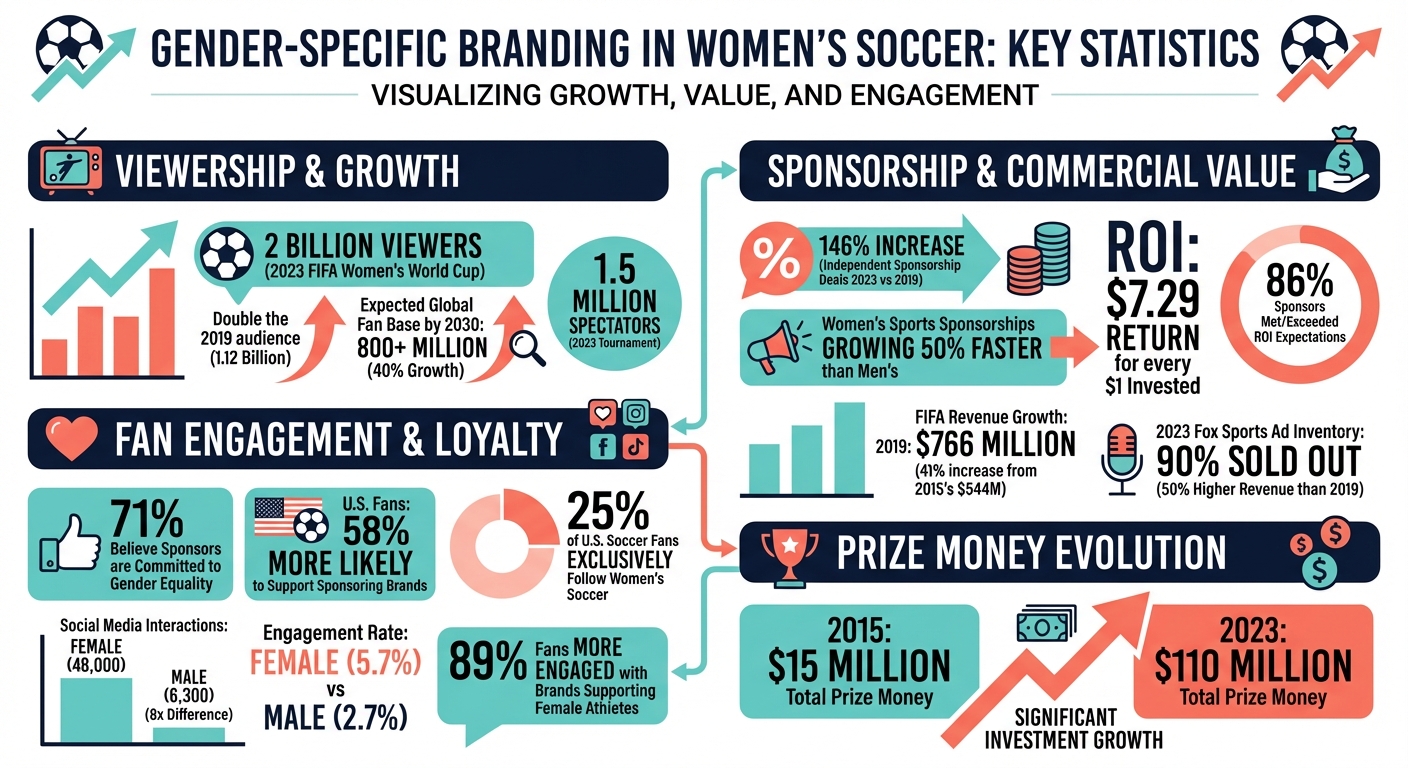
Gender-specific branding in soccer is reshaping how women’s and men’s teams are marketed, celebrated, and perceived. By unbundling sponsorship rights and creating distinct team identities, brands are connecting with fans on issues like gender equality and empowerment. The 2023 FIFA Women’s World Cup, for example, drew 2 billion viewers – double the 2019 audience – and saw a 146% increase in independent sponsorship deals. Yet, challenges remain: 96% of female players still wear kits designed for men, highlighting gaps in practical support.
Key insights include:
- Bias in perception: A University of Zurich study found viewers rated women’s soccer lower when players’ genders were known, but ratings equalized when gender was hidden.
- Fan loyalty: 71% of Women’s World Cup fans believe sponsors are committed to gender equality, and U.S. women’s soccer fans are 58% more likely to support brands that invest in the sport.
- Commercial growth: Sponsorships in women’s sports are growing 50% faster than in men’s, with an average $7.29 return for every $1 invested.
From custom uniforms to targeted campaigns, gender-specific branding is not just improving visibility but also creating tangible financial returns for brands and teams alike.
Women’s Soccer Growth: Key Statistics on Viewership, Sponsorship, and Fan Engagement
Branding’s Impact on International Soccer Tournaments
What Gender-Specific Branding Means
In soccer, gender-specific branding goes far beyond surface-level marketing – it shapes how teams define themselves through their visual identity, merchandise, and overall image. This includes elements like uniform designs, team logos, and even how players present themselves on platforms like social media. Research indicates that elite female players often emphasize professionalism, skill, and competitiveness to connect with their audience. Ana Cristina Picinin De Rezende Costa put it succinctly:
"The footballers presented themselves first as players and second as females".
This strategy fosters credibility, appealing to fans who prioritize performance and athleticism over gender-focused narratives.
Still, the sports industry is heavily influenced by gender stereotypes, with sociocultural norms often favoring masculinity. These biases can lead to reduced investment in women’s sports, limiting resources that could enhance performance. Studies show that such perceptions often outweigh evaluations based on actual performance quality. Despite these challenges, the branding of women’s soccer has undergone a remarkable shift in recent years, reflecting a broader change in how the sport is perceived.
Soccer Branding Through the Years
The branding of women’s soccer has come a long way from its early days when it was overshadowed by gendered stereotypes. For example, the inaugural FIFA Women’s World Cup in 1991 was dubbed the "M&M Cup" due to the scarcity of sponsorship deals. Fast forward to 2019, and the tournament attracted a global broadcast audience of 1.12 billion viewers. By 2023, commercial partnerships for the Women’s World Cup had more than doubled compared to 2019, showcasing a major shift in how brands view these tournaments – not as secondary events, but as standalone opportunities with immense potential.
This evolution mirrors a larger movement within women’s soccer, as it steps out of the shadow of the men’s game to establish its own fanbase and market identity. Sponsorships in women’s sports are now growing 50% faster than in men’s leagues, with 86% of sponsors reporting that their investments met or exceeded their return on investment expectations. These trends highlight that gender-specific branding strategies are not just socially forward-thinking – they also make strong business sense.
How Culture and Society Shape Branding Decisions
Cultural factors are now playing a central role in shaping branding strategies for women’s soccer. Research shows that international success for women’s teams is more closely tied to proactive policies supporting women’s sports and gender equality than to a nation’s economic strength. This means that effective branding must align with local social values and reflect progress in gender equity.
The fanbase of women’s soccer also reflects these cultural shifts. For example, 24% of female fans fall into the 16–24 age group, compared to just 14% of male fans. These younger, tech-savvy fans expect brands to take meaningful stances on social issues. In fact, 89% of fans are more engaged with brands that support female athletes, and 68% of female fans are more likely to buy from companies that sponsor their favorite teams or leagues. Companies like Wooter Apparel are tapping into this ethos by designing custom uniforms that blend high-performance functionality with cultural relevance, helping teams build identities that resonate with diverse audiences.
sbb-itb-4d95ad3
Gender-Specific Branding Effects on Performance and Perception
Building Player Confidence and Team Unity
How players perceive themselves is deeply influenced by gender-specific branding. Research indicates that creating distinct branding for women’s teams – like maintaining separate social media accounts – helps build a stronger team identity and advances individual careers. In contrast, combining branding efforts with men’s teams often reinforces gender biases, limiting opportunities for female athletes to gain proper recognition. Nataliya Bredikhina, Assistant Professor of Sport Management at the University of Kansas, highlights this issue:
"Intuitively, you’d think when men and women are branded together on one account it would be good… But it actually has the opposite effect. It verifies, essentially, the same gender discrimination we see online and in society."
Beyond social media, portraying female athletes as “agents of change” and “role models” fosters a sense of purpose and identity, particularly for younger audiences. This approach not only boosts players’ confidence on the field but also strengthens their professional image. Teams that invest in unique and empowering visual identities help athletes feel respected and valued, which in turn enhances fan loyalty and opens doors to greater commercial success.
Fan Engagement and Commercial Value
Gender-specific branding doesn’t just uplift players – it also delivers measurable commercial benefits. Female athletes significantly outperform their male counterparts in social media engagement, with posts from women athletes averaging 48,000 interactions compared to just 6,300 for men – an impressive eightfold difference. This heightened engagement translates directly into economic value: for every $1 invested in women’s elite sports, corporate sponsors see an average return of $7.29 in customer value.
Fans of U.S. women’s soccer, in particular, exhibit extraordinary loyalty. Research shows that 78% of these fans trust women athletes, and they are 58% more likely to support brands that sponsor women’s sports. Additionally, 25% of U.S. soccer fans exclusively follow women’s soccer, underscoring the sport’s distinct and dedicated audience. Leela Srinivasan, CEO of Parity, emphasizes the opportunity this creates for brands:
"In an era when trust is the hardest currency to earn, women’s soccer fans are essentially handing brands a blank check – if the brand shows up authentically."
Custom uniforms from Wooter Apparel capitalize on this dynamic by offering teams the ability to design high-quality, personalized apparel that reflects their unique identity. This investment not only strengthens player unity but also resonates with an engaged fanbase, driving both emotional connection and commercial growth.
Case Studies: Successful Gender-Specific Branding Examples
FIFA Women’s World Cup
The FIFA Women’s World Cup has become a standout example of how gender-specific branding can deliver real results. The 2023 tournament reached an estimated 2 billion people worldwide and drew 1.5 million spectators, proving just how much global interest there is in women’s soccer. This enthusiasm was matched by a significant financial commitment: total prize money soared to $110 million, a dramatic leap from $15 million in 2015.
Major brands leaned into this momentum with campaigns tailored specifically for women’s soccer. In June 2023, Nike introduced custom kits for the U.S. Women’s National Team, drawing inspiration from abstract expressionism to set them apart from European styles. Visa took another route in July 2023 by launching a fan-voted "Player of the Match" award for all 64 games. On top of that, Visa supported woman-owned small businesses in each winner’s home country with contributions ranging from $5,000 to $50,000. Meanwhile, The Lego Group joined the conversation with its 899-piece "Icons of Play" set, spotlighting soccer stars like Megan Rapinoe, Sam Kerr, Yuki Nagasato, and Asisat Oshoala as part of their "Play Unstoppable" campaign aimed at challenging gender stereotypes.
The commercial results were just as impressive. By early June 2023, 90% of ad inventory on Fox Sports had already sold out, with revenue climbing 50% higher than in 2019. Andrea Fairchild, Visa’s Senior Vice President and Head of Sponsorships, highlighted the power of focusing solely on women’s soccer:
"The separating of the FIFA Women’s World Cup from the men’s World Cup just gave us the ability to continue our commitment to women’s football in what I would say is a bit more dynamic way."
By unbundling media and sponsorship rights, brands could directly invest in women’s soccer instead of treating it as an add-on to men’s tournaments. This approach paid off: FIFA brought in $766 million in revenue during the 2019 Women’s World Cup year – a 41% increase from the $544 million earned in 2015. As the sport grows, teams can tap into this momentum by working with companies like Wooter Apparel to design custom v-neck soccer jerseys that reflect their unique identity and connect with this expanding audience.
Olympic Soccer Tournaments
Unlike the FIFA Women’s World Cup, Olympic soccer tournaments embrace a unified national branding strategy. During the 2012 London Olympic Games, both men’s and women’s teams represented their countries under a shared identity. This approach allowed female athletes to be seen as "model citizens" and "serious athletes", rather than being primarily defined by their gender. The shift was particularly impactful in the UK, where the 2012 Olympics marked a turning point. Researchers noted a move away from institutional sexism in 2011 to what they described as a "new age" of respectful media coverage.
The branding during the Olympics focused on "football-centered coverage", steering away from gendered narratives. Researchers Stacey Pope, Rachel Allison, and Kate Petty emphasized:
"This is especially the case during high-profile international events, where the conventional rules for reporting on women’s sport can be ‘bent’ and national identity overrides gender identity."
This strategy ensured that women’s teams received the same level of prestige and media attention typically reserved for men’s soccer, particularly during the tournament itself. However, maintaining this visibility after the event has remained a challenge, with women’s sports accounting for only 5–10% of total sports media coverage.
What’s Next for Gender-Specific Soccer Branding
New Developments in Uniform Design
The future of soccer branding for women is heading toward a more tailored approach, focusing on the specific needs of female athletes. In June 2023, Adidas made waves by introducing its largest-ever women’s kit bag for the FIFA Women’s World Cup. This included the "Oceaunz" Official Match Ball equipped with connected ball technology, alongside custom-fitted sports bras and period-support shorts featuring FlowShield Technology. Adidas also significantly increased its production of women-specific products, offering 15 times more in 2023 compared to 2019. This focus on functionality addresses critical concerns, such as the fact that breasts can move up to 7.5 inches during high-impact activities, with 75% of female athletes expressing worries about leaks. Claudia Scholl highlighted the importance of proper fit, stating:
"Breasts can move up to 19cm in high impact movements. Players can make 100 sprints in a game where they reach in excess of 20KM/h. So correctly fitting product is essential".
Beyond functionality, teams are using custom-designed kits to make bold branding statements. For example, in March 2024, FC Bayern Munich Women debuted their first bespoke kit, featuring a sleek black design with orange-pink pinstripes, created in collaboration with Adidas, the players, and model Lena Gercke. Similarly, in 2025, Legia Warsaw‘s women’s team introduced Poland’s first custom jersey for women. COO Amanda Pietrzak emphasized the growing momentum of the sport:
"Women’s football does not wait for permission; it craves focus".
For teams aiming to combine performance with unique identity, providers like Wooter Apparel offer fully customized designs that meet both aesthetic and technical demands. While innovation continues to enhance on-field performance, ethical production practices are also reshaping the broader industry.
Environmental and Ethical Production Practices
Sustainability and ethical practices are becoming essential elements in gender-specific soccer branding. With 57.1% of German fans indicating they would pay more for sustainable merchandise, leagues are now requiring transparency in environmental and social sustainability efforts. For instance, fans were willing to pay an average of $39.18 for a sustainably produced t-shirt, compared to $32.82 for a conventional one.
Ethical considerations are also influencing uniform design, particularly when it comes to reducing period-related stress. Research shows that dark-colored shorts can improve performance by alleviating anxiety, leading teams like England, New Zealand, Manchester City, and Orlando Pride to adopt them over traditional white options. Sports economist Alex Krumer strongly supported this shift:
"This is one of the easiest conclusions for policy advice that I can give… Don’t play in white shorts, full stop".
England defender Lucy Parker echoed this sentiment, adding:
"Anything that relieves the mental stress of the players is a good thing. If it’s one less thing to worry about, then why not?".
The link between sustainability and gender equality is also gaining attention. A study in the MDPI Sustainability Journal found that national success in women’s soccer correlates with investments in broader sustainability efforts, including gender equality. The journal noted:
"Sustainability and gender equality are deeply linked because inclusive innovative policies ensure women’s participation in environmental, economic, and social decision-making".
With the global fan base for women’s soccer expected to grow by nearly 40% by 2030, reaching over 800 million people, teams and brands that focus on both cutting-edge performance and ethical production will be best positioned to thrive in this expanding market.
FIFA unveils 2027 women’s world cup logo
Conclusion: Main Points on Gender-Specific Soccer Branding
Gender-specific soccer branding has grown from an overlooked concept to a key force driving both performance and fan engagement. Studies reveal that when gender differences are minimized, player ratings become equal. This finding challenges the outdated logic that has long been used to justify lower investments in women’s soccer.
Branding plays a direct role in boosting team performance and player confidence. From custom crew neck soccer jerseys to high-quality facilities, modern branding strategies support athletes on and off the field. For example, female athletes see a 5.7% engagement rate on social media – more than double the 2.7% rate for male athletes. Additionally, 78% of women’s soccer fans report trusting female athletes "a lot", creating a strong base for loyalty.
These engagement numbers also open doors to commercial growth. Women’s soccer fans are 58% more likely to purchase sponsored products compared to fans of other women’s sports. With the global fan base projected to surpass 800 million by 2030 and 25% of U.S. soccer fans exclusively watching women’s games, the market is rich with branding potential.
The move toward athlete-focused collaborations and purpose-driven branding reflects changing fan expectations. Teams that prioritize professional identity and authentic, custom soccer hoodies are better positioned for long-term success. Researcher Carlos Gómez González has highlighted how gender biases shape perceptions of women’s soccer, emphasizing that thoughtful branding can help shift these attitudes.
FAQs
What is gender-specific soccer branding?
Gender-specific soccer branding uses targeted marketing and design strategies to differentiate between men’s and women’s soccer. This often includes distinct visual elements, messages, and imagery crafted to appeal to specific audiences, aligning with societal expectations around gender.
Why does “unbundling” sponsorship rights matter?
Unbundling sponsorship rights plays a key role in giving women’s sports the chance to stand on their own. By marketing and valuing them independently from men’s sports, it opens up fresh revenue opportunities and draws in sponsors who recognize the potential for growth in women’s competitions. This separation allows women’s sports to carve out their own identity, attract committed partners, and build a foundation for sustained growth and greater visibility.
How can teams turn branding into better uniforms?
Teams can make their uniforms stand out by weaving in design elements that showcase their identity and resonate with fans. Incorporating regional, historical, or symbolic motifs can create a strong sense of connection and pride. Retro-inspired designs or bold, distinctive graphics not only enhance the visual appeal but also help solidify the team’s branding. Adding a personal touch – like involving fans in the design process or including local symbols – can make uniforms feel more meaningful. This approach not only strengthens community ties but also boosts the appeal of merchandise.