
Looking to make your team uniforms eco-friendly? Biodegradable fabrics are a smart choice for reducing waste without compromising performance. These materials naturally decompose, unlike synthetic fabrics that pollute for centuries. Popular options like organic cotton, bamboo, and Tencel® offer comfort, durability, and moisture-wicking properties tailored to different sports. Certifications like GOTS and OEKO-TEX ensure the materials meet safety and sustainability standards. Partnering with trusted suppliers and custom apparel providers simplifies the process of sourcing and designing biodegradable uniforms. Here’s everything you need to know to get started.
20 Textile Certifications You Must Know | OEKO-TEX, GOTS, GRS, ISO & Fabric Sourcing Guide
sbb-itb-4d95ad3
Biodegradable Fabric Options for Sports Teams
Biodegradable Fabric Comparison for Sports Teams: Organic Cotton vs Bamboo vs Tencel
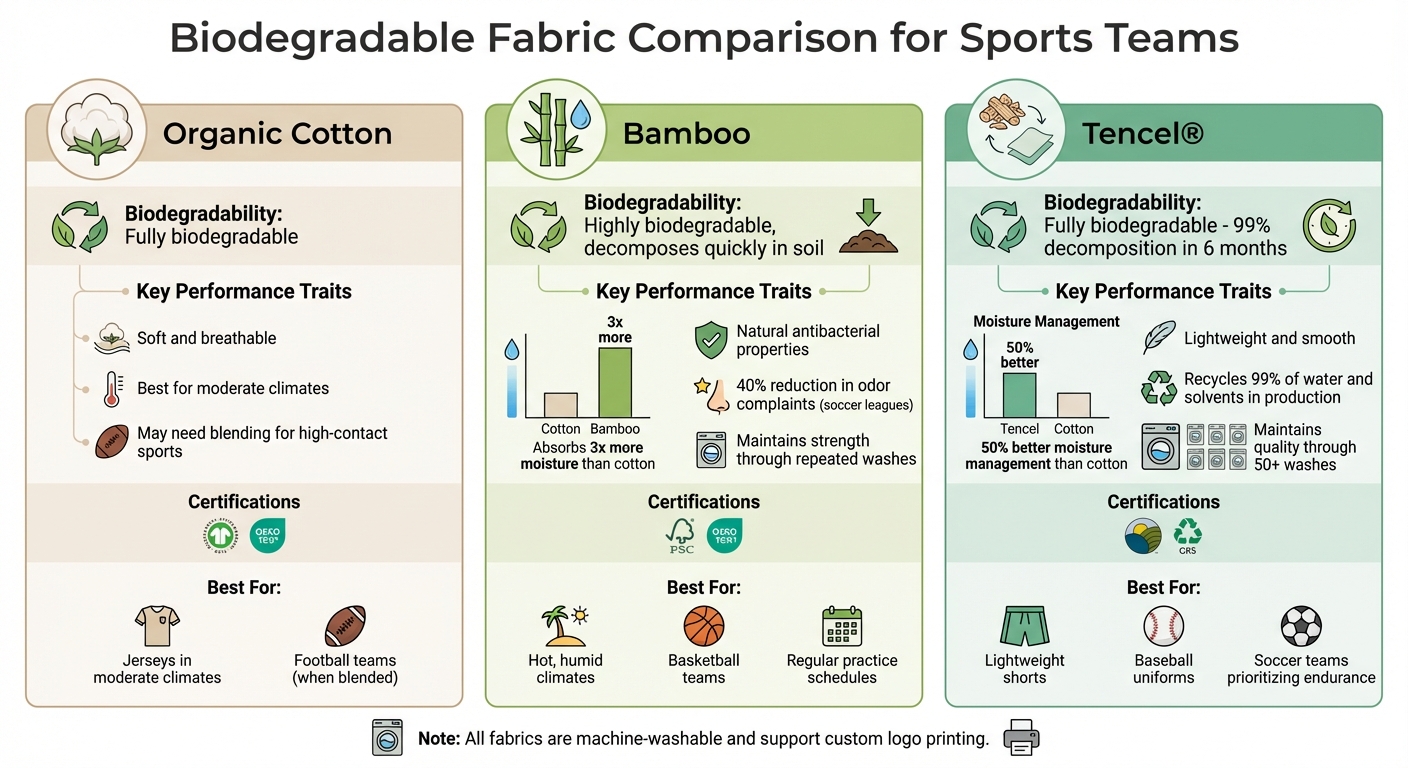
When it comes to outfitting sports teams, choosing the right biodegradable fabric is about more than just environmental awareness – it’s about balancing sustainability with athletic performance. Popular choices like organic cotton, bamboo, and Tencel® each bring unique strengths to the table, making them suitable for different sports, climates, and performance needs.
Organic cotton is a fully biodegradable option grown without toxic pesticides or GMOs. It’s naturally soft and breathable, making it a great choice for jerseys in moderate climates. Certified by GOTS, this fabric avoids harsh chemical treatments, but its durability might need a boost from blending with other fibers for high-contact sports like football.
Bamboo fabric stands out for its moisture-wicking abilities, absorbing up to three times more moisture than cotton. Its natural antibacterial properties help reduce odor, which is a game-changer for teams practicing regularly. In fact, some soccer leagues reported a 40% drop in odor complaints after switching to bamboo uniforms. Plus, bamboo decomposes quickly in soil while maintaining its strength through repeated washes.
Tencel®, made from wood pulp, is another lightweight, biodegradable choice. It offers 50% better moisture management than cotton, making it ideal for gear where speed and comfort are key, like lightweight shorts or baseball uniforms. Tencel® is fully compostable, breaking down 99% in soil within six months. Produced through a process that recycles nearly all water and solvents, it’s also a standout for eco-conscious teams.
Biodegradable Fabric Comparison
| Fabric | Biodegradability Benefits | Performance Traits | Certifications |
|---|---|---|---|
| Organic Cotton | Fully biodegradable | Soft, breathable | GOTS, OEKO-TEX® |
| Bamboo | Highly biodegradable | Moisture-wicking, durable | FSC, OEKO-TEX® |
| Tencel® | Fully biodegradable | Lightweight, smooth | USDA Biobased, GRS |
How to Choose the Right Fabric for Your Team
Selecting the best fabric depends on your sport, climate, and performance needs. For example, basketball teams in hot, humid areas – like the Southern U.S., where summer temperatures often hit 80°F or higher – can benefit from bamboo’s moisture-wicking properties to prevent chafing during intense games. Football teams, facing the rigors of contact-heavy play, may prefer organic cotton blends for their mix of breathability and durability. Soccer teams prioritizing endurance might lean toward Tencel® for its lightweight feel, allowing for better movement on the field.
Weather also matters. Teams in cooler, wetter regions like the Pacific Northwest might appreciate organic cotton’s breathable comfort, while bamboo or Tencel® are better suited for hot summer practices and games.
Other factors to consider include cost, maintenance, and customization. All three fabrics are machine-washable and support custom logo printing. Testing samples is a smart move – check how the fabrics perform with sublimation printing and through repeated washes. Both bamboo and Tencel® typically hold up well, maintaining their quality through 50+ washes. Once you’ve narrowed down your choice, the next step is finding a reliable supplier to bring your team’s uniforms to life.
Certifications to Look for When Sourcing Biodegradable Fabrics
After selecting potential fabrics, the next step is ensuring they align with sustainable practices. Certifications play a key role here, as they provide third-party verification to confirm that fabrics meet specific environmental and safety standards. This step is essential for ensuring your team uniforms meet sustainability goals.
Main Fabric Certifications
Global Organic Textile Standard (GOTS) stands out as the leading certification for organic fibers. It covers the entire supply chain, from harvesting to labeling, and requires fabrics to contain at least 70% or 95% certified organic fibers. GOTS also enforces strict environmental, social, and chemical guidelines. The latest version, GOTS 8.0, released in March 2026, introduces new requirements for due diligence, stricter chemical criteria, and measures to address textile waste.
"GOTS certification guarantees: environmentally friendly production and processing processes, respect and improvement of working conditions, and the prohibition of hazardous inputs such as toxic heavy metals." – Ecocert
OEKO-TEX® Standard 100 focuses on consumer safety by testing finished textile products for harmful substances, ensuring they are safe for direct skin contact.
Global Recycled Standard (GRS) certifies fabrics for recycled content and includes additional environmental and social requirements. It mandates a minimum of 20% recycled content for tracking purposes and ensures proper documentation throughout the supply chain.
Organic Content Standard (OCS) tracks and verifies the organic material content in a finished product. It’s particularly useful for blended fabrics, such as cotton-elastane mixes, where GOTS criteria may not apply but organic content still needs to be confirmed.
| Certification | Primary Focus | Fiber Requirement | Social/Chemical Criteria |
|---|---|---|---|
| GOTS | Organic integrity & processing | 70% or 95% organic | Strict social and chemical limits |
| OCS | Fiber traceability | Any % of organic | No social or chemical requirements |
| OEKO-TEX | Human safety/Toxicity | N/A | Focuses on harmful substance testing |
| GRS | Recycled content | Minimum 20% for tracking | Includes social/environmental criteria |
These certifications not only validate sustainability but also ensure fabrics meet both quality and environmental standards.
How Certifications Verify Quality and Environmental Standards
Certifications go beyond labels – they involve detailed processes to confirm that fabrics meet ethical, environmental, and performance expectations. For example, GOTS certification includes annual on-site inspections of all operators, from post-harvest handling to garment manufacturing. This rigorous process supports organic production systems, which can reduce water usage by up to 80% compared to conventional methods.
Understanding the distinction between Scope Certificates (SCs) and Transaction Certificates (TCs) is also important. Scope Certificates verify a supplier’s overall capability, while Transaction Certificates confirm that a specific shipment complies with the standard. Always request a Transaction Certificate with each order to ensure transparency.
To avoid falling for misleading marketing claims, verify certifications by checking the product label for a license number or QR code. Use official databases like the GOTS public database or the OEKO-TEX Label Check to confirm authenticity. A valid GOTS label, for instance, will include the logo, grade, certification body name, and license number.
"If something is GOTS + OEKO-TEX, it’s almost always a great choice." – Lexy Silverstein
Consumers are increasingly drawn to verified sustainable products, with research showing these items can achieve 15–20% higher online conversion rates. For teams, this transparency fosters trust among parents, sponsors, and community members who prioritize eco-friendly choices. Be aware, though, that certified organic fabrics often come with a 15–30% price premium due to audit costs, segregation requirements, and lower farm yields. To ensure availability, plan ahead – sourcing certified organic or biodegradable fabrics typically requires 3–6 months to secure certified lots and proper documentation.
How to Source Biodegradable Fabrics for Team Uniforms
Sourcing biodegradable fabrics for team uniforms involves more than just finding a supplier. It requires thorough vetting, careful budget planning, and testing fabric samples to ensure they meet both performance and sustainability needs.
Finding and Vetting Suppliers
Start by identifying suppliers that specialize in certified biodegradable materials. To confirm their legitimacy, request a Scope Certificate (SC) and certification license number. Cross-check these details using official databases like the GOTS Public Database to verify their authenticity.
To avoid falling for unverified claims, ask suppliers for third-party lab reports detailing biodegradation rates. Additionally, inquire about their use of biodegradable or low-impact dyes and whether they offer recycled biodegradable options, such as polyester enhanced with CiCLO technology.
Suppliers unwilling or unable to provide this documentation should raise concerns. Trustworthy suppliers will back their claims with transparency, offering Transaction Certificates (TCs) for each shipment. These certificates confirm the material’s origin and its sustainable journey through the supply chain. Also, ensure the fabrics meet biodegradability standards like ASTM D6400 in the U.S. or EN 13432 in Europe.
Once you’ve verified a supplier’s credentials, focus on balancing cost and quality to meet your team’s needs.
Balancing Cost and Quality
Sustainable fabrics often come with a higher price tag – expect costs to be 15% to 30% more than conventional synthetic fabrics due to specialized production and certification expenses. While this may strain your initial budget, the durability of these materials can reduce long-term replacement costs.
For activewear, look for fabrics with moisture-wicking properties and stretch. This is especially important when designing custom esports polo shirts or other performance-driven apparel. For outerwear, prioritize options that are durable and wind-resistant. Hemp, for instance, is up to three times stronger than cotton and uses minimal water, making it ideal for rugged, long-lasting uniforms. TENCEL Lyocell is another excellent choice for activewear, as it’s created through a closed-loop process that recycles over 99% of water and chemicals.
Discuss Minimum Order Quantities (MOQs) with suppliers early in the process. Biodegradable fabrics often require higher order volumes than conventional materials. If you only need smaller quantities for initial testing, negotiate sampling surcharges to try the fabric before placing a bulk order.
Once you’ve identified fabrics that meet your cost and quality requirements, it’s time to test them.
Ordering Samples and Testing Fabrics
Before committing to a full order, always test fabric samples. Request 3–5 yards of material to create prototype custom team crew neck T-shirts. Put these prototypes through around 20 high-temperature wash cycles to evaluate shrinkage, colorfastness, and elasticity.
Examine the fabric’s drape, texture, and color absorption using technical data sheets and test reports. These should provide insights into tensile strength, pilling resistance, and moisture-wicking capabilities.
Lastly, ask suppliers about the fabric’s end-of-life requirements. Determine whether the material needs industrial composting or can be composted at home. This information helps guide your team on proper disposal practices, ensuring a fully sustainable approach.
Working with Custom Team Apparel Providers like Wooter Apparel
After ensuring your fabric samples meet both performance and eco-friendly standards, the next step is partnering with a custom apparel provider. This collaboration simplifies the entire process, from design to delivery.
Creating Custom Uniforms with Biodegradable Fabrics
Switching to biodegradable fabrics requires a dependable partner who shares your commitment to quality and sustainability. Custom apparel providers make this transition easier by offering access to material specifications, pricing, and verified certifications through digital platforms. Lower order minimums are another bonus, helping teams adopt sustainable options without unnecessary hurdles. This streamlined approach eliminates much of the complexity and delays often linked to sourcing eco-friendly materials.
Wooter Apparel specializes in fully sublimated custom designs for sports teams, including basketball, football, baseball, softball, and soccer. They incorporate biodegradable materials that meet performance standards while allowing orders as small as a single item.
Benefits of Choosing Wooter Apparel
Wooter Apparel ensures sustainability through certifications like GOTS and OEKO-TEX Standard 100. These verifications mean you don’t have to spend time double-checking credentials – they’ve already done the heavy lifting for you.
In addition to their eco-friendly focus, Wooter Apparel provides free custom designs and advanced sublimation techniques. This results in vibrant, long-lasting prints that not only look great but also extend the lifespan of the uniforms, reducing waste over time.
With fast delivery and personalized service, switching to biodegradable fabrics is hassle-free. Whether you’re purchasing a full team set, like the MVP Basketball Uniform Package ($199.99), or just a single piece, Wooter Apparel supports you every step of the way – from choosing materials to receiving your final product.
Wrapping It Up
Key Takeaways
Choosing biodegradable fabrics for your team uniforms is simpler than you might think. Opt for materials like organic cotton, hemp, linen, or bamboo blends that align with your sport’s needs. Partnering with custom apparel providers can make the process even easier – they handle everything from sourcing pre-approved biodegradable options to verifying materials, designing, and delivering your uniforms. Following these steps ensures your team gear is both environmentally friendly and ready to perform at its best.
Setting the Standard in Team Sports
Beyond the practical perks, selecting biodegradable uniforms sends a powerful message about your team’s values. It reflects a commitment to reducing chemical pollution, conserving water, and supporting sustainable manufacturing practices. Certified biodegradable uniforms showcase leadership and prove that competitive sports and environmental responsibility can go hand in hand. By making this choice, you’re not just equipping your team – you’re inspiring others to embrace sustainability in their own ventures.
FAQs
Which biodegradable fabric is best for my sport and climate?
The most suitable biodegradable fabric for your activities depends on both the intensity of the sport and the climate. Merino wool is a solid choice for high-intensity sports due to its moisture-wicking abilities, resistance to odors, and ability to regulate temperature effectively. If you’re engaging in outdoor activities in hot weather, hemp or bamboo fabrics are excellent options because they are breathable and dry quickly. For less intense activities or moderate climates, cotton or linen might work well, though they tend to retain moisture and are not as biodegradable as the other options.
How can I verify a fabric’s certifications are real?
To ensure a fabric’s certifications are legitimate, start by checking for verification from well-known standards such as GOTS (Global Organic Textile Standard) or the Responsible Wool Standard (RWS). Make sure the documents haven’t been tampered with and, if in doubt, reach out directly to the certifying organization for confirmation. Establishing a thorough process that includes verified certifications, chain-of-custody reviews, and using digital verification tools can help confirm the accuracy of the fabric’s sustainability claims.
Do biodegradable uniforms need special washing or disposal?
Biodegradable uniforms are generally low-maintenance, but a little extra care can go a long way in preserving their eco-friendly properties. Stick to mild, non-toxic detergents when washing, and steer clear of harsh chemicals like bleach or fabric softeners, as these can interfere with the material’s ability to break down naturally. Whenever possible, opt for air drying – it’s gentler on the fabric and helps conserve energy.
When it’s time to dispose of these uniforms, make sure to follow local composting or recycling guidelines. Proper disposal ensures they decompose as intended, minimizing waste and their impact on the environment.