
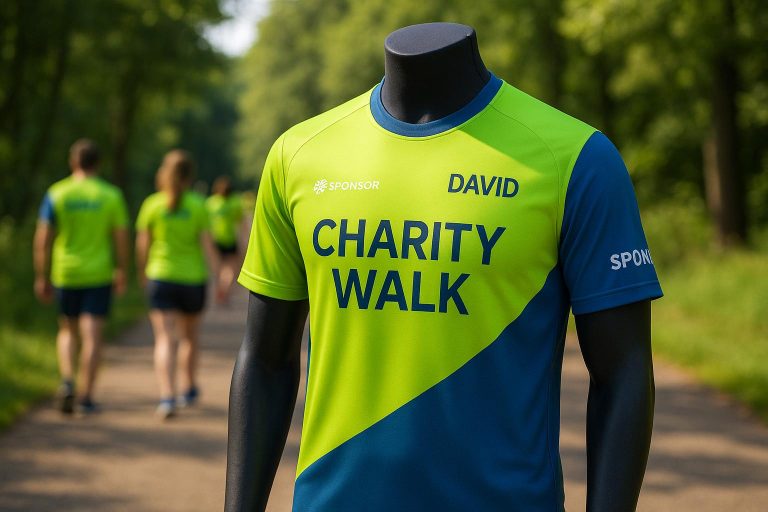
Designing charity walk jerseys requires balancing comfort, visibility, and branding. Here’s the process in a nutshell:
- Comfort: Use lightweight, moisture-wicking fabrics like polyester for long walks. Offer inclusive sizes (XS to 4XL+) and gender-specific fits for maximum comfort.
- Visibility: Choose bright or neon colors for safety. Add reflective elements for events at dawn, dusk, or near traffic.
- Branding: Incorporate the charity’s logo, colors, and mission prominently. Use clear text and high-contrast designs for readability from a distance.
- Sponsor Placement: Follow sponsorship agreements for logo size and placement. Prioritize charity branding while keeping sponsors visible.
- Personalization: Add participant names, team names, or memorial messages to make jerseys meaningful keepsakes.
- Weather Adaptation: Provide options like short sleeves for summer or long sleeves for cooler conditions.
How to Make a Charity Run T-Shirt
Review Event Guidelines and Branding Requirements
Before diving into jersey design, it’s crucial to gather all official event rules and branding materials. Nonprofits and event organizers usually provide detailed guidelines that outline everything from logo usage to safety standards. Skipping this step could lead to expensive reprints, dissatisfied sponsors, and jerseys that fail to represent the charity properly.
Collect Event-Specific Requirements
Start by requesting three key documents from the event organizer or charity contact: brand guidelines, the sponsorship prospectus or deck, and the participant information packet. These documents typically include approved logo formats, exact color codes (Pantone, hex, or CMYK), required text elements, and any safety-related specifications.
Establish a direct line of communication with someone from the charity – often in marketing, communications, or development – who can clarify details like logo spacing, font sizes, and mandatory messaging. For example, many charities require specific phrases like "Official Charity Partner" or the event name and year to appear in predetermined locations and sizes. Create a checklist of essential elements such as the charity logo, event name, date, location, website or QR code, sponsor logos, and any legal disclaimers. This checklist will serve as your blueprint, ensuring no details are missed.
Keep everything organized in a shared folder, including PDFs of logos, vector files (AI or EPS), and written guidelines. If you receive low-resolution files like JPEGs or screenshots, request vector versions to maintain professional quality. Additionally, confirm if the event has specific visibility requirements, such as reflective inks or materials, especially for events happening at dawn or dusk. Many U.S. charity walks now recommend or require neon colors and reflective elements to enhance participant visibility.
Match Charity Branding
Once you’ve secured the brand guidelines, your next task is to translate them into a jersey design that aligns with the charity’s identity while making an impact at the event. Request the charity’s brand kit, which should include official color codes, fonts, and logo variations. Use these exact colors and fonts to build the jersey’s palette – if a children’s hospital uses a specific blue and yellow, stick to those shades for the main design and accents.
Ensure the charity’s logo and tagline are easily recognizable from 10 to 15 feet away. High-contrast colors and simple backgrounds work best to avoid distractions. For instance, if a breast cancer charity specifies pink and gray in its branding, use pink as the primary jersey color and gray for accents like sleeves or side panels to maintain consistency while adding visual interest.
Nonprofits often provide approved slogans, awareness ribbons, and taglines. These elements must be used exactly as specified. Awareness ribbons, such as pink for breast cancer or teal for ovarian cancer, are widely recognized symbols, and charities typically outline their precise shapes and colors. Place these elements where required, such as beneath the logo or across the back, to uphold brand consistency and recognition.
When incorporating multiple elements – like the charity logo, event logo, and team name – establish a clear hierarchy. The charity logo should take the most prominent spot, often centered on the chest at 7 to 9 inches wide for adult sizes. Position the event logo or name in a secondary location, such as the upper back or sleeve, at 3 to 4 inches wide. The team name can appear below the front logo or across the upper back in a smaller but bold font. Use size and contrast to ensure the charity’s branding remains the focal point, especially in group photos that will likely be shared on social media or in future marketing.
Follow Sponsor Placement Rules
Sponsor visibility is a key priority for charity walks, and sponsorship agreements often include detailed instructions on logo placement, size, and order. Sponsorship decks typically outline tiers – Title, Gold, Silver, Bronze – and specify corresponding logo sizes and placement rules. For example, the title sponsor’s logo might be prominently placed on the upper back, while secondary sponsors are arranged in rows below or on sleeves, based on their tier.
Respect each sponsor’s clear space requirements and use the vector files they provide. Avoid altering logos – no stretching, recoloring, or effects – unless explicitly allowed. Some sponsors may have co-branding rules that dictate placement zones, minimum sizes, or restrictions like "no competitor logos nearby." These details influence how logos are distributed across the jersey. Before finalizing the design, send a proof to the charity or sponsor liaison for approval. This step ensures sponsors feel their investment is recognized and protects future relationships.
If conflicts arise – such as a title sponsor requesting the front-center spot reserved for the charity – refer to the sponsorship agreement. A common compromise is a shared front design, with the charity logo centered and the sponsor logo placed above or below it. Alternatively, the sponsor’s logo can dominate the upper back while receiving exclusive placement on sleeves or signage. Always get written approval from both the charity and the sponsor for any changes, along with updated mockups, to avoid disputes or last-minute issues.
To keep multiple sponsor logos legible and uncluttered, group them into rows of similarly sized logos with a minimum width of 1.5 to 2 inches for adult sizes. Simplify complex logos by using one-color versions if allowed, which maintains readability and keeps the charity branding prominent. Place smaller sponsor logos on the lower back, reserving higher-visibility areas like the shoulders and sleeves for top-tier sponsors. Avoid placing logos in areas that might be obscured by backpack straps or hydration packs. If space runs out, prioritize logos with contractual visibility requirements and move extras to banners, signage, or digital acknowledgments instead of shrinking them to unreadable sizes.
Before production, create a pre-production checklist that aligns with event rules, charity branding, and sponsor placements. Review each jersey mockup against this checklist and share a full-color PDF proof (front, back, and sleeves) with the charity and top sponsors for approval. Save all email approvals and final mockups to address any questions later. If you’re working with a custom-uniform provider like Wooter Apparel, take advantage of their free design proofs, which can incorporate charity branding, sponsor hierarchies, and visibility requirements. Iterate until the design meets all guidelines.
| Aspect to Confirm With Organizer/Charity | Why It Matters for Jerseys | Typical U.S. Guideline Details |
|---|---|---|
| Brand assets | Ensures correct logo/colors | Vector logo files, Pantone/hex colors, approved fonts |
| Required text elements | Legal and branding compliance | Event name, year, city/state, charity name, website |
| Sponsor hierarchy & rules | Determines logo order/size | Title sponsor larger; smaller logos beneath or on back |
| Safety & visibility rules | Participant safety on U.S. roads | High-visibility shirt colors, reflective prints in low light |
| Placement restrictions | Avoids brand misuse | No logos over seams or low-contrast areas; maintain clear space |
| Approval process | Prevents reprints & conflicts | Mockup review by charity brand team and top sponsors before production |
With the design guidelines and branding in place, the next step is to focus on selecting materials and fits that ensure participants stay comfortable during the event.
Choose Materials and Fits for Comfort
Once you’ve tackled the branding and sponsor requirements, it’s time to focus on comfort. Charity walks often stretch over several hours and miles, so participants need jerseys that keep them cool, dry, and comfortable. Selecting the right materials and fits is key to achieving this balance.
Pick Performance Fabrics
The fabric you choose plays a huge role in how comfortable walkers feel throughout the event. Lightweight, moisture-wicking polyester or polyester blends are top choices for charity walk jerseys. These materials pull sweat away from the skin, dry quickly, and help regulate body temperature, making them ideal for extended activity. Performance polyester, in particular, is known for staying lightweight, reducing chafing, and keeping walkers feeling fresh.
For added comfort, look for jerseys with breathable mesh panels under the arms or along the sides. These panels improve airflow and help prevent overheating. Basic cotton, while breathable, is generally avoided for long walks because it tends to absorb sweat, becoming heavy and causing irritation.
To balance cost and performance, mid-weight polyester (about 3.5 to 4.5 oz/yd²) is a solid choice. It offers durability without feeling bulky. Pair this with high-quality screen printing or sublimation techniques to ensure logos and graphics stay sharp through multiple washes. For higher fundraising tiers, you can reserve premium features like all-over sublimation or specialty finishes, keeping costs manageable while delivering a polished, long-lasting jersey.
Before finalizing your order, test fabric samples for softness, stretch, and breathability. This ensures the garment feels comfortable for participants of all ages and fitness levels. Companies like Wooter Apparel specialize in athletic-grade materials and can guide you toward lightweight, breathable options that maintain vibrant colors and logos, even with repeated use.
| Fabric Type | Moisture Management | Breathability | Comfort in Heat (75–90°F) | Durability & Colorfastness | Best Use in Charity Events |
|---|---|---|---|---|---|
| Cotton Jersey | Absorbs sweat; stays damp and heavy | Breathable but ineffective when saturated | Can cause overheating and chafing | May fade or shrink; prints may crack | Cooler-weather events; budget giveaways |
| Polyester / Performance Blend | Wicks sweat; dries quickly and feels light | Designed to breathe; often with mesh | Better temperature regulation in heat | Retains color and shape; graphics last | High-activity outdoor events |
Provide Multiple Sizing and Fit Options
Offering various sizing and fit options is crucial to ensuring everyone feels comfortable. Include both unisex and women’s cuts to accommodate different body shapes and preferences. Unisex styles with a relaxed fit work well for most participants, providing extra room in the chest, waist, and sleeves. Women’s cuts, on the other hand, often feature a more tailored fit through the waist, shorter sleeves, and a wider neckline for better mobility. For those with athletic builds, slim or athletic fits can help minimize fabric flapping and reduce chafing.
Provide a detailed size chart with chest and length measurements (in inches) and clear instructions for measuring. Adding notes like “size up if between sizes” or “runs slightly large” can help participants make informed choices. Aim to offer sizes ranging from XS to at least 3XL and, if possible, extend to 4XL or 5XL to ensure inclusivity.
To streamline the process, encourage team captains to gather sizes early and provide sample jerseys at in-person meetings when possible. Including questions about preferred cuts, typical T-shirt sizes, and interest in optional long-sleeve or outer layers on the registration form can also help. A visual sizing guide on the event page, along with a simple spreadsheet for team captains, makes size collection and order submission easier.
Wooter Apparel excels in offering gender-specific cuts, like custom racerback basketball jerseys for women and girls. Their customer feedback highlights their flexibility in meeting diverse needs. For example:
“Sizing was a tight fit like we requested.” – Wooter A.
“Comfy and well fitting.” – Jacob G.
Adjust for U.S. Weather and Walk Conditions
The weather and climate of your event’s location should guide your decisions on sleeve length and fabric weight. For summer walks in the U.S., where temperatures often reach 75–90°F, short-sleeve designs with mesh panels are a great choice to prevent overheating and manage sweat. In cooler spring or fall mornings (50–65°F), consider pairing short-sleeve jerseys with moisture-wicking long-sleeve base layers or arm sleeves, allowing participants to adapt as temperatures rise.
In regions with unpredictable or cooler weather – such as Northern states in early spring or late fall – offering a long-sleeve version in the same performance fabric or a lightweight quarter-zip layer can keep participants comfortable during chilly starts (40–55°F). For summer walks with early-morning starts that warm up later, design jerseys that work as both a standalone piece and a base layer under a zip-up.
Consider offering optional add-ons like thin, packable quarter-zips or lightweight hoodies in matching branding. These can be tied around the waist or unzipped as temperatures climb. Avoid bulky cotton sweatshirts, as they trap sweat and can cause discomfort once participants warm up.
For mid-day summer heat, prioritize short-sleeve or sleeveless tops with mesh backs or sides for better airflow. By designing the jersey as the outer visible layer, you can advise participants to wear moisture-wicking base layers underneath for cooler starts. This approach ensures everyone stays comfortable, no matter the conditions.
Plan Colors, Graphics, and Logo Placement
Once you’ve decided on the fabric and fit for your jerseys, it’s time to focus on the visual design. This step is about turning your jerseys into a branding powerhouse that not only represents your event but also ensures participants stand out, promotes your cause, and acknowledges sponsors.
Choose High-Visibility Colors
Colors do more than just look good – they serve a purpose. Start with your charity’s signature colors and add bright or neon accents to boost visibility.
If your primary color is dark – like navy blue, burgundy, or forest green – use it in smaller areas, such as side panels, collars, or as outlines for text and logos. For the main jersey body, go with a bright, eye-catching color. In U.S. parks, streets, and event spaces, neon yellow, bright lime green, orange, or atomic blue are great choices. These colors not only stand out but also provide excellent contrast for darker text and graphics.
Contrast is key for readability. Dark-colored text (e.g., black, navy, or dark green) pops on neon or light-colored jerseys, while white or light-colored text works best on darker backgrounds. Avoid combinations like red text on black or yellow on white, as these can be hard to read.
To ensure your design works in all conditions, test color mockups in various lighting – sunrise, midday, and dusk. Once you’re satisfied with the palette, move on to arranging the layout.
Arrange Jersey Layout
Your chosen colors set the tone, but the layout ties everything together. Think of your jersey as divided into zones, each with its own role:
- Front chest: This is prime real estate for your event or team name and your charity’s main logo. Keep these elements centered and large enough to be seen from several feet away. Title sponsor logos can go on the upper left or right chest to keep the charity branding front and center.
- Upper back: Use this space for the event name or team slogan, with letters large enough (4–5 inches tall) to be readable from 20–30 feet away.
- Mid to lower back: Perfect for participant names or numbers, sized between 2.5–3.5 inches tall with about 0.5 inches of spacing. Below that, add sponsor logos in rows.
- Sleeves and shoulders: Ideal for secondary logos, such as presenting sponsors, partner organizations, or awareness icons.
Stick to a clear text hierarchy. The event or team name should be the largest and boldest element, followed by participant names or numbers, then charity logos, with sponsor logos being the smallest. For fonts, go with bold sans-serif options like Helvetica Bold or Impact for maximum readability. Limit your palette to two or three main colors, plus neutral blacks or whites, and use simple, recognizable icons – like a ribbon, heart, or footprint – over intricate designs. Be sure to leave enough negative space around logos and text to keep the design clean and professional.
"The design team took my thoughts and created several perfect options for our swim team, using our logo created by one of our swimmers." – Tammy S., Customer Representative
To see how everything comes together, use online jersey design tools or templates. Platforms like Wooter Apparel offer free custom design services where you can upload logos, pick colors, and preview a realistic 3D version of your jersey. This ensures all elements – front, back, and sleeves – work well together.
Include Safety Features
For events taking place near sunrise, sunset, or on routes with vehicle traffic, safety features are non-negotiable. Neon base colors combined with reflective inks can make a big difference in low-light conditions.
Reflective ink or heat-transfer vinyl (HTV) can be applied to key elements like the event name on the back or the logos on the front chest. Adding reflective piping or trim along seams, hems, collars, and sleeve edges ensures participants remain visible from all angles, especially when moving.
For early-morning or evening events, a neon yellow jersey with reflective text and side panels is a smart choice. This combination keeps participants visible without sacrificing style.
The trick is to balance safety features with your overall design. Reflective elements and neon accents should enhance your charity’s branding, not overpower it.
"Colors, patterns, fit are excellent." – Duane R., Customer
When working with a custom uniform provider like Wooter Apparel, make sure to discuss safety needs early. Their team can help integrate reflective vinyl, neon fabrics, and strategic color placement into your design, ensuring your jerseys meet visibility and branding goals while staying comfortable.
sbb-itb-4d95ad3
Add Personalization and Charity Messaging
Once the layout and safety features are in place, it’s time to personalize the jerseys. Adding names, team details, and charity slogans turns a simple shirt into a meaningful keepsake that participants will cherish.
Add Personal Details to Jerseys
Customizing jerseys with participant names, team names, and memorial messages makes them more personal and reflective of the event’s purpose. These details can be strategically placed to maintain a polished look.
- Participant Names: Add names to the back of the jersey, just above the number. Use a bold, sans-serif font like Arial or Helvetica, sized between 2–3 inches tall. This ensures names are easy to read from 10–20 feet away, making group photos and event snapshots more impactful.
- Team Names: Place team names prominently across the chest or below the number on the back. For instance, a charity walk jersey might display "Team Hope" on the chest, with individual names above the numbers on the back. This setup balances team unity with individual recognition.
- Memorial Messages: Many participants walk in honor or memory of loved ones. Short messages like “In Memory of Mom” or “Walking for John Smith” add a heartfelt touch. These can be placed on the sleeve, side panel, or lower back to avoid cluttering the main design. Limit these messages to one line with 25–30 characters for consistency.
For larger teams, streamline the process by using an online registration form. Include fields for first names, team names, jersey numbers (if applicable), and optional memorial messages. Assign a team captain to compile and submit the final details in a spreadsheet for easy upload to your apparel provider’s system. Platforms like Wooter Apparel simplify bulk uploads and offer free design proofs to ensure everything looks perfect.
To maintain a cohesive look, keep the base design consistent across all jerseys – use the same colors, logo, and layout, while adding personal touches only in designated areas.
Include Awareness Symbols and Phrases
Incorporating symbols and short phrases tied to your charity’s mission makes the jerseys both recognizable and emotionally impactful. Keep these elements simple and strategically placed.
- Awareness Symbols: Ribbons are a powerful visual cue for charity causes. A pink ribbon for breast cancer, a red ribbon for HIV/AIDS, or a puzzle piece for autism instantly communicates the mission. Place these symbols on the sleeve, collar, or near the hem so they don’t compete with the main logo. For example, a breast cancer walk jersey could feature the charity’s logo on the left chest, a pink ribbon on the right sleeve, and the event name across the back. This layout creates clear focal points without overwhelming the design.
- Impactful Phrases: Short slogans tied to your mission – like “Walk for a Cure,” “Hope in Every Step,” or “Stronger Together” – amplify your message. These can be placed across the chest, below the number on the back, or on the sleeves. Stick to 3–5 words for maximum clarity and emotional resonance.
Use high-contrast colors for text – white on dark jerseys or black on lighter ones – and avoid placing text over busy patterns or gradients. Tools like Wooter Apparel’s design platform allow you to preview the jerseys from multiple angles, ensuring every detail is clear and visually appealing.
To extend awareness beyond the event, consider adding your charity’s website, social media handles, or even a QR code on the sleeve or hem. Some organizers also include donation-focused slogans like “Walk. Fundraise. Make a Difference,” turning the jersey into both a keepsake and a promotional tool.
Complete the Design Process
With the layout and messaging finalized, it’s time to prepare for production. Start by selecting a base jersey style – short-sleeve performance jerseys are a popular choice. Choose colors that align with your charity’s branding while ensuring high visibility. Position the main logo, team name, and event name in prominent areas.
Next, integrate personal details like names, numbers, and memorial messages, along with awareness symbols and slogans. Use a 3D design tool to preview the jersey from all angles, checking for potential issues like text that’s too small, logos that clash, or overcrowded elements.
Request a digital proof from your apparel provider and review it thoroughly on a large screen. If possible, print a physical copy to see how colors and text appear under different lighting conditions. Double-check spelling, placement, and sizing of all elements, and ensure that charity-specific colors are accurate. Involve team captains or a small review group to verify their names and messages.
Avoid common pitfalls like overcrowding the design, mixing too many fonts or colors, or rushing the proofing process. Start the design process 6–8 weeks before the event to allow time for revisions and production.
Once the digital proof is approved, the jerseys move into production. The result should be a clean, polished design that reflects your charity’s mission, celebrates each participant’s personal connection to the cause, and becomes a treasured keepsake for years to come.
Why Choose Wooter Apparel for Charity Walk Jerseys
Once you’ve finalized the design and fabric choices for your charity walk jerseys, finding the right apparel partner is the last step. Wooter Apparel stands out by offering high-performance materials, expert design support, and a full range of coordinated team gear to elevate your charity walk experience.
Custom Design and Material Quality
Wooter Apparel uses advanced sublimation printing and moisture-wicking polyester fabrics designed to meet the unique demands of long charity walks. Sublimation printing ensures your designs – logos, sponsor names, and event details – are embedded directly into the fabric. This means they stay sharp and vibrant, even after multiple washes. This durability is especially crucial for charity walks in warm or humid climates, whether you’re braving a sunny morning in Florida or an afternoon in Texas.
For organizers, this means jerseys that look polished throughout the event and beyond. This matters not only for team photos and social media posts but also for keeping your cause in the spotlight long after the walk is over.
"Wooter delivers the best fully sublimated apparel to sports teams and organizations around the world. Our high quality sublimated uniforms are made to last so your players can look and feel their best."
Wooter’s reputation backs up its claims, with an impressive average rating of 4.9 out of 5 stars from over 1,200 reviews. Customers frequently highlight the durability and comfort of the materials. One customer shared, "The jerseys are very well made and of great quality", while another remarked, "The colors are amazing." These features are especially important for jerseys that participants might wear again for future walks, workouts, or casual outings, boosting your charity’s visibility over time.
The sublimation process also opens up endless possibilities for colors and intricate designs – without extra printing costs. This flexibility is ideal for charity walks that require a mix of elements, such as the main charity logo, sponsor branding, awareness ribbons, and event details. The result? Bold, eye-catching jerseys that stand out in a crowd and photograph beautifully.
Free Design Services and Easy Customization
Wooter Apparel doesn’t just provide quality materials – it also makes the design process seamless. Their in-house design team offers free custom design services, working closely with organizers to create professional jersey layouts. Whether it’s incorporating your charity logo, event name, sponsor branding, or personalized elements like participant names or memorial messages, Wooter’s designers ensure every detail comes together perfectly. They also offer multiple design revisions, placement suggestions, and mockups from various angles so you can approve the design with confidence before production begins.
"The design team took my thoughts and created several perfect options for our swim team, using our logo created by one of our swimmers. The team absolutely loves the fit and comfort of the warm ups and wears them with pride." – Tammy S., Customer
Customers consistently praise the ease and speed of Wooter’s design process. One reviewer noted, "The designs were awesome and any changes were made quickly and precise", while another shared, "Wooter made ordering our jerseys a breeze." Dedicated sales representatives guide you every step of the way, ensuring even first-time organizers can navigate the process smoothly.
Wooter also offers online customization tools that let you choose jersey colors, accent details for collars and sleeves, and fonts for names and slogans. Their experienced team provides expert recommendations to ensure your jerseys align perfectly with your charity’s branding.
Matching Team Apparel Options
Wooter Apparel goes beyond jerseys to help your entire team present a unified, professional image. They offer a full range of matching apparel and accessories, such as custom shorts, warm-up jackets, sweatshirts, performance T-shirts, and jogger pants. All items are made from the same high-quality fabrics and feature the same design elements, so your team looks cohesive from head to toe.
Providing options like matching shorts for participants and warm-up jackets for cooler weather ensures everyone stays comfortable throughout the event. Many organizers also order performance T-shirts for volunteers or supporters who aren’t walking but still want to show their solidarity. This creates a consistent and visually striking presence across the event.
A unified team look does more than boost morale – it also enhances your charity’s visibility and professionalism. Matching apparel makes a strong impression in event photos, social media posts, and during the walk itself, helping to engage donors and attract future participants.
Wooter offers U.S. standard sizes ranging from youth to adult (small to 3XL or larger), with fit options like standard, relaxed, and performance fits. Detailed size charts in inches help organizers gather accurate sizing information, ensuring everyone feels comfortable and included.
While production times can vary based on order size and customization, most orders are completed within 2–4 weeks after design approval, fitting well within typical charity walk planning timelines.
Conclusion
Creating the perfect charity walk jersey means finding the right mix of comfort, branding, and personalization. Start by following event rules for logo placement and sponsor visibility. Opt for moisture-wicking fabrics to keep participants comfortable, and design jerseys that highlight your charity’s mission while allowing for personal touches like participant names or team slogans.
Think about the weather when choosing your design. Lightweight short-sleeve options work well for summer events, while long sleeves or quarter-zips are better for cooler temperatures. Make sure to offer a wide range of sizes, from kids’ options to adult 3XL or beyond, so everyone feels included. These thoughtful choices not only keep participants comfortable during the walk but also help your charity gain exposure as people continue wearing their jerseys long after the event.
Wooter Apparel makes the process easy with fully sublimated designs that keep logos and awareness symbols crisp, even after multiple washes. Their free custom design service provides detailed mockups from all angles, so you can approve every detail before production. Plus, Wooter offers matching team gear – shorts, warmups, hats, and more – so your group looks polished and professional, boosting your charity’s credibility and fundraising efforts.
"Wooter delivers the best fully sublimated apparel to sports teams and organizations around the world. Our high-quality sublimated uniforms are made to last so your players can look and feel their best."
Ready to get started? Request a free design mockup from Wooter Apparel and create jerseys that keep your team comfortable, showcase your cause, and make your participants proud to represent your mission.
FAQs
How can I make sure the charity walk jerseys follow event guidelines and branding requirements?
To make sure your charity walk jerseys comply with event guidelines and branding rules, start by carefully reviewing any instructions from the event organizers. Look out for specifics like approved color schemes, logo placement, and any limits on text or imagery.
When designing the jerseys, pick colors that match the event’s theme or the cause it supports. Ensure that logos and text are easy to read and stand out. Position logos in noticeable spots, like the chest or back, and size them appropriately. If you’re working with a custom apparel provider, clearly communicate these requirements to avoid any misunderstandings.
For top-notch, fully customizable jerseys, think about partnering with a professional designer or an experienced apparel company that specializes in team uniforms. This can help you create jerseys that not only meet the rules but also look fantastic and represent the cause effectively.
How can I include sponsor logos on charity walk jerseys without overshadowing the charity’s branding?
When designing jerseys that balance sponsor logos with charity branding, it’s important to give the charity’s logo and message the spotlight. Position the charity’s logo in a prominent area – like the chest or upper back – where it naturally catches the eye. Sponsor logos can then be placed in less central spots, such as the sleeves or lower back, ensuring they remain visible without overshadowing the charity’s branding.
To maintain a polished appearance, use sponsor logo colors that blend seamlessly with the jersey’s overall design. Whenever possible, collaborate with sponsors to tweak their logo size or colors for better harmony with the jersey while keeping their branding recognizable. This approach ensures the charity’s mission stands out while still giving sponsors the acknowledgment they deserve.
How can I design charity walk jerseys that are comfortable and suitable for different weather conditions?
When creating jerseys for charity walks, comfort and weather readiness should take center stage. Opt for fabrics that are breathable and wick moisture, helping participants stay cool and dry in warm conditions. At the same time, the material should offer enough insulation to keep walkers comfortable when temperatures drop. Lightweight, stretchy fabrics are a great choice for ensuring ease of movement over long distances.
You might also want to include layering options, such as long-sleeve or zip-up styles, to cater to colder climates. Thoughtful design features like ventilation panels and carefully placed seams can help reduce chafing, making the experience more enjoyable. By focusing on these details, you can design jerseys that not only look appealing but also support participants throughout the event.