

Sports uniforms often go beyond functionality – they tell stories and connect teams to their roots. This article highlights five iconic sports uniforms that celebrate heritage through thoughtful design and meaningful details. From the Seattle Sounders’ "Salish Sea Kit" to Brazil’s 1970 World Cup jersey, each uniform blends historical elements with modern performance needs.
Key Highlights:
- Seattle Sounders’ "Salish Sea Kit" (2025): Features Coast Salish weaving patterns, the Lushootseed phrase "Water is Sacred", and an orca tail, symbolizing the Salish Sea’s importance.
- Chicago Bulls‘ 1996 Home Jersey: A clean white jersey symbolizing dominance during their legendary 72–10 season, with bold red and black accents reflecting Chicago’s sports identity.
- Brazil’s 1970 World Cup Jersey: Bright yellow and green design inspired by the national flag, representing pride and success during their historic World Cup win.
- New Zealand All Blacks Rugby Jersey: Incorporates Māori patterns like the Pūhoro and Manaia, connecting players to their ancestors and New Zealand’s legacy.
- Argentina’s 1986 Away Jersey: Improvised design worn during Maradona’s iconic "Hand of God" and "Goal of the Century", symbolizing resilience and national identity.
These uniforms showcase how sports teams can honor their histories while engaging fans and communities. By combining heritage-inspired elements with advanced fabric technology, modern designs can preserve these stories for future generations.
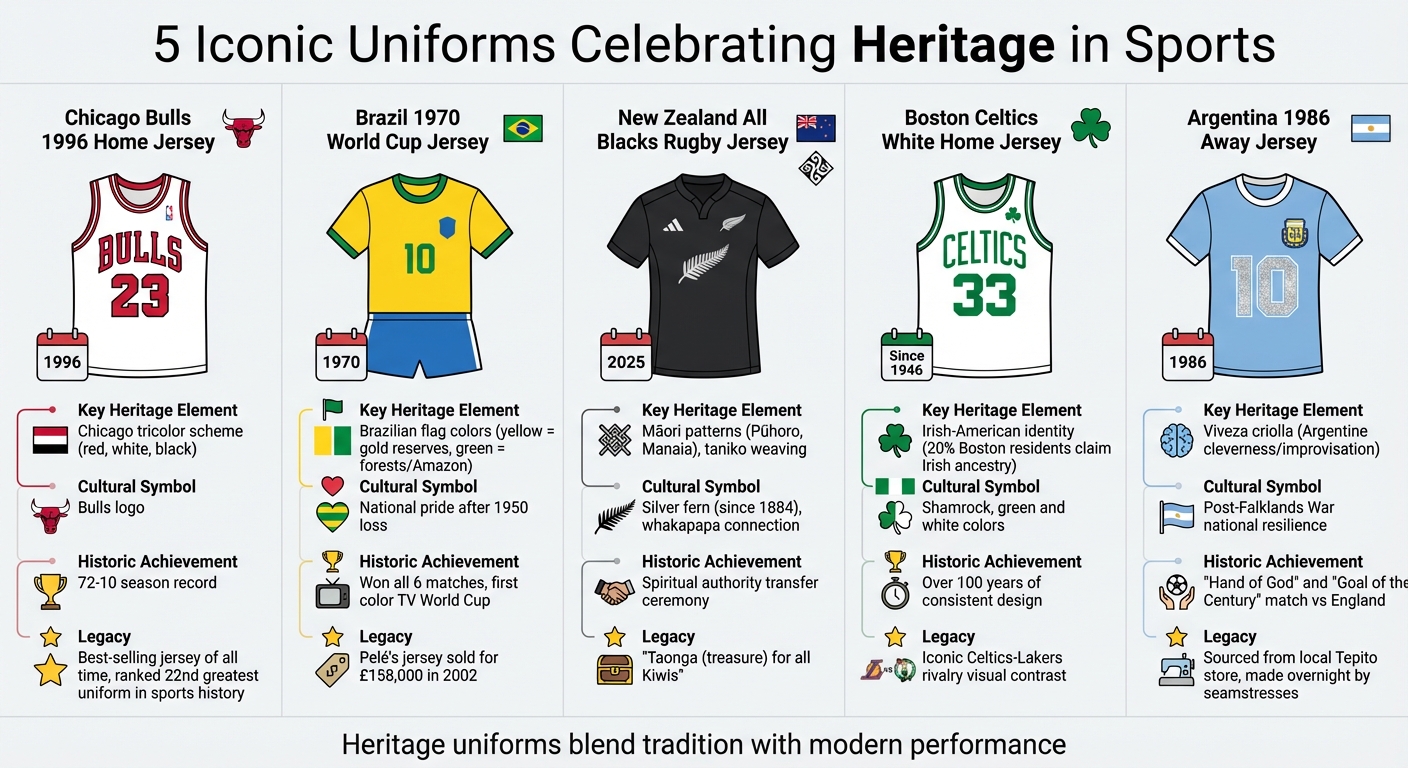
5 Iconic Heritage Sports Uniforms: Design Elements and Cultural Significance
1. Chicago Bulls 1996 Home Jersey

Cultural Significance
The Chicago Bulls’ 1996 home jersey wasn’t just sportswear – it became a symbol of dominance and success. During their record-breaking 72–10 season, this clean white jersey represented basketball at its peak. Michael Jordan’s jersey from this legendary era became the best-selling jersey of all time, outpacing even the sales of icons like Kobe Bryant, LeBron James, and Magic Johnson. Beyond the court, the jersey also influenced bold design trends in luxury fashion, leaving a lasting impression.
Design Elements Reflecting Heritage
This jersey captured the essence of Chicago with its timeless and iconic design. The tricolor scheme of red, white, and black was a hallmark of Chicago sports. Bold red lettering stood out against the clean white base, while the collar and armholes featured streamlined white–red–white striping for a sharp, polished look. The Bulls’ unmistakable logo appeared prominently on both sides of the shorts, and the large, central player numbers added a sense of strength and precision to the overall design.
Historical Impact in Sports
The 1996 home jersey became a defining symbol of the Chicago Bulls’ golden era. It was the uniform of choice during their second championship three-peat and played a part in the NBA’s global rise during the 1990s. With bold typography and striking color contrasts, the jersey embodied power and dominance, creating a visual identity that resonated worldwide. Ranked as the 22nd greatest uniform in sports history, this jersey has remained a fan favorite across generations, appealing to everyone from kids to grandparents. It set a standard for heritage-inspired sportswear, paving the way for future designs in athletic apparel. This legacy continues today through high-quality equipment, including custom team game basketballs designed for modern performance.
sbb-itb-4d95ad3
2. Brazil National Team 1970 World Cup Jersey
Cultural Significance
Brazil’s 1970 World Cup jersey isn’t just a piece of sportswear – it’s a symbol of national pride and creativity on the field. The bright yellow with green trim reflects the Brazilian flag, a design introduced in 1953 to replace the white kit, which many associated with the heartbreak of the 1950 World Cup loss. The yellow represents Brazil’s gold reserves, while the green highlights its rich forests and the Amazon. Blue shorts and white details evoke the Rio night sky, complete with its blue globe and white stars. Captain Carlos Alberto perfectly captured its importance:
"For Brazilians, that yellow jersey is sacred. When we wear it, of course we feel pride but it also brings responsibility, a responsibility to inspire and to excite."
The cultural weight of this jersey is matched by the thoughtfulness behind its design.
Design Elements Reflecting Heritage
The iconic design was the brainchild of Aldyr Garcia Schlee, an 18-year-old illustrator who won a nationwide contest in 1953 that attracted 401 entries. While the color scheme paid tribute to Brazil’s heritage, the 1970 version also introduced modern updates. Designed specifically for the Mexican climate, the jersey featured lightweight, sweat-resistant materials to help players perform in the high-altitude heat. This blend of tradition and practicality made it a standout both visually and functionally.
Historical Impact in Sports
The 1970 World Cup jersey also holds a special place in sports history. It was part of the first World Cup broadcast live in color, and Brazil’s radiant yellow kit stood out brilliantly against the backdrop of the Mexican sun. The team won all six matches, showcasing "futebol arte" – a joyful and skillful style of play that captivated the world. Its legacy was cemented further when a jersey worn by Pelé during the tournament sold at auction for £158,000 in 2002. Reflecting the cultural and historical weight of the victory, the Jornal do Brazil compared it to the moon landing:
"Brazil’s victory with the ball compares with the conquest of the moon by the Americans."
This iconic jersey not only set the standard for future Brazil kits but also remains a timeless symbol of the beauty and artistry of the game.
3. New Zealand All Blacks Rugby Jersey

Cultural Significance
The All Blacks jersey is much more than a piece of sportswear – it’s a connection to whakapapa, the lineage that ties players to their ancestors and New Zealand’s lasting legacy. Players see themselves as caretakers of this heritage, a responsibility deeply rooted in tradition. Before games, karakia (prayers and incantations) are performed to awaken the jersey’s mauri, or life force. Designer Kahurangi Falaoa captured this sentiment beautifully:
"This jersey is more than just something the players wear – it’s a living story. Each element carries the voice of our ancestors and the stories of our past, present and future." – Kahurangi Falaoa
The jersey incorporates elements of Te Ao Māori (the Māori worldview), with patterns that symbolize balance, unity, and striving for excellence. These cultural meanings are woven into its design, ensuring the jersey reflects New Zealand’s traditions in every detail.
Design Elements Reflecting Heritage
The silver fern, an emblem of the All Blacks since the late 19th century, has a storied history. Initially, it appeared as gold on a dark blue jersey in 1884, later transitioning to silver on black – a look that earned the team its famous nickname during their 1905 European tour. Modern iterations of the jersey honor these roots. For instance, the 2019 Rugby World Cup jersey incorporated taniko (traditional Māori weaving patterns) created in collaboration with Māori artists.
In June 2025, New Zealand Rugby and adidas unveiled the "Te Tauihu Matua" (The Chiefly Bow) jersey, designed by Kahurangi Falaoa of Ngāti Tūwharetoa. This new design debuted on June 28, 2025, in Tokyo against Japan XV, following a ceremonial transfer of spiritual authority by tohunga from Ngāti Toa and Te Āti Awa. The jersey features elements like the Pūhoro pattern, representing speed and agility, and the Manaia, a guardian figure symbolizing the balance between war and peace.
Historical Impact in Sports
The All Blacks jersey has constantly evolved, blending tradition with modern advancements. Early versions, made from heavy cotton, were notorious for retaining mud, while today’s jerseys are crafted from lightweight, moisture-wicking polyester designed to reduce grip for opponents. The white collar, introduced in the 1920s, has become an iconic feature, often revived in special edition jerseys. One standout design is the 2011 Rugby World Cup jersey, which featured embossed silver fern detailing and remains a fan favorite.
The haka, performed before every match, further deepens the spiritual connection tied to the jersey. It links players to their ancestors and reinforces the significance of the silver fern. As RYOS NZ eloquently put it:
"It is a taonga (treasure) that belongs not only to the 15 players on the pitch, but to all Kiwis who carry it in their hearts."
4. Boston Celtics White Home Jersey

Irish-American Identity
The Boston Celtics’ white home jersey is more than just sportswear – it’s a tribute to the city’s Irish-American roots. Back in 1946, Celtics founder Walter A. Brown made a bold choice to embrace Boston’s Irish heritage through the team’s identity. As he famously said, "The Celtics… Boston’s rich Irish heritage. We’ll put them in green uniforms and call them the Boston Celtics", even pushing through initial resistance from his PR officer, Howie McHugh. This decision resonated deeply, especially in a city where about 20% of residents claim Irish ancestry, making Boston one of the most Irish cities in the U.S..
The white home jersey, paired with the iconic green, represents more than team colors – it embodies "Celtic Pride." Jamie Ritenour of CJP Apparel highlights this sentiment:
"To many fans, green and white are more than just colors. These hues embody team spirit, unity, and the ‘Celtic pride’ that is synonymous with the Celtics."
The white reflects the team’s unwavering commitment to excellence, while the green signifies loyalty, resilience, and a nod to Irish traditions.
A Design Rooted in Tradition
The jersey’s design is intentionally simple yet powerful. Bold green lettering and the unmistakable shamrock are at the forefront, showcasing the team’s deep connection to Irish heritage. This minimalism allows the cultural elements to shine. The shamrock, a symbol rich in Irish folklore, ties directly to Boston’s history of Irish immigration. Even the team’s mascot, Lucky, reinforces this heritage, donning shamrock-patterned attire and wielding a traditional Irish shillelagh.
A Legacy in Sports and Beyond
Over the years, the Celtics’ white home jersey has become one of the most iconic uniforms in NBA history. Its presence is felt in legendary rivalries, particularly the Celtics-Lakers clashes, where Boston’s white and green face off against Los Angeles’s purple and gold, creating a visual and emotional contrast that defines basketball loyalty and history. Beyond the court, the jersey has left its mark on pop culture, frequently appearing in films, TV shows, and collaborations with major brands. It’s more than just a uniform – it’s a symbol of Boston’s heritage and the Celtics’ enduring identity.
5. Argentina National Team 1986 World Cup Jersey
Cultural Significance
Argentina’s 1986 World Cup away jersey stands as a testament to viveza criolla – a phrase that captures Argentine cleverness and resourcefulness. Born out of necessity, it embodies the nation’s knack for improvisation and adaptability. This jersey also carried deeper meaning, serving as a unifying symbol of identity for a country still recovering from the Falklands War just four years earlier. It became a declaration of resilience during a time of political and economic uncertainty.
Design Elements Reflecting Heritage
The story behind the jersey is as remarkable as the match it was worn in. On June 22, 1986, in Mexico City, Argentina faced extreme heat and altitude. Manager Carlos Bilardo deemed the team’s heavy cotton Le Coq Sportif jerseys unsuitable for the conditions. In a scramble for a solution, lightweight blue polyester shirts were sourced from a local Tepito store. When Diego Maradona inspected the options, he confidently declared, "That one. We’ll beat England in that one".
What followed was a whirlwind of creativity. Two seamstresses worked overnight to attach AFA crests to the jerseys, while kit man Tito Benrós added silver, sparkly numbers. The details were so striking that Maradona later recalled players having sparkles on their faces during the game. Interestingly, the crests sewn onto the jerseys featured an older design, missing the traditional laurel leaves.
Historical Impact in Sports
This hastily assembled jersey achieved legendary status during Argentina’s iconic 2–1 victory over England. It was in this match that Maradona delivered two of the most famous goals in soccer history: the controversial "Hand of God" and the breathtaking "Goal of the Century." Forward Jorge Valdano vividly remembered the moment the jerseys were revealed:
"A shiny blue shirt appeared, with silver numbers. Maradona said, ‘What a beautiful shirt.’ We were all surprised"
The jersey came to embody what journalist Carlos Martínez described as the essence of Argentine football:
"a play that, beyond controversy, captured a way of understanding football: cleverness, wit, the ability to do the unexpected"
Despite its improvised origins, the jersey is now celebrated as a cultural treasure in Argentina. It highlights how some of the most enduring symbols can emerge from the most unexpected circumstances. Much like the other iconic uniforms discussed, this jersey demonstrates how creativity and national pride can transform a team’s identity into something unforgettable.
RANKING THE NEW NBA HERITAGE JERSEYS

How Modern Teams Can Use These Ideas
Iconic uniforms – like the Chicago Bulls’ striking red and black or Argentina’s standout designs – are more than just clothing; they tell stories. Modern teams have the opportunity to create custom designs that reflect their heritage while meeting today’s performance needs.
Sublimation technology makes this easier than ever. Unlike traditional screen printing, which can crack or fade over time, sublimation embeds colors and patterns directly into the fabric. This means teams can include intricate symbols, historical elements, or bold heritage colors that remain vibrant through countless games and washes. A great example of timeless design is the Las Vegas Raiders. Their black-and-silver pirate crest has stayed the same since 1964, earning its place as one of the NFL‘s most recognizable looks for nearly 60 years.
For teams looking to get started, Wooter Apparel offers free custom design services. Their design team works closely with you to bring heritage-inspired ideas – whether it’s a local pattern, a historic crest, or a meaningful color scheme – to life. Sublimated jerseys start at just $16.99, and with over 2,000 five-star reviews highlighting their precise color matching and design quality, the process is simple. Share photos or sketches of your heritage concepts, then refine the design using their online apparel builder.
Modern uniform design goes beyond simply recreating the past. It’s about blending tradition with innovation. Advanced technology not only supports features like moisture-wicking fabrics and ergonomic fits but also ensures cultural symbols are preserved in the designs. With no minimum order requirements and full customization options for jerseys, shorts, and warmup gear, teams of all sizes can craft uniforms that honor their roots. These designs allow teams to celebrate their heritage every time they step onto the field.
Conclusion
Sports uniforms that pay tribute to heritage tell powerful stories, bridging generations and connecting fans to the essence of their teams. As seen in the examples throughout this article, incorporating historical elements into uniform design creates a lasting legacy.
Some heritage uniforms have stood the test of time. The Boston Celtics, for instance, have maintained their classic design elements for over a century, fueling fan loyalty and driving merchandise success. Similarly, the Las Vegas Raiders’ black-and-silver pirate crest, introduced in 1964, remains one of the most recognizable designs in the NFL.
Every team has a story waiting to be celebrated. Whether it’s a unique pattern, meaningful colors, or symbols that reflect the community’s spirit, these elements can be seamlessly integrated into uniforms. Thanks to modern sublimation technology, teams can now embed intricate heritage details directly into fabric, ensuring vibrant, long-lasting designs that won’t fade or peel.
Heritage-inspired uniforms do more than honor the past – they spark innovation for the future. Teams of all sizes can create apparel that reflects their identity while prioritizing comfort and performance. By collaborating with skilled designers who understand how to merge tradition with functionality, teams can craft uniforms that elevate both pride and play on the field.
For those ready to bring their vision to life, Wooter Apparel offers custom football uniforms and fully sublimated designs that capture every detail of your team’s unique story.
FAQs
How do teams choose heritage symbols respectfully?
Teams approach the use of heritage symbols with care by working closely with experts and respecting traditions. This process includes thoughtfully incorporating motifs, symbols, and colors that represent cultural values while avoiding appropriation. Designers pay close attention to the cultural significance of colors and symbols, ensuring their choices honor the heritage they represent. The goal is to strike a balance between respecting tradition and introducing fresh design elements, all while maintaining the authenticity of the heritage being celebrated.
Why are sublimated uniforms better for detailed designs?
Sublimated uniforms stand out for their ability to display intricate designs with precision. This technique embeds dye directly into the polyester fabric at the molecular level, resulting in vibrant, full-color visuals, seamless gradients, and photorealistic images. Even with regular washing, these designs remain durable and resistant to fading.
How can my team turn local history into a uniform?
To create a meaningful and inspiring uniform, start by delving into your team’s history. Explore archives, old photos, and memorabilia to uncover elements like colors, logos, or patterns that hold significance. Look for symbols or motifs that represent the identity of your community and its story.
Next, work with skilled designers to give these elements a fresh, modern touch. Use high-performance fabrics to ensure the uniform is functional while staying true to its roots. This thoughtful combination of past and present not only honors local history but also builds a sense of pride and unity among your team and the community.