
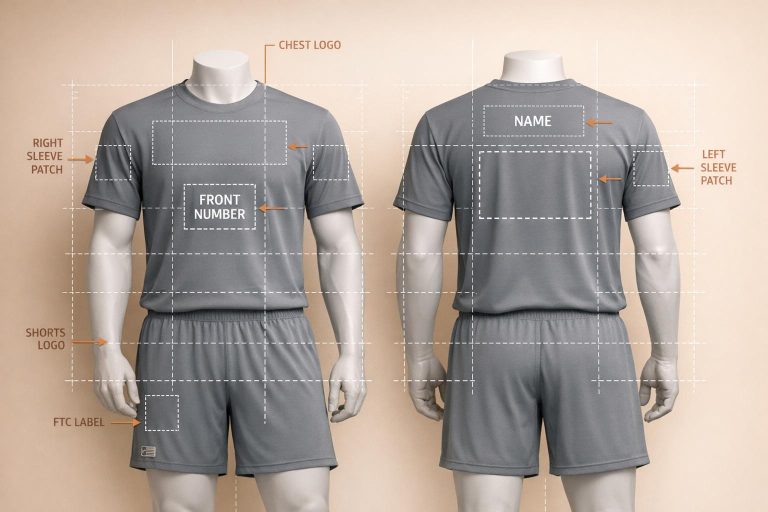
Getting label placement right on team uniforms is about meeting regulations, keeping designs professional, and ensuring sponsor visibility. Missteps can lead to fines, disqualification, or poor branding. Here’s what you need to know:
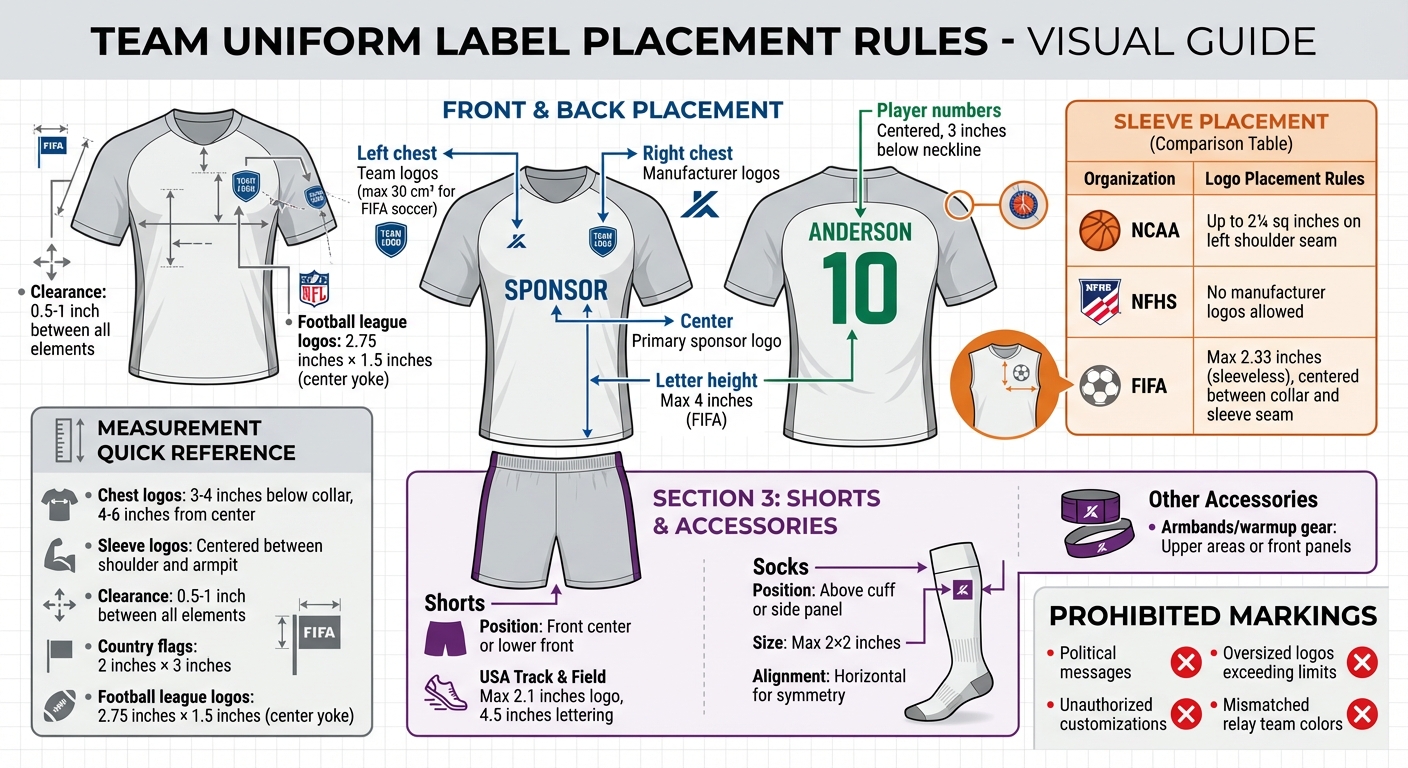
- Front & Back Placement: Team logos go on the left chest, manufacturer logos on the right, and sponsor logos in the center. For soccer, FIFA caps team logo areas to 30 cm² and letters to 4 inches high. Player numbers are centered on the back, 3 inches below the neckline, with names above.
- Sleeve Placement: Rules vary by organization. NCAA allows small manufacturer logos, while NFHS prohibits them. FIFA limits sleeve logos to 2.33 inches for sleeveless jerseys.
- Shorts & Accessories: Manufacturer logos on shorts are placed front-center or lower-front, with strict size limits. Accessory labels (e.g., socks) must be small and symmetrical.
- Prohibited Markings: No political messages, oversized logos, or unauthorized customizations. Relay teams must match in colors and logos, similar to the consistency required for custom football uniforms.
Key Tip: Use precise measurements and follow league rules to avoid compliance issues. Labels must also meet FTC requirements for fiber content, origin, and manufacturer identity. Partnering with experts can streamline the process.
Team Uniform Label Placement Guide by Position and Sport
How to Create and Place Names and Numbers for Jerseys
sbb-itb-4d95ad3
Placement Rules for Shirts and Jerseys
These guidelines are designed to ensure uniform labels comply with regulatory standards while maintaining clear brand visibility.
Front and Back Placement
The front of a jersey follows a specific layout. Team logos are placed on the left chest, while manufacturer logos go on the right. The primary sponsor logo takes center stage. For soccer jerseys under FIFA regulations, the team name or logo must fit within a rectangular area no larger than 30 cm² (approximately 4.7 square inches), with letters capped at 4 inches in height. For sleeveless soccer jerseys, FIFA limits country flags to 2 inches by 3 inches, positioned at the top left front.
On the back, player numbers are centered and should sit 3 inches below the neckline. Player names are placed directly above the numbers for easy identification.
Additional rules for sleeve placements are determined by organizations like the NCAA, NFHS, and FIFA.
Sleeve Placement
Sleeve placement standards vary depending on the governing body. The NCAA allows manufacturer logos up to 2¼ square inches on the left shoulder seam, back, or front of jerseys. In contrast, the NFHS does not permit manufacturer logos on high school uniforms. For FIFA soccer jerseys, logos on sleeveless designs must be centered between the collar and sleeve seam, with a maximum size of 2.33 inches. Secondary sponsor logos can be added to sleeves if the primary sponsor logo is on the front chest. When measuring for placement, use the shoulder seam or cuff as reference points to ensure proper alignment.
Label Placement for Shorts and Accessories
Shorts Label Placement
Shorts come with stricter placement rules compared to jerseys, ensuring a clean and professional look. The manufacturer’s logo should be placed either at the front center or lower front in a rectangular layout. For USA Track & Field uniforms, the logo size must not exceed 2.1 inches, with lettering capped at 4.5 inches. This single-placement method avoids visual clutter and maintains consistency across the team.
It’s essential to ensure the logo is positioned correctly across all sizes, from youth to adult, to keep the design balanced. The placement should be high enough to stay visible during play but not interfere with waistband adjustments.
Accessories follow similar guidelines to maintain a cohesive and uniform appearance.
Accessory Labeling Standards
Accessories, just like the main uniform pieces, must comply with strict regulations to maintain branding consistency. For socks, place the labels above the cuff or on the side panel, with a maximum size of 2×2 inches. These labels should be horizontally aligned to ensure symmetry, making them visible from the sidelines while adhering to lower-leg decoration limits set by regulations.
For items like armbands and warmup gear, labels should be positioned on upper areas or front panels for clear visibility during play and team introductions. According to NFHS rules, any outer garments worn by relay or cross-country teams must match in dominant color, school logo, and color combinations. High-contrast colors are recommended for logos to ensure visibility while blending seamlessly with the team’s color scheme.
At Wooter Apparel, we integrate these rules into every custom uniform design, ensuring labels are perfectly placed for visibility and compliance with sports regulations.
Allowed and Prohibited Markings
Clear guidelines for uniform markings help maintain compliance and ensure a polished, professional appearance. These rules, defined by governing bodies, protect the uniform’s design and uphold regulatory standards.
Permitted Markings
Certain markings are allowed, provided they meet size and placement requirements. These include:
- Manufacturer logos: For track and field uniforms, these must not exceed 2.33 inches in width and 2.25 inches in all dimensions. They should be placed on the front, centered between the collar and sleeve seam.
- Country flags: Flags must remain within 2 inches by 3 inches.
- Team names and logos: These must be centered on the tank and fit within a rectangular area no larger than 30 cm², with letters no taller than 4 inches.
- Player names and numbers: Standard placement and sizing rules apply.
- Commemorative patches: Allowed on compression tanks and jerseys, provided they do not exceed 4 inches square and are positioned beside the manufacturer’s logo.
Sponsor logos are also permissible in many sports but must follow strict size and placement rules set by governing bodies. These logos are commonly found on the center of the jersey or sleeves, with dimensions varying by sport. Additionally, federal law mandates that most textile products include a label with fiber content, country of origin, and manufacturer identity. These regulatory labels are distinct from decorative markings and must remain visible to meet legal requirements.
Prohibited Markings
Certain markings are strictly forbidden. These include:
- Political messages or personal slogans
- Unauthorized commercial advertising
- Markings that exceed approved size limits
- Customizations that deviate from approved designs
For relay and cross-country teams, NFHS rules require matching dominant colors, school logos, and color combinations on outer garments. Individual customizations beyond these approved markings are not allowed. Any marking placed in an unauthorized location also violates uniform standards.
How to Ensure Compliance and Visibility
Getting label placement right requires practical methods and thorough checks before production. Accurate measurements and detailed documentation are key to maintaining uniform standards.
Measurement Techniques
Start with a detailed placement checklist that aligns with your sport’s governing body rules. Before production, confirm that all logos and labels meet the official guidelines for your league or competition level. Use tools like measuring tapes and markers, anchored to fixed points such as collars, seams, or waistbands, to ensure precision. For example, chest logos should typically be 3–4 inches below the collar and 4–6 inches from the center. Sleeve logos should sit centered between the shoulder and armpit, with at least a 0.5–1 inch gap from seams.
Federal law requires that labels include essential information – fiber content, country of origin, care instructions, and manufacturer identification – and that they remain accessible to consumers. The FTC also mandates that labels should not be placed in hard-to-reach spots, like the inside of elbows. When measuring spacing between design elements, ensure a clearance of at least 0.5–1 inch between labels, player numbers, names, and other graphics to keep each element visually distinct.
Recording these measurements in a clear, standardized format ensures consistency across all uniforms.
Visual Reference Tables
To simplify compliance, create a visual reference table documenting these precise measurements. This table should outline the exact placement details for each uniform type and include sport-specific requirements. For example:
- Custom pro football jerseys: League logos should measure 2.75 inches wide by 1.5 inches high and be positioned at the center of the yoke on the neck front.
- Track and field uniforms: Country flags are limited to 2 inches by 3 inches.
Conclusion
Label placement on team uniforms is about more than just looks – it’s about meeting regulations and showcasing a professional image on the field or court. This guide highlights the essential rules for positioning logos, labels, and markings to ensure your uniforms are compliant and cohesive.
The Federal Trade Commission mandates that apparel labels must be easy to spot, read, and access. Beyond meeting these legal standards, proper label positioning enhances your team’s polished appearance and reinforces its brand identity, all while staying within league guidelines.
Using precise measurement techniques and visual reference tools can help you double-check placements before production, saving you from costly mistakes or reprints down the line.
Partnering with skilled custom uniform providers can make this process even smoother. Wooter Apparel, for example, offers fully sublimated team uniforms with accurate label placement built into the design. Their team is well-versed in the requirements of various sports leagues, ensuring your uniforms not only meet regulations but also look modern and professional.
Whether you’re designing for a youth league or a high-level competition, attention to label placement shows a commitment to quality and respect for the game. Double-check your specs and work with trusted providers to keep your team looking sharp and ready to compete.
FAQs
Which rules apply to my league?
When it comes to team uniforms, the placement of labels like names, numbers, and logos isn’t random – it’s governed by specific rules that vary by sport and league. These regulations typically outline the size, location, and visibility of each element. For instance, basketball uniforms must display numbers on both the front and back, while soccer jerseys often have strict size limits for logos.
To avoid any headaches or penalties, it’s always a good idea to check your league’s official guidelines for precise requirements. If you’re unsure, turning to professionals like Wooter Apparel can simplify the process. They specialize in creating uniforms that meet league standards, saving you from costly mistakes.
How do I measure logo placement accurately?
To measure logo placement on sports uniforms with precision, you can rely on tools like rulers, templates, or laser guides. Typical positioning guidelines include:
- Chest: 2–4 inches below the collar.
- Left Chest: 3–4 inches from the collar.
- Upper Back: 4–6 inches below the neckline.
It’s always a good idea to test the placement on sample garments first. This helps ensure proper alignment, the right logo size, and adherence to league or branding requirements.
What’s the difference between FTC labels and logos?
Labels required by the FTC serve a specific purpose: they provide essential details like fiber content, country of origin, and care instructions to meet federal regulations. These labels are all about transparency and ensuring compliance with the law.
On the other hand, logos are all about branding. They act as visual identifiers, representing teams, sponsors, or organizations. Unlike labels, logos are not federally mandated but are instead regulated by league rules and branding guidelines. These rules dictate their placement, size, and overall compliance with sports-related standards to maintain consistency and professionalism.