
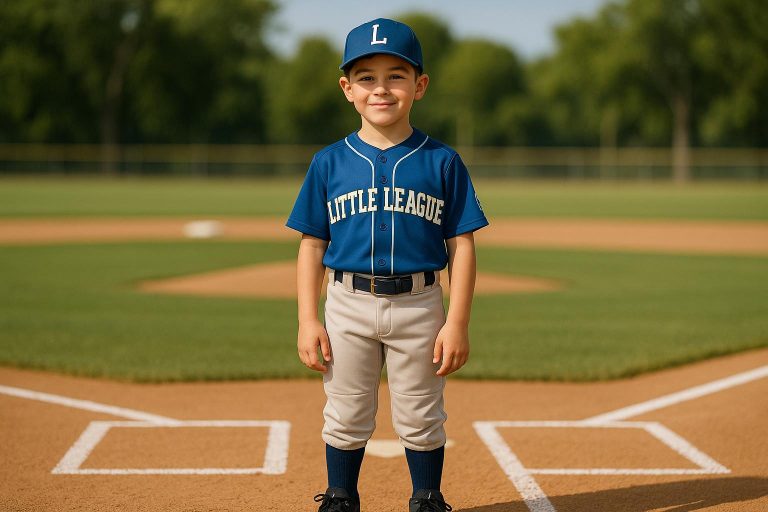
Uniforms in Little League aren’t just for looks – they’re mandatory. Players must meet specific guidelines to participate in games and tournaments. Key components include:
- Official Little League Patch: Costs $2.25 and must be sewn or ironed on jerseys; printed patches are prohibited.
- Jersey/T-Shirt: Includes team name, league logo, and patch. Placement of the patch depends on sleeve type.
- Team Hat/Visor: Required for baseball; optional for softball.
- Pants, Belt, and Socks: Pants are typically gray or white, with belts and socks matching team colors (belts required for older groups).
Gear requirements include:
- Bats: Must meet USABat or BPF 1.20 standards.
- Helmets: NOCSAE-approved, with stickers allowed if appropriate.
- Cleats: Rubber for younger players; metal allowed for older ones.
2025 updates shift gear checks to team leaders, allowing jewelry and stickers on helmets if appropriate. Always verify local league rules for additional requirements. Proper uniforms foster unity and ensure compliance with Little League standards.
How to Apply the Little League Patch
Must Have Uniform Parts
Every Little League player needs three main parts for their uniform to make it the full set.
Jersey or T-Shirt
The jersey is the core of the outfit. It should have three things: the team name, the league logo, and the required Little League shoulder patch. Most jerseys also have player numbers, and often players’ last names or a sponsor’s name on the back.
The Little League patch should be sewn or ironed on the jersey – you can’t use print methods like screen-printing.
Where to put the patch varies:
- Raglan sleeves: Put the patch 3 inches below the left shoulder seam.
- Set-in sleeves: Place the patch 1 inch below the left shoulder seam.
- No sleeves: Stick the patch on the left chest.
Teams should not print or copy the patch design on the jerseys. This rule keeps the Little League name and mark safe.
Team Hat or Visor
Baseball players need to wear the league hat, and softball players often use visors to look the same.
Pants, Belt, and Socks
Pants are usually gray or white, chosen by the team leader or league rules. Unlike jerseys and hats, parents must buy pants since the league does not give them.
For older groups (AA Rookies and above), belts matching the team colors are needed. In younger groups, belts might not be needed if there are no loops on the pants.
Socks should be one color that fits with the team colors, making the look work as one.
Leagues might have more uniform rules, so always check twice. Teams can work with places like Wooter Apparel to make sure uniforms meet all Little League and local needs, include the correct patch placing and team needs. This makes sure things are done right and quick.
Needed Gear and Safe Wear
In Little League, the right gear and sticking to safety rules is a must. Team leaders are key in making sure all gear meets the newest rules, as umpires don’t check gear before games now.
Glove and Bat
Gloves need to fit the player’s age and role. Small gloves are best for young kids as they are easier to handle, while big kids may need bigger gloves for their position.
Bats must follow the right Little League rules. For baseball, bats have to be USABat standard from January 1, 2018. Softball players need bats that meet the BPF 1.20 rule. Old bats are not okay now. Leaders must check bats are okay before games start. Bats with added parts like choke-knobs or thumb protectors can’t be used. This keeps play safe and fair.
Batting Helmet and Cleats
After gloves and bats, look at helmets and shoes for safety.
Batting helmets are a must for all. Helmets should be NOCSAE-approved and fit well so they don’t move during play. Players can put fun stickers on their helmets, but check them often for any damage.
Cleats can be different for each age. Young ones must wear rubber or molded cleats, and big kids can use metal cleats if it’s okay locally.
Protective Gear
Protective gear is key, just like the right clothes and gear.
Athletic supporters or compression shorts are said to be good for all boys and are a must for catchers and older boys. Protective cups are needed for all boy catchers and urged for all boys on the field.
Extra gear like mouth guards, face protectors, batting gloves, arm sleeves, and gear bags are your choice. These pieces are not needed by Little League, but they add comfort and safety. Any gear on hands or wrists should be one plain color that’s not like a baseball or softball. Neoprene sleeves are okay if they are one solid color and not white or gray.
Teams wanting custom gear can check out Wooter Apparel.
| Tool Type | Must Have | Who Uses It | Rule Set |
|---|---|---|---|
| Bat (Baseball) | USABat must | All baseball guys | Start Jan 1, 2018 |
| Bat (Softball) | BPF 1.20 must | All softball guys | Now in use |
| Helmet | Must be NOCSAE-ok | All in the game | Must use it |
| Cleats | Only rubber | Young ones | For safe play |
| Cleats | Metal is ok | Older ones | Check with your place |
| Cup to guard | Must wear | Male catchers, Older ones | Must have for safety |
Custom Rules and Local Play Rules
When making team shirts, it’s key to note both the main Little League rules and extra rules your local league may have. While Little League International sets the main rules, local leagues may have their own needs that teams must stick to. These points add to the common shirt and gear talked about before.
Color and Look Needs
Shirts must keep the same color and look for all players, as set by league rules. This means all tops, pants, socks, and belts must match in a team. This rule makes sure all is fair and lets umpires tell teams apart in games.
Some local leagues may have strict color rules. For example, a league may say all teams must wear dark blue pants or ban some color mixes to cut mix-ups. Like, if a team has red and white, another team in the same league may not use those same colors.
Before you order shirts, ask league heads about any color bans. Some leagues may have set color boards or ask teams to show shirt designs for okay before the season starts.
Patch Place and 2025 Rule Changes
The main Little League patch must be on every shirt. This patch marks Little League players from other young baseball groups. See the earlier "Jersey or T-Shirt" part for how to put it right. Only iron-on or sewn patches are good – printed or dyed ones are not.
Changes for the 2025 season change some rules on shirts and gear:
- Jewelry is now okay, but not medical alert stuff.
- Players can add stickers to their helmets if they are not too much or unfit.
- Neoprene sleeves are okay in baseball if they are one full color (not white or gray).
Also, note a big change in checking gear. Umpires won’t check gear before games – this is now up to team heads. Heads must make sure all is right from the get-go.
Making Sure of Local Needs
Your local league may have extra rules not in the main Little League rules. Some leagues let player names on shirts, team logos on sleeves, or own lines on socks and belts. Others may keep to a plain style with little change.
To dodge problems, talk to your league heads to make sure of all rules before you buy shirts. Many leagues give out rule books at the start of the season that show just what’s allowed.
Keep up with rule changes all season by having the free Little League Rulebook App. This app is often made new to show any changes through the season that could touch your team.
It’s also smart to team up with a uniform provider who knows Little League rules well. Firms such as Wooter Apparel focus on making custom fits that meet Little League needs, with the right patch spots and color match. They also give free design advice to help teams dodge any rule problems.
sbb-itb-4d95ad3
How to Get and Order Uniforms
After your uniform meets all the needed rules, the next steps – getting the right fit and ordering on time – are key to making sure your team is set for the season.
Tips on Fitting
Having fittings in person when you sign people up is a smart move. It helps you get the right sizes and cuts down on errors. This also makes it easier and cheaper to avoid having to swap things later.
Note important sizes like height, weight, chest, waist, and inseam. For hats, check the size around the head in inches, and for jerseys, look at the chest size. Use different size charts for jerseys, hats, and pants for the best accuracy. By taking care with these sizes, each player will have a uniform that fits them well.
"The team absolutely loves the fit and comfort of the warm ups and wears them with pride."
– Tammy S., Customer Representative
Make some space for growth, but don’t give up on a good fit or being safe. Also, check again for correct spellings of player names and their chosen numbers during fittings to keep from making errors in special orders.
When sizes are sure, a good order way will make sure kits come long before the season starts.
How to Order and Time It Takes
After you get the right sizes, plan to order kits at least 4–6 weeks before the season begins. This amount of time lets us handle making, sending, and any quick fixes needed – this is key if you ask for unique styles or full dye kits.
Here’s how to usually order:
- Give out size charts and show samples.
- Get sizes when people sign up or at sizing meets.
- Check all order info, such as custom details.
- Place the final order with all needed info.
- Let there be enough time for making and sending before giving kits to players.
Wooter Apparel makes this easier by making custom kits in just 3 weeks, so your team is set right when needed.
"Olga assured me that the jerseys would be done on time, and they actually arrived a week ahead of schedule."
– Derrick M., Customer
Before you final place your order, check all the design bits again. Keep an eye out, as items like pants, socks, and belts often do not come with the main jersey and hat. Working well with your team manager makes sure all parts match in both color and look.
It’s key to tell parents about size deadlines and order needs in a clear way. Getting a few more uniforms in usual sizes may save you when there’s a late sign-up or a size swap. This makes sure every player has a fitting uniform as the season starts.
Wooter Apparel gives free chats to help you make uniforms that hit every Little League rule.
Gear and Clothes Check List
Getting set for Little League rules needs some work, mostly because of the 2025 rule changes. Now, these changes put the duty for gear checks on team leaders, so coaches must have a good way to keep track of all needed gear for games and training. Here is a simple list that can help leaders make sure they have all they need in terms of gear and clothes.
List View Summary
This list shows the main points to check for all is good. Starting in 2025, leaders need to do checks before each game. The list has both the old rules and the new ones.
| Item | Need It? | Who Gives? | Main Rules | 2025 News |
|---|---|---|---|---|
| Jersey/Team Shirt | Yes | League | Needs league logo, sponsor, player number, and the official patch | Same |
| Team Hat/Visor | Yes (Baseball) / Not a must (Softball) | League | Must have team logo during games | Same |
| Pants | Yes | Mom or Dad | Must be in team colors set by the manager | Same |
| Belt | Yes (older groups) | Mom or Dad | Needed for A-Ball and up; must be team colors | Same |
| Socks | Yes | Mom or Dad | One color, fits team rules | Same |
| Little League Patch | Yes | League/Mom or Dad | Stick to patch rules in the jersey part | Not listed |
| Glove | Yes | Mom or Dad | Right for age; older groups need leather | Same |
| Bat | Yes | Mom or Dad/League | Must have USA Baseball stamp and be right size for the group | No new mods |
| Batting Helmet | Yes | Mom or Dad/League | Must be NOCSAE-approved; small divisions need a full facemask; safe stickers okay | Stickers okay |
| Cleats | Yes | Mom or Dad | Only molded cleats; no metal spikes for Tee Ball, Minor, and Major | Same |
| Athletic Support/Compression Shorts | Yes (for boys) | Mom or Dad | Boys wear them under pants | Same |
| Protection Cup | Yes (boys in A-Ball+ and catchers) | Mom or Dad | Must for safety | Same |
By 2025, some big changes will come into play. We won’t see bats being changed and any under shirt a pitcher wears must stand out from the ball’s color. Now, players can wear jewelry and put stickers on their helmets as long as they keep it clean, not too much, or rude. On the arm they don’t use to throw, pitchers need one plain color that is easy to see against the ball, and baseball folks can go for neoprene sleeves with no undershirt, as long as they’re not white or gray.
Local clubs might add extra rules, so check with your league boss. Some could be tough on how tall socks can be, what brand of cleats, or matching colors right. Always double-check these things before you settle on team wear.
Pay extra care to the Little League patch. It’s the only real sign of a right uniform, no fake patches like printed ones are okay. You can buy real patches for about $2 to $3 from approved shops.
Keep this list close when you fit teams, order uniforms, or check gear before games. Being ready on these rules helps skip holdups and keeps everyone’s head in the game.
Ending Thoughts
Getting your Little League team ready for the season is way easy when you stick by the official dress rules. This list makes sure your team fits all rules, letting each player focus on what’s key – the game.
The 2025 season brings in big updates that push for deeper checks of gear by team heads. A dress that fits all rules not only lifts team spirit but also keeps the game clean.
Having the right uniform is key in showing who your team is, keeping everyone safe, and fitting the rules for official games. Brands like Wooter Apparel help a lot by providing team dresses that check all boxes. With things like totally unique designs, free design help, and lots of top-notch choices, they make it simple to order while making sure your team looks sharp.
Always do a recheck of dress and gear rules with your local league before you order. This helps you keep track of any special rules where you are. Start early and keep things in order, and this list will help you with each step, from shirts to safety gear.
FAQs
How should the Little League patch be placed on different types of jerseys?
The Little League patch placement on jerseys is usually guided by official league rules. In most cases, the patch is sewn onto the left sleeve of the jersey. For sleeveless jerseys, the patch is typically positioned on the upper left chest. To ensure accuracy, double-check with your local league for any specific placement requirements.
If your team needs custom uniforms that align with Little League standards, it’s worth partnering with a provider experienced in crafting durable and well-designed uniforms tailored to your team’s needs.
What steps can team leaders take to make sure all uniforms meet the updated Little League requirements for the 2025 season?
To make sure your team’s uniforms meet the updated Little League requirements for the 2025 season, here’s what you need to do:
- Check the Official Rules: Look over the latest Little League rulebook or visit their website to understand the specific uniform guidelines. Pay attention to approved colors, logos, and numbering rules.
- Ensure Proper Fit: Double-check that each uniform fits well, giving players the comfort and range of motion they need on the field.
- Include All Required Details: Make sure uniforms have everything they need – like league patches, player numbers, and any other mandatory identifiers specified in the rules.
- Choose a Reliable Supplier: Partner with a trusted provider, such as Wooter Apparel, known for producing custom team uniforms that align with official Little League standards.
By taking these steps, your team will be ready to hit the field while staying fully compliant with the rules for the new season.
How can parents ensure their child’s Little League uniform fits well and meets league requirements?
To make sure your child’s Little League uniform fits well and meets all league requirements, start by checking the official uniform guidelines from your local league. These rules usually outline specifics like jersey numbers, colors, and logos to ensure consistency.
When choosing the uniform, take accurate measurements of your child. Grab a flexible measuring tape and measure their chest, waist, and inseam. Then, compare these numbers to the sizing chart provided by the uniform supplier. A good fit is key – uniforms that are too tight or too loose can affect both comfort and performance.
Also, verify that all parts of the uniform – like caps, socks, and belts – align with the league’s standards. If you’re considering custom uniforms, companies like Wooter Apparel offer design services to help you create a personalized look while staying within league rules.