
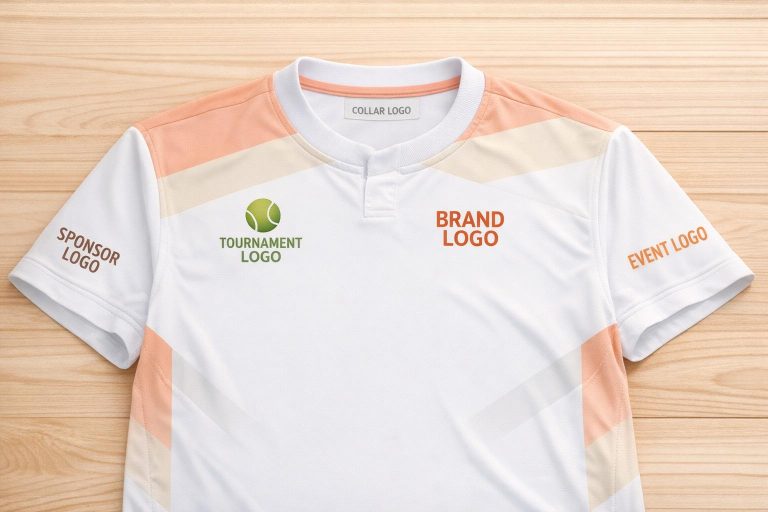
When designing tennis jerseys, proper logo placement is essential to meet official regulations and maintain a professional appearance. Misplaced logos can lead to disqualification, fines, or costly redesigns. Here’s what you need to know:
- ITF Rules: Logos must adhere to strict size limits. For example, commercial logos on sleeves are limited to 3 sq. in., while manufacturer logos can be up to 4 sq. in. on the front or back. Sleeveless jerseys follow different rules for logo placement.
- Grand Slam Guidelines: Tournaments like Wimbledon have additional requirements, such as all-white attire, which can affect logo visibility.
- Positioning Tips: Sponsor logos are best placed on sleeves for visibility, while team logos often go on the chest or back for branding. Proper placement ensures logos remain clear during movement.
- Sizing Consistency: Logo sizes must remain the same across all jersey sizes, regardless of the player’s size.
To ensure compliance and a polished design, work with professional services that understand these regulations and can create durable, high-quality jerseys.
Official Rules for Tennis Jersey Logos
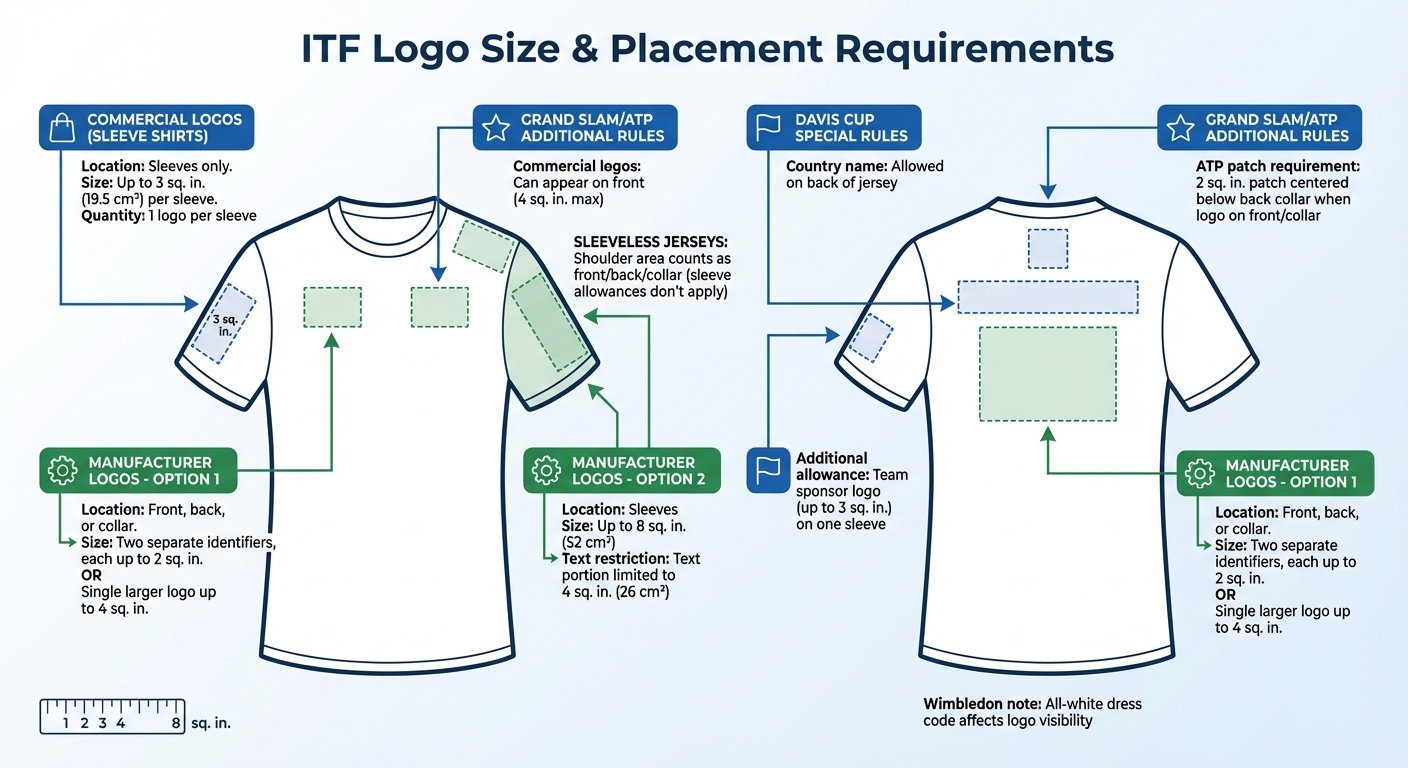
ITF Tennis Jersey Logo Size and Placement Requirements Guide
Before diving into tennis jersey design, it’s crucial to understand the official rules about logo placement. Both the International Tennis Federation (ITF) and professional tours like the ATP have strict guidelines on where logos can go and how large they can be. Failing to comply with these rules can lead to on-court enforcement, so it’s worth getting the details right. Below are the ITF’s specific requirements for logo size and placement.
ITF Logo Size and Placement Requirements
According to ITF rules, commercial logos on sleeve shirts are allowed only on the sleeves, with a single logo per sleeve, each measuring up to 3 square inches (19.5 cm²). Manufacturer logos have more flexibility – they can appear as two separate identifiers on the front, back, or collar (each up to 2 square inches) or as a single larger logo (up to 4 square inches). On the sleeves, manufacturer logos can be as large as 8 square inches (52 cm²), but if the logo includes text, the text portion is limited to 4 square inches (26 cm²).
For sleeveless jerseys, the shoulder area counts as part of the front, back, or collar, so the sleeve-specific allowances don’t apply. In Davis Cup matches, players are allowed an additional team sponsor logo (up to 3 square inches) on one sleeve, and the country name can also be displayed on the back of the jersey. These rules ensure a balance between branding and maintaining the sport’s professional look.
Grand Slam Tournament Rules
Grand Slam tournaments, like Wimbledon and the US Open, build on ITF regulations with their own unique standards. While the size restrictions remain consistent, major tournaments often introduce stricter guidelines. For example, Wimbledon enforces an all-white dress code, even during warm-ups, which can impact how visible logos are.
Under ATP rules, commercial logos typically restricted to the sleeves can also appear on the front of the jersey, with a maximum size of 4 square inches each. If a sponsor logo is placed on the front or collar, an ATP patch (up to 2 square inches) must be centered below the back collar. Ultimately, referees and chair umpires have the authority to decide whether attire complies with these rules. If a player’s outfit doesn’t meet the standards, adjustments must be made before play can continue.
How to Position Logos on Tennis Jerseys
Once you’ve ensured your logos meet size restrictions, the next step is placing them where they’ll make the biggest impact. Thoughtful positioning not only enhances visibility but also complements the jersey’s natural flow during movement. Below, we’ll cover the best spots for sponsor and team logos.
Sponsor Logo Placement and Visibility
The sleeves are a prime location for sponsor logos. The set-in sleeves of tennis jerseys provide excellent visibility from various angles, making them ideal for showcasing sponsorships. Plus, this placement keeps the overall design clean and focused on the team’s branding. Be sure to consider how the fabric moves during play to prevent the logo from distorting or losing its shape.
Team Logo Placement for Brand Identity
To highlight your team’s identity, place the logo in a prominent spot. The left or center chest is a classic choice, but for V-neck or Pro-Neck styles, it’s a good idea to position the logo slightly lower to avoid clashing with the neckline.
Don’t overlook the back of the jersey – it’s another great area to reinforce your team’s branding. By using sublimation printing, your team logo becomes a permanent part of the fabric, creating a sleek, professional appearance that stands up to repeated washes without peeling or fading.
Logo Sizing Guidelines
Getting your logo sizes just right means walking the line between visibility and compliance. On one hand, your branding needs to stand out, even from a distance. On the other, you must stick to strict official limits. The good news? Tennis regulations rely on fixed square-inch measurements, making it easier to apply these rules consistently across your team. Here’s how to select and adjust logo sizes to stay within those boundaries.
Choosing Logo Sizes That Meet Regulations
Tennis rules focus on maximum logo areas, not specific dimensions, giving you some freedom with shapes. Sponsor logos, for instance, must stick to a 3 sq. in. limit, regardless of jersey size. That means a small jersey and an extra-large jersey both follow the same rules – no scaling up or down.
Manufacturer logos have slightly different guidelines. You’re allowed one manufacturer logo on the sleeve, up to 8 sq. in. (52 cm²). However, any text within that logo must fit within 4 sq. in. (26 cm²). This means you could feature a bold emblem or symbol, but the brand name itself has to stay smaller.
"If Chair Umpires are unsure of the identification size or positioning then it is safer to check with the Supervisor/Referee." – ITF Clothing Manual
To maximize visibility, design your logos at the largest allowed size. For example, a 3 sq. in. logo could take the form of a 2" × 1.5" rectangle or a 2" diameter circle. This ensures your branding stands out during matches while staying well within the rules.
Adjusting Logo Sizes for Different Jersey Sizes
Since the regulations are based on fixed square-inch limits, logos must remain the same size across all jersey sizes. A logo that’s 3 sq. in. on a small jersey must also be 3 sq. in. on an extra-large one. Scaling the logo for larger jerseys isn’t allowed, as the rules prioritize absolute size over proportional adjustments. This approach ensures consistent branding across your team.
However, you can tweak placement to maintain visual balance. Larger jerseys might require slight adjustments to positioning, especially to keep the logo looking centered and proportionate. Sublimation printing makes this process seamless. Your design team can customize placements for each jersey size without altering the logo dimensions .
For best results, consider working with a professional design service. For example, Wooter Apparel’s team can create mockups that show how your logos will look across all sizes, ensuring compliance with the 3 sq. in. limit while keeping your branding sharp and visible. And with sublimation printing embedding the logos directly into the fabric, you’ll get durable designs that resist peeling and fading, even after countless washes.
sbb-itb-4d95ad3
Custom Tennis Jersey Design Options
Creating a custom tennis jersey is all about merging compliance with creativity. By following detailed logo placement rules, you can design jerseys that not only meet official standards but also showcase your team’s identity. Partnering with a specialized provider like Wooter Apparel simplifies this process. They ensure your designs align with ITF and tournament regulations while delivering a polished, professional look that makes your team stand out.
Why Choose Wooter Apparel for Custom Jerseys?

Wooter Apparel collaborates directly with teams to produce fully sublimated tennis jerseys that meet official guidelines. Their expert design team handles all the technical aspects, like precise logo placement, so you can focus on bringing your team’s vision to life.
Using advanced sublimation technology, Wooter permanently embeds logos, names, and numbers into the fabric. This process prevents common issues like peeling, cracking, or fading. With a stellar 4.9-star rating from 1,238 reviews, customers frequently highlight the quality and precision of their work.
"Jessica was great – she made numerous changes for us and helped tremendously."
– Coach O.
Wooter also offers a quick turnaround time of 3–4 weeks, with an optional rush service of 2–3 weeks for those on tighter deadlines. Their collaborative approach ensures every detail, including logo placement, is finalized and compliant with regulations before production begins.
How to Start Your Custom Design Project
Getting started with Wooter Apparel is simple and hassle-free. Fill out their request form to receive a free design and quote – there are no hidden fees for adding player names, numbers, or other design elements. To kick things off, submit your team colors, logos (preferably in vector formats like .ai or .pdf), and any specific logo placement requirements from your league or tournament.
During the design consultation, you’ll work closely with professionals like Jason or Albert, who are often praised for their responsiveness and attention to detail. Whether it’s specifying exact logo sizes or placements, they’ll create detailed mockups to show how the final design will look across various jersey sizes.
"Jason in design was great and prompt to respond to our questions."
– James C.
If you don’t have vector files handy, Wooter’s team can redraw your logos for an additional fee, ensuring they print clearly at any size. They also provide sizing charts for tennis apparel and offer a refundable sizing kit for large orders, making it easier to ensure a perfect fit for everyone on your team.
Conclusion
Getting the logo placement right on tennis jerseys isn’t just about following the rules – it’s about showcasing your team’s identity while staying compliant with ITF and tournament-specific guidelines. When logos are sized and positioned correctly, they not only pass inspections but also enhance visibility, ensuring your team and sponsors make a strong impression during matches.
Working with skilled designers can make all the difference. They take the technical requirements and turn them into polished designs that are both compliant and visually appealing. Using durable sublimation printing technology, these designs stand the test of time, resisting peeling, cracking, or fading, so your jerseys look sharp all season long.
Wooter Apparel’s design team has mastered this process. From precise logo placement to creating detailed mockups for all jersey sizes, they handle every detail with care. Their 4.9-star rating from 1,238 reviews speaks to their dedication to quality and precision . This expertise ensures your jerseys meet all regulations without compromising on style or team spirit.
By focusing on accurate logo placement from the start, you can avoid unnecessary delays or costly changes down the line. Professional consultations help you navigate the rules while turning your vision into reality, resulting in jerseys that perform as well as they look.
With expert guidance, premium materials, and advanced printing techniques, your team can step onto the court with confidence, knowing their jerseys meet every standard while reflecting their unique identity. Investing in proper logo placement isn’t just about compliance – it’s about setting your team up for success.
FAQs
What are the official logo size guidelines for tennis jerseys?
The International Tennis Federation (ITF) has clear rules about logos on tennis jerseys. A logo on the main part of the jersey can’t be larger than 6 inches in size. For sleeve logos, the combined area is capped at 6 square inches per sleeve, and players can have up to two logos on each sleeve.
These guidelines are in place to keep players’ attire looking polished and consistent. It’s always a good idea to review the most recent ITF regulations to make sure everything meets the official standards.
How does Wimbledon’s all-white dress code impact logo placement on tennis jerseys?
Wimbledon has a famously strict all-white dress code, and this rule extends to sponsor logos on players’ outfits. These logos must either be white or closely match the outfit’s color. Placement is also tightly controlled, with logos allowed only in designated areas like the chest, sleeves, or shorts. The goal? To keep the tournament’s classic all-white look intact and ensure the spotlight remains on the players, not the branding.
Can logo sizes be adjusted to fit different jersey sizes?
Logos are usually adjusted to fit the proportions of each jersey size. For instance, adult jerseys commonly feature logos that are 6–10 inches wide across the chest. Meanwhile, youth or women’s jerseys might use smaller logos to keep the design balanced and visually pleasing, ensuring the logo looks great and fits well on every size.