
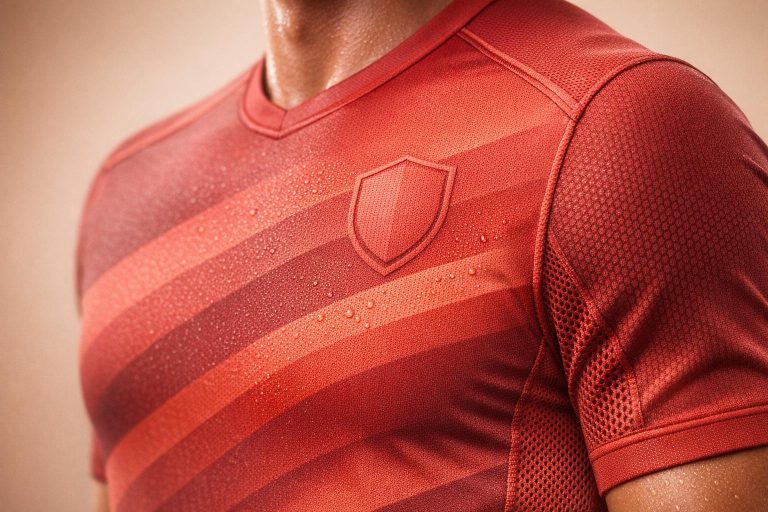
Modern soccer jerseys are a blend of performance, comfort, and team identity. Unlike the heavy wool sweaters of the 1800s, today’s jerseys are engineered using lightweight polyester blends with moisture-wicking technology to keep players dry and cool. Key advancements include:
- Materials: High-performance polyester (135–165 g/m²) with elastane for stretch and durability.
- Moisture Management: Sweat moves to the fabric’s surface for quick evaporation, avoiding discomfort.
- Breathability: Engineered mesh panels and airflow mapping prevent overheating.
- Customization: Sublimation printing embeds designs into the fabric for vibrant, long-lasting graphics.
- Fit: Slim designs reduce drag, improve movement, and resist opponent interference.
These jerseys are built for durability, with abrasion-resistant fibers and eco-friendly recycled polyester options. They also balance performance with storytelling, using designs inspired by local heritage, bold patterns, and clean aesthetics. Whether it’s a slim fit for aerodynamics or sublimated designs for personalization, modern jerseys combine advanced technology with visual appeal to meet the demands of players and fans alike.
Inside Nike’s insane football shirt lab 🤓

sbb-itb-4d95ad3
Materials and Performance Fabrics
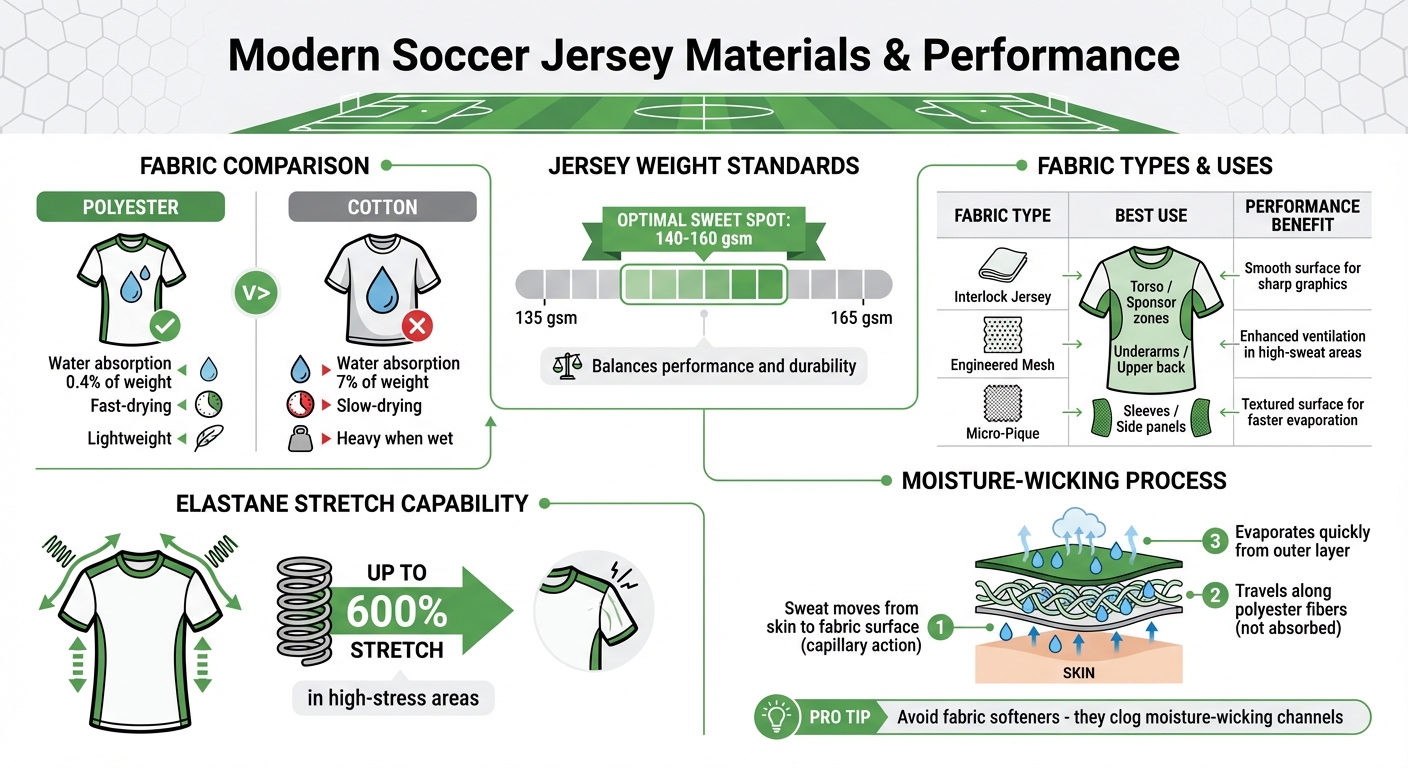
Modern Soccer Jersey Materials and Performance Comparison
Soccer jerseys have come a long way, with modern materials now offering an impressive mix of performance and style. Polyester is the go-to fabric, and for good reason. It absorbs only 0.4% of its weight in water, compared to cotton’s 7%. This property ensures jerseys stay light and dry, even during intense 90-minute matches in humid conditions.
"Polyester delivers fast-drying comfort, crisp branding, and robust supply at scale – advantages that matter from academy fields to international broadcast." – Ivy Lee, Luson Sport
Most jerseys weigh between 135–165 grams per square meter (gsm), with the 140–160 gsm range hitting the sweet spot for balancing performance and durability. Different knit structures are designed for specific purposes: interlock knit provides a smooth surface for sponsor logos, while engineered mesh and micro-pique textures enhance ventilation and speed up sweat evaporation.
Blending polyester with elastane allows for up to 600% stretch in high-stress areas like collars and sleeves, ensuring durability. For visual elements, polyurethane offers water-resistant, heat-sealed logos and badges with sharp detail.
Moisture-Wicking Technology
Moisture-wicking technology relies on capillary action to move sweat from your skin to the fabric’s outer layer, where it evaporates quickly. This keeps the skin dry, enabling the body to cool itself more effectively during high-intensity play.
"The finer the diameter, the more individual fibers you can get in one yarn, which means more tiny channels that sweat can run along." – Janet Brady, Associate Professor of Materials Technology, Thomas Jefferson University
Polyester’s tightly bonded, water-resistant structure forces sweat to travel along the fibers rather than being absorbed. In contrast, cotton absorbs sweat, making it heavy and uncomfortable – a definite drawback for athletes.
To maintain moisture-wicking performance, avoid fabric softeners. These can clog the tiny channels in the fabric, reducing its effectiveness. Wash jerseys inside out in cold water and air dry them to protect the fibers and heat-sealed logos.
Breathability and Ventilation
Breathability is key to preventing overheating, allowing air to circulate through the fabric while moisture evaporates. Modern jerseys use "airflow mapping" or "zoned ventilation", placing engineered mesh panels in areas prone to sweating, like the underarms and upper back. These panels are more than just holes; they are carefully crafted knit structures designed to cool without compromising durability.
Sublimation printing has become the go-to method for breathable jerseys. Unlike traditional screen printing or vinyl transfers, which block airflow by adding thick surface layers, sublimation bonds ink directly with polyester fibers. This process leaves fabric pores open, ensuring ventilation while delivering vibrant, permanent designs.
| Fabric Type | Best Use | Performance Benefit |
|---|---|---|
| Interlock Jersey | Torso / Sponsor zones | Smooth surface for sharp graphics |
| Engineered Mesh | Underarms / Upper back | Enhanced ventilation in high-sweat areas |
| Micro-Pique | Sleeves / Side panels | Textured surface for faster evaporation |
This combination of ventilation and sublimation printing ensures jerseys remain breathable and effective under the toughest conditions.
Durability and Longevity
Modern polyester jerseys are built to last. They are treated for abrasion resistance, making them tough enough to handle slides, tackles, and constant contact on the field. Polyester’s tightly bonded fibers naturally resist ripping, while elastane in stress zones like shoulders and sleeves adds extra durability.
To keep jerseys in top shape, wash them in cold water on a gentle cycle and air dry them. Many manufacturers now use recycled polyester (rPET) from plastic bottles, offering the same durability as virgin polyester while reducing waste.
At Wooter Apparel, we incorporate these advanced materials and techniques into our custom v-neck soccer jerseys. Our fully sublimated designs retain breathability and deliver bold team identities that won’t fade, crack, or peel – even after countless matches and washes. These innovations are at the core of what makes modern jerseys both high-performing and customizable.
Fit and Design Standards
Modern soccer jerseys have come a long way, blending advanced fabrics with fully customizable team uniforms and precise fits to enhance player agility and performance. Gone are the days of the loose, oversized jerseys from the early 2000s. Today’s designs focus on sleek, athletic silhouettes that not only look sharp but also improve on-field performance by reducing drag and ensuring comfort.
Let’s dive into how different fits and design details impact player performance.
Streamlined vs. Loose Fits
The debate between loose and tight jersey fits boils down to two key factors: aerodynamics and opponent interference. Baggy jerseys create drag and give opponents an easy grip during play. On the other hand, modern slim-fit designs strike the perfect balance by reducing drag while maintaining comfort.
"Tighter soccer jerseys, especially skin-tight ones, improve a player’s aerodynamics and their movement. There are no loose ends or fabric to catch the wind, meaning there’s no drag." – admin, Pesstatsdatabase
While skin-tight jerseys excel at cutting drag, they can cause discomfort, such as chafing. That’s why slim-fit jerseys have become the go-to choice. They’re snug enough to minimize drag but still comfortable for the full 90 minutes. A notable example is the Kappa Kombat jersey, introduced for the Italian national team at Euro 2000. Its fabric could stretch up to 40 cm (approximately 15.7 inches), making it easier for referees to detect shirt-pulling during matches.
| Feature | Tight/Streamlined Fit | Loose/Baggy Fit | Slim/Snug Fit (Modern Standard) |
|---|---|---|---|
| Aerodynamics | High (No drag) | Low (High drag) | High |
| Opponent Interference | Hard to grab | Easy to pull | Difficult to grab |
| Comfort | Can cause chafing | High comfort | Balanced comfort |
| Performance Focus | Speed and power | Casual play | All-around performance |
Beyond fit, the flexibility of the material plays a crucial role in ensuring unrestricted movement on the field.
Freedom of Movement
Modern soccer jerseys are crafted with 4-way stretch fabrics, often a blend of polyester and spandex, to allow players to move freely in every direction. These materials, combined with engineered knit structures, ensure that players can sprint, pivot, and tackle without feeling restricted. Elastane, for example, can stretch up to 600% of its original length without tearing, highlighting its durability. This flexibility ensures players can stay focused on the game rather than being distracted by their gear.
"Storelli gear feels comfortable… It’s all pretty light product, and you don’t feel like you’re wearing it when it’s on, so it’s not a distraction." – Goalkeeper, Storelli
Additionally, zoned ventilation – using different fabrics in specific areas – further enhances comfort while maintaining a snug fit.
Home vs. Away Kit Requirements
League regulations set clear rules for home and away kits, particularly to avoid color clashes during matches. Goalkeeper kits must also contrast with outfield player uniforms while adhering to rules on color contrast, number sizes, and badge placements.
Clubs stick to consistent color schemes across their match, training, and travel gear to maintain a unified look. For broadcast accuracy, 100% polyester is typically used, as it ensures precise color reproduction across all kit types. While sublimation is commonly used for intricate body graphics, heat transfers are preferred for names and numbers, providing clean edges that meet league standards for personalization.
Customization and Sublimation Techniques
Modern materials have significantly improved athletic wear, enhancing breathability and comfort. But when it comes to jersey customization, sublimation has truly transformed the game. This method offers endless design possibilities while ensuring the performance athletes demand remains uncompromised.
Full-Color Sublimation Printing
Sublimation is a fascinating chemical process where solid ink turns into gas without ever becoming liquid. When heated to temperatures between 380–420°F, the gaseous ink bonds directly with polyester fibers at a molecular level. Unlike traditional methods like screen printing or heat transfers, sublimation integrates the design into the fabric itself, making it part of the jersey rather than just a layer on top.
"Sublimation is a chemical process where a solid turns into gas without going through the liquid stage." – Wooter Apparel
This process comes with major advantages. Because the ink becomes part of the fabric, the jersey remains lightweight and breathable – key for athletes who need to stay comfortable during long matches. Even after countless washes or hours in the sun, the designs won’t crack, peel, or fade. Plus, sublimation allows for unlimited colors, gradients, and intricate all-over prints without increasing production costs per color.
Another perk? Sublimation is eco-friendly. It produces no waste and doesn’t require water during production. However, it only works with 100% polyester or polyester-coated materials, so it’s not compatible with cotton fabrics.
| Feature | Sublimation Printing | Traditional (Screen/Heat Transfer) |
|---|---|---|
| Texture | Soft-hand feel; ink blends into fabric | Heavy or thick "plastic" surface feel |
| Breathability | Excellent; fabric pores stay open | Reduced; ink layers block ventilation |
| Durability | Permanent; no cracking or peeling | Prone to cracking, peeling, or fading |
| Color Options | Unlimited colors and gradients | Limited by screen or layer count |
Adding Team Identity
Sublimation also simplifies the process of adding player names, numbers, and logos directly into the jersey design. With each jersey printed from its own digital transfer, individual customization doesn’t require the costly setup changes associated with screen printing.
To achieve sharp and professional results, designers rely on high-resolution vector files like AI, EPS, or PDF formats. These files ensure that logos and numbers remain crisp and clear, regardless of jersey size. Tools like Adobe Illustrator and CorelDRAW help designers create scalable graphics that won’t pixelate. Manufacturers even provide digital templates with "safe zones" and "bleed areas" to ensure all elements stay perfectly aligned during assembly. Using the CMYK color model and anchoring designs to official Pantone (PMS) codes ensures consistent colors across production runs.
This precision in design allows jerseys to go beyond functionality, showcasing deeper stories and identities.
Incorporating Local and Cultural Elements
Sublimation’s design flexibility opens the door for jerseys to reflect local pride and historical significance. Teams are increasingly using this method to incorporate meaningful elements like landmarks, symbols, and references to their heritage. Its ability to print high-resolution images and intricate graphics directly onto fabric makes it ideal for creating jerseys with rich, detailed designs.
With seam-to-seam printing, designers can create cohesive visual narratives that flow across the entire jersey, from front to back and sleeve to sleeve. Careful alignment ensures these patterns remain continuous, even across separate fabric panels. This approach has become a popular way for teams to celebrate their identity in bold, visually striking ways.
Wooter Apparel, a leader in fully sublimated soccer jerseys, gives teams the chance to create custom designs that combine performance with personality. Their jerseys consistently earn praise for their vibrant colors, comfortable fit, and the way they match the original design concepts. With a 4.9/5 star rating from over 1,330 reviews, they’ve proven their commitment to quality. Orders typically ship within 2–3 weeks, and many designs have no minimum order requirements, making customization accessible for teams of all sizes.
This mastery of sublimation sets the stage for the exciting design trends to come.
Design Inspiration and Current Trends
Modern soccer jerseys have evolved far beyond mere athletic uniforms. They now serve as powerful symbols of identity and storytelling, blending cutting-edge design with deeper meanings. This shift, often described as "minimalism with meaning", focuses on clean designs that highlight team identity without overcomplicating the aesthetic. Jerseys today aren’t just about performance or fit – they’re about belonging and the stories they tell.
Color Blocking and Patterns
Bold geometric patterns and intricate textures are redefining jersey design. Instead of simple stripes, teams are weaving local culture and history into their kits. For instance, some jerseys feature graphics inspired by city skylines, historical mosaics like Spanish Azulejos tiles, or architectural elements from iconic landmarks. A standout example is FC Cologne’s 2025 limited-edition kit, which celebrated the 777th anniversary of the Kölner Domkirche cathedral with masonry-inspired patterns. Thanks to advanced sublimation techniques, these intricate designs remain lightweight and breathable.
Embossed and debossed details are also making waves. These techniques give jerseys a premium, tactile quality that flat sublimated prints can’t replicate. As Phil Delves from Football Shirt Authority explains:
"The more premium feel of an embossed pattern is another clear advantage of the technique. Sublimated shirts may offer almost complete freedom in terms of aesthetic, but the flat nature of most sublimated kits pales in comparison to an embossed kit where the details can be felt as well as seen".
Another trend is the rise of custom typefaces, which enhance a team’s visual identity. Fonts are carefully chosen to reflect the team’s character – sharp, angular designs project aggression, while rounded forms convey unity and approachability. These thoughtful design choices ensure jerseys stand out in a crowded market while reinforcing each team’s unique story.
Minimalist and Clean Aesthetics
On the other end of the spectrum, sleek and understated designs are gaining traction. Off-white shades like ivory and ecru are becoming popular as sophisticated alternatives to traditional white or black kits. These subtle tones elevate jerseys from sportswear to versatile lifestyle pieces.
"A collar instantly elevates the jersey from pure athletic wear to a fashionable piece, often allowing for contrasting colors or subtle trim that frames the crest beautifully." – AlexWear, XTeamwear
The growing retro revival trend ties into this minimalist approach. Vintage elements like polo collars, V-neck styles, and classic logos (such as the Adidas Trefoil) bring nostalgia into modern designs. Bayern Munich’s 125th-anniversary shirt, featuring the Trefoil logo, perfectly combined heritage with contemporary performance standards in December 2025.
Minimalism also extends to sponsor logos. Monochrome treatments and embossed finishes are being used to integrate logos seamlessly, avoiding the "walking billboard" look. This approach ensures jerseys remain professional and visually cohesive while preserving their storytelling potential.
Seasonal and Event-Specific Themes
Jerseys are increasingly becoming tools for storytelling, celebrating cultural heritage, and marking milestones. Clubs are using special designs to commemorate anniversaries, honor icons, or highlight local traditions. For example, Bayern Munich’s 2025-26 Oktoberfest jersey celebrated both the club’s 125th birthday and the 190th anniversary of the first Weisn festival. These designs forge emotional connections that go beyond the game.
Adidas took a similar approach with Argentina’s 2026 World Cup home kit. The design featured three shades of blue, symbolizing the team’s championship years (1978, 1986, and 2022), and included the birth year of the AFA, 1896, etched into the collar. Thomas Mace, VP Design at adidas Football, explained:
"Every jersey tells a story – blending cultural heritage with modern aesthetics – and is built using our most advanced technologies to keep players cool and comfortable on football’s biggest stage".
Tribute patches are another way teams are adding meaning to their designs. These small details, often placed over the heart or on the sleeve, honor founding years, beloved icons, or community initiatives. Custom apparel providers like Wooter Apparel make it possible for even smaller teams to integrate these meaningful elements into their designs without compromising quality.
As Dan Jones from SoccerBible aptly puts it:
"Kits now carry cultural value. They bleed into lifestyle, streetwear, even music and design scenes. They’re badges of belonging, shorthand for identity".
Conclusion
Modern soccer jerseys are a perfect mix of advanced engineering, team identity, and performance-driven design. Made almost exclusively from 100% polyester, these jerseys excel at moisture management and staying lightweight. Unlike cotton, which absorbs sweat and gets heavy, polyester keeps its weight consistent and performance reliable – even in the most humid conditions.
Fit also plays a key role. Jerseys designed for fluid movement help players sprint, slide, and turn without restriction. Features like zoned ventilation – with micro-mesh panels placed in high-heat areas – enhance airflow, while reinforced stitching ensures durability against the wear and tear of competitive play.
Sublimation printing has revolutionized how teams showcase their identity. By embedding dye directly into polyester fibers, designs resist cracking, peeling, or fading, even after repeated industrial washes. This means teams can display intricate patterns, bold colors, and unique elements that remain sharp and vibrant under stadium lights.
"Polyester delivers fast-drying comfort, crisp branding, and robust supply at scale – advantages that matter from academy fields to international broadcast" – Ivy Lee, Luson Sport.
To get the best results, teams should opt for jersey finishes that prevent clinging in humid conditions and request strike-off samples to ensure consistent color across all panels. With the soccer apparel market expected to surpass $73 billion by 2027, investing in quality materials and thoughtful design isn’t just about performance – it’s about building team pride and making an impact on and off the field.