
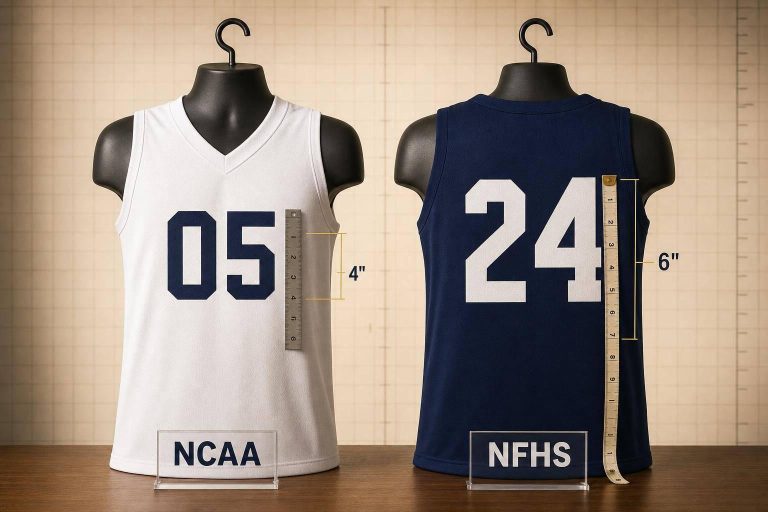
If you order the wrong basketball jersey numbers, you can end up with unusable uniforms and a 3-to-4-week reorder delay. That’s the main takeaway here.
I’d sum it up like this: NCAA and NFHS are more alike than different on basketball number rules. Both rule sets limit jersey numbers to digits 0 through 5, both require 4-inch front numbers and 6-inch back numbers, and both now bar numbers that match the jersey color for the 2024–25 season and after.
Here’s what I’d check before placing any order:
- Legal number digits: only 0–5
- Front number size: at least 4 inches
- Back number size: at least 6 inches
- Placement: numbers on front and back
- Color contrast: numbers must stand out from the jersey
- Logo/patch limit: no more than 2.25 square inches
- Risk point: one mistake across a full roster can mean extra cost per jersey and lost time
A lot of people think NCAA and NFHS use different back-number sizes. They don’t. The article’s own comparison shows 6 inches for both. So if I were ordering uniforms, I’d focus less on “NCAA vs. NFHS size differences” and more on digit limits, color contrast, placement, and proof review.
Quick Comparison
| Rule | NCAA | NFHS |
|---|---|---|
| Allowed digits | 0–5 | 0–5 |
| Front number minimum | 4 inches | 4 inches |
| Back number minimum | 6 inches | 6 inches |
| Front and back numbers required | Yes | Yes |
| Numbers can match jersey color | No | No |
| Logo/patch cap | 2.25 sq. in. | 2.25 sq. in. |
If you want the short version: the safest move is to proof every jersey for number choice, size, contrast, and logo space before production starts.
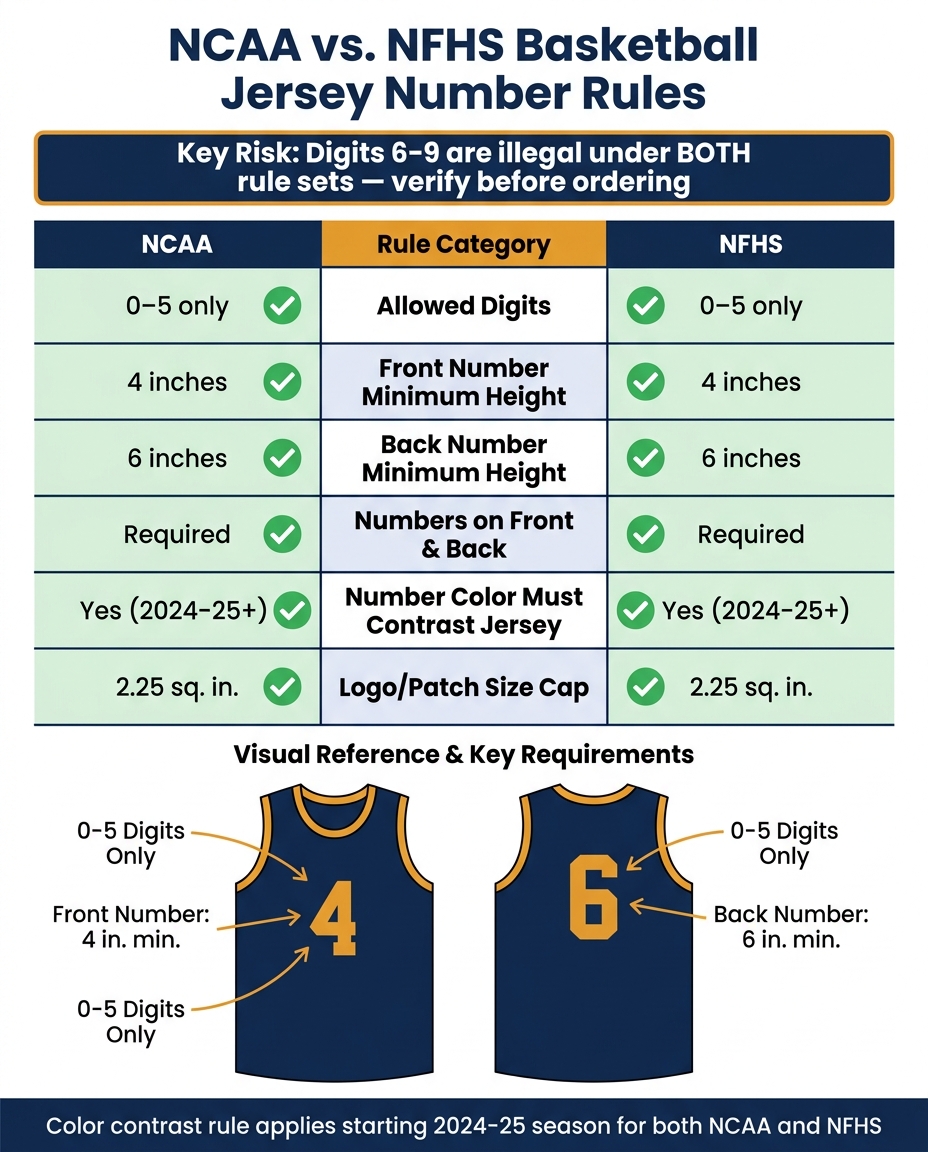
NCAA vs. NFHS Basketball Jersey Number Rules: Side-by-Side Comparison
Good Question: What are the NCAA rules for numbers on basketball jerseys?
NCAA Basketball Number Rules
NCAA rules spell out what counts as a legal jersey number, along with the required size and placement. If any part is off, the jersey can’t be used in official games. For custom orders, that means the number range, size, and placement all need to be locked in before production starts.
Legal Numbers Under NCAA Rules
NCAA rules require Arabic numerals, and every player on the roster has to wear a different number. There’s one big limit here: you can only use digits 0 through 5. So numbers with 6, 7, 8, or 9 aren’t allowed.
Front and Back Number Size Requirements
Front numbers must be at least 4 inches tall, and back numbers must be at least 6 inches tall. That minimum size helps officials and scorekeepers identify players from across the court without squinting or guessing.
Placement, Centering, and Visibility
Size alone isn’t enough. Placement matters too, because the numbers need to stay easy to read during play. NCAA rules require numbers on both the front and back of the jersey. The number also has to sit on a background that clearly contrasts with it.
There’s another detail many people miss: logos, trademarks, and labels are capped at 2.25 square inches so they don’t get in the way of number visibility. And starting with the 2024–25 season, jersey numbers can’t be the same color as the jersey itself, again to keep them visible.
Next, compare those standards with NFHS, where the number limits and sizing are different.
NFHS Basketball Number Rules
NFHS keeps the same basic front-and-back number size minimums as NCAA. But the rules for color and number presentation are not the same. If you’re ordering high school uniforms, check the number style, contrast, and rule details before production. It can save a lot of hassle later.
Legal Number Combinations Under NFHS Rules
NFHS limits legal numbers to combinations that use only the digits 0 through 5, shown in Arabic numerals.
Number Size, Style, and Placement Requirements
NFHS uses the same minimum number sizes as NCAA: front numbers must be at least 4 inches tall, and back numbers must be at least 6 inches tall. Numbers also have to appear on both the front and back of the jersey.
Where NFHS stands apart is enforcement. At the high school level, game officials and scorekeepers depend on clear, consistent number sizing, so these rules tend to get close attention.
Color Contrast and Uniform Consistency
Starting with the 2024–25 season, NFHS does not allow jersey numbers that match the color of the jersey fabric. That means the number has to stand out clearly, not blend into the uniform.
NFHS also limits logos, labels, and patches to 2.25 square inches. It’s a small detail, but it matters when a team is locking in a custom jersey design.
Those points come into focus when teams line up NFHS rules next to NCAA requirements.
sbb-itb-4d95ad3
Key Differences Between NCAA and NFHS Rules
The clearest difference people look for is back-number height. In practice, though, there isn’t a gap here: NCAA rules require back numbers to be at least 6 inches tall, and NFHS sets the same minimum. The front-number minimum also matches, so the table below sticks to the points that matter most during approval.
Side-by-Side Rule Comparison Table
| Rule Category | NCAA | NFHS |
|---|---|---|
| Back number minimum height | 6 inches | 6 inches |
| Number color restriction | Cannot match jersey fabric (2024–25) | Cannot match jersey fabric (2024–25) |
What the Differences Mean for Coaches and Administrators
NFHS limits jersey numbers to digits 0 through 5 and bars numbers that match the jersey fabric color.
That means coaches and school staff should check number choice and color contrast before custom artwork goes to production. It’s a small step, but it can save time, rework, and approval issues later.
How to Order Compliant Custom Basketball Jerseys
Pre-Order Checklist for Number Compliance
Before you send artwork to production, check the design against the rule book your team plays under – NCAA or NFHS. That step can save a lot of back-and-forth later.
Here’s what to verify:
- Legal digits only: Player numbers can use only digits 0–5. Digits 6–9 are not allowed under either rule set.
- Front number height: The front number must be at least 4 inches tall for both NCAA and NFHS.
- Back number height: The back number must be at least 6 inches tall for both NCAA and NFHS.
- Color contrast: The number color needs to stand out clearly from the jersey. Low-contrast color pairings can fail review. Under NFHS rules, jersey numbers also cannot match the jersey body color starting in the 2024–25 season.
- Neutral zone: Keep the 12-inch center zone solid and free of clutter.
- Logo and patch size: Make sure any logo or patch stays within the square-inch limit for the rule set you follow.
Check the proof against this list before production starts.
Applying the Rules to Custom Uniform Design
These rules don’t just affect the number itself. They also shape how much room you have for names, logos, and graphics.
Once you account for the required number size and centered placement, the open space on the jersey shrinks fast. Wordmarks, graphic accents, and other design touches need to work around that setup without crowding the numbers or crossing into the neutral zone. A design can look great on screen and still run into trouble if those elements sit too close to the required placement area.
Conclusion: Key Rules Teams Should Double-Check
The most common trouble spots are number range, height, contrast, and logo placement.
NCAA and NFHS both use the same digit limits and the same minimum number sizes, but teams still need to verify color-contrast rules and logo limits before approving artwork. These issues are easy to miss when the focus is on style instead of approval. Double-check the digit range, number height, contrast, and logo placement before production.
FAQs
Can a team use number 00 under NCAA or NFHS rules?
Yes. Both NCAA and NFHS rules allow 00, along with approved number ranges such as 0–5, 10–15, 20–25, 30–35, 40–45, and 50–55.
One thing to watch: teams should not use both 0 and 00 on the same roster. That can lead to scoring confusion.
What happens if a jersey number breaks the rules?
A jersey number that breaks the rules can cause all kinds of headaches: penalties, equipment violations, point deductions, or even players getting sidelined or ruled ineligible to play.
The safe move is simple: check the exact rules for your league or governing body before you lock in your uniform design. That could mean the NCAA, NFHS, or another organization tied to your competition. Wooter Apparel can help with common league requirements, but teams should still confirm the rules for their own league.
Do basketball jersey names or graphics affect number placement?
Yes. Names and graphics can affect number placement because you need clear spacing for a clean, league-compliant design.
Player names usually sit above the back number, with at least 1 inch of space so nothing feels cramped or overlaps. Keep both elements centered so the name and number stay easy to read.