
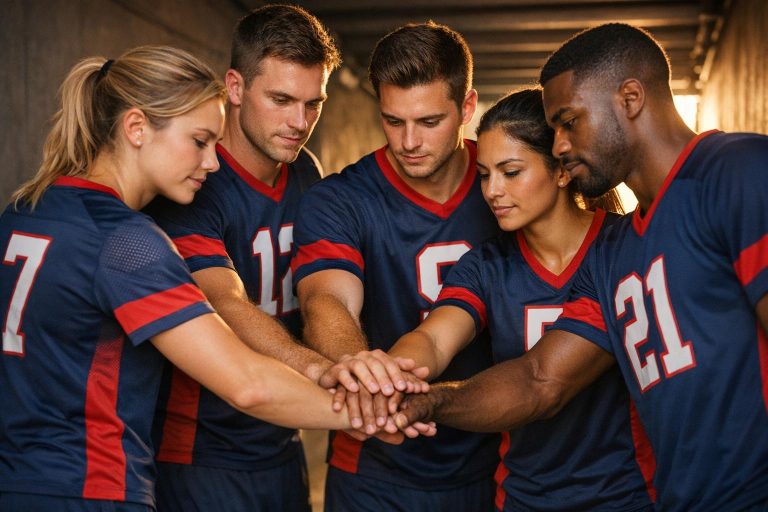
Uniforms do more than make teams look unified – they actively influence performance. Research shows that wearing a uniform triggers changes in the brain, enhancing teamwork, focus, and motivation. Key findings include:
- Brain Activation: Uniforms stimulate areas linked to empathy and reward, boosting group cohesion.
- Enclothed Cognition: The symbolic meaning of uniforms sharpens focus and confidence.
- Color Impact: Colors like red and black affect aggression and readiness, while white improves visibility.
- Practical Design: Custom uniforms support physical needs, improving comfort and performance.
Uniforms transform players into a team, aligning their mindset and actions for better results.
How Uniforms Impact Team Performance: Key Research Findings
Boost Your Athletic Performance with Psychology Driven Sportswear Design
How Uniforms Improve Team Performance: Research Findings
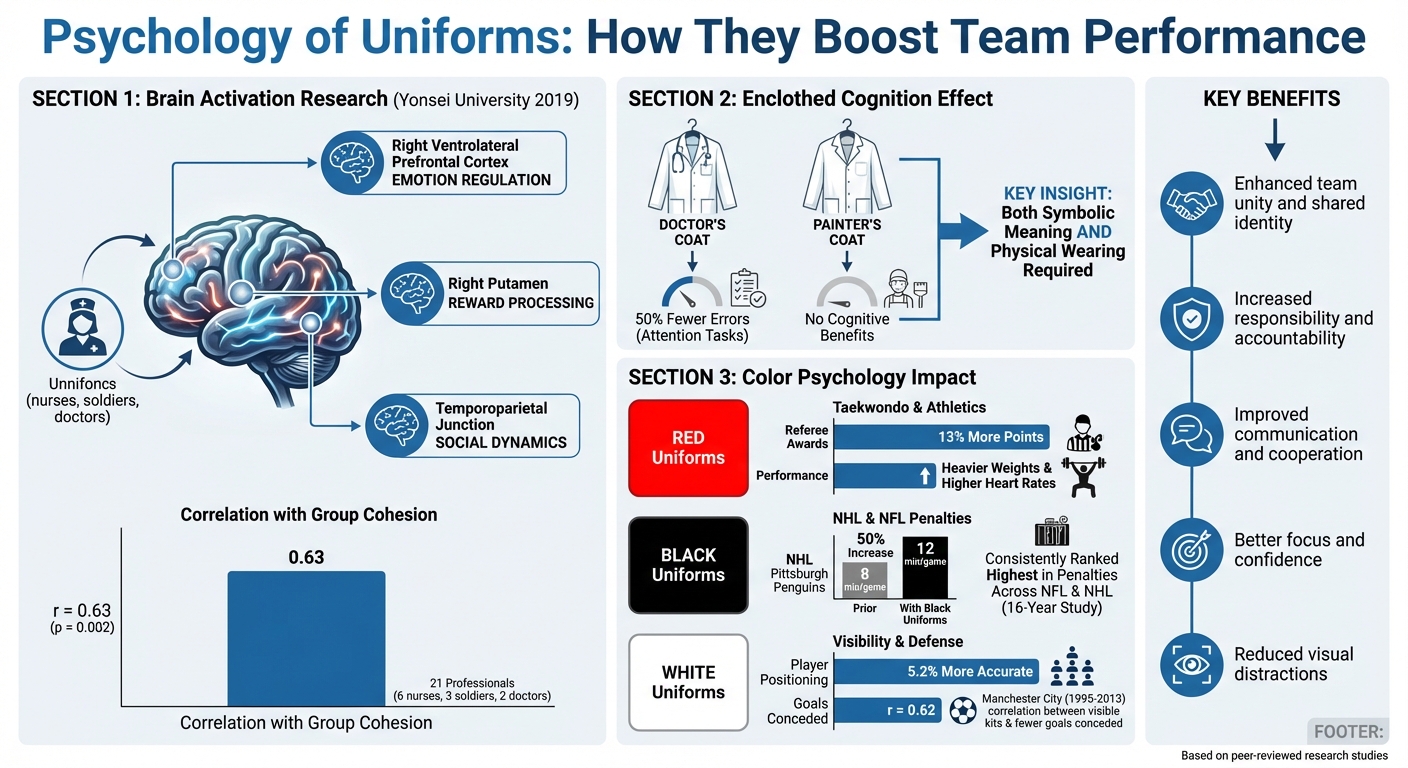
Studies reveal that uniforms can activate specific brain mechanisms to enhance team performance. A notable study conducted by Yonsei University in July 2019 examined 21 professionals, including six nurses, three soldiers, and two doctors, using fMRI scans. The results showed that viewing themselves in uniform triggered significant activity in the right ventrolateral prefrontal cortex and right putamen – areas of the brain linked to emotion regulation and reward processing. This neural activity strongly correlated with group cohesion, with a correlation coefficient of r = 0.63 (p = 0.002) for social integration. These findings highlight how uniforms can play a key role in strengthening team unity, fostering responsibility, and improving communication.
Creating Unity and Shared Identity
Uniforms act as a powerful visual symbol that helps individuals see themselves as part of a group rather than as separate entities. This shared identity simplifies role recognition and reinforces the idea of working toward a collective goal. The Yonsei study also found that wearing uniforms activates the temporoparietal junction, a brain region crucial for understanding social dynamics and perspective-taking. By making it easier to identify team members, uniforms naturally enhance coordination and group cohesion.
Increasing Responsibility and Accountability
Uniforms also contribute to a heightened sense of professional pride and accountability. Yeon-Ju Hong, a researcher from Yonsei University, explains:
"Wearing police uniforms gives the belief and authority that members will perform much more competently and responsibly than when they wear casual wear".
This sense of authority and responsibility, instilled by the uniform, sets a standard of excellence and encourages individuals to meet those expectations.
Improving Communication and Cooperation
Uniforms help minimize visual distractions and enhance the ability to interpret teammates’ intentions, improving both verbal and non-verbal coordination. Supporting this, research on enclothed cognition found that participants wearing white lab coats made 50% fewer errors on tasks requiring high levels of attention compared to those in casual attire. This improved focus can translate into better decision-making and teamwork, especially in high-pressure situations.
The Enclothed Cognition Effect
The concept of enclothed cognition dives into how our clothing influences our thoughts, emotions, and actions. This psychological phenomenon hinges on two key elements: the symbolic meaning of the clothing and the physical act of wearing it. Researchers Hajo Adam and Adam Galinsky elaborate:
"Enclothed cognition involves the co-occurrence of two independent factors – the symbolic meaning of the clothes and the physical experience of wearing them."
For sports teams, uniforms do more than just distinguish players – they actively shape their mindset and performance. This phenomenon not only sharpens cognitive function but also leads to tangible athletic improvements.
How Uniforms Boost Focus and Confidence
Experiments like those involving white lab coats highlight the power of enclothed cognition. In one study, participants wearing a coat described as a "doctor’s coat" made 50% fewer errors. Interestingly, when the same coat was labeled a "painter’s coat", the cognitive benefits vanished entirely.
This demonstrates that the symbolic meaning of clothing is just as crucial as the garment itself. When an athlete puts on their team jersey, they’re not just dressing for the game – they’re stepping into a mindset of professionalism, discipline, and peak performance. Adam and Galinsky explain:
"Although the saying goes that clothes do not make the man, our results suggest they do hold a strange power over their wearers."
However, the effect only works when the uniform is worn. Seeing it on a hanger or imagining it doesn’t trigger the same mental boost. Athletes need to physically wear their gear to experience the increased focus and confidence.
These psychological shifts translate into real-world sports performance.
Sports Team Examples
Studies of professional sports teams provide clear evidence of how uniforms influence player behavior and outcomes. A 1988 analysis of the National Football League (NFL) and National Hockey League (NHL) revealed that teams in black uniforms consistently ranked among the league leaders in penalties. When teams switched to black uniforms mid-season, penalties spiked immediately, suggesting that the color impacted both how players saw themselves and how referees judged them.
Uniform color can even affect physical readiness. A February 2013 study in the Journal of Sport and Exercise Psychology tested 28 male athletes in red and blue jerseys. When wearing red, participants lifted heavier weights and maintained higher heart rates during competition compared to when they wore blue. While wearing red didn’t guarantee victory, it clearly influenced physical intensity and preparedness.
That said, the effect of uniform design isn’t universal. A study of American collegiate basketball games over seven seasons (2012–2018) found no significant link between uniform colors and winning outcomes in this less aggressive, long-duration sport. The enclothed cognition effect is strongest when the symbolic meaning of the uniform aligns with the sport’s demands – aggression for combat sports, precision for technical events, and unity for team-based games. These findings highlight how uniform design can directly shape player behavior and performance.
sbb-itb-4d95ad3
Design and Color Psychology in Uniforms
Color Psychology: How Colors Affect Performance
A team’s uniform color doesn’t just catch the eye – it shapes behavior, influences decisions, and even impacts physical performance. Studies show that certain colors trigger psychological responses tied to both biology and societal norms.
Take red, for example. It’s a powerhouse in competitive sports. Biologically, red mimics oxygenated blood, which is often associated with aggression and strength. This connection isn’t just theoretical – it’s backed by numbers. In taekwondo matches, referees awarded athletes in red 13% more points than those in blue, even when their performances were identical. Red also affects how athletes perceive themselves and their opponents. In one study, female college athletes rated red-uniformed teams as more confident and "strongest", while teams in black were labeled as "meanest".
Speaking of black, this color is often linked to aggression, and it doesn’t just influence perception – it changes behavior. A striking example comes from the NHL’s Pittsburgh Penguins during the 1979-1980 season. After switching from light blue to black uniforms mid-season, their penalty average shot up from 8 minutes per game to 12 minutes per game – with no roster changes. Over a 16-year span, teams wearing black in the NFL and NHL consistently ranked among the highest in penalties. Professor Geoff Haddock from Cardiff University summed it up perfectly:
"The color of a sports team’s uniform can have big consequences".
Then there’s white, which offers a practical edge. Its high visibility makes it easier to identify players on the field. In controlled trials, player positioning was recognized 5.2% more accurately when athletes wore white instead of green uniforms. A long-term study of Manchester City (1995-2013) found a strong correlation (r = 0.62) between wearing visible kits in away games and conceding fewer goals. Researchers concluded:
"The outfit colour may indirectly influence football match results, warranting more attention to the home and away shirts by team managers and football scientists".
These psychological and practical effects of color lay the groundwork for how design elements further enhance team identity and performance.
Design Elements and Fan Support
A well-designed uniform does more than look good – it strengthens team identity and boosts morale. From sharp logos to coordinated fabrics, thoughtful design makes teams appear more professional and commands respect from opponents, officials, and fans. Brian F., a Wooter Apparel customer, shared this insight:
"The rest of our league saw our jersey post and said we have the best official looking jerseys in the entire league".
But design isn’t just about aesthetics. Clear, functional elements improve on-field recognition and decision-making, especially in outdoor sports where conditions like rain or fog can reduce visibility. Features like lightness and vividness in uniform design become critical here. Teams that invest in custom designs – using performance-enhancing materials like moisture-wicking fabrics rated 4.9/5 by over 1,200 customers – create an environment where players feel confident and comfortable. This combination of style and function allows athletes to focus solely on their game.
When paired with the psychological power of color, these design choices amplify team cohesion and performance, ensuring every detail contributes to success on the field.
Using Custom Team Uniforms to Improve Performance
Sport-Specific Uniform Designs
Different sports place unique demands on their uniforms, and tailoring designs to meet these needs can have a big impact on both comfort and performance. For instance, basketball players benefit from lightweight, breathable jerseys that allow free arm movement for shooting and passing. Soccer players, who spend 90 minutes in constant motion, need moisture-wicking fabrics to stay cool. Baseball and softball uniforms must be durable enough to handle slides and pivots while remaining flexible. Football gear, on the other hand, has to accommodate protective padding without sacrificing the team’s identity.
This attention to sport-specific functionality doesn’t just address physical needs – it also supports mental readiness. Researchers refer to this as enclothed cognition, where the uniform acts as a psychological tool, boosting self-confidence and agility by aligning form with function.
Sublimated uniforms, which embed dye directly into the fabric, are a great example of this balance. These uniforms stay vibrant through repeated washes while remaining lightweight and flexible – qualities that are crucial for sports requiring constant movement. By combining durability with performance, custom designs can elevate both individual and team dynamics.
Wooter Apparel: Custom Uniform Solutions for Teams
Wooter Apparel takes sport-specific needs to the next level by offering custom uniforms that seamlessly blend style and functionality. Specializing in fully sublimated uniforms for basketball, football, baseball, softball, and soccer, Wooter Apparel ensures that every team looks and feels prepared to perform at their best.
One standout feature is their free custom design service, which allows teams to create personalized gear at an affordable price. Jerseys start at just $16.99, and teams can also choose from shorts, warmup gear, and complete uniform packages. The sublimation process enables detailed designs with unlimited colors, gradients, patterns, and sponsor logos – all without adding extra weight or sacrificing breathability.
This customization offers more than just aesthetic appeal – it strengthens team identity and cohesion, reinforcing the psychological benefits of enclothed cognition. Plus, the molecular-level dye infusion ensures that designs won’t fade, crack, or peel, making these uniforms a smart, long-term investment for teams looking to enhance both their appearance and performance. Whether it’s creating a unified look or meeting the demands of the game, Wooter Apparel delivers solutions that work on and off the field.
Conclusion
Research highlights how matching uniforms can trigger a psychological shift, bringing individuals together as a unified team. This shift activates brain networks tied to empathy, reward, and emotion regulation, fostering improved focus, responsibility, and teamwork – all of which directly enhance performance on the field.
The concept of enclothed cognition further illustrates how simply wearing a uniform can boost focus and confidence, especially in high-pressure situations. This subtle mental edge can make all the difference during critical moments.
On a broader level, matching uniforms help eliminate visual hierarchies, fostering a sense of equality and trust among teammates. When everyone looks the same, differences in background fade, creating a shared sense of purpose. This visual unity becomes a constant reminder that every effort – whether a pass, tackle, or sprint – contributes to the team’s collective success.
Investing in quality uniforms isn’t just about appearances. Sublimated designs that resist fading, cracking, or peeling ensure a team’s identity stays intact season after season. With durable, custom designs, teams not only look unified – they perform as one.
FAQs
How do team uniforms improve performance and teamwork?
Team uniforms have a meaningful impact on performance and teamwork, thanks to the psychological and behavioral effects they bring to the table. When players wear matching uniforms, it creates a strong sense of unity and shared purpose. This connection helps foster equality among team members, reducing personal conflicts and building trust. With trust in place, communication improves – an essential ingredient for any team’s success.
Uniforms also play a key role in boosting confidence and morale. Wearing high-quality, thoughtfully designed gear can make athletes feel more professional and motivated, sharpening their focus and determination during games. Beyond just performance, coordinated uniforms reinforce a sense of belonging and responsibility, pushing players to give their best for the team’s success. By inspiring pride and togetherness, team uniforms become a subtle yet powerful way to enhance both individual effort and collective achievement.
What is enclothed cognition, and how does it impact team performance?
Enclothed cognition refers to the psychological phenomenon where the clothes we wear impact our mindset, emotions, and behavior. It’s not just about expressing identity – what we wear can actively shape how we think and act.
For athletes, uniforms play a key role in this process. Wearing gear that embodies qualities like strength, unity, or professionalism can elevate confidence, sharpen focus, and encourage teamwork. When uniforms are well-made and thoughtfully designed, they can enhance an athlete’s mental readiness, making them feel more capable and driven. This mental edge often translates into better personal performance, stronger team cohesion, and improved results during games or competitions.
How do uniform colors like red and black impact team performance and behavior?
Uniform colors like red and black can play a significant role in shaping team performance and behavior because of the psychological and social meanings tied to them. Red is often associated with energy, aggression, and dominance. This can push players to be more assertive and competitive during games, potentially giving them an edge. However, this heightened intensity might come at a cost, as it could also lead to an increase in fouls or penalties.
On the other hand, black uniforms carry connotations of power and authority but are also linked to perceptions of aggression. Research indicates that wearing black can influence how players see themselves, encouraging more assertive behavior. Interestingly, it may even sway referees’ decisions, leading to more penalties against teams in black. These responses stem from the cultural and social meanings attached to these colors, subtly impacting how teams perform and interact during games.