
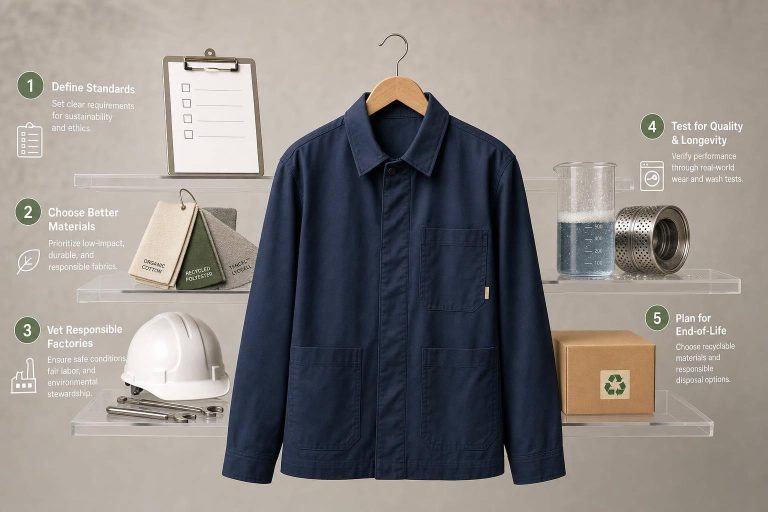
If you buy uniforms more than once, the low quote is only part of the cost. I’d look at five things first: fabric, worker conditions, wear life, washing performance, and what happens when the uniform is no longer usable.
Here’s the short version:
- The textile sector produces about 2% to 10% of global carbon emissions
- It uses about 79–93 billion cubic meters of freshwater each year
- Better wear life can cut replacements by about 25%
- In the U.S., about 17 million tons of textile waste were generated in 2018, and only 15% was reused or recycled
So if I were sourcing uniforms, I’d do this:
- Set clear rules before asking for quotes
- Pick lower-impact fabrics that fit the job
- Check factory labor records and audits
- Test samples through repeated washing
- Plan for repair, reuse, donation, or recycling
That’s the whole playbook. Good sourcing is less about slogans and more about proof. You want documents, wash-test results, and a clear replacement plan before you place a bulk order.
| What I’d check | What matters most |
|---|---|
| Standards | Fiber rules, chemical limits, factory disclosure |
| Fabric | rPET for performance, organic cotton for comfort, blends for mixed use |
| Labor | Code of conduct, third-party audits, subcontractor list |
| Wear life | Shrinkage, seam strength, colorfastness, print hold |
| End of use | Repair options, hand-me-down use, take-back or recycling |
If I had to sum up the article in one line, it would be this: buy uniforms that last longer, come with proof, and have a plan after the last wear.
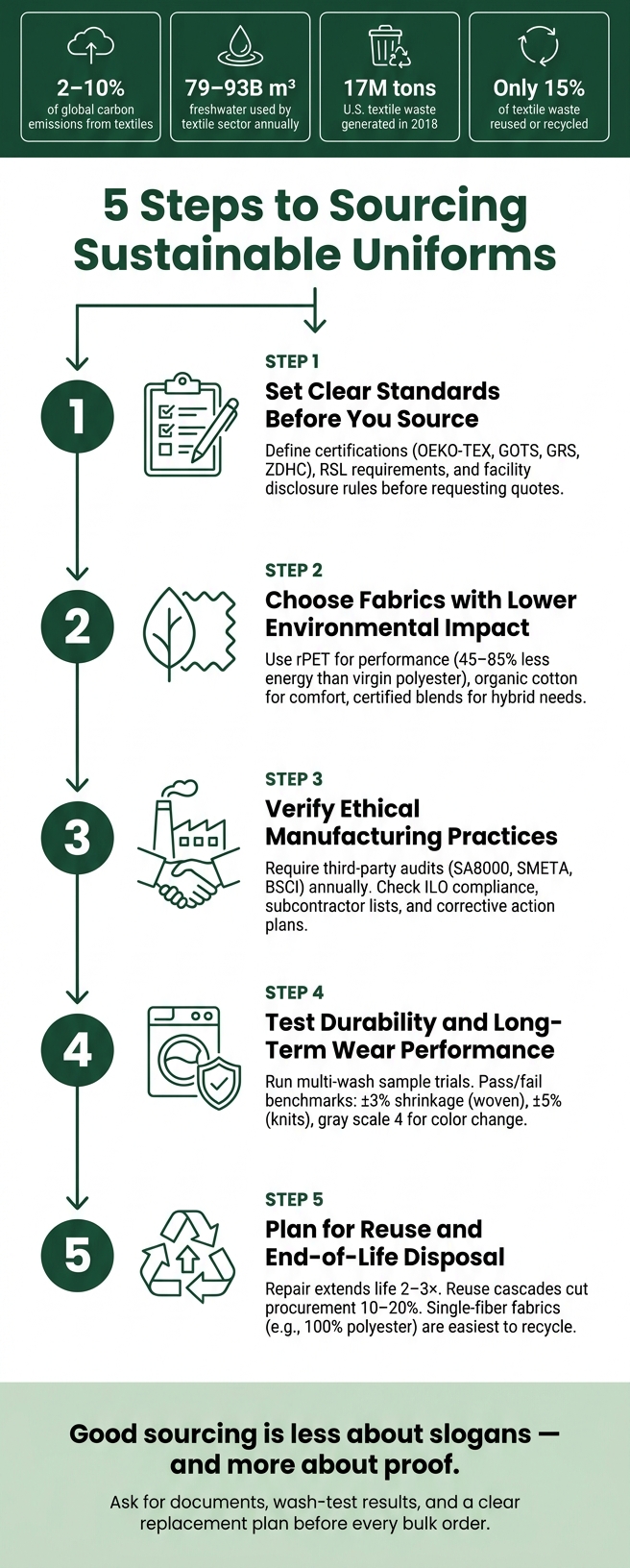
5-Step Sustainable Uniform Sourcing Checklist
What to Clarify Before You Order Sustainable Uniforms
Before you contact a supplier, put together a one-page sourcing brief. It makes quote requests a lot cleaner and helps suppliers match what you need. It also cuts waste from wrong fabric choices, extra samples, and avoidable reorders. Think of that brief as the baseline for every quote you review.
Define Use, Performance, and Wear Conditions
Start with the basics: how will the uniforms actually be used? Different settings call for different performance needs. A youth basketball team may care most about breathability, stretch, and moisture management. An outdoor field program may need UV tolerance and abrasion resistance. You should also note exposure to heat, cold, sweat, rain, and how often the uniforms will be washed.
Wash frequency matters more than people think. If a uniform is laundered several times a week, it needs stronger colorfastness, better seam strength, and print or sublimation that holds up over time. A uniform that gets washed only now and then won’t face the same stress. That’s why it helps to spell out your minimum wash count, shrinkage tolerance, and color retention up front. Suppliers can only hit the target if you give them one.
Set Your Budget, Reorder Schedule, and Order Minimums
Write down your target unit cost in U.S. dollars, but don’t stop there. Look at cost per wear, not just the price tag. If a uniform lasts longer, the cost per use drops, and you create less replacement waste.
Your brief should also include:
- Total budget
- Reorder timing
- Lead times
- Minimum order quantities
These details shape the quote in a big way. A sports program placing small starter orders and restocking by season has very different needs from a school district making one large annual purchase. If suppliers don’t have that context, their pricing may miss the mark.
Confirm Decoration, Sizing, and Compliance Requirements
Be clear about your decoration method – printing, embroidery, heat transfer, or sublimation. Each one wears differently. Sublimation, for example, bonds the design to the fabric, which helps cut down on cracking and peeling.
Next, confirm your full size run. Include youth, women’s, men’s, and unisex fits, and note whether you need athletic, standard, or relaxed profiles. It’s also smart to ask for sample approvals before bulk production. That small step can save a lot of hassle later.
Last, list any compliance requirements vendors must meet. Depending on your setting, that may include restricted-substance rules, school uniform policies, workplace safety rules, or league regulations. Ask vendors for documentation that proves compliance instead of taking broad claims at face value.
When your brief covers use, performance, budget, decoration, sizing, and compliance, you’re in a much better spot to compare suppliers fairly. Then you can evaluate them on the same terms in the next step.
1. Set Clear Standards Before You Source
Once the brief is ready, put your supplier expectations in writing before you ask for quotes. A one-page sourcing policy makes it much easier to compare bids side by side, and it gives suppliers a clear baseline from the start.
Your policy should spell out which certifications you approve based on your biggest risks. That includes OEKO-TEX Standard 100 for skin-contact safety, GRS for recycled content, GOTS for organic fibers, and ZDHC MRSL for chemical control.
It should also include a Restricted Substances List (RSL). Name the chemical classes you won’t allow, set threshold limits, and require accredited lab reports for both fabrics and finished garments. If that part is vague, things get messy fast.
After you lock in material and chemical rules, track where production actually happens. Ask suppliers to disclose every Tier 1 and Tier 2 facility. For Wooter Apparel, that means the mills, sublimation partners, and sewing factories. Make facility disclosure mandatory.
A simple three-tier system works well here:
- Non-negotiables: no child or forced labor, RSL compliance, and facility disclosure
- Preferred attributes: recycled content and audited social compliance
- Aspirational goals: lifecycle assessments and climate targets
This gives suppliers a straight answer on where you draw the line and where you have room to flex. Once those standards are in place, you can start comparing fabric options against them.
2. Choose Fabrics with Lower Environmental Impact
After you set your standards, pick fibers based on how the garment will be used. Use rPET for performance, organic cotton for comfort, and certified blends when you need both. The key is simple: match each fiber to the wear conditions already listed in your sourcing brief.
Recycled polyester (rPET) is usually the go-to option for performance uniforms. It wicks moisture, stands up to repeated washing, and often uses 45% to 85% less energy per kilogram than virgin polyester. One athletic shirt can also keep about 8 to 10 PET bottles out of waste streams.
That said, rPET has a tradeoff. It can shed more microfibers during washing than virgin polyester. To reduce that risk, specify tighter knits or weaves. It also helps to favor recycled fiber made from old textiles instead of bottle-based feedstock. And don’t stop at a supplier’s claim. Ask for GRS certification, which checks recycled content and also covers chemical restrictions and worker welfare – not just whether recycled material was used. A fabric claim on its own isn’t enough if the supply chain can’t back it up.
Organic cotton makes sense for off-field or lifestyle pieces where breathability and softness matter more than moisture management. It’s grown without synthetic pesticides or fertilizers, which can lower some chemical and health impacts compared with conventional cotton. Look for GOTS certification. For sportswear, GOTS can still work because it allows up to 25% synthetic or regenerated fibers, which means a GOTS-certified performance blend is possible.
Certified blends can give you a middle ground. Think organic cotton mixed with recycled polyester, or recycled synthetics paired with lyocell. These blends can balance durability, stretch, comfort, and wicking while lowering impact compared with standard options. If you go this route, check each fiber on its own. For example, the organic portion should have GOTS, and the recycled portion should have GRS. Don’t rely on one broad "sustainable" label to cover the whole fabric.
| Fabric | Best Use Case | Certification | Watch-Out |
|---|---|---|---|
| Recycled polyester (rPET) | Game jerseys, performance tops | GRS or RCS | Microplastic shedding |
| Organic cotton | Off-field apparel, lifestyle pieces | GOTS | Lower moisture wicking |
| Certified blends | Hybrid performance/casual uniforms | GOTS + GRS per fiber | Verify each component separately |
Ask for third-party lab reports and chain-of-custody documents. Then verify the factory and labor claims behind each material. After that, check whether the people and facilities making the uniforms meet the same bar as the fabric.
3. Verify Ethical Manufacturing Practices
Fabric certifications don’t tell the whole story. If the factory falls short on labor standards, those certifications don’t mean much. Once the fabric is approved, the next step is to check the factory behind it.
Start with a written supplier code of conduct that clearly cites ILO fundamental conventions: no child labor, no forced labor, reasonable working hours, safe and healthy working conditions, freedom of association and collective bargaining, and non-discrimination. Think of this as the bare minimum. Any factory making your uniforms should meet that bar before you place an order.
Next, require third-party audits at least once a year – not supplier self-checks. Audits like SA8000, SMETA, or amfori BSCI can help review payroll, working hours, safety records, and worker interviews. When an audit report comes in, look for three things:
- The facility name and address match the actual production site
- The audit date is within the last 12 to 18 months
- Any non-conformities include a documented corrective action plan with a timeline for fixing them
The point isn’t just to collect paperwork. It’s to make sure the written code of conduct shows up in day-to-day working conditions.
You should also ask for backup documents, including worker contracts, payroll records, time sheets, fire safety certificates, and a list of any subcontractors. If a supplier sends cutting, sewing, or decoration to another facility, that site needs the same review. For certified fabrics, match chain-of-custody documents to batch IDs and list every certified site in the production chain.
4. Test Durability and Long-Term Wear Performance
Once you’ve checked fabric specs and factory claims, the next step is simple: test the finished garment in actual wear conditions. Compliance papers and recycled content sound good on paper, but they don’t tell you how a uniform will hold up after wash after wash. Before you place a bulk order, test samples to make sure the uniforms can survive repeated laundering.
Don’t rely on product marketing. Ask for pre-production lab reports that cover seam strength, shrinkage, and colorfastness after laundering. Then spell out pass/fail standards in the spec sheet: ±3% shrinkage for woven fabrics, ±5% for knits, gray scale 4 for color change, and 3–4 for staining. That gives you a clear benchmark instead of a vague promise.
Colorfastness matters even more for team uniforms. This is where many programs get burned. Dark uniforms and heavily branded pieces often need tighter fading checks because color loss on logos, name marks, or the base fabric can make the uniform look worn long before the fabric itself gives out. AATCC TM61 simulates about five home launderings in 45 minutes.
GSM can help as an early filter, but it shouldn’t be treated as proof of durability. Two fabrics can have the same GSM and still perform very differently based on knit structure and finish. That’s why laundering and seam tests matter more than weight alone.
Run a multi-wash sample trial using your actual laundering setup. After that, inspect the garment for:
- Pilling
- Seam distortion
- Print cracking or blurred sublimation
- Fit changes
This last check helps protect both your budget and your sustainability goals by showing whether the uniform can handle repeated use before replacements are needed. Use those results to decide if the uniform is ready for bulk ordering.
sbb-itb-4d95ad3
5. Plan for Reuse and End-of-Life Disposal
Once you’ve covered durability, the next step is simple: decide what happens to the uniform before it wears out.
A lot of teams treat disposal like a last-minute problem. That’s a mistake. End-of-life planning should be part of sourcing from day one. Before you place an order, think about the uniform’s next stop. Pick fabrics, construction, and suppliers that make repair, reuse, and recycling easier.
The EPA estimated that the U.S. generated 17 million tons of textile waste in 2018, and only 15% was recycled or reused. The rest went to landfills or was burned for energy.
Repair comes first. A loose seam, a detached nameplate, or a small tear doesn’t mean the uniform is finished. A basic repair plan for seams, numbers, and zippers can keep gear in play much longer. In fact, simple repair protocols can extend uniform life 2–3 times. That matters because the uniforms most worth repairing and passing down are usually the ones built well in the first place. So the fabric and construction choices you make at sourcing shape how long that uniform stays in use.
When uniforms are outgrown or rotated out, redistribution is one of the easiest ways to keep them off the trash pile. A common example is passing varsity uniforms down to JV or middle school teams. Some U.S. school districts report cutting annual procurement needs by 10–20% through these reuse cascades. For community leagues, donation partnerships with local youth programs or nonprofits can work well too, as long as the uniforms still meet basic quality standards:
- no major tears
- legible numbers
- appropriate logos
If a garment can’t be repaired or passed down, send it to the right recycling stream instead.
For uniforms that are beyond reuse, material choice matters a lot. Fiber content affects what can be recycled and where it can go. Single-fiber uniforms, such as 100% polyester, are easier to recycle than mixed-fiber blends. Decoration choices matter too. Thick overlays can get in the way of recycling. It’s worth asking suppliers which recycling streams fit each fabric. Also ask whether they offer take-back programs with prepaid labels, pickups, or order credits.
Fabric Comparison Table
Use this table to line up fabric choice with performance, washing needs, and end-of-life goals.
As a rule of thumb, recycled polyester works well for high-wear uniforms. Organic cotton fits comfort-first pieces. And blends sit in the middle, giving you a mix of comfort and wear life, but with more trade-offs when recycling is the goal.
| Criteria | Organic Cotton | Recycled Polyester (rPET) | Blended Fabrics (e.g., Cotton/rPET) |
|---|---|---|---|
| Durability | Moderate – softer fiber, lower abrasion resistance | High – strong, shape-retaining, abrasion-resistant | Moderate to high – depends on fiber ratio; 85/15 organic cotton/rPET blends can extend garment life by ~2.3×. |
| Moisture Management | Weak – retains moisture, slower to dry | Strong – wicks sweat away, dries quickly | Moderate – varies by fiber ratio and knit construction |
| Traceability | Easiest to verify when certified organic standards and transaction records are available | Strong when recycled-content documentation and chain-of-custody records are available | Harder to verify; ask for a clear fiber breakdown and documentation for each fiber |
| Recycled/Organic Content Potential | Can be 100% certified organic fiber | Can range from partial to nearly full recycled content | Variable; the exact fiber ratio should be disclosed |
| Best Use Cases | Off-field apparel, warmups, fanwear, coach shirts, polos, and low-to-moderate intensity uniforms | Game jerseys, shorts, practice gear, and other high-performance uniforms | Sideline gear and multi-purpose items where comfort, stretch, and durability matter |
Use this comparison to narrow your fabric shortlist before you check certifications and chain-of-custody records.
Next, verify each fabric claim with the right certifications and documentation.
Certification and Verification Table
Use this table as a quick approval check before you place an order. The idea is simple: match each fabric claim to the proof behind it.
| Criteria | OEKO-TEX STANDARD 100 | OEKO-TEX MADE IN GREEN | GOTS | Fair Trade |
|---|---|---|---|---|
| What It Confirms | Every component of the finished garment – fabric, thread, prints, labels, and zippers – has been tested against over 1,000 harmful substances | Product safety plus environmentally responsible production and socially responsible working conditions at certified facilities | Certified organic content plus environmental and social processing standards | Fairer wages, safer conditions, and worker protections |
| Primary Focus | Chemical safety of the finished product | Product safety plus environmental and social performance with traceability | Organic fiber content plus holistic processing standards | Labor rights and fair trading practices |
| Supply-Chain Scope | Finished product and all components; product-level testing, not factory working conditions | Multi-stage: spinning, dyeing, wet processing, and cut-and-sew; key facilities must be registered and connected in the myOEKO-TEX platform and hold STeP certification | Full post-harvest supply chain: ginning, spinning, weaving/knitting, dyeing, printing, cut-and-sew, trading, and distribution | Farm level for Fairtrade cotton, plus ginners, spinners, dyers, and cut-make-trim factories processing Fairtrade-certified fibers |
| Documents to Request | PDF certificate with number, holder name, product scope, and validity dates; verify online | STANDARD 100 certificate, MADE IN GREEN label or product ID, and valid STeP certificates for key facilities; verify via myOEKO-TEX dashboard | GOTS Scope Certificate for each facility and a Transaction Certificate for each shipment | Current factory certificate or permission-to-trade and documentation of Fairtrade content and traceability |
| What to Verify | Confirm the exact product and components are named on the certificate; check validity dates and certificate number online | Scan or enter the label ID using the public traceability tool to confirm listed facilities match your order | Never accept a GOTS claim without a Transaction Certificate for your specific shipment – a Scope Certificate alone does not prove your goods are certified | Confirm Fair Trade applies to the factory and the specific garment line, not just one product in the supplier’s catalog |
| When to Use It | Baseline chemical safety for all skin-contact items | Combined safety, environmental, and social assurances with traceable production steps | Organic-fiber uniform programs where fiber origin and processing standards both matter | When labor rights and living wages are top organizational priorities |
For most U.S. schools, leagues, and businesses, a smart starting point is OEKO-TEX STANDARD 100 for all skin-contact items. Then layer on GOTS, MADE IN GREEN, or Fair Trade based on what matters most for the order: fiber content, traceability, or labor conditions.
Think of it like a filter. One label helps you check chemical safety. Another helps you track where the product moved through production. Another speaks to organic fiber rules. And another puts the focus on worker treatment. If a supplier makes a claim, they should be able to back it up with the right document – no gray area, no hand-waving.
Conclusion
Sustainable uniform sourcing is a process, not a one-time call. Put these five steps together, and sustainability claims become something you can check, repeat, and use from season to season. Standards, materials, factories, durability, and end-of-life planning need to line up. If one piece is missing, costs, performance, or disposal plans can fall apart fast.
Use this checklist for every quote, sample, and reorder:
- Set clear standards – define use, fit, compliance, and sustainability targets before requesting quotes.
- Choose lower-impact materials – match fiber choice to performance needs.
- Verify ethical manufacturing – require current audits, traceability, and a signed code of conduct.
- Test durability – wash samples before approving bulk production.
- Plan for end of life – decide on reuse, repair, donation, or recycling before ordering.
If you source from Wooter Apparel, use the same questions to compare materials, durability, and reorder planning from one season to the next.
For U.S. schools, teams, leagues, and organizations, audited facilities, lower-impact materials, durable construction, and responsible disposal make a stronger case than price alone. Don’t look at cost in isolation. Compare value, performance, and accountability. Use this checklist every season, and the process gets simpler to run again.
FAQs
How do I compare cost per wear?
Compare cost per wear by looking at the total cost across a uniform’s full lifecycle, not just the price tag on day one. What matters is the whole picture: how long the uniform lasts, how much care it needs, and how often you’ll have to replace it.
Sustainable uniforms may cost 15% to 30% more upfront, but they often last longer. That can mean fewer replacements and lower costs over time. And if you add a reuse program, uniform costs can drop by up to 60%.
Which certifications matter most for uniforms?
Focus on the certifications that fit what you care about most.
OEKO-TEX Standard 100 matters for synthetic performance uniforms because it checks for harmful substances. If you’re buying natural-fiber apparel, like organic cotton warm-ups, GOTS is often the top pick. It covers the supply chain and fair labor practices.
For recycled materials, look for GRS or RCS. And if ethical manufacturing is a priority, WRAP can help confirm labor and safety standards through audits.
How can I recycle old uniforms?
To dispose of old team uniforms responsibly, start by trying to extend their life. Reissue clean, repaired gear so it can stay in use, or donate usable uniforms to youth teams and community groups.
If items are beyond repair, look into take-back programs or textile recycling services so the materials can be reused instead of sent to a landfill. You can also check local recycling or composting rules to see what options are available in your area.