

Uniform production is a major contributor to global carbon emissions, with the textile industry accounting for 5-10% of these emissions. Shifting to eco-conscious practices can drastically reduce the environmental impact of uniforms while offering long-term cost savings and improved quality. Here’s how:
- Eco-Friendly Materials: Use recycled polyester, organic cotton, hemp, or Tencel™ to minimize resource use and waste.
- Efficient Processes: Sublimation printing and waterless dyeing conserve energy and water while ensuring durable designs.
- Ethical Standards: Certifications like GOTS, WRAP, and OEKO-TEX ensure fair labor practices and safe production methods.
- Longevity and Circularity: Durable designs, repairable uniforms, and take-back programs extend product life and reduce waste.
- Reduced Emissions: Local production and optimized logistics cut transportation-related emissions.
- Performance Tracking: Monitor energy, water use, and emissions to identify improvement areas.
How 1.5 Million Plastic Bottles Are Turned Into Clothing Every Day | World Wide Waste
Choosing Sustainable Materials for Uniforms
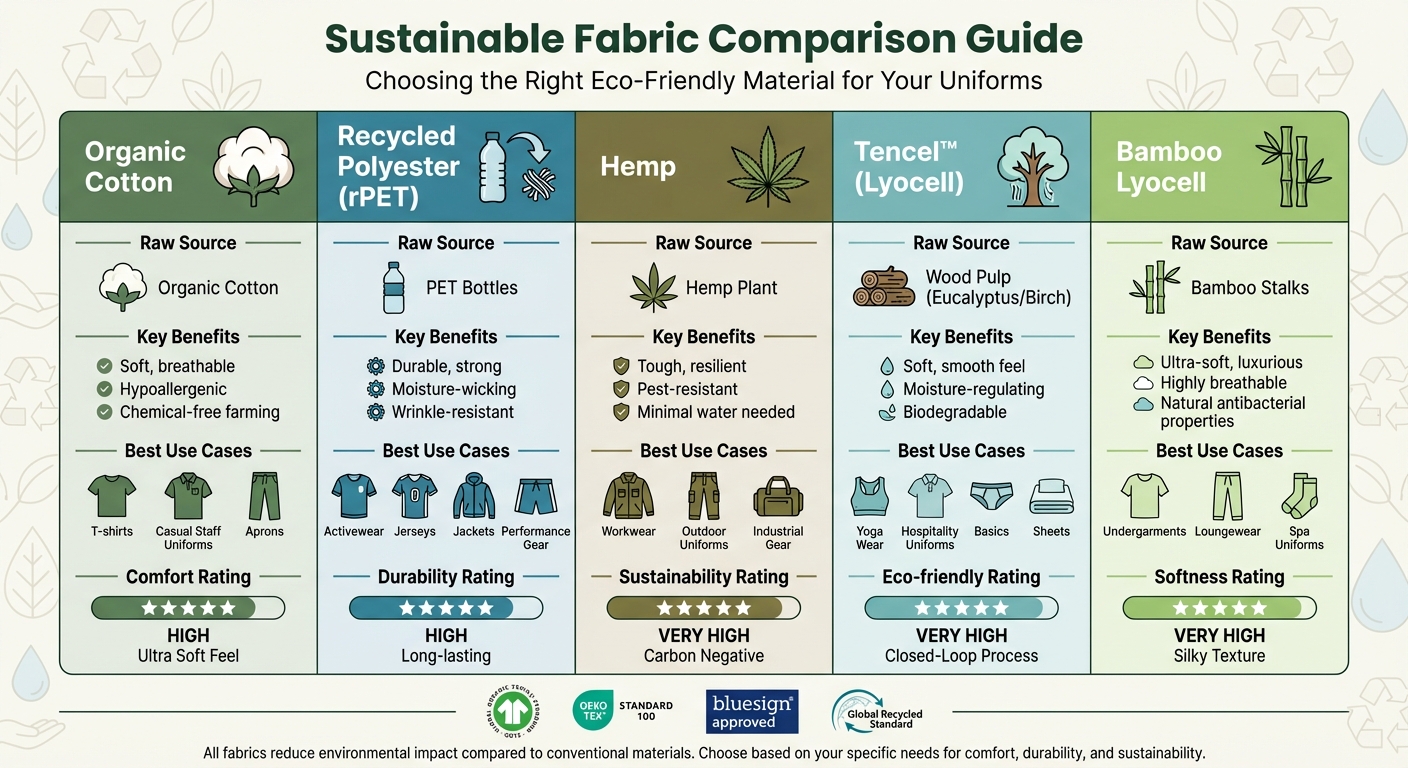
Sustainable Fabric Comparison Guide for Uniform Manufacturing
Eco-Friendly Fabric Options and Benefits
When it comes to sustainable uniforms, picking the right materials can make a big difference. Let’s break down some eco-friendly fabric options and their practical benefits.
Recycled polyester (rPET), made from post-consumer PET bottles, is a go-to for activewear. It’s tough, moisture-wicking, and reduces the need for virgin polyester. You’ll often see it in jerseys, jackets, and other performance-focused clothing.
Organic cotton, certified by GOTS, is breathable and soft, making it ideal for casual or lifestyle uniforms. While it does require more water to grow, its comfort and hypoallergenic properties make it a popular choice.
Hemp, a naturally pest-resistant crop, thrives with minimal water and no pesticides. Its durability and breathability make it perfect for workwear or outdoor uniforms that need to handle tough conditions.
Tencel™ (Lyocell), crafted from wood pulp in a closed-loop process, stands out for its softness, moisture control, and biodegradability. It works well for yoga uniforms, hospitality apparel, or any design focused on comfort. Similarly, bamboo lyocell offers an ultra-soft feel and natural breathability, making it a favorite for base layers and loungewear.
Here’s a quick comparison of these fabrics:
| Fabric Type | Raw Source | Key Benefits | Best Use Cases |
|---|---|---|---|
| Organic Cotton | Organic Cotton | Soft, breathable, hypoallergenic | T-shirts, casual staff uniforms |
| Recycled Polyester | PET Bottles | Durable, moisture-wicking | Activewear, jerseys, jackets |
| Hemp | Hemp Plant | Tough, pest-resistant | Workwear, outdoor uniforms |
| Tencel™ (Lyocell) | Wood Pulp | Soft, moisture-regulating, biodegradable | Yoga, hospitality, basics |
| Bamboo Lyocell | Bamboo | Ultra-soft, breathable | Undergarments, loungewear |
Once you’ve chosen the right materials, the next step is to focus on dyeing and finishing methods that keep environmental impact to a minimum.
Low-Impact Dyeing and Finishing Methods
Did you know that the dyeing and finishing stage accounts for 52% of greenhouse gas emissions in the fashion supply chain? Traditional dyeing processes use massive amounts of water, energy, and chemicals, making this phase critical for sustainability improvements.
Waterless dyeing and plant-based dyes are excellent solutions for reducing resource use and chemical waste. For sports uniforms, sublimation printing is a standout option. It bonds dye directly to polyester fibers, eliminating water use while ensuring vibrant colors that won’t peel or fade.
To ensure your dyeing methods are truly eco-conscious, look for certifications like:
- OEKO-TEX® Made in Green: Focuses on chemical safety.
- Bluesign®: Ensures resource efficiency.
- GOTS: Guarantees organic processing standards.
It’s also a good idea to ask suppliers for Technical Data Sheets and third-party audits to verify their environmental claims and steer clear of greenwashing.
Meeting Performance Requirements with Sustainable Materials
Sustainability doesn’t mean compromising on performance. In fact, eco-friendly fabrics can match or even exceed the standards of conventional materials.
Take recycled polyester, for example. It delivers the same durability and moisture-wicking properties as virgin polyester, making it ideal for high-performance sports gear like basketball jerseys or football uniforms.
For less intense activities, Tencel™ shines with its natural breathability and moisture management – perfect for yoga or leisure sports. Meanwhile, hemp blends offer unmatched toughness, making them a great choice for rugged team apparel.
To ensure you’re getting what you need, request certifications like the Global Recycled Standard (GRS) and review technical data to confirm performance claims, such as durability and moisture control. This way, you can align your eco-friendly goals with uniforms that are built to last and perform.
At Wooter Apparel, we’re committed to integrating these sustainable materials into our designs. The result? Custom uniforms that not only perform at their best but also help reduce environmental impact.
Ethical Manufacturing Practices
Sustainability isn’t just about the environment – it’s also about treating workers fairly, ensuring safe working conditions, and promoting ethical practices. These efforts not only reduce supply chain risks but also strengthen trust within communities. Let’s take a closer look at key certifications that help verify ethical production standards.
Certifications for Ethical Manufacturing
Third-party certifications are essential for confirming that suppliers meet ethical standards. One of the most prominent programs is Worldwide Responsible Accredited Production (WRAP). WRAP’s certification is based on 12 core principles, which include the prohibition of forced labor, child labor, and harassment, as well as requirements for fair pay, health and safety, and compliance with environmental regulations. Most WRAP-certified facilities achieve Gold status, which remains valid for one year.
"Every certificate we issue affirms that a facility has proven its operations are safe, humane, and sustainable in accordance with current international standards and local laws." – WRAP
Another important certification is the Global Organic Textile Standard (GOTS), which not only focuses on organic fibers but also enforces strict social and environmental criteria throughout the manufacturing process. Similarly, OEKO-TEX Made in Green ensures that products are created in facilities that are environmentally responsible and uphold safe, socially conscious working conditions. For recycled materials, the Global Recycled Standard (GRS), managed by Textile Exchange, tracks raw materials through the supply chain while ensuring social compliance.
When selecting suppliers, it’s crucial to confirm they have no history of severe violations, such as child labor, forced labor, or physical intimidation of audit teams. WRAP-certified facilities, for instance, undergo random, unannounced assessments after certification to ensure they continue to meet these standards.
Certifications like these not only validate ethical practices but also provide a solid foundation for supply chain transparency.
Supply Chain Transparency and Traceability
Ethical certifications are just the beginning. Transparent supply chains ensure that every step of production aligns with sustainable and ethical values. Leading companies are now using advanced tools like blockchain, satellite imagery, and standards such as the Content Claim Standard (CCS) to verify the integrity of their supply chains.
The Content Claim Standard (CCS) tracks a product’s journey, documenting each stage to confirm that specific raw materials – like recycled content or organic fibers – are present in the final product. Textile Exchange, which oversees this standard, works with over 30 third-party certification bodies to audit approximately 90,000 sites worldwide.
"Our chain of custody standard and traceability system document a product’s path through all stages of production, ensuring companies can make verified product claims." – Textile Exchange
To implement supply chain transparency in your operations, start by mapping all tiers of your supply chain, not just your direct suppliers. This approach helps uncover hidden risks related to environmental and labor practices. Require suppliers to disclose their labor and environmental policies as part of their contracts, and verify their claims through third-party audits conducted by accredited bodies. This level of scrutiny not only ensures ethical production but also helps meet emerging legal requirements.
By combining ethical certifications with transparent supply chain practices, organizations can confidently demonstrate their commitment to sustainable and socially responsible manufacturing.
At Wooter Apparel, we work exclusively with certified manufacturers who uphold these ethical standards, ensuring your custom uniforms are produced under fair and safe conditions.
Designing Uniforms for Longevity and Circularity
Making uniforms last longer has a bigger impact on reducing their environmental footprint than recycling ever could. Studies highlight that extending a garment’s lifespan is the most effective way to lower carbon emissions, conserve water, and cut down on waste. It reduces the need for constant production cycles, which are resource-intensive. These strategies build on the use of sustainable materials and ethical practices discussed earlier.
Prioritizing Durability in Design
Durability begins with choosing the right materials and construction techniques. Fabrics designed for high performance – like 12 oz polyester or 150 denier mesh – are far more resistant to wear and tear compared to lighter materials. For instance, AK Knit (Airknit) fabric, with its 150 denier composition, is the go-to choice for professional hockey uniforms because it combines breathability with outstanding durability.
Reinforcing areas prone to stress, such as buttons and hems, helps prevent common failures that often lead to early disposal. Strengthening these components ensures uniforms can withstand heavy use. Testing garments through repeated washes also identifies weak points in color retention and seam strength, addressing potential issues before they become problems.
"The most significant opportunity to reduce carbon, water, and waste is to increase the active life of clothes." – WRAP
Using Modular and Timeless Designs
Durability is only part of the equation – design also plays a critical role in extending a uniform’s life. Modular designs allow for mix-and-match functionality, while timeless styles ensure the uniforms stay relevant year after year. Sticking to a limited color palette makes it easier to add new pieces down the line without clashing with existing inventory.
By standardizing fit with "fit blocks" (consistent sizing templates), manufacturers can ensure garments fit the same across seasons and suppliers. This consistency reduces waste caused by poorly fitting uniforms and simplifies adding new pieces later. Simplifying designs by reducing overlays, underlays, and trim variations also makes repairs and recycling more manageable.
Recycling and End-of-Life Options
Planning for what happens when a uniform is no longer usable is just as important as its initial design. Reissuance programs, which clean and repair used uniforms, are a cost-effective way to keep garments in circulation instead of replacing them with new ones.
Designing for disassembly – by using repair-friendly methods and avoiding permanent adhesives – makes it easier to replace worn parts or recycle materials. Opting for monomateriality, such as using 100% recycled polyester instead of blended fabrics, simplifies recycling at the garment’s end-of-life. When uniforms are beyond repair, take-back programs ensure they’re recycled properly, avoiding landfills or incineration.
These strategies underscore the importance of sustainability at every stage of uniform production, from design to disposal.
At Wooter Apparel, we focus on creating custom uniforms built to last. By using premium materials and thoughtful construction methods, we ensure your team’s gear performs season after season.
sbb-itb-4d95ad3
Reducing Transportation and Production Emissions
Transportation and production are major contributors to the carbon footprint of uniforms. With manufacturing often outsourced to countries with less stringent pollution controls, emissions from these processes can travel far and impact global air quality. This means that any improvement in the supply chain – no matter where it occurs – can have worldwide benefits.
Optimizing Logistics and Delivery
How uniforms are transported from the factory to their end users plays a big role in their environmental impact. One of the simplest ways to cut down on delivery-related emissions is by opting for standard ground shipping instead of expedited air freight. Air transport produces significantly more carbon per mile than ground options, so planning ahead to avoid last-minute air shipments is key.
Storing inventory in multiple fulfillment centers and consolidating shipments can also shorten travel distances and reduce emissions. Automated inventory systems help by prioritizing standard shipping methods over urgent, high-emission air freight. Working with dependable manufacturers who closely monitor production timelines ensures on-time delivery, reducing the need for carbon-heavy replacement shipments.
Once uniforms are delivered, how they’re cared for can further impact their environmental footprint.
Promoting Sustainable Care Practices
Sustainable care routines are another effective way to lower a uniform’s overall emissions. Washing garments in cold water and less frequently can significantly cut energy and water use over the lifespan of the clothing. Most modern detergents are designed to work just as well in cold water, making this an easy change for teams to adopt.
Switching to biodegradable, concentrated detergents helps prevent harmful runoff into waterways. Additionally, avoiding dry cleaning services that use perchloroethylene (PERC) – a chemical known to contaminate groundwater – can make a big difference in reducing environmental harm. Small changes like these can add up, creating a meaningful impact over time.
Measuring and Improving Sustainability Performance
Track energy consumption, emissions, waste, and water usage to identify areas for improvement and implement meaningful changes.
Key Metrics for Tracking Sustainability
One of the first metrics to consider is energy intensity, which measures energy consumption per unit of production – such as MMBtu per uniform produced. This approach allows you to evaluate efficiency regardless of production volume. To build a comprehensive energy profile, record data for electricity (kWh), natural gas (therms), and Btu usage.
For emissions, include both direct and indirect greenhouse gases like CO₂, methane, nitrous oxide, and fluorinated gases in your inventory. Facilities emitting 25,000 metric tons or more of carbon dioxide equivalent annually must report their emissions to the EPA. Additionally, use waste stream metrics and conduct regular audits to pinpoint recycling opportunities. Keep a close eye on water consumption, especially in processes like dyeing and finishing, and monitor waste from overstock or outdated materials.
Real-world examples highlight the potential of these methods. For instance, 3M reduced energy usage by 46% through Lean Six Sigma initiatives and set a goal for an additional 25% reduction. Similarly, Lasco Bathware’s kaizen event led to annual savings of $99,290 and cut natural gas usage by 12.6 million cubic feet. Applying these metrics gives you the tools to evaluate and improve the sustainability of your uniform production processes, paving the way for ongoing progress.
Continuous Improvement Methods
Frequent evaluations of production processes, material sourcing, and logistics can reveal overlooked opportunities for improvement. For example, energy treasure hunts – three-day assessments with cross-functional teams – often uncover simple, low-cost energy-saving measures through operational and maintenance adjustments. Another effective method is value stream mapping, which incorporates energy and water data into process flow charts, making it easier to identify environmental waste alongside production inefficiencies.
To benchmark your performance, use tools like the ENERGY STAR Portfolio Manager, which allows you to compare your facility’s energy and water usage against similar operations nationwide. Facilities scoring 75 or higher out of 100 may qualify for ENERGY STAR certification. The EPA also offers over 60 free resources, such as the Simplified Greenhouse Gas Emissions Calculator and the Waste Reduction Model (WARM), tailored for small and medium-sized manufacturers to help establish baselines.
Finally, applying Lean Six Sigma techniques can help isolate the root causes of energy use fluctuations and eliminate process variations that lead to waste and defects. By combining these tools and strategies, you can make measurable progress toward sustainability goals while improving overall efficiency.
Conclusion
The textile industry’s impact on the planet is a pressing issue, and taking action is no longer optional. Opting for sustainable materials not only reduces reliance on fossil fuels but also allows for uniforms that are both durable and high-performing.
While sustainable uniforms may cost 15–30% more upfront, their longevity makes them a smart investment in the long run, cutting overall costs over time. Programs that focus on reusing uniforms – cleaning, repairing, and redistributing functional gear – can slash uniform expenses by up to 60% while preventing waste from piling up in landfills. As Jermyn Street Design aptly states:
"The most sustainable uniform is one that lasts".
This cost-effectiveness underscores the urgency of adopting greener practices. Start with a lifecycle audit to analyze your current impact. Then, during regular reorders, introduce certified sustainable materials, testing samples for 90 days before committing to a full rollout. Make sure your manufacturing partners hold certifications like GOTS, OEKO-TEX, or WRAP to uphold ethical standards and maintain transparency across the supply chain.
Consumer preferences are shifting rapidly – 76% of buyers are willing to spend more on sustainable products. By choosing eco-friendly uniforms, you align with these values, showcasing your dedication to ethical practices and environmental responsibility. This transition might require effort and planning, but the rewards – for your team, your budget, and the planet – are undeniable. Take the lead in transforming uniform production into a more sustainable and responsible process.
FAQs
What are the best eco-friendly materials for making uniforms?
When it comes to making uniforms with sustainability in mind, recycled polyester (rPET) stands out as a popular choice. This material is crafted from recycled plastic bottles, giving waste a second life. By using rPET, manufacturers can cut down on energy use and CO₂ emissions while also helping to keep plastic out of landfills and oceans.
Other environmentally-conscious materials include organic cotton, which is grown without the use of harmful pesticides, and bamboo fabric, celebrated for its renewability and ability to biodegrade. These options not only lessen the environmental footprint but also deliver on the essentials of durability and comfort – key factors for uniforms.
How can I make sure my uniform supplier is ethical and sustainable?
To make sure your uniform supplier aligns with ethical and sustainable practices, start by digging into their approach to fair labor standards, eco-conscious materials, and energy-efficient production methods. Check if they’re transparent about their policies and request certifications that prove they meet established labor and environmental guidelines.
Suppliers focused on sustainability often incorporate eco-friendly fabrics, cut down on energy use, and aim to reduce waste throughout their production process. For instance, Wooter Apparel places a strong emphasis on both quality assurance and ethical practices, ensuring their manufacturing methods meet high ethical standards.
By asking detailed questions, evaluating their processes, and confirming their certifications, you can confidently choose a supplier that matches your commitment to ethical and sustainable production.
Why is it important to design uniforms for durability and sustainability?
Creating uniforms with durability and eco-consciousness in mind offers a host of advantages. Durable uniforms are built to handle frequent wear, repeated washing, and demanding activities, which means fewer replacements and lower overall expenses. Opting for materials like reinforced or recycled polyester enhances their longevity without compromising on comfort or functionality.
On the sustainability side, the focus shifts to uniforms that can be repaired, recycled, or repurposed, cutting down on textile waste and reducing environmental impact. Using single-material fabrics and designing for easy disassembly makes recycling more efficient and encourages greener manufacturing practices. This approach not only reflects environmental responsibility but also helps organizations save money over time while staying true to their commitment to sustainable principles.