
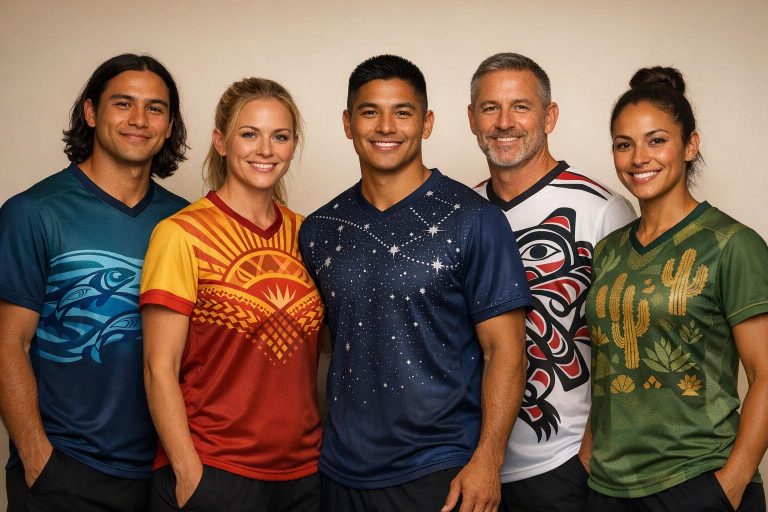
Sports teams are collaborating with Indigenous artists to create uniforms that honor Native heritage and tell powerful stories. These efforts educate fans, celebrate Indigenous traditions, and inspire communities. Here’s a quick look at five teams making an impact:
- Curling Canada: Olympic uniforms in 2022 and 2026 featured designs symbolizing teachings, unity, and natural elements, created by Indigenous artists like Patrick Hunter and Shelby Gagnon.
- Toronto Argonauts: Their 2024 "Orange Jersey Game" featured a redesigned logo and jerseys by Emily Kewageshig, incorporating symbols of resilience and Indigenous values.
- Saskatchewan Roughriders: Partnered with Chris Chipak for logos and warm-up jerseys reflecting Treaty 6 heritage and prairie symbolism, with proceeds supporting Indigenous scholarships.
- Cleveland Guardians: Collaborated with local Indigenous groups to integrate heritage into their "City Connect" uniforms, fostering learning about Cleveland’s Native history.
- Seattle Kraken: Partnered with the Muckleshoot Indian Tribe to feature their seal on jerseys, alongside specialty designs inspired by Coast Salish art, while supporting Indigenous youth programs.
These initiatives go beyond design, creating meaningful connections and supporting Indigenous communities through education, representation, and funding.
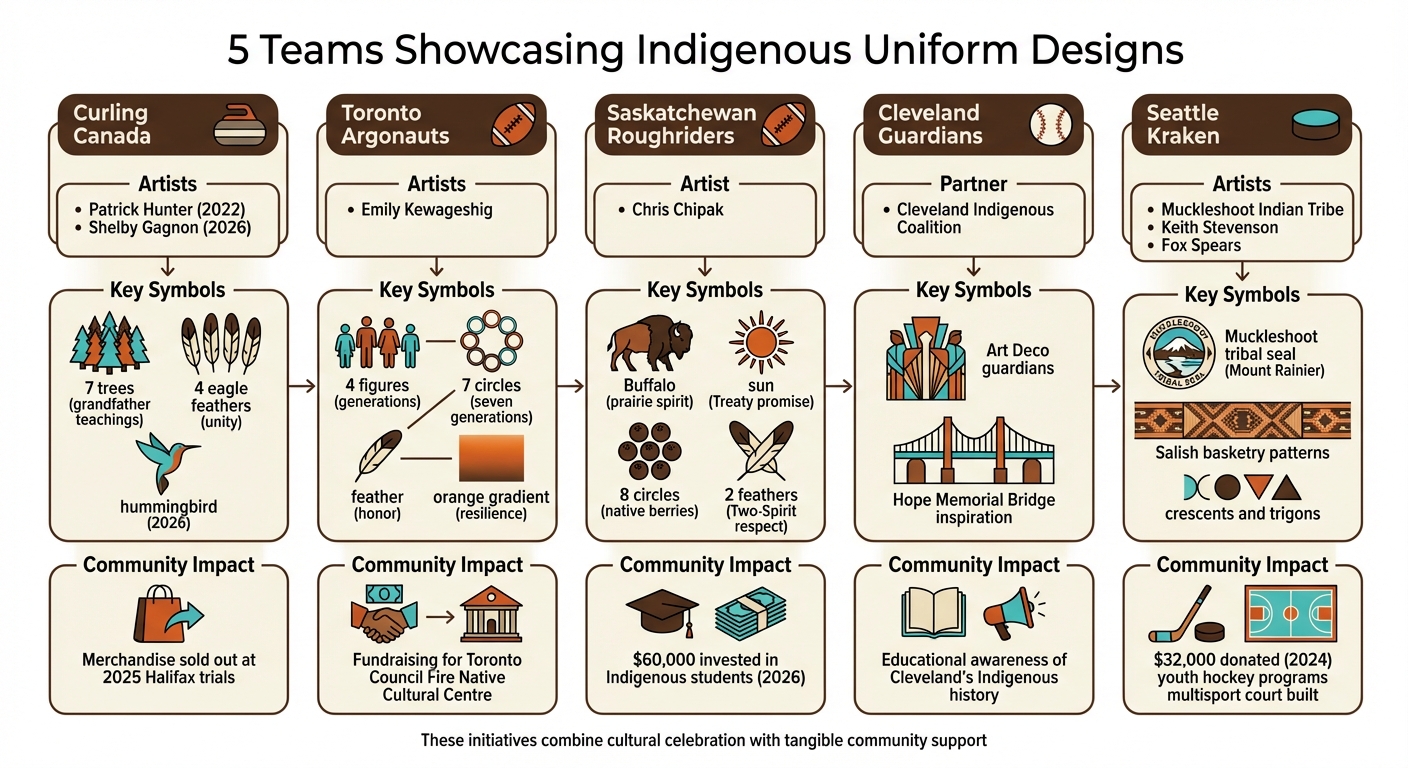
5 Sports Teams with Indigenous Uniform Designs: Artists, Symbols, and Community Impact
The Story Behind the New Zealand Breakers’ Indigenous Uniform
sbb-itb-4d95ad3
1. Curling Canada National Teams
Curling Canada has made a strong effort to integrate Indigenous heritage into its team uniforms. By collaborating with Indigenous artists for the 2022 and 2026 Olympic uniforms, the organization aligns its initiatives with the Truth and Reconciliation Commission‘s Call to Action No. 83.
Working with Indigenous Artists
For the 2022 Beijing Winter Olympics, Curling Canada teamed up with Patrick Hunter, a 2-Spirit Anishinaabe artist from Red Lake, Ontario. Hunter worked closely with designer Kevin Hurrie and Dynasty Curling, a Métis-owned custom apparel company based in Winnipeg. The 2026 uniforms featured designs by Shelby Gagnon, a 2-Spirit Anishinaabe/Cree artist from Aroland First Nation. Gagnon collaborated with Regina-based designer Steph Schmidt and Goldline Curling, the manufacturer.
These partnerships brought traditional symbols and cultural elements into the spotlight, creating designs that celebrate Indigenous heritage. Many organizations now seek premium team uniforms to showcase similar cultural storytelling.
Indigenous Patterns and Motifs Used
The 2022 uniforms were rich with symbolism. They featured seven trees representing the seven grandfather teachings – love, humility, wisdom, bravery, honesty, truth, and respect. Four eagle feathers symbolized team unity, while sacred elements like braided sweetgrass, cedar, tobacco, and sage adorned the inner sleeves, offering spiritual strength.
For the 2026 designs, the hummingbird became the central motif, chosen for its four-year lifespan, which parallels the Olympic cycle. Flowing lines in the design reflected the water elements of Lake Superior, emphasizing the importance of protecting natural resources like land and water.
Effect on Community and Awareness
The 2026 designs resonated deeply, with merchandise selling out at the Halifax Olympic trials in late 2025. Nolan Thiessen, CEO of Curling Canada, highlighted the broader impact of these collaborations:
"I think this is a really neat story to work with a really talented artist, to use our platform to showcase their skills and maybe create awareness in other communities that haven’t thought about curling before".
2. Toronto Argonauts
The Toronto Argonauts brought Indigenous culture to the forefront of Canadian football with their 2024 "Orange Jersey Game." For this event, they partnered with Emily Kewageshig, an Anishnaabe artist and visual storyteller from Saugeen First Nation No. 29, to redesign their logo for the September 28, 2024, game against the Montreal Alouettes. This collaboration marked a meaningful step in integrating Indigenous artistry into the team’s visual identity.
Working with Indigenous Artists
Kewageshig’s contributions extended beyond the logo. Her artwork appeared on game-day graphics, in-stadium signage, digital content, and a redesigned helmet logo. Players also wore special orange pro football jerseys during pregame warmups, aligning with the league-wide Truth and Reconciliation initiative. Speaking about the experience, Kewageshig shared:
"I come from a small community and when my art and our culture is put on the forefront, it is a shared celebration. I was able to integrate symbolism within the logo that honors who we are as Indigenous people and that is so special to me".
Indigenous Patterns and Motifs Used
The updated logo is rich with Indigenous symbolism. Four figures rising from the water represent Indigenous peoples across past, present, and future generations, connecting to the four directions of the medicine wheel. Seven circles within the boat pay homage to the "seven generations" principle, which emphasizes the importance of considering future generations. A feather beside the "A" signifies honor and bravery, while heart-shaped openings reflect the community’s spirit. The orange gradient, symbolizing sunrise and sunset, ties to resilience and the message of Orange Shirt Day while highlighting daily opportunities for growth.
Effect on Community and Awareness
The initiative was met with widespread community support. The Argonauts hosted groups such as Tyendinaga First Nation, Six Nations of the Grand River, and the Wandering Spirit School at BMO Field. The event included a pre-game address by Chief Claire Sault of the Mississaugas of the Credit and a halftime performance featuring the Red Bear Singers and Indigenous Pow-wow dancers. Fundraising efforts, including the MLSE Foundation’s 50/50 lottery, jersey auctions, and sales of Indigenous-inspired hoodies, generated significant contributions for the Toronto Council Fire Native Cultural Centre. By embracing Indigenous patterns and themes, the Argonauts not only enriched their identity but also celebrated and honored Indigenous heritage in a meaningful way.
3. Saskatchewan Roughriders
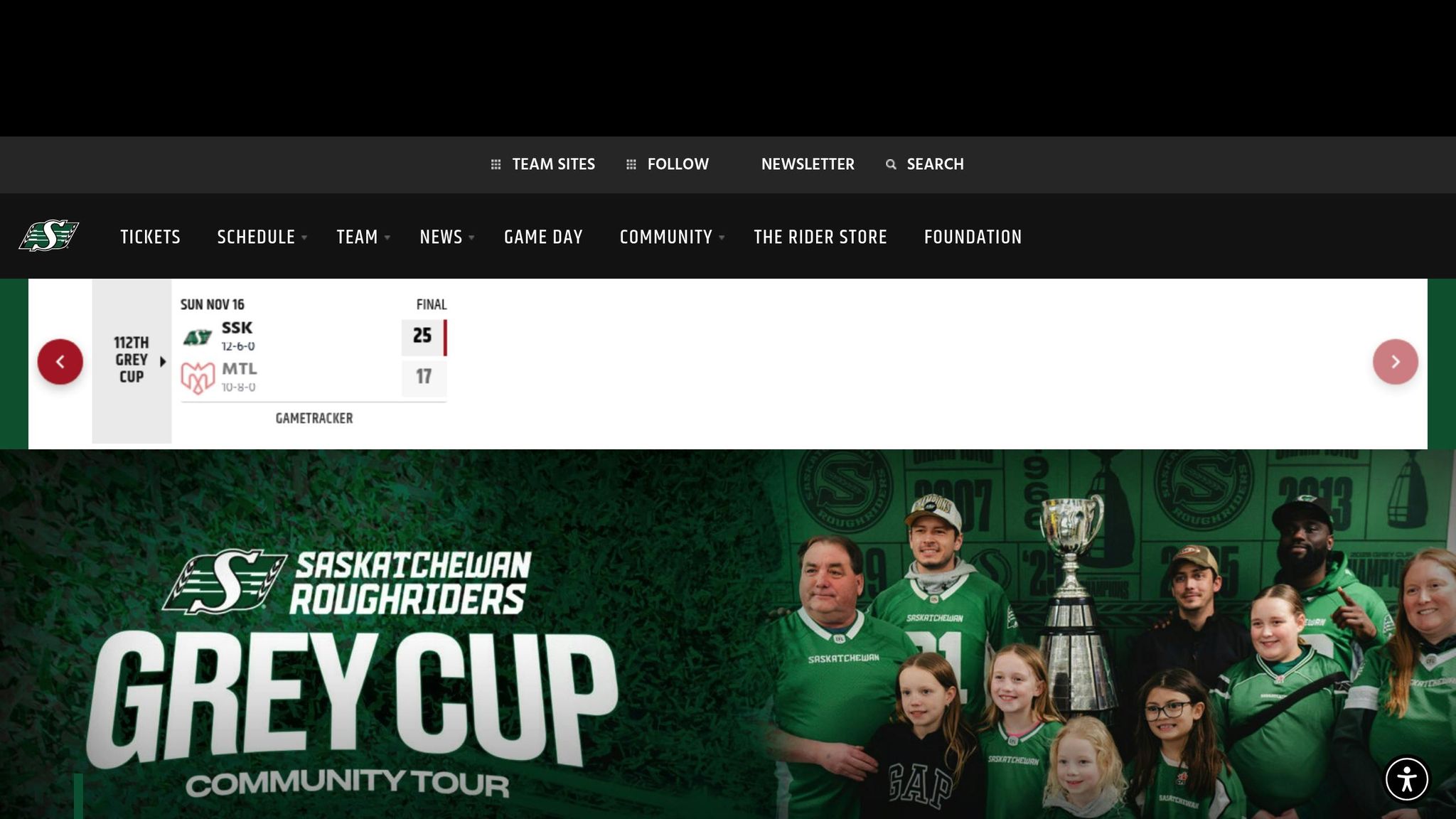
The Saskatchewan Roughriders collaborated with Chris Chipak from the Red Pheasant Cree Nation (Treaty 6) in Saskatoon to create an Indigenous-inspired logo. This design was first showcased in September 2024 during the "kisiskâciwan game" against the Ottawa Redblacks. The team worked closely with its Indigenous Advisory Group to ensure the design authentically reflected Indigenous heritage and values. This partnership marked the beginning of a broader effort to honor Indigenous artistry and culture through their branding.
Working with Indigenous Artists
Chipak’s involvement with the Roughriders extended beyond a single project. In November 2025, after the Roughriders triumphed over the Montreal Alouettes with a 25–17 Grey Cup victory, he unveiled another tribute logo. This design featured a buffalo with deep roots and a feather adorning the Grey Cup trophy. Reflecting on his work, Chipak shared:
"My focus on this piece was to promote the importance of the land and the beauty of the prairies. I hope as this logo is revealed it provides healing, hope and inclusion to all".
This design carried profound cultural significance, weaving together symbols that celebrate both the land and its people.
Indigenous Patterns and Motifs Used
The logo incorporates rich layers of Indigenous symbolism. The buffalo represents the spirit of the Saskatchewan prairies, embodying selflessness and the interconnectedness of life. A sun element signifies the Treaty promise and the unity of all living things. The ribbon-like skyline reflects Saskatchewan’s title as "the land of the living skies" and nods to traditional ribbon skirts. A river motif, accented with eight circles, represents the eight native berries of the region. Two upright feathers symbolize respect, inclusion, and the contributions of Two-Spirit individuals. For the special game, players wore orange warm-up jerseys featuring "Saskatchewan Roughriders" written in Cree syllabics, further emphasizing the team’s commitment to honoring Indigenous culture.
Effect on Community and Awareness
The logo’s impact extended far beyond its artistic and symbolic elements, fostering a deeper connection with the community. In January 2026, the Saskatchewan Roughriders Football Club and its Foundation teamed up with the First Nations University of Canada to invest $60,000 in Indigenous students. This included a $40,000 "Away from Home" bursary and a $20,000 scholarship. Third-year student Breanna Desnomie expressed her gratitude, saying:
"Knowing that the Roughriders, the Foundation, and FNUniv believe in Indigenous students like me gives me confidence to work hard and give back to my community".
The team also held raffles for limited-edition orange warm-up jerseys, with proceeds supporting the Northern Saskatchewan Football League and "Grow the Game" camps in Indigenous communities. Chipak noted that many Indigenous families embraced the logo, proudly purchasing merchandise as a symbol of representation and pride for their loved ones.
4. Cleveland Guardians
The Cleveland Guardians work closely with the Cleveland Indigenous Coalition, which includes the American Indian Movement of Ohio, the Lake Erie Native American Council, and the Committee of 500 Years of Dignity & Resistance. This partnership highlights a shared effort to create meaningful designs and strengthen community connections.
Design Inspiration and Community Collaboration
The "City Connect" uniform draws inspiration from the Art Deco "Guardians of Traffic" statues on the Hope Memorial Bridge. This design reflects the team’s partnership with local Indigenous groups, showcasing a commitment to representing their heritage and contributions.
Impact on Community Awareness
Through this collaboration, the Guardians encourage fans to learn about Cleveland’s Indigenous history. The initiative sparks conversations that honor the enduring influence of Indigenous communities, fostering deeper connections and enriching the city’s narrative.
5. Seattle Kraken
The Seattle Kraken have taken meaningful steps to collaborate with Indigenous communities, creating a unique and impactful partnership.
Building Relationships with Indigenous Artists
Before their first puck drop, the Kraken initiated partnerships with Indigenous communities in 2019. They organized listening sessions with over 30 Indigenous leaders and sought tribal blessings for their arena site. To guide these efforts, the team worked with Native consultants like Pyramid Communications and Temryss Lane of the Lummi Nation, ensuring their outreach to Coast Salish tribes was thoughtful and informed.
"We engaged Native consultants to help us on this journey. We’re not internally qualified to do this on our own."
- Mari Horita, Senior VP of Community Engagement and Social Impact, Seattle Kraken
In February 2023, the Kraken made history by partnering with the Muckleshoot Indian Tribe, becoming the first NHL team to permanently feature an Indigenous tribe’s logo on their jerseys. Additionally, for Indigenous People’s Night, they collaborated with Karuk artist Fox Spears in 2021 and Muckleshoot cultural arts educator Keith Stevenson in 2024 to design specialty custom jerseys inspired by traditional basketry and Salish art forms.
Meaning Behind the Designs
The Muckleshoot tribal seal now appears on the right chest of all Kraken home and away jerseys. This circular emblem showcases Mount Rainier (Tahoma) against a turquoise sky with an earthen-colored base, symbolizing the tribe’s deep connection to their ancestral lands. The 2024 specialty jerseys also feature an orange base, a nod to the "Every Child Matters" campaign.
"This is our official tribal seal. This is it. There is no variation. The Kraken have not adjusted it in any way. It’s incredibly empowering."
- Donny Stevenson, Vice-Chair, Muckleshoot Indian Tribe
Salish artistic elements, such as crescents, trigons, and ellipses, are woven into the jerseys, creating a balance of positive and negative space. The letters and numbers incorporate designs of a spear and a mountain, reflecting key elements of the Muckleshoot Great Seal. These thoughtful details celebrate tradition while fostering a sense of unity.
Strengthening Community Bonds
This partnership has amplified Indigenous voices and brought their stories to millions of hockey fans. The Muckleshoot Indian Tribe, with around 3,300 enrolled members, has grown from economic challenges to becoming a key sports partner over the last 27 years. Events like the December 6, 2021 game, which saw significant Indigenous participation, have further strengthened ties within the community.
The Kraken’s efforts extend beyond symbolism. They’ve built a multisport court on the Muckleshoot reservation and launched youth hockey programs for Indigenous kids. Proceeds from specialty jersey auctions support the Potlatch Fund, which has distributed over $5.5 million to Native individuals and organizations in the Pacific Northwest. During Indigenous Peoples Night in December 2024, the Kraken Unity Fund also donated $32,000 to the United Indians of All Tribes Foundation.
Conclusion
Indigenous uniform designs have reshaped how sports teams connect with their communities, offering a meaningful way to honor the original caretakers of the land. These jerseys go beyond aesthetics – they educate fans about tribal histories, languages, and art. For instance, when the Phoenix Suns incorporated the word for "sun" in 22 different Indigenous languages on their City Edition uniforms in November 2022, they highlighted the richness and vitality of Arizona’s tribal nations, emphasizing their living languages and cultures.
These initiatives leave a lasting impact. The Seattle Sounders, for example, allocated the first $50,000 from their Salish Sea Kit sales to Native-led organizations. Similarly, the Premier Lacrosse League supports Anishinabe Baagaadowewin through proceeds from jersey sales, reinforcing the connection between lacrosse and its Indigenous origins. Such efforts, coupled with genuine collaborations with Indigenous artists, ensure cultural symbols are used respectfully while providing tangible benefits to these communities.
For teams aiming to create uniforms that reflect their values and tell compelling stories, fully sublimated custom designs are a powerful option. They allow for the precise reproduction of intricate patterns, such as Coast Salish weaving, or the inclusion of multiple Indigenous languages. The Phoenix Suns’ attention to detail demonstrates that authentic designs require time, consultation, and the right production techniques. Companies like Wooter Apparel specialize in these fully sublimated uniforms, ensuring complex cultural designs are brought to life with the durability needed for competitive play.
The foundation of these projects is genuine partnerships. Danielle Morsette of the Suquamish Tribe, reflecting on the Sounders project, emphasized:
"It was important for them to recognize that we were the weavers and the culture bearers who had the knowledge to execute this the best way it could".
FAQs
How can teams avoid cultural appropriation in Indigenous uniform designs?
Teams can steer clear of cultural appropriation by working closely and respectfully with Indigenous communities and experts. This involves engaging with tribal leaders, artists, and representatives to ensure that symbols and patterns are represented accurately and respectfully. Some teams go a step further by collaborating directly with Indigenous designers, allowing them to integrate cultural elements in a way that maintains their true meaning and honors Indigenous sovereignty and heritage.
Do these uniforms financially support Indigenous communities?
These uniforms often work to highlight Indigenous communities by collaborating with Indigenous artists, making donations, and celebrating their heritage. However, it’s unclear if they offer direct financial assistance to these communities.
Can my team create fully sublimated Indigenous-inspired uniforms?
Yes, your team can design fully sublimated uniforms inspired by Indigenous art. Many national and professional sports teams have embraced this approach, integrating Indigenous artwork and symbols into their uniforms. These designs celebrate heritage and cultural pride while delivering high-quality performance and style.