
Organic fabrics are transforming team sportswear by combining comfort, performance, and reduced ecological impact. Here’s a quick rundown of the best organic materials for uniforms:
- Organic Cotton: Soft, breathable, and requires 91% less water than conventional cotton.
- Hemp: Extremely durable, mold-resistant, and uses minimal water and energy.
- Bamboo: Smooth, moisture-wicking, and naturally temperature-regulating.
- Tencel (Lyocell): Strong, wrinkle-resistant, and wicks moisture 50% better than cotton.
- Modal: Silky texture, resists pilling, and effectively manages sweat.
- Linen: Tough, dries quickly, and thrives in warm weather.
- Hemp-Organic Cotton Blend: Combines hemp’s strength with cotton’s softness for balanced durability and comfort.
Each fabric offers unique benefits, from moisture control to long-lasting durability, making them ideal for sports teams looking to reduce their environmental footprint while maintaining high performance. Want high-quality custom uniforms? Companies like Wooter Apparel make it easy to incorporate these fabrics into personalized designs.
Design a no Plastic Sportswear Collection
1. Organic Cotton
Organic cotton stands out as an eco-conscious choice for team uniforms. By steering clear of synthetic pesticides, herbicides, and GMOs, it helps safeguard ecosystems and promotes healthier soil. Its environmental advantages are backed by solid sustainability metrics.
Sustainability Benefits
- Water Efficiency: Organic cotton requires up to 91% less blue water compared to conventional cotton.
- Lower Emissions: It produces approximately 46% less CO₂, making it a greener option.
- Natural Farming Practices: Techniques like crop rotation and composting not only maintain soil fertility but also enhance carbon storage in the soil.
This makes organic cotton a smart step toward reducing environmental impact while supporting sustainable agriculture.
2. Hemp
Hemp stands out as one of the toughest natural fibers available for making team uniforms. Its tensile strength goes beyond that of organic cotton, making it a reliable choice for athletic wear. What’s even more impressive? Hemp actually becomes stronger with each wash. While most fabrics wear down over time, hemp thrives under the strain of frequent and intense laundering – perfect for teams that train hard and compete often.
Durability
Hemp fibers are naturally tough and highly resistant to wear and tear, making them ideal for sports involving high-impact or abrasive movements like sliding or friction from equipment. On top of that, hemp resists mold and mildew, even in damp or humid conditions. This durability means uniforms made from hemp can last longer, even under challenging conditions.
Moisture-Wicking Ability
Hemp is highly absorbent, capable of holding up to 20% of its weight in water without feeling damp. Its natural capillary action draws sweat away from the body, moving it to the fabric’s surface where it evaporates quickly. This efficient moisture management helps athletes stay cool and comfortable, even during intense play.
Breathability
Beyond its ability to handle moisture, hemp also has antimicrobial and antibacterial properties. These features help combat odor-causing bacteria, keeping uniforms fresher for longer between washes. For teams prioritizing performance and hygiene, hemp delivers on both fronts, making it an excellent choice for demanding sports environments.
Sustainability Benefits
The 2018 Farm Bill legalized industrial hemp as a crop across the United States, paving the way for increased domestic production. This makes hemp not only a high-performing material but also a more accessible and eco-conscious option for textile manufacturing.
3. Bamboo
Bamboo fabric is a standout choice for team uniforms, offering a soft yet durable option that holds up under intense wear. Its long, smooth fibers resist pilling, even during demanding sports like soccer or rugby. While pure bamboo viscose is luxuriously soft, blending it with materials like organic cotton or recycled polyester enhances its strength, making it ideal for high-contact sports.
Moisture-Wicking Ability
Bamboo fabric excels at managing moisture, quickly pulling sweat to the surface for evaporation. This keeps athletes dry and comfortable, even during the most intense games. According to MORI, "The fabric has the incredible ability to wick moisture away from their skin… air is able to flow freely through the fabric so their body temperature is able to regulate". By keeping skin dry, bamboo fabric helps prevent irritation and rashes, making it a practical choice for athletes. Its ability to manage moisture directly complements its standout breathability.
Breathability
Bamboo’s unique fiber structure allows for excellent airflow, helping athletes stay cool in the heat and warm in the cold. This natural thermoregulation ensures comfort in a variety of weather conditions, making bamboo uniforms versatile for year-round use. Similar to fabrics like organic cotton and hemp, bamboo balances functionality with eco-friendly advantages. Its long, durable fibers also withstand regular machine washing, making it a reliable option for the rigorous demands of team sports.
Sustainability Benefits
Bamboo is one of the fastest-growing woody plants globally, requiring minimal land and thriving without harmful pesticides or chemicals. When processed in a closed-loop system, water and non-toxic solvents are recycled, reducing environmental harm. Additionally, bamboo is a natural cellulose fiber, meaning it’s biodegradable and leaves a smaller environmental footprint when uniforms reach the end of their lifespan. For teams aiming to combine performance with sustainability, bamboo checks all the boxes.
4. Tencel (Lyocell)

Tencel stands out as another excellent option for high-performance, eco-friendly fabric. Known for its natural softness and impressive durability, Tencel is crafted from sustainably sourced wood pulp, resulting in long fibers that outperform traditional cotton in strength and longevity.
Durability
One of Tencel’s biggest advantages is its fiber strength, which makes it more resistant to wrinkles and better at maintaining its shape compared to other organic fabrics. Unlike older rayon fabrics, Tencel holds its structure even after multiple washes, ensuring a consistent fit season after season. It only shrinks about 3% during the first wash and remains stable afterward. This reliability is essential for uniforms that need to maintain their fit over time. Additionally, Tencel’s ability to hold dye exceptionally well ensures team colors stay vibrant, even with frequent laundering.
Moisture-Wicking Ability
Tencel excels in moisture management, wicking moisture 50% more effectively than cotton. This feature helps reduce odor by limiting bacterial growth, making it an excellent choice for activewear.
Breathability
With its superior breathability, Tencel allows air to circulate freely, preventing heat from being trapped. This ensures athletes stay comfortable, whether they’re playing in the summer heat or cooler fall weather. As the Chief Commercial Officer at LENZING AG explains:
That softness, the friendliness for the skin, and the moisture management are really the three key advantages that lyocell brings versus a lot of other alternatives.
This combination of features helps regulate temperature effectively, keeping players comfortable in various conditions.
Sustainability Benefits
Tencel’s production process is designed with sustainability in mind. Its closed-loop system recycles 99% of the chemicals used, significantly reducing its environmental impact. Compared to generic lyocell, Tencel production emits at least 50% fewer carbon emissions and uses 50% less water. Moreover, Tencel fibers are fully biodegradable and compostable, ensuring they won’t contribute to long-term waste. For teams that prioritize both performance and environmental responsibility, Tencel offers a compelling solution. Its blend of durability, comfort, and eco-conscious production makes it a standout choice for organic uniforms.
5. Modal
Modal brings together a luxurious feel and reliable performance, making it a standout choice for athletic wear. Made from beech tree cellulose, this semi-synthetic fabric offers a silky texture while delivering durability suited for high-performance activities. Let’s explore its key features: durability, moisture management, breathability, and eco-friendly production.
Durability
Modal is built to last, maintaining its quality even after repeated use and washing. It resists pilling, fading, and shrinking, and can handle washing temperatures up to 140°F (60°C) [19, 22]. Unlike cotton, which can lose its shape over time, Modal holds its structure and keeps its colors vibrant. As KenDor Textiles highlights:
"These cellulosic fiber offerings boast high tenacity, unparalleled next-to-skin softness, biodegradability and eco-responsible production including the dedicated use of renewable forestry practices."
Moisture-Wicking Ability
When it comes to moisture control, Modal stands out. It effectively wicks away sweat, keeping athletes dry even during the most intense activities. This feature not only helps regulate body temperature but also minimizes odor, ensuring comfort throughout the game.
Breathability
Modal’s natural breathability allows air to flow freely, making it a great option for various climates. Its lightweight and flexible design ensures unrestricted movement, offering athletes a comfortable and adaptable fit.
Sustainability Benefits
Modal is produced using a closed-loop process that recycles water and chemicals, reducing environmental impact [22, 23]. High-quality Modal, like TENCEL™ Modal, is made from wood certified by FSC or PEFC standards, ensuring responsible sourcing [22, 23]. Additionally, Modal is fully biodegradable and compostable under industrial conditions. It can also meet OEKO-TEX® STANDARD 100 certification, guaranteeing it’s free from harmful substances [21, 22]. This makes Modal a fabric that not only performs well but also aligns with eco-conscious values.
sbb-itb-4d95ad3
6. Linen
Linen stands out as one of the toughest natural fibers, making it a smart choice for team uniforms that need to endure heavy use. Derived from flax stalks, this fabric combines long-lasting strength with environmentally conscious production, giving teams a reliable option without sacrificing quality or sustainability.
Durability
Linen is impressively strong – up to three times tougher than cotton and even 20% stronger when wet. It resists pilling, lint, and abrasion, even after numerous washes. Plus, it can handle high laundering temperatures without breaking down. Its natural texture, created by unique nodes in the fibers, adds flexibility and a distinct look, further boosting its durability.
Moisture-Wicking Ability
Linen is excellent at absorbing moisture and dries much faster than cotton. This makes it a great choice for managing sweat, especially during moderate physical activities where staying cool is essential. While it doesn’t perform like advanced synthetic fabrics, its moisture-absorbing properties make it a practical option for maintaining comfort during sports.
Breathability
Thanks to its high heat conductivity and naturally large fibers, linen allows heat to escape and promotes airflow. Its open weave construction enhances ventilation, keeping athletes comfortable and cool, particularly during outdoor games in warm weather.
Sustainability Benefits
Linen’s environmental advantages are hard to ignore. Flax, the plant used to produce linen, grows well in poor soil with minimal fertilizer and requires far less water compared to cotton. Nearly every part of the flax plant is used, reducing waste. Plus, linen biodegrades quickly – often in just a few weeks when buried. These qualities make it one of the most eco-conscious fabric options for team uniforms, offering an appealing balance of performance and environmental responsibility.
7. Hemp-Organic Cotton Blends
A hemp-organic cotton blend combines hemp’s toughness with the soft touch of organic cotton. Together, they create a fabric that balances strength and comfort, making it a great choice for sportswear.
Durability
Hemp-organic cotton blends are built to last longer than pure cotton. Hemp, known for being one of the sturdiest natural fibers, adds strength and resilience to the mix. It’s naturally resistant to mold and UV rays – qualities that are especially valuable for outdoor sports gear. Over time, hemp fibers become softer without losing their durability, making this blend a long-term performer.
Moisture-Wicking Ability and Breathability
Hemp and organic cotton are both naturally absorbent and breathable, making this blend excellent for managing sweat during high-intensity activities. These fibers allow air to flow freely, helping athletes stay cool and dry. Unlike synthetic fabrics that trap heat and moisture, this natural blend encourages ventilation and reduces discomfort. Plus, it offers better odor control by limiting moisture retention and slowing bacterial growth. As Kari Morales from OrganicCottonPlus.com states:
The natural fibers are all good – they are breathable, absorbent, and comfortable to wear. They are recyclable, and also biodegradable when no longer usable.
Sustainability Benefits
Beyond its performance advantages, the blend shines in terms of sustainability. Hemp naturally resists pests, cutting down the need for synthetic pesticides. Since the fabric is made entirely from natural fibers, it’s biodegradable and doesn’t shed microplastics when washed. This means that when these garments are no longer wearable, they decompose naturally, avoiding the environmental harm of landfill waste.
Performance Comparison of 7 Organic Fabrics
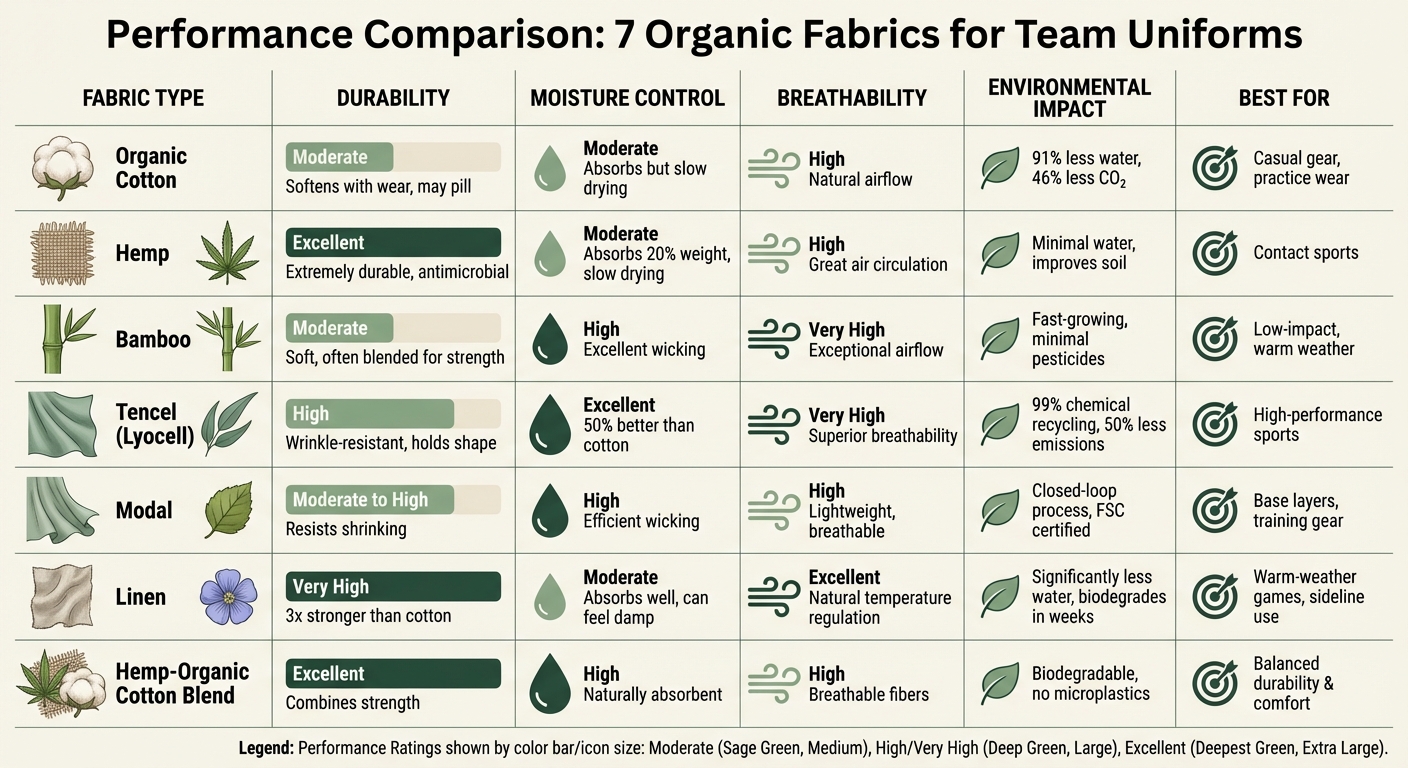
Organic Fabric Performance Comparison for Team Uniforms
Let’s break down how seven popular organic fabrics perform when it comes to durability, moisture control, breathability, environmental impact, and athletic performance. Here’s a side-by-side comparison to help you make informed choices for team sports:
| Fabric | Durability | Moisture Control | Breathability | Environmental Impact | Team Sports Performance |
|---|---|---|---|---|---|
| Organic Cotton | Moderate; softens with wear and may pill over time | Moderate; absorbs moisture but dries more slowly | High; natural airflow keeps athletes comfortable | Uses less water than conventional cotton and avoids synthetic pesticides | Great for casual team gear and practice wear |
| Hemp | Excellent; extremely durable with natural antimicrobial properties | Moderate; absorbs moisture but dries slower than synthetics | High; allows great air circulation | Requires minimal water, supports soil health, and is biodegradable | Perfect for sports involving physical contact |
| Bamboo | Moderate; soft and comfy, often blended for added strength | High; naturally wicks moisture from the skin | Very high; exceptional airflow and temperature regulation | Grows quickly with minimal pesticide use | Best for low-impact activities and warm-weather games |
| Tencel (Lyocell) | High; resists wrinkles and holds its shape well | Excellent; absorbs moisture effectively and dries quickly | Very high; smooth fibers promote airflow | Produced using a closed-loop process that recycles nearly all solvents; sustainably sourced | Top-notch for high-performance team sports |
| Modal | Moderate to high; stays soft and resists shrinking | High; efficiently wicks moisture away | High; lightweight and breathable for comfort | Made with a low-waste closed-loop process using renewable beechwood | Ideal for base layers and training gear |
| Linen | Very high; becomes softer and stronger after each wash | Moderate; absorbs moisture well but can feel damp during play | Excellent; naturally regulates temperature in hot conditions | Uses significantly less water than cotton and improves soil quality | Best for warm-weather games and sideline use |
| Hemp-Organic Cotton Blend | Excellent; combines hemp’s strength with cotton’s comfort | High; naturally absorbent with good ventilation | High; breathable fibers help reduce heat buildup | Biodegradable, with reduced chemical use and no microplastics | A balanced choice for both durability and comfort |
Each fabric shines in its own way, depending on the type of activity and conditions. Tencel stands out for its unbeatable moisture control and breathability, making it perfect for high-intensity sports. Hemp is your go-to for rugged durability and antimicrobial benefits, ideal for contact-heavy games. Meanwhile, bamboo offers exceptional airflow and comfort, especially in warmer climates, and hemp-organic cotton blends strike a good balance between strength and comfort.
When choosing fabrics for custom uniforms, focus on durability, moisture-wicking ability, and breathability to maximize performance and comfort. These insights can help you match the right fabric to the specific needs of your team.
Using Organic Fabrics with Wooter Apparel Custom Uniforms
Wooter Apparel takes custom uniforms to the next level by using full sublimation technology to embed vibrant designs directly into the fabric. This advanced printing method works seamlessly with organic materials, ensuring your team’s logos and colors stay bold and sharp, even after countless games and washes.
"Sublimation is the best technology available right now and lets you create amazing uniforms that will last for many years".
With Wooter Apparel, you can start designing your uniforms using their free in-house design services. Whether you prefer organic cotton or Tencel, you can customize everything – team colors, logos, names, and even fabric weights (ranging from 140 to 280 GSM). This smooth design process transitions into fast production and thorough quality checks to ensure every detail is perfect.
Quality assurance plays a key role in Wooter Apparel’s process. For large orders, they provide sizing sets and custom samples to confirm fabric quality, color accuracy, and fit. Standard orders are completed in 2–4 weeks, with rush options available for tighter deadlines. Pricing is competitive across sports, with basketball jerseys starting at $19.99, full sets at $39.99, and soccer jerseys beginning at $13.99 per piece.
What sets Wooter Apparel apart is their ability to streamline the entire process – from design to production – without requiring a minimum order. This makes sustainable, custom uniforms accessible to organizations of all sizes . Their production facilities, accredited for safety and efficiency, deliver high-quality apparel to teams in 25 countries worldwide. By combining organic fabric options with efficient manufacturing, Wooter Apparel delivers eco-friendly, high-performance uniforms that meet the needs of modern teams.
Conclusion
Organic fabrics bring a range of benefits to team uniforms, offering improved breathability, greater durability, and a reduced environmental impact compared to traditional materials. Whether it’s the softness of organic cotton, the moisture-wicking properties of Tencel, or the added strength of hemp-organic cotton blends, these fabrics not only enhance performance but also promote eco-conscious practices. Each material we’ve discussed contributes uniquely to both functionality and sustainability, making them ideal choices for teams aiming to excel while minimizing their environmental footprint.
Earlier, we explored how these fabrics are built to handle the demands of intense games and frequent washes. Their combination of performance and longevity makes them a smart choice for organizations that prioritize quality and sustainability. By opting for these materials, teams can take a meaningful step toward sustainable design without compromising on durability or style.
Ready to bring these eco-friendly options to life? Wooter Apparel integrates these sustainable fabrics into custom uniforms, blending cutting-edge design with high-performance materials. Choosing organic fabrics doesn’t just elevate your team’s performance – it sends a clear message about your commitment to environmental responsibility.
"Stand out with personalized designs that not only look great but also enhance your performance." – Wooter Apparel
Wooter Apparel makes it simple to create sustainable uniforms. Use their Apparel Builder or connect with their sales team for a free custom design and quote. No matter your team size, you can seamlessly access custom, eco-friendly uniforms that combine style, performance, and sustainability.
FAQs
Why are organic fabrics more eco-friendly than traditional materials?
Organic fabrics come from natural fibers that are grown without synthetic pesticides, chemical fertilizers, or genetically modified seeds. This environmentally mindful approach helps cut down on air, soil, and water pollution compared to traditional textile farming methods. Plus, these fibers are biodegradable, breaking down far quicker than synthetic materials – helping to reduce both landfill waste and microplastic pollution.
Fabrics like organic wool also tend to use less water and energy during production and are easier to recycle or repurpose. Thanks to their natural breathability and moisture-wicking abilities, clothing made from organic materials often requires less frequent washing, which can save both water and energy in the long run. For teams looking for sustainable, high-performing uniform options, organic fabrics offer a smart and eco-friendly solution.
How does Tencel’s moisture-wicking performance compare to bamboo’s?
When it comes to moisture-wicking fabrics, both Tencel and bamboo are top contenders, making them great options for activewear such as team uniforms. Bamboo is often recognized for its superior ability to manage moisture, while Tencel is known for its high absorbency and fast-drying capabilities. These qualities ensure that athletes stay dry and comfortable during intense physical activities, with both fabrics delivering similar performance in this area.
Are hemp uniforms durable enough to handle frequent washing?
Hemp uniforms are known for their durability and ability to handle frequent washing without compromising their strength. Thanks to the toughness of hemp’s natural fibers, the fabric holds up well over time, even with repeated use. This makes hemp a smart option for team uniforms that need to stay in good condition through regular wear and cleaning.