
The NCAA three-point shot has transformed basketball, becoming a core element of modern strategy. Here’s what you need to know:
- Key Records:
- Career Leader: Antoine Davis (588 three-pointers, 2018–2023).
- Single-Season Record: Stephen Curry (162 three-pointers, 2007–08).
- Tournament Game Record: Jeff Fryer (11 three-pointers, 1990).
- Recent Milestones:
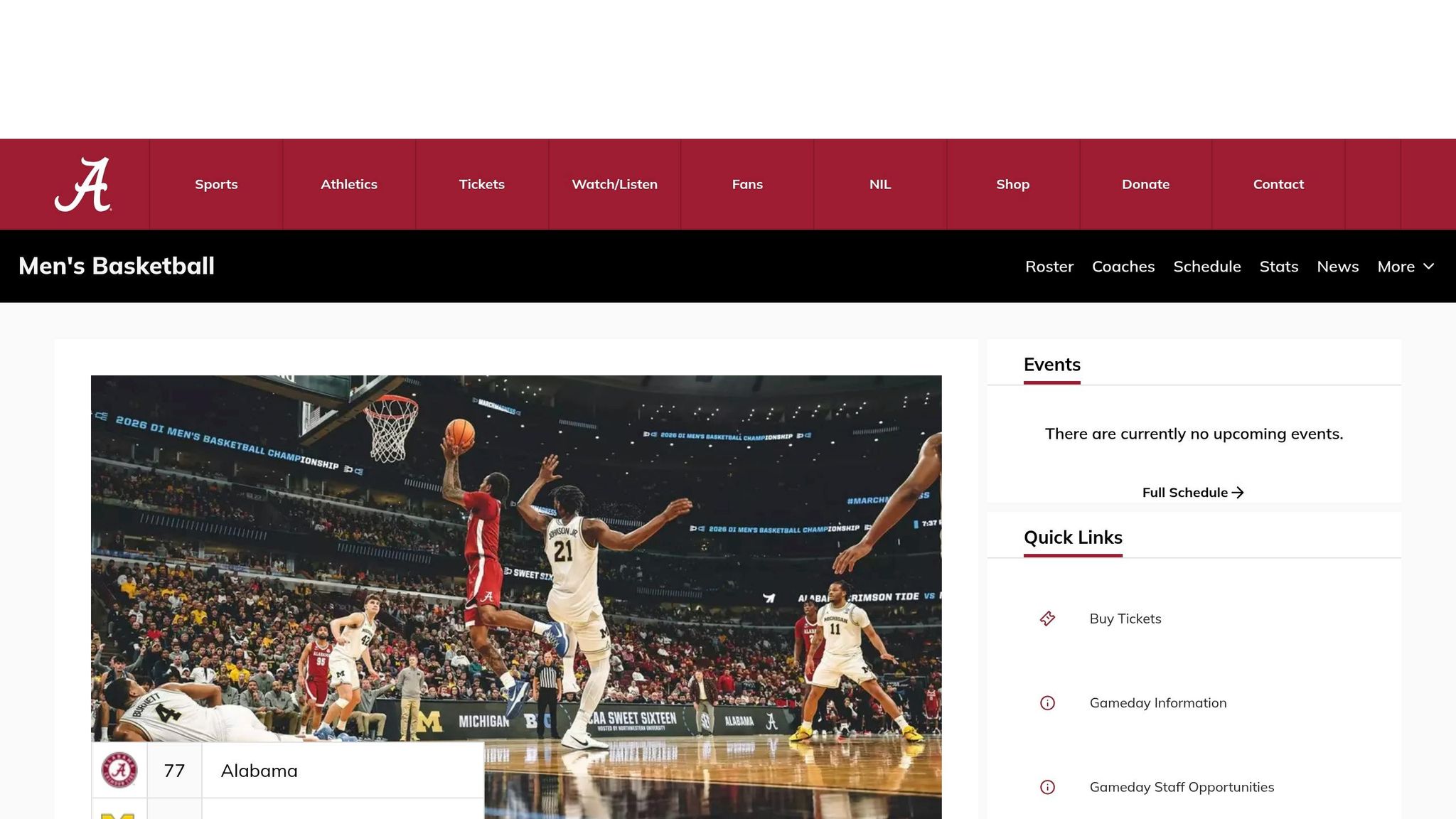
- In March 2025, Alabama set a new tournament record with 25 three-pointers in a single game.
- Three-pointers now account for 39.5% of all Division I shot attempts, a 24-season high.
- Three-Point Line Evolution:
- Introduced in 1986 at 19 ft 9 in.
- Current distance (since 2021): 22 ft 1.75 in, aligned with FIBA standards.
- Notable Performances:
- Jack Taylor holds the all-time single-game record with 27 three-pointers (2012).
- Players like Fletcher Magee, Darius McGhee, and Max Abmas have also left their mark.
- Impact on Strategy:
Coaches like Nate Oats (Alabama) and systems like "The Grinnell System" focus on maximizing three-point attempts for efficiency.
The three-point shot has reshaped the game, from record-breaking performances to its influence on team tactics. Dive deeper into its history, standout players, and evolving strategies below.
Alabama hits tournament record 25 3-pointers in Sweet 16 win
sbb-itb-4d95ad3
Major Moments in NCAA Three-Point History
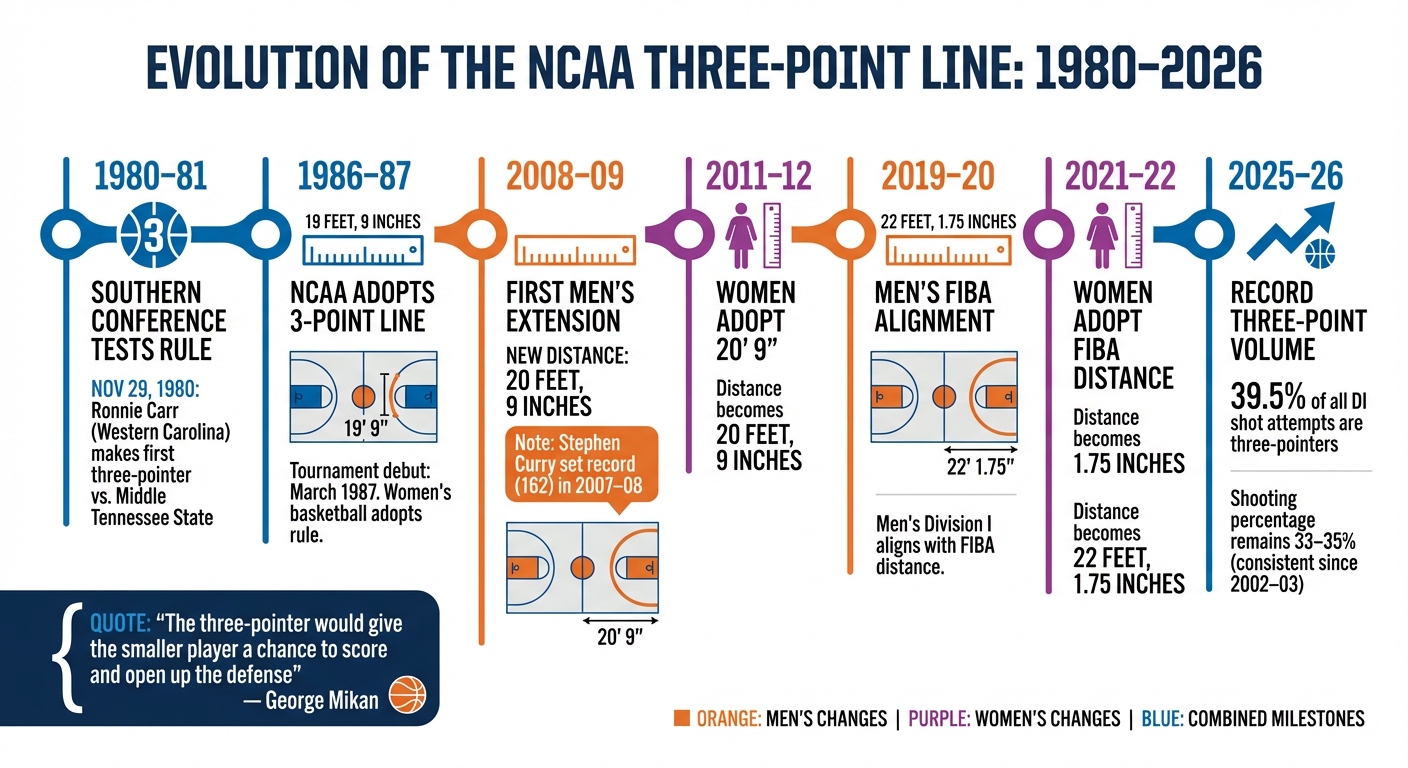
NCAA Three-Point Line Evolution Timeline 1980-2026
When the NCAA Added the Three-Point Line
In April 1986, the NCAA officially introduced the three-point line for the 1986–87 season, placing it at a distance of 19 feet, 9 inches. This decision fundamentally changed college basketball strategies, with the rule making its tournament debut in March 1987.
The idea of the three-point shot had been in development for years. The Southern Conference was the first collegiate league to test the rule during the 1980–81 season. On November 29, 1980, Ronnie Carr of Western Carolina made history by sinking the first three-point field goal in college basketball during a game against Middle Tennessee State – six years before the NCAA adopted the rule nationwide.
The rationale for the three-pointer reflected lessons learned by professional leagues like the ABL and ABA. It brought excitement to the game and gave smaller players a greater chance to shine. ABA Commissioner George Mikan once explained:
"The three-pointer would give the smaller player a chance to score and open up the defense to make the game more enjoyable for the fans."
The NCAA saw the three-point shot as basketball’s answer to the home run – a dramatic play capable of shifting momentum and sparking thrilling comebacks. Women’s basketball followed a similar timeline, adopting the rule in 1986–87 and making it mandatory by the 1987–88 season.
These early moves laid the groundwork for the rise of players who would go on to redefine the game with their long-range shooting.
First Players to Dominate Three-Point Shooting
Trailblazers like Darrin Fitzgerald and Timothy Pollard quickly showcased the potential of the three-point shot. Fitzgerald set the bar high in the inaugural 1986–87 season, hitting 158 three-pointers across 28 games – a single-season average of 5.64 that remains unmatched. His performance demonstrated how a perimeter-focused offense could thrive.
Pollard, playing for Mississippi Valley State, also left his mark by leading the NCAA in three-pointers per game for two straight seasons. He averaged 4.71 in 1988 and 4.43 in 1989, finishing his career with an impressive average of 4.57 three-pointers per game.
By 1998, Curtis Staples of Virginia hit a major milestone, becoming one of the first players to surpass 400 career three-pointers. Staples finished with 413, proving that a player could build a successful career around long-range shooting. These early stars paved the way for modern teams that now center their offensive strategies on the three-point line.
How Rule Changes Affected Three-Point Records
As the three-point shot grew in prominence, rule changes reshaped its role in the game, influencing both strategy and individual achievements. Despite the NCAA moving the line back twice since 1986, Division I shooting percentages have stayed consistent, ranging between 33% and 35% since 2002–03, with a rate of 34.1% as of March 2026.
The first major adjustment came in the 2008–09 season, when the men’s line was extended from 19 feet, 9 inches to 20 feet, 9 inches. Notably, Stephen Curry set a single-season record with 162 three-pointers in 2007–08, just before the change. Women’s basketball eventually followed suit, adopting the same distance in the 2011–12 season.
The latest shift aligned NCAA basketball with international standards. In 2019–20, the men’s Division I line moved to the FIBA distance of 22 feet, 1.75 inches, with women’s basketball adopting the same distance in 2021–22. Teams adapted by focusing on floor spacing and creating open looks, leading to an increase in three-point attempts. By the 2025–26 season, three-pointers accounted for 39.5% of all shot attempts, up from 32.1% in 2002–03.
These changes challenged players to refine their skills while maintaining the importance of the three-pointer, cementing its place as a cornerstone of modern basketball strategy.
Record-Holding Players in NCAA Three-Point Shooting
All-Time Career Three-Point Leaders
The NCAA’s increasing focus on three-point shooting has led to some remarkable career records. Antoine Davis of Detroit Mercy sits at the top of the NCAA Division I leaderboard with an impressive 588 career three-pointers made between 2018 and 2023. His career was extended by the NCAA’s COVID-19 eligibility waiver, giving him an extra season to compete. Over 144 games, Davis attempted a staggering 1,566 three-pointers, averaging 11.7 attempts per game in his final season, and totaled close to 3,000 field goal attempts.
Other notable career leaders include Darius McGhee of Liberty, who made 528 three-pointers from 2018 to 2023, and Max Abmas, who tallied 512 during his time at Oral Roberts and Texas (2019–2024). Fletcher Magee of Wofford, known for his accuracy, made 509 three-pointers between 2015 and 2019 while shooting 43.5%. Travis Bader of Oakland added 504 three-pointers to his name from 2010 to 2014. Even Stephen Curry of Davidson, despite playing only three seasons, made a significant impact with 414 three-pointers in just 104 games. These career milestones set the stage for extraordinary single-season performances.
Best Single-Season Three-Point Performances
Stephen Curry’s 2007–08 season remains iconic, with 162 three-pointers made over 36 games – a feat achieved just before the NCAA extended the three-point line.
Antoine Davis followed closely, recording 159 three-pointers in 33 games during his fifth year of eligibility in the 2022–23 season. Darrin Fitzgerald of Butler holds the record for the highest per-game average in a single season, with 158 three-pointers across 28 games (5.64 per game) during the first year the three-point line was introduced in 1986–87. Fletcher Magee matched Fitzgerald’s total in 2018–19, averaging 4.51 per game. While these season-long records are impressive, individual games have also showcased the extraordinary potential of three-point shooting.
Record Three-Point Games
Single-game performances highlight the explosive nature of three-point shooting. Jack Taylor of Grinnell College holds the all-time NCAA record for three-pointers in a single game, sinking 27 shots on 71 attempts on November 20, 2012. In that game, Taylor scored an astonishing 138 points, including 80 in the second half and seven consecutive three-pointers in less than two minutes – a testament to Grinnell’s high-volume shooting philosophy.
In NCAA Tournament play, Jeff Fryer of Loyola Marymount set the record with 11 three-pointers on 15 attempts (73.3%) during a 149–115 victory over Michigan on March 18, 1990. Only six players in tournament history have managed to hit 10 or more three-pointers in a single game. Among them, Mark Sears of Alabama made 10 three-pointers against BYU on March 27, 2025, a standout performance given his 14.3% shooting from deep in the six games prior. Similarly, Jack Gohlke of Oakland hit 10 three-pointers in a 2024 upset over Kentucky, with all 20 of his field goal attempts coming from beyond the arc.
NCAA Teams with the Best Three-Point Shooting Records
Programs with Consistent Three-Point Success
When it comes to three-point shooting, a few NCAA programs have carved out a reputation for excellence. Take Alabama, for instance. They made history on March 27, 2025, during the NCAA tournament, sinking 25 of 51 three-point attempts (a 49.0% success rate) in a Sweet 16 matchup against BYU. That game ended in a commanding 113–88 victory. Their dominance didn’t stop there – on March 23, 2026, they hit 19 three-pointers in a game against Texas Tech, further cementing their status as a shooting powerhouse.
Duke University is another name synonymous with three-point success. Known for legendary shooters like JJ Redick, Duke has consistently excelled across different eras. A standout moment came on March 15, 2001, when they set a tournament record with 18 three-pointers against Monmouth.
Smaller programs have also made their mark. Oakland University has gained recognition for producing elite shooters, including Travis Bader, a former all-time career leader in three-pointers. Meanwhile, Loyola Marymount (LMU) became famous in the late ’80s and early ’90s for their fast-paced offensive approach, known as "The System." This strategy emphasized rapid three-point shooting and led to a long-standing tournament record of 21 three-pointers against Michigan in 1990.
These successes underscore how specific programs and coaching strategies have redefined the role of the three-point shot in college basketball.
Team Three-Point Records
Beyond individual excellence, team achievements have pushed the boundaries of what’s possible in a single game. Alabama’s 25 three-pointers on March 27, 2025, shattered LMU’s 1990 record of 21. That same game between Alabama and BYU also set a tournament record for combined three-point attempts, with both teams taking 81 shots from beyond the arc.
Other standout performances include Villanova, which drained 18 three-pointers against Kansas in the 2018 national championship on March 31, 2018. West Virginia matched that total on March 26, 2005, in a game against Louisville.
In Division III, Grinnell College holds the overall NCAA single-game record. On November 20, 2012, Jack Taylor hit 27 three-pointers during a jaw-dropping 138-point performance. Grinnell’s unique approach, known as "The Grinnell System", has helped the program lead the NCAA in scoring for 17 out of 19 seasons, thanks to its emphasis on maximizing three-point opportunities.
How Coaches Build Three-Point Shooting Teams
Behind these records are coaching systems designed to exploit the three-point line. Over time, as the three-point line was moved farther back, teams adapted their strategies to maintain accuracy and volume.
One of the earliest innovators was Paul Westhead, whose "The System" at Loyola Marymount in the late 1980s focused on relentless pace and shooting volume. This approach led to a memorable 149–115 win over Michigan in 1990, with Jeff Fryer contributing 11 of the team’s 21 three-pointers.
Another influential figure is David Arseneault Jr., who created "The Grinnell System." This strategy prioritizes high-volume three-point shooting and encourages players to aim for individual and team records. Reflecting on Jack Taylor’s record-breaking performance, Arseneault explained:
"The team left open the possibility [for a record] if he got off to a great start"
and
"Taylor has earned the right to have the ball in his hands even more than last year"
Some coaches also tailor their systems to showcase elite specialists. For example, Oakland’s Jack Gohlke focused exclusively on three-pointers during a 2024 tournament game against Kentucky. He finished with 10 made threes and 32 points, leading Oakland to an 80–76 upset victory.
These coaching philosophies demonstrate how tactical innovation and player specialization have elevated the three-point shot into a game-changing weapon in college basketball.
What’s Next for NCAA Three-Point Records
Current Players Who Could Break Records
Milan Momcilovic from Iowa State is a standout name in the conversation about breaking NCAA three-point records. This 6′8″ junior has already rewritten Iowa State‘s single-season record books and is now targeting some of the most prestigious marks in NCAA history. By March 2026, Momcilovic had drained 137 three-pointers while shooting an impressive 49.61% from deep. He averages 3.7 makes per game at 50.7% efficiency – a notable contrast to Stephen Curry’s 4.5 makes per game at 43.9% during his unforgettable season at Davidson.
Iowa State head coach TJ Otzelberger didn’t hold back in praising his star shooter:
"We all know that Milan is the best shooter in the country, and I don’t think that’s debatable".
Even Kansas head coach Bill Self chimed in, acknowledging Momcilovic’s talent:
"I don’t think you do anything other than pat him on the butt and say well done".
Part of Momcilovic’s success stems from unconventional practice drills, where a missed three-pointer results in the opposing team earning three points – an approach that sharpens both focus and accountability on the court.
Another player making headlines is Fletcher Loyer from Purdue. The senior recently became just the fourth player in Purdue‘s history to hit 100 three-pointers in a single season, achieving this milestone during the 2026 NCAA Tournament.
As these record-chasing players continue to push boundaries, modern data and analytics are reshaping how their achievements are measured and understood.
The Role of Data Analysis in Three-Point Shooting
Analytics have completely changed how teams approach the three-point line. During the 2025–26 season, Division I teams set a 24-season high, with 39.5% of all shot attempts coming from beyond the arc. The math is simple: a three-pointer offers 50% more value than a standard field goal, making it a cornerstone of efficient offensive strategies.
Alabama head coach Nate Oats summed up the approach:
"The math part of it is how can you create the most efficient offense… if you’re all in on getting the most efficient shots you can, the 3-point line and taking 3s has to be a part of that. It just does".
Under Oats’ leadership, Alabama attempted 4,436 three-pointers over four seasons – 339 more than any other Division I team. This strategy helped secure a No. 1 overall seed in 2023, a Final Four appearance in 2024, and an Elite Eight run in 2025.
Duke’s Jon Scheyer, however, offers a slightly different perspective. For him, the threat of the three-point shot is just as important as taking more of them. He explained:
"For me, it’s actually not even the fact of shooting more 3s. It’s about having the threat to shoot the 3. And I think that’s the biggest key, is spacing".
Duke’s approach in the 2025–26 season reflected this philosophy, with 44.4% of their shots coming from behind the arc while maintaining a No. 4 ranking in adjusted offensive efficiency.
On the defensive side, St. John’s head coach Rick Pitino highlighted the importance of stopping opponents from capitalizing on three-point opportunities:
"It’s not how many you make, how many you take, but how many you stop. So, if everybody is shooting the 3, the team that’s gonna win it is the team that defends the 3".
KenPom analytics further reveal that 23 of the last 24 national champions ranked in the top 21 for adjusted offensive efficiency. These insights not only influence current strategies but also raise questions about how the game might evolve in the future.
Possible Future Changes to Three-Point Rules
As analytics continue to shape the game, discussions about potential changes to three-point rules are gaining traction. Historically, adjustments to the three-point line have significantly impacted play, but future changes may focus more on regulating shot volume than altering distances.
Despite previous line extensions, national shooting percentages have remained steady – a testament to teams adapting through better training, data-driven approaches, and refined player development. Many athletes also utilize custom basketball hoodies during warmups to maintain muscle temperature and focus. With three-pointers now accounting for nearly 30% of made shots and Final Four teams attempting record-breaking volumes, future milestones will likely be driven by sheer shot attempts rather than improved accuracy. For instance, in the 2025–26 season, only 18.4% of Final Four teams in the three-point era have matched the current season’s shot volume.
As teams lean further into analytics and specialized shooting techniques, the ceiling for individual and team records will continue to rise. However, whether rule changes will accompany this evolution remains an open question.
Conclusion
Main Points About NCAA Three-Point Records
The introduction of the three-point line during the 1986–87 season marked a turning point for college basketball, though its initial impact was modest. Over time, it has become a cornerstone of offensive strategy, with three-pointers accounting for 39.5% of all Division I shot attempts by the 2025–26 season.
Standout records include Antoine Davis’ career total, Stephen Curry’s single-season achievements, and Alabama’s remarkable 25 three-pointers in a game against BYU. Despite the growing reliance on long-range shots, national shooting percentages have consistently ranged between 33% and 35% since 2002.
How Three-Point Records Changed Basketball
The rise of three-point records reflects how the shot has reshaped basketball strategy. Modern coaches like Nate Oats from Alabama have embraced its efficiency – delivering 50% more points than a standard field goal – leading to unprecedented shooting volumes, such as Alabama’s 4,436 three-point attempts over four seasons.
The three-pointer has also become a game-changer in tournament settings, leveling the playing field and enabling underdog victories like Oakland’s upset over Kentucky and UMBC’s historic win against Virginia .
Former Villanova coach Jay Wright captured the importance of the three-pointer in today’s game:
"You’ve got to be able to shoot the 3 to go deep in the tournament… now the way teams play defense, if you can’t shoot 3s, they’re going to load up on your 3-point shooters and take them away."
This evolution has made three-point shooting not just a record-breaking pursuit but a critical element of modern basketball strategy. These milestones and approaches highlight the profound and lasting influence of the three-point shot on college basketball.
FAQs
Do three-point records count the same across different line distances?
In 2019, the NCAA adjusted the three-point line to align with the FIBA distance of 22.1 feet (6.75 meters). This shift made three-point shots more challenging, requiring greater accuracy and skill. As a result, comparing records across different eras becomes tricky, since the increased distance adds a new layer of difficulty to the achievement.
How did the COVID-19 eligibility waiver affect career three-point records?
The COVID-19 eligibility waiver gave student-athletes an extra year to compete if their seasons were disrupted by the pandemic. This extra time opened the door for many players to chase or surpass career three-point records. With additional seasons to play, athletes had more chances to hit milestones, leaving a noticeable mark on the record books.
Why are teams taking so many more threes now than in past seasons?
In modern college basketball, teams are increasingly relying on three-point shots as a central strategy. Since the three-pointer was introduced in the 1986-87 season, the game has transformed significantly. What once revolved around dominating the paint has shifted toward long-range shooting.
Why the change? The three-pointer is not just exciting – it’s efficient. It forces defenses to stretch across the court, opening up new scoring opportunities. And in high-stakes tournaments like March Madness, the three-point shot can be a game-changer, often tipping the scales and fueling unexpected upsets. It’s no wonder teams are leaning into this strategy more than ever.