
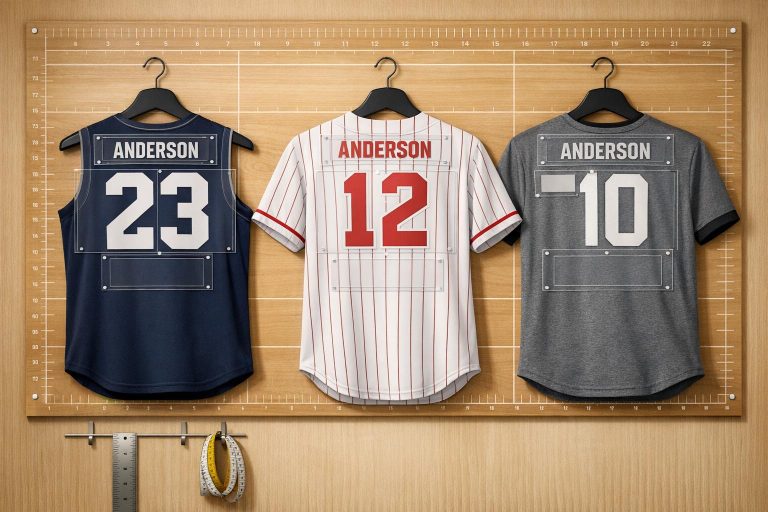
Uniform rules in sports leagues like the NBA, MLB, and MLS ensure team identity, improve player performance, and provide clear visuals for fans and officials with custom uniforms. These guidelines also integrate branding opportunities, balancing tradition with modern demands. Here’s a quick breakdown:
- NBA: Jerseys follow a four-edition system (Association, Icon, Statement, City), with strict rules on numbering and sponsor placement. Materials focus on comfort and mobility.
- MLB: Home jerseys are white, away are gray, with consistent numbering and sleeve rules, often seen in custom button-down baseball jerseys. Nike‘s Vapor Premier fabric prioritizes breathability.
- MLS: Jerseys include team crests, sponsor logos, and Apple TV patches. Numbering and colors are designed for visibility and clarity.
Uniform designs also drive revenue, as seen in the NBA’s $1 billion+ annual merchandise sales and MLS’s growing sponsorship income. While some changes, like MLB’s 2024 redesign, have sparked debate, leagues continue to balance aesthetics, function, and financial goals.
1. NBA Uniform Regulations
Jersey Design
NBA jerseys are crafted from moisture-wicking fabrics with mesh panels, designed to keep players comfortable and mobile. The jerseys come in various neckline styles, including V-neck, crew, and hybrid cuts, with side panels tailored to enhance movement. A "jock tag" at the bottom front of each jersey displays the NBA logo along with team-specific details. Instead of the old "Home" and "Away" labels, the league now uses a four-edition system: Association, Icon, City, and Statement. Additionally, original franchises can sport a Classic Edition, celebrating their history. This setup highlights the NBA’s effort to unite team identity with functionality.
Numbering Rules
Player numbers are displayed on both the front and back of the jersey, with dimensions no smaller than 6 inches tall and 0.75 inches wide to ensure visibility. The number color must sharply contrast with the jersey’s base color. Players can choose numbers from 0 to 99, but only one or two digits are allowed. Surnames are printed on the back in letters no taller than 2 inches. Players are also required to keep their jerseys tucked into their shorts during the game.
Color Guidelines
Traditionally, home teams wore light-colored uniforms while visiting teams donned darker ones. However, this practice has become more flexible, with teams able to adjust through mutual agreement. The four uniform editions offer teams creative freedom while maintaining league-wide consistency. Typically, Association uniforms are lighter, while Icon editions use bold colors that reflect the franchise’s identity.
Sponsor Integration
Commercial logos are prohibited on NBA game uniforms, except for footwear, which can feature manufacturer logos tied to personal endorsement deals with brands like Nike, Adidas, or Converse. Teams are allowed a small sponsorship patch on the jersey, typically placed on the upper left chest or above the player’s name. To maintain a professional and uncluttered look, no additional branding is permitted. Accessories like headbands and wristbands are also regulated – headbands can’t exceed 2 inches in width, wristbands can’t be wider than 4 inches, and shorts must not hang more than 1 inch below the knee.
sbb-itb-4d95ad3
2. MLB Uniform Regulations
Jersey Design
MLB jerseys use the Nike Vapor Premier chassis, designed to provide 25% more stretch and dry 28% faster than previous uniforms. This redesign, introduced in 2018 through a collaboration between MLB, Nike, and Fanatics, aimed to meet players’ needs for lighter, more breathable, and better-fitting jerseys. Denis Nolan, MLB Senior VP, and Stephen Roche, VP of MLB Authentic Collection, led this effort to enhance player comfort and performance.
"Nike’s goal was simple: create jerseys that addressed the needs and desires of the players, namely lighter, more breathable and better-fitting uniform tops." – MLB.com
Uniform consistency is a must – players on the same team are required to wear identically styled jerseys. Sleeve lengths must match across players, and sleeves cannot be frayed, slit, or ragged. Pitchers face additional restrictions: they cannot wear white or gray sleeves to avoid distracting batters. Home uniforms typically feature the team’s nickname, while away lightweight button down baseball jerseys display the city or state name. Safety regulations also prohibit elements like glass buttons or polished metal, and no patterns can mimic a baseball’s shape.
MLB also enforces strict rules for jersey numbering to maintain clarity and uniformity.
Numbering Rules
Each player must wear a unique number on the back of their jersey, with digits at least 6 inches tall in a contrasting solid color. All players on a team must follow the same font and style for their numbers. While back numbers are mandatory, front numbers are optional but must match the overall style if used. Player names, if included, must appear on all jerseys and typically feature the last name unless an exception is approved by the Commissioner’s Office.
The number 42, retired league-wide to honor Jackie Robinson, holds a special place in MLB – it’s the only number universally retired across the league. Traditionally, numbers 60 and above were reserved for spring training or players with uncertain roster spots. However, as more lower numbers are retired, higher numbers are becoming a way for players to express individuality. For instance, in 2019, Adam Ottavino became the first player in New York Yankees history to wear number 0.
Color Guidelines
Home uniforms are traditionally white, while away uniforms are gray or dark. Starting in 2023, teams are generally limited to four main uniform sets (home, away, and two alternates) plus one "City Connect" uniform. Nike also introduced a standardized color palette to ensure that logos, lettering, and patches align perfectly with the team’s official colors.
"For the first time, we had a uniform where all the colors matched exactly with the hats and the on-field colors. They had always been close, but they weren’t exact. Now they are." – Stephen Roche, Vice President, MLB Authentic Collection/Global Consumer Products
Undershirts must be a single solid color. Pitchers face additional restrictions – they cannot have numbers, letters, or insignia on their undershirt sleeves. Footwear is also regulated: at least 51% of a player’s shoe surface must feature the team’s primary colors, which are typically black, white, or gray.
In addition to these design and color rules, MLB has incorporated sponsor branding into uniforms.
Sponsor Integration
Under the 2022 Collective Bargaining Agreement, MLB teams can now sell advertising space on jerseys and helmets. Teams can feature patches on jersey sleeves and decals on batting helmets, a move inspired by similar programs in the NBA and NHL. This initiative is projected to generate over $170 million in annual revenue. The 2024 uniform redesign by Nike and Fanatics balances these new branding opportunities with traditional baseball aesthetics and functionality.
These evolving uniform standards reflect MLB’s efforts to blend tradition with modern performance needs and commercial opportunities – an approach that mirrors trends in other major sports leagues.
MLB Uniform Changes for 2025-26 (FINALLY!)
3. MLS Uniform Regulations
MLS has established clear guidelines for jersey design, numbering, and sponsorships, following the example set by leagues like the NBA and MLB. These rules aim to balance aesthetics, performance, and branding.
Jersey Design
Every custom v-neck soccer jersey in the MLS must include three key elements: the team crest, the MLS logo, and the primary front-of-kit sponsor. The jerseys are crafted from lightweight, breathable materials to ensure comfort and durability during matches. Additionally, an Apple TV logo patch is featured on the left sleeve, highlighting the league’s partnership with the streaming giant.
Numbering Rules
Players are assigned unique numbers that must be in a single, contrasting color to ensure they are easily visible. Back numbers are designed to be legible from at least 164 feet (50 meters) away. To further enhance visibility, the stroke width of the numbers typically falls between 0.8 and 2 inches. These specifications help avoid confusion during gameplay, such as officiating errors related to offside calls.
Color Guidelines
To prevent color clashes, MLS mandates that teams wear alternate shorts or socks when necessary, ensuring clear visual distinction on the field. Goalkeepers are also required to wear jerseys that set them apart from outfield players, making them easily identifiable to referees and fans. These rules promote clarity and reduce potential confusion during matches.
Sponsor Integration
MLS jerseys can feature up to four commercial placements: front-of-kit, left sleeve, right sleeve, and lower back. The lower back sponsorship slot, introduced for the 2026 season, allows logos up to 9 inches wide and 4 inches tall – about 80% the size of the front-of-kit sponsor. This addition has generated over $1 million annually for some clubs.
Front-of-jersey sponsorships began in 2007, while sleeve patches were introduced in 2020. By the 2025 season, 20 of the 30 MLS teams had secured right sleeve sponsors. All sponsorship deals must be approved by the league to ensure alignment with MLS values. Under the league’s single-entity structure, sponsorship revenue is shared between the league and its clubs.
Pros and Cons
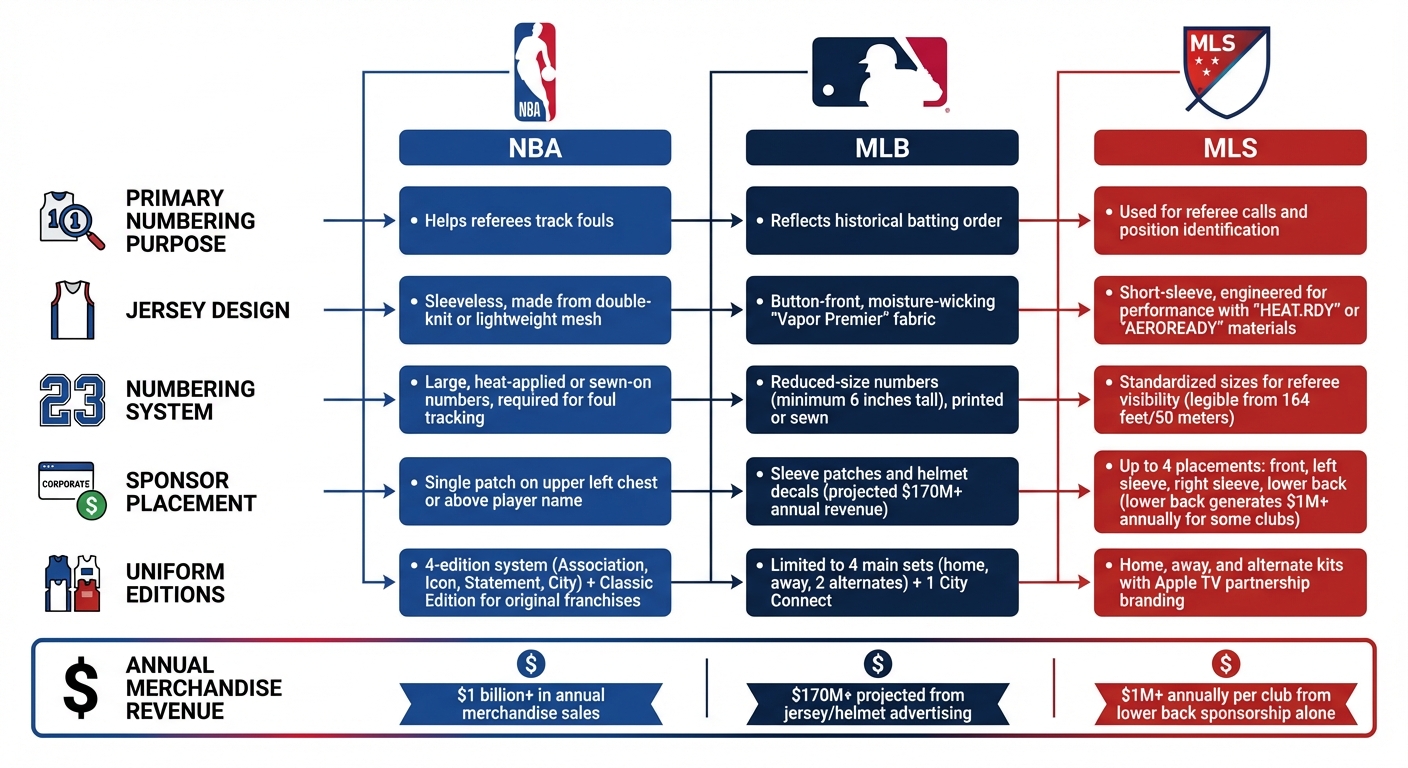
NBA vs MLB vs MLS Uniform Regulations Comparison Chart
Uniform regulations in the NBA, MLB, and MLS represent a balancing act between tradition, player performance, and commercial interests.
The biggest advantage of standardized numbering systems is how they simplify player identification during games. In basketball and soccer, referees use these numbers to log fouls, technical violations, and disciplinary actions like yellow or red cards. Writing down a number is far quicker and less error-prone than jotting down a name during fast-paced gameplay. This system also benefits fans, as larger numbers on uniforms make it easier to follow the action – especially in the days before high-definition screens became standard.
On the downside, prioritizing modern performance fabrics often comes at the expense of traditional aesthetics. For instance, MLB’s 2024/2026 uniform redesign reduced the size of letters and numbers to accommodate lighter fabrics like Nike’s Vapor Premier. This change sparked backlash. Philadelphia Phillies shortstop Trea Turner voiced his frustration, saying: "Everyone hates them." MLB Commissioner Rob Manfred, however, defended the redesign:
"I think after people wear them a little bit, they are going to be very popular."
Meanwhile, MLB Players Association Executive Director Tony Clark expressed skepticism:
"Each day has yielded something new that doesn’t seem to make as much sense as you would like it."
Here’s how uniform features compare across the NBA, MLB, and MLS:
| Feature | NBA | MLB | MLS |
|---|---|---|---|
| Primary Numbering Purpose | Helps referees track fouls | Reflects historical batting order | Used for referee calls and position identification |
| Jersey Design | Sleeveless, made from double-knit or lightweight mesh | Button-front, moisture-wicking "Vapor Premier" fabric | Short-sleeve, engineered for performance with "HEAT.RDY" or "AEROREADY" materials |
| Numbering System | Large, heat-applied or sewn-on numbers, required for foul tracking | Reduced-size numbers, printed or sewn | Standardized sizes for referee visibility |
| Sponsor Placement | Common on "Statement" and "City Edition" jerseys | Seen on select jersey tiers like Elite and Limited | Prominent branding for clubs and sponsors on the front |
Commercial interests play a big role in uniform decisions. Historically, some MLB team owners resisted adding player names to uniforms, fearing it would hurt game program sales since fans relied on programs to match numbers with names. Today, sponsorships have become a key revenue stream across leagues. However, integrating sponsor logos requires careful league approval to align with team and league branding. These trade-offs highlight how uniform regulations juggle team identity, player performance, and financial goals all at once. Similar standards apply to other contact sports, where pro football jerseys must balance durability with league-mandated branding.
Conclusion
The uniform policies in the NBA, MLB, and MLS highlight how leagues navigate the balance between preserving team identity and embracing commercial opportunities. While the NBA and MLB stick to a more reserved model with a single jersey patch, MLS is pushing boundaries with its sponsorship strategies, offering a glimpse into the future of sports marketing.
Starting after the 2026 All-Star Break, MLS will allow a fourth sponsorship placement – sized at 80% of the primary front patch. This move marks a clear departure from the NBA and MLB’s conservative approach.
Carter Ladd, the Chief Revenue Officer of MLS, shared the rationale behind this decision:
"We feel like this is the right moment in time to unlock a new asset for our clubs to capture the attention coming out of the World Cup."
This decision has proven lucrative, with some MLS clubs generating eight-figure annual revenues. The new patch alone is projected to bring in over $1 million annually for high-value teams. According to Ladd, this calculated expansion reflects MLS’s strategy to meet growing demand while capitalizing on the momentum from global events like the World Cup.
Ultimately, these evolving uniform standards do more than enhance game-day aesthetics – they also fuel advancements in team apparel design. For teams looking to combine cutting-edge performance with a distinct identity, Wooter Apparel offers fully sublimated, high-quality uniforms tailored to meet the demands of today’s game.
FAQs
Why do leagues regulate uniform numbers so tightly?
Leagues enforce strict rules on uniform numbers to make players easily recognizable to referees, fans, and broadcasters. This clarity helps streamline communication, minimizes mistakes, and ensures teams stick to league guidelines. Clear numbering also plays a role in improving safety by reducing any confusion during gameplay.
What’s driving the push for more sponsor patches on jerseys?
Teams and leagues are finding fresh ways to boost revenue by adding sponsor patches to jerseys. Recent changes in rules by organizations such as the NCAA and MLS now permit extra patches, opening the door for teams to tap into new income sources. This move highlights the growing emphasis in sports on leveraging uniform sponsorships to enhance financial opportunities.
How can teams design custom uniforms that still meet league rules?
When creating custom uniforms, it’s essential to align with your league’s specific rules. This means diving into the details of guidelines around jersey colors, sizes, logos, and their placement. For example, player numbers and team crests often have strict size and visibility requirements that you’ll need to meet.
One way to make this process easier? Work with professional uniform providers like Wooter Apparel. They can help ensure your designs not only comply with the rules but also showcase your team’s unique identity.
Don’t forget to stay updated on league regulations. Rules can change, and overlooking updates could lead to costly errors.