
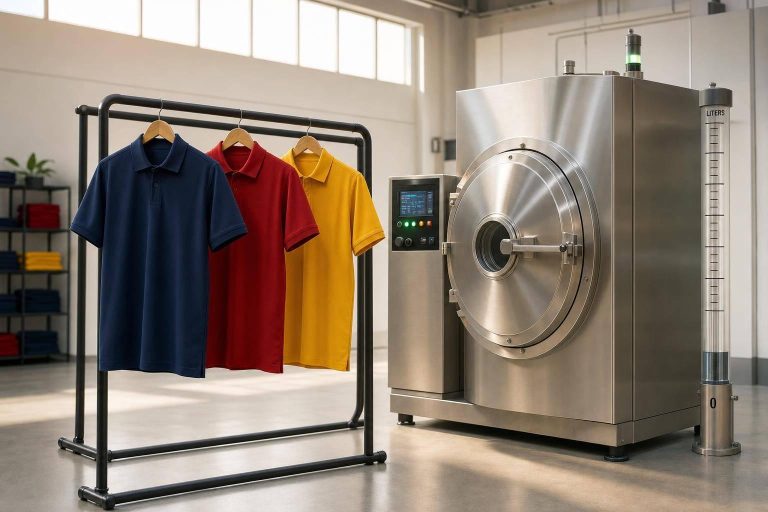
If you buy custom polyester uniforms, waterless dyeing can cut water use to near zero in the dye step, trim energy use by about 40%, and still deliver strong color and wash performance. The tradeoff is simple: machine costs are much higher, and supplier options are more limited.
Here’s the short version:
- Best fit: Polyester jerseys, shorts, and warmups
- Top method for fabric dyeing: Supercritical CO₂ (scCO₂)
- Top method for logos and graphics: Low-water sublimation/digital printing
- Main quality result: Many studies found wash and rub ratings of 4–5
- Main cost issue: scCO₂ machines can cost about $1.5 million to $4 million
- Main sourcing issue: Good results depend on the fabric, factory setup, and test data
If I were buying uniforms, I’d focus on three things first:
- Colorfastness after washing
- Sweat and rub test results
- How well reorders match the first run
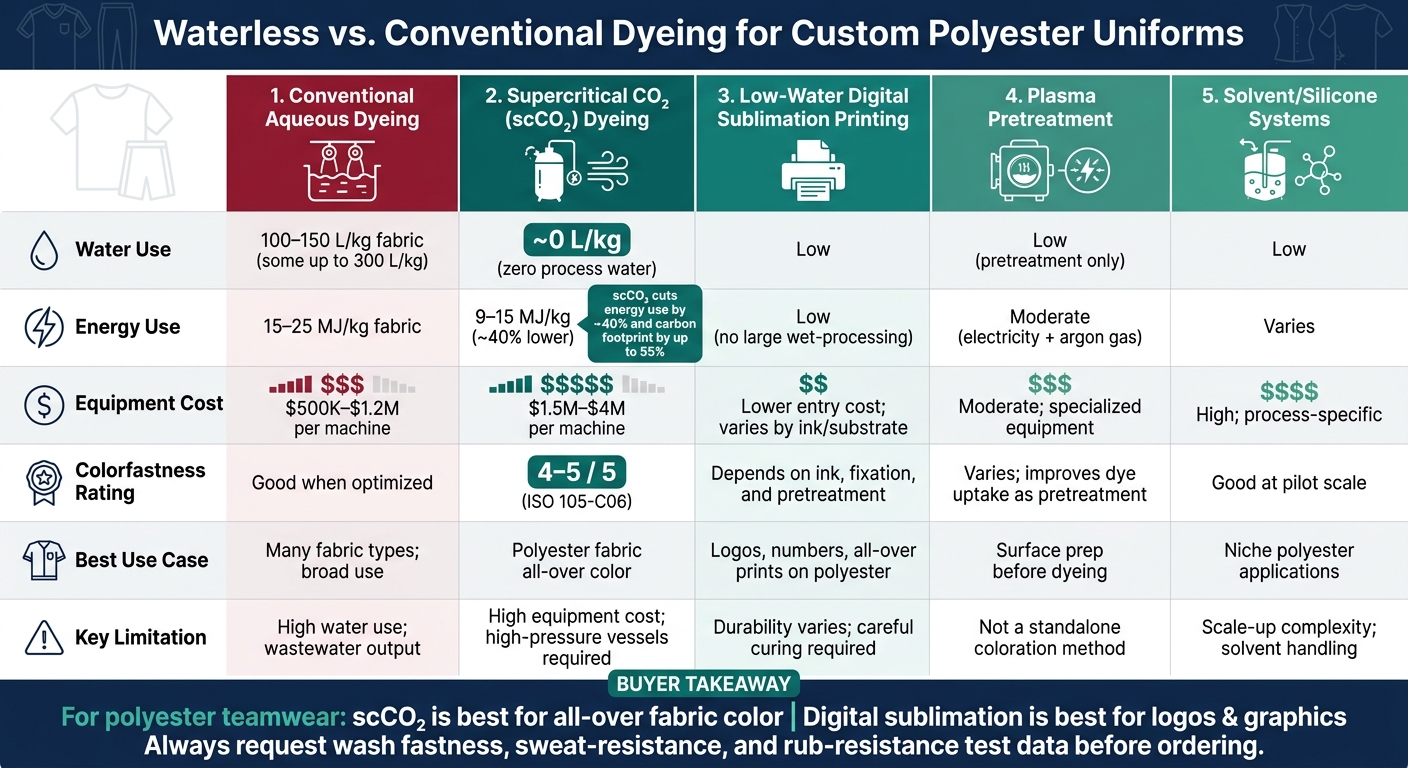
Waterless vs. Conventional Dyeing: Cost, Quality & Sustainability Compared
Alchemie Endeavour™ : Waterless Smart Dyeing
sbb-itb-4d95ad3
Quick Comparison
| Method | Best Use | Water Use | Quality Notes | Main Limitation |
|---|---|---|---|---|
| Conventional aqueous dyeing | Many fabric types | High | Solid baseline | High water use and wastewater |
| scCO₂ dyeing | Polyester fabric color | Near 0 L/kg in dye step | Strong color depth and even shades | High equipment cost |
| Plasma pretreatment | Surface prep before dyeing | Low | Can improve dye uptake | Not a full color process |
| Low-water sublimation/digital printing | Logos, numbers, all-over prints on polyester | Low | Sharp graphics and clean detail | Cure/setup affects wear life |
| Solvent/silicone systems | Niche polyester use | Low | Early results look good | Scale and solvent handling |
So the bottom line is clear: for polyester teamwear, waterless or low-water color methods can improve resource use without giving up the look and wear teams expect. But before you order, you should ask for lab test data instead of relying on broad “green” claims.
What Studies Show About Uniform Quality
Color Strength, Uniformity, and Logo and Number Clarity
The big question is simple: can lower-water methods match standard dyeing when quality is on the line?
For polyester, research on supercritical CO₂ (scCO₂) dyeing says yes. In many cases, it does even better than water-based dyeing. Studies using K/S values – a common way to measure color depth – found scores from 10.08 to 11.07 at 120°C, along with deeper saturation and little loss after washing.
That matters for custom collegiate football jerseys. If the base fabric has rich, even color, logos, numbers, and gradients tend to look sharper. Edges stay clean. Panel-to-panel color blocking looks more precise across jerseys, shorts, and warmups. Industrial trials also found steady results across bobbins and fabrics. For teams, that points to better shade matching across a full set of uniforms and more accurate reorders later on.
Colorfastness After Washing, Sweat, and Friction
Strong color on day one is nice. But for team uniforms, the real test is what happens after games, sweat, and repeat washes.
Here, the scCO₂ research looks solid. Multiple studies report wash fastness ratings of 4 to 5 on the standard gray scale, where 5 means no visible change, after ISO 105-C06 testing. One study described the results as production-ready at 120°C and 20–25 MPa.
Rub-off resistance also looks good. Industrial trials report dry and wet rub-off ratings of 4 to 5. In plain English, the dye stays inside the fiber instead of rubbing off the surface. For contact sports, that can help dark jerseys avoid staining white pants or undershirts during play or in the wash.
There is one caution worth noting. A real-world case study on waterless-dyed recycled polyester leggings found color change and staining issues in perspiration, rub-off, and abrasion tests. So while the lab data is strong, results can still shift depending on the fiber blend and how the garment is used.
Quality Results by Dyeing Method: Comparison Table
| Process Type | Fiber Compatibility | Color Strength | Colorfastness | Uniformity | Key Limitation |
|---|---|---|---|---|---|
| Conventional aqueous dyeing | Broad; well established | Good baseline | Good when optimized | Generally reliable | High water use; wastewater output |
| Supercritical CO₂ (scCO₂) | Strongest for polyester | Equal or higher K/S than water-based dyeing | Wash/rub/light fastness often 4–5 | Good levelness and even fiber penetration | High-pressure equipment required |
| Silicone/solvent-based systems | Mainly polyester-focused | Promising in pilot testing | Can be good at pilot scale | Good process control possible | Solvent management; scale-up complexity |
| Plasma-assisted pretreatment | Polyester and other synthetics | Can significantly boost uptake; one study reported color strength nearly quadruple vs. untreated fabric | Can improve fastness; results vary | Helps surface activation; not a full dyeing method | Primarily a pretreatment, not standalone coloration |
| Low-water digital sublimation printing | Well-suited for polyester sportswear | Strong for graphics and logos | Depends on ink, fixation, and pretreatment | Excellent design precision | Durability varies; careful curing required |
Looking across these methods, scCO₂ has the strongest evidence for dyed polyester quality, while low-water digital sublimation printing stands out for graphics and logos. That split matters when you’re making custom basketball jerseys at scale, because the best choice may depend on whether the top priority is all-over fabric color or sharp printed design work.
Cost and Production Effects for Custom Uniform Orders
Where Waterless Dyeing Can Cut Operating Costs
Waterless dyeing can lower costs in a few direct ways: less water coming in, less wastewater to treat, and less energy spent on drying. Studies estimate that conventional dyeing uses about 164 liters of water and 449 grams of chemicals per kilogram of fabric. That’s a big input load, especially when you’re dealing with custom uniforms instead of long, predictable factory runs.
That matters most for teams that order in small batches or place repeat orders as rosters change. Even a 10% drop in chemical use could save about $40 per ton of fabric, or about $869,760 per year at factory scale.
For custom uniform orders, the savings don’t just come from lower utility use. They also come from fewer rinse and wash steps and less rework between runs. If a team needs a short run, a repeat order, or a fast turnaround, those time savings can be just as useful as the dollar savings.
Some waterless systems, especially supercritical CO₂, can also remove the drying stage altogether. DyeCoo reported that its process speeds dyeing by 40% and cuts energy use by 60% compared with conventional dyeing. For teams facing tournament deadlines or last-minute roster changes, that shorter cycle can make a big difference.
Why Adoption Can Still Be Expensive
The catch is the upfront cost.
Supercritical CO₂ systems need high-pressure vessels and special safety systems that standard dye lines don’t require. A Yale report on DyeCoo put the cost of one waterless dyeing machine at USD 2.5 million to USD 4 million. Another estimate places production-scale scCO₂ equipment at $1.5 million to $3.5 million per machine, compared with $500,000 to $1.2 million for conventional aqueous equipment.
Cost per kilogram also shifts a lot based on vessel size. A Chalmers-cited study found that scCO₂ dyeing of PET cost €5.51/kg in a 300-liter vessel, but that number dropped to €2.01/kg in a 2,000-liter vessel. Conventional European water dyeing came in at €1.07 to €3.07/kg.
That puts scale right at the center of the issue for medium-size uniform runs. If polyester volume is steady, the equipment cost can be spread across more output. If orders are uneven, the math gets harder in a hurry.
Retrofitting an existing plant adds even more cost and disruption. The new process may need different temperature and pressure conditions, different solvent-handling systems, or different colorant inputs. So yes, the economics can improve with volume. But buyers still need to weigh those resource savings against energy use and emissions.
Cost and Scalability Factors: Comparison Table
| Method | Capital Cost | Main Operating Cost Drivers | Cycle Time | Best for short runs |
|---|---|---|---|---|
| Conventional aqueous dyeing | Lower ($500K–$1.2M/machine) | Water, wastewater treatment, chemicals, drying | Longer; more post-processing and wash steps | Moderate; familiar but resource-heavy |
| Supercritical CO₂ (scCO₂) | Highest ($1.5M–$4M/machine) | Lower water, wastewater, and drying costs; recyclable CO₂ | Often shorter; drying is eliminated | Good for repeated polyester runs at scale |
| Solvent-based systems | High; process-specific | Solvent recovery, ventilation, chemical handling | Varies by chemistry and recovery setup | Limited; still emerging commercially |
| Plasma-assisted pretreatment | Moderate; specialized equipment | Electricity, argon gas, process control | Adds a step; not a full dyeing replacement | Best as a pretreatment, not standalone |
| Low-water digital printing and sublimation | Lower entry cost; costs vary by ink and substrate | Ink, substrate prep, fixation; no large wet-processing batches | Fast setup; easy design switching | Strong fit for short runs and custom designs |
These cost tradeoffs start to matter once you factor in order volume, reorder frequency, and production speed. The next step is to look at whether those cost gains line up with the environmental side as well.
Sustainability Results and What They Mean for U.S. Buyers
Water, Wastewater, and Chemical Reductions
Beyond cost, the biggest upside of waterless dyeing is simple: it slashes water use and wastewater output.
Conventional dyeing still runs through a huge amount of water. Studies of 18 textile factories found an average water intake of 164 liters per kilogram of fabric, with dyehouse water at 136 L/kg and wastewater discharge at 119 L/kg. For a typical custom team order of 50–100 kg of fabric, that works out to about 5,000–30,000 liters (1,300–7,900 gallons) of water per run, and much of that leaves the plant as chemically loaded wastewater.
That hits U.S. buyers in a very direct way. Suppliers have to pay for water, treatment, and compliance, and those costs don’t just vanish. One industrial survey found 449 grams of chemicals per kilogram of textile, including dyes, salts, dispersants, and pH regulators. No surprise, then, that wastewater treatment is a major cost center and a compliance headache for mills.
Supercritical CO₂ dyeing changes that picture. For polyester jerseys, shorts, and warmups, the dyeing step uses zero water and produces no wastewater effluent. CO₂ is recovered and reused at about 95% efficiency, and because the process doesn’t need dispersing agents or leveling salts, chemical inputs fall as well.
For U.S. buyers, this matters when reviewing supplier disclosures, audit reports, and certification claims. A mill that says it’s "saving water" is not the same as a mill running a dye bath with no process water at all. That leads straight to the next issue: energy.
Energy Use and Emissions Tradeoffs
Lower water use doesn’t always mean lower energy use. In this case, though, waterless dyeing often helps on both.
Conventional wet dyeing burns energy in several places at once: heating large dye baths, pumping water, running high-temperature dryers, and treating wastewater. Drying by itself can use about 3,800 kJ per kilogram of water evaporated. That’s a big deal, because supercritical CO₂ systems skip the drying step entirely.
Comparative analyses place conventional aqueous dyeing at around 15–25 MJ of energy per kilogram of fabric and 3.1–4.7 kg of CO₂ equivalent per kilogram. ScCO₂ dyeing comes in at about 9–15 MJ/kg and roughly 2.1 kg CO₂/kg. In plain terms, that points to about 40% lower energy use and up to 55% lower carbon footprint per kilogram of dyed fabric. Some facility-level analyses also report 80–95% cuts in water footprint when plants move from standard dyeing to waterless systems.
There is one catch. ScCO₂ systems still need electricity to compress CO₂ and hold it at supercritical pressure. So the climate upside depends on the plant’s power source and how well the system is run. If a supplier makes big claims, buyers should ask for life-cycle assessment data or third-party certifications that show total energy use and emissions, not just water savings.
Environmental Indicators by Technology: Comparison Table
The side-by-side numbers make the gap easier to see.
| Technology | Water Use (per kg fabric) | Wastewater Output | Chemical Inputs | Energy Profile | Reduction vs. Conventional |
|---|---|---|---|---|---|
| Conventional aqueous dyeing | 100–150 L/kg; some operations reach 200–300 L/kg | High; ~119 L/kg discharged with dyes, salts, and auxiliaries | ~449 g/kg of textile | High; heating, drying, and treatment | Baseline |
| Water-saving modified processes | ~104 L/kg vs. ~120 L/kg with rinse recycling | Reduced, but still significant | Slightly reduced; same general inputs | Moderate improvement; drying still required | ~10–30% water reduction |
| Supercritical CO₂ (scCO₂) dyeing | ~0 L/kg in the dyeing step | None; closed-loop CO₂ recovery | No dispersants or salts; CO₂ recycled | Lower overall; no drying, but high-pressure electricity required | ~95% lower water use; ~40–55% lower energy and emissions |
For buyers, the real job is telling apart a true waterless process from a process that’s simply using a bit less water.
What This Means for Wooter Apparel and Custom Team Buyers
Best Fit for Polyester Jerseys, Shorts, and Warmups
Once you move from research to an actual team order, the big question is simple: where does this work best? The clearest answer is polyester. Waterless and low-water color methods like sublimation printing, supercritical CO₂ dyeing, and digital textile printing tend to perform best on synthetic fibers, and the quality data lines up with that.
Studies show that supercritical CO₂ dyeing on polyester can produce high color strength and strong fastness. It also runs at lower temperatures than standard water-based dyeing, while using almost no water.
For fully sublimated uniforms, the design becomes part of the fabric itself. That means sharp logos, player numbers, and multi-color graphics stay crisp and don’t crack or peel, even after repeated washing and hard use. If you’ve ever seen old screen-printed uniforms start to break down mid-season, you know why that matters. It’s a big deal for repeat team orders.
Wooter Apparel‘s fully sublimated polyester line matches this use case well. That’s why this research matters here in a very direct way: the strongest quality upside shows up most clearly in polyester performance gear.
How Sustainability Can Factor Into Buying Decisions
Fit and print quality matter first. For most schools, clubs, and youth programs, price and performance usually come before sustainability. That’s fair. Budgets are tight, and uniforms need to hold up.
That said, the research shows that waterless and low-water methods can cut water use by 50% to 95% and lower energy use by up to about 75% compared with standard wet dyeing.
This starts to matter more when a program orders again and again over time. If uniforms are replaced every year or two, those production choices add up. A supplier that uses far less water and creates less wastewater may fit district policy goals or the values of a school, club, or league.
Before placing an order, ask for:
- Wash fastness data
- Sweat-resistance data
- Rub-resistance data
That gives you something more concrete than broad "eco-friendly" claims.
Conclusion: Key Findings on Quality, Cost, and Sustainability
For buyers, the main takeaway is pretty straightforward: waterless dyeing can deliver the quality teams need while cutting environmental impact. The catch is higher setup cost and fewer supplier options.
For custom team buyers, polyester uniforms are the strongest match for waterless dyeing. That’s where the quality upside is clearest, and where the cost and sustainability tradeoffs make the most sense. The research gives buyers a better set of questions to ask suppliers instead of taking general green marketing at face value.
FAQs
Is waterless dyeing only suitable for polyester uniforms?
No. Waterless dyeing is not limited to polyester.
Sublimation printing does require polyester or polyester-coated materials. But other waterless and low-water dyeing methods can work across a broader mix of sportswear fabrics, including cotton and knits.
How can I verify a supplier’s waterless dyeing claims?
Ask for clear, official documents that back up the supplier’s waterless dyeing claims. That can include Life Cycle Assessment (LCA) data that shows water and CO2 savings, along with certifications like the Global Recycled Standard.
It also helps to ask about supply chain transparency and proof that the supplier follows safety and environmental rules. A solid manufacturer should be able to show clear records of its dyeing methods and how it cuts resource use.
Will reorder colors match the first uniform run?
Yes. Waterless dyeing methods like CO2 dyeing, along with low-water sublimation, help colors stay bold and hold up over time.
Here’s why: sublimation bonds the dye directly into polyester fibers instead of sitting on top of the fabric. That helps the color last and keeps the finished look more consistent. On top of that, advanced color controls make repeat orders more reliable.
So if you reorder using the same design files and the approved color palette, the new uniforms should match the look of the first production run.