
How many systems does your team touch just to ship one custom uniform order?
For most brands and distributors, it looks something like this: design files in one folder, rosters in spreadsheets, approvals in email, production notes in chat, and reorders handled from memory.
It works at low volume.
Then growth hits.
Suddenly, small mistakes become expensive. Approvals slow down. Rosters drift out of sync. Compliance gets harder. And every new client adds more operational friction.
The problem is not demand.
The problem is infrastructure.
This guide explains how brands run custom uniform programs under their own name using white-label software, with UniformOS powering operations behind the scenes. You will see how this model replaces scattered tools with one structured system and how it is actively utilized by Wooter in real production environments.
White-label uniform software gives brands and distributors a way to operate custom apparel programs without building their own technology stack.
On the front end, you control:
Your clients experience everything as your platform.
On the back end, the software handles:
Instead of moving information between spreadsheets, inboxes, and shared folders, orders flow through a single operational system designed specifically for custom uniforms.
This matters because custom apparel is not just ecommerce.
It involves:
Generic tools were not built for this.
White-label uniform software exists to solve that gap. It lets brands own the customer experience while outsourcing operational complexity to infrastructure purpose-built for uniforms.
In simple terms, you stay focused on market growth while the system handles structure.
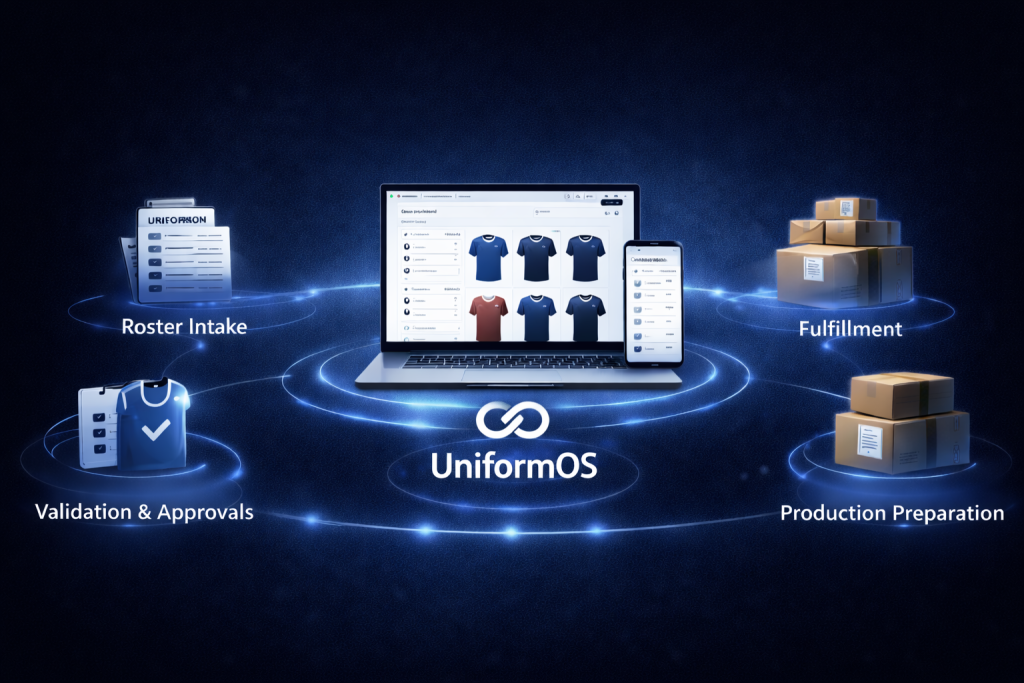
UniformOS is the operational engine behind this model.
It manages everything that usually breaks when custom uniforms scale.
Instead of collecting player data in loose documents, UniformOS captures sizes, names, and numbers as defined fields. This removes ambiguity at the very start of the order.
No free text. No guessing.
The system applies checks automatically:
Errors are caught early, when fixes are simple.
Design proofs are created directly from the same data used for production. Customers review exactly what will be manufactured and approve inside the workflow.
There is a clear record of what was accepted and when.
Once approved, orders move into production with verified inputs. There is no manual handoff between teams and no interpretation of email instructions.
The system prepares production-ready data automatically.
Completed orders do not disappear. Designs, roster formats, and size sets are saved so future orders follow the same structure.
This turns reorders into a repeatable process instead of a rebuild.
Together, these capabilities replace the patchwork of tools most brands rely on. UniformOS centralizes intake, validation, approvals, and production coordination into one workflow designed specifically for custom apparel.
This is not theoretical software.
It is actively used by Wooter to manage real-world custom uniform operations at scale, including team programs, approvals, and fulfillment. That production environment serves as proof that the system works under real volume, not just in demos.
While UniformOS runs operations in the background, brands still need a clean way for customers to start orders.
That front-end experience matters.
If clients struggle to design uniforms or submit roster details, everything downstream slows down. That is why the platform pairs backend workflow with a customer-facing customization layer.
Through Wooter’s custom apparel builder, brands can offer a guided ordering experience where customers:
Instead of emailing mockups and collecting rosters separately, customization happens inside the ordering process.
This does two important things.
First, it improves the customer experience. Teams see what they are ordering and provide all details upfront, without back-and-forth.
Second, it converts customization into structured input. Names, numbers, and sizes enter the system in defined fields, ready for validation and production. There is no need to reconcile design files with spreadsheet rosters later.
This is what replaces the traditional “send us your roster” model with a modern intake workflow.
Brands control the storefront and client relationship. Customers design and submit orders visually. UniformOS then takes over operationally, validating data, generating proofs, and preparing production.
Together, the builder and UniformOS create a full loop:
customers design → orders become structured → operations run centrally → production starts with verified data.
That connection between front end and backend is what makes white-label uniform software usable at scale.
White-label uniform software only matters if it works under real production pressure.
UniformOS is not a conceptual platform or a lightweight ordering tool. It is actively used to run Wooter’s own custom uniform operations, handling live orders across teams, leagues, and programs.
That means the same system brands access is already managing:
This matters because custom uniforms introduce complexity that standard ecommerce does not.
Every order includes personalization.
Every roster changes.
Every design requires approval.
Every production run depends on accurate inputs.
UniformOS was built inside a working uniform business to solve these exact problems. It evolved alongside real operational needs, not theoretical product requirements.
In practice, this gives brands something most software platforms cannot offer:
a system proven in live manufacturing environments.
Instead of experimenting with untested workflows, distributors and apparel brands step into infrastructure that already supports real customization at scale.
You are not adopting a new process.
You are inheriting one that already works.
Most brands do not realize how fragmented their uniform operations have become until they try to scale.
What starts as a few spreadsheets quickly turns into a stack of disconnected tools:
Each tool solves a small problem. Together, they create operational drag.
UniformOS replaces this patchwork with a single workflow designed specifically for custom apparel.
Instead of jumping between platforms, brands manage everything in one place:
There is no need to reconcile documents or interpret instructions.
The system becomes the source of truth.
This shift changes how teams work day to day. Operations move faster. Mistakes surface earlier. Reorders become predictable. And internal coordination no longer depends on memory or manual follow-ups.
Rather than building and maintaining your own software stack, you operate on top of infrastructure purpose-built for uniforms.
That is the difference between managing orders and running a scalable program.
Once ordering and operations run through a single system, brands gain capabilities that are difficult to achieve with manual workflows.
This is where white-label uniform software starts to feel like a platform, not just a tool.
You sell under your own name.
Your logo, your pricing, your customer communication, your storefront.
Clients interact with your brand, not a third-party vendor. UniformOS operates behind the scenes, handling structure and production while you stay front-facing.
This makes it possible to grow your apparel business without giving up ownership of the customer relationship.
Distributors often manage multiple programs at once. Different teams. Different organizations. Different timelines.
UniformOS centralizes all of that into one workflow.
Instead of tracking each account separately across folders and inboxes, orders from multiple clients flow through the same operational system. Rosters, approvals, and production status live in one place.
This simplifies internal coordination and makes volume manageable.
Brands can launch team or organization-specific stores where players and parents place orders directly from pre-approved designs.
Customers self-serve. Orders enter the system already structured.
For distributors, this removes manual order collection while still keeping branding consistent across programs.

Custom uniforms rarely stop after the first delivery.
New players join. Seasons change. Teams refresh designs.
UniformOS preserves order structure so reorders follow the same pattern:
Instead of rebuilding orders from scratch, brands extend existing programs.
This turns seasonal updates into predictable revenue rather than operational resets.
Together, these capabilities allow brands and distributors to operate custom uniform programs with the consistency of software, not the fragility of manual processes.
You do not just fulfill orders.
You run repeatable apparel workflows.
As custom programs grow, approvals and branding compliance become harder to manage.
Without structure, teams rely on email threads and screenshots to confirm designs. That is how outdated proofs slip into production and sponsor logos end up placed incorrectly.
UniformOS brings approvals into the workflow.
Design proofs are generated from production-ready data. Customers review exactly what will be printed and approved inside the system. Each approval becomes a recorded checkpoint, not an assumption.
If you want to see how structured approvals reduce production errors, this guide on custom uniform design approval workflows explains how brands avoid last-minute fixes by locking designs before manufacturing:
Compliance is handled the same way.
For brands working with sponsors or licensed programs, logo placement and usage rules must be respected on every order. UniformOS keeps designs connected to rosters and approvals so compliance is enforced consistently across teams and seasons.
This resource on designing uniforms with sponsor logos legally is especially useful for distributors managing branded programs at scale:
Together, approvals and compliance become part of the system, not manual checkpoints added at the last minute.
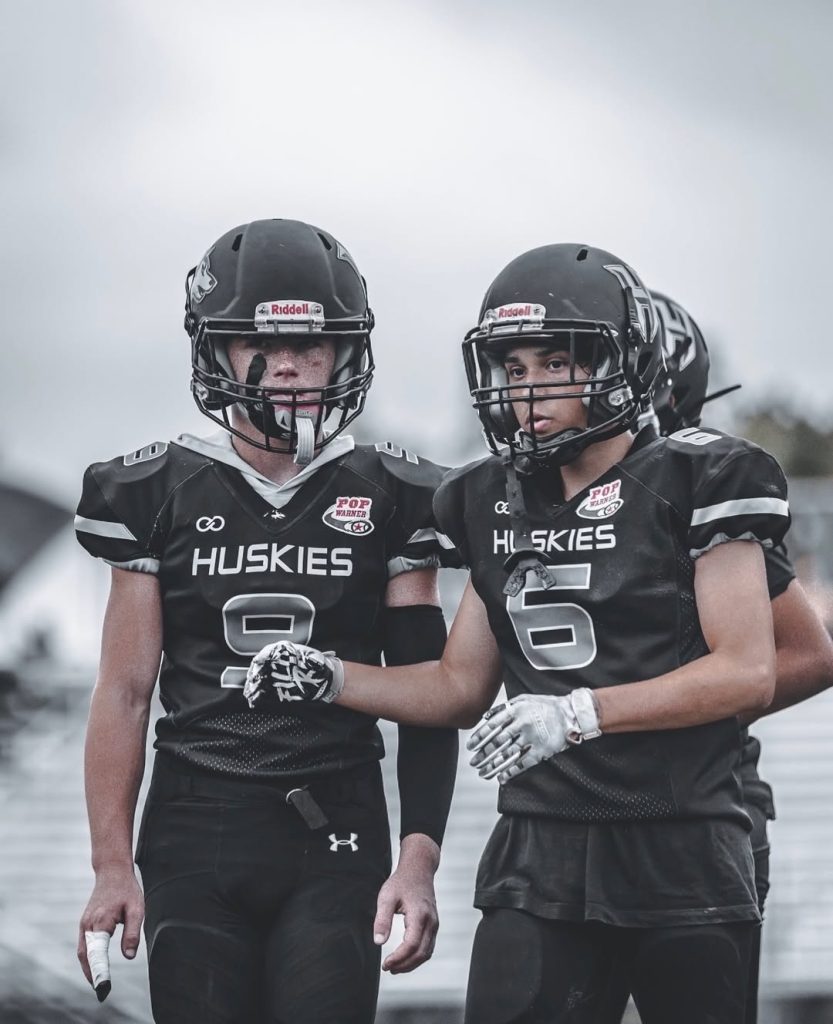
Once the platform is in place, brands can expand across multiple uniform categories without changing their operational process.
For example, distributors can launch programs for custom baseball uniforms for teams and leagues while keeping roster intake, approvals, and production flowing through the same backend workflow:
The product category changes.
The operational system stays the same.
That consistency is what allows brands to scale across sports and programs without rebuilding their process each time.
Yes. Brands sell under their own name while UniformOS handles roster management, approvals, production routing, and reorders behind the scenes.
No. Manufacturing and fulfillment are handled through Wooter’s production environment, allowing brands to remain asset-light.
Yes. Distributors can launch co-branded team stores for different organizations while managing all orders through a single backend workflow.
Wholesale provides blank products. UniformOS provides operational infrastructure, including customization, approvals, production coordination, and repeatable reorders.
Design proofs are generated from production-ready data. Customers approve inside the workflow, creating a clear record before orders move into manufacturing.
Yes. UniformOS centralizes orders from multiple clients and programs, allowing distributors to manage everything through one operational platform.
If your team is juggling rosters, proofs, and reorders across multiple tools, your process will break as volume grows. Wooter brings ordering, workflow, production, and fulfillment into one scalable system.