
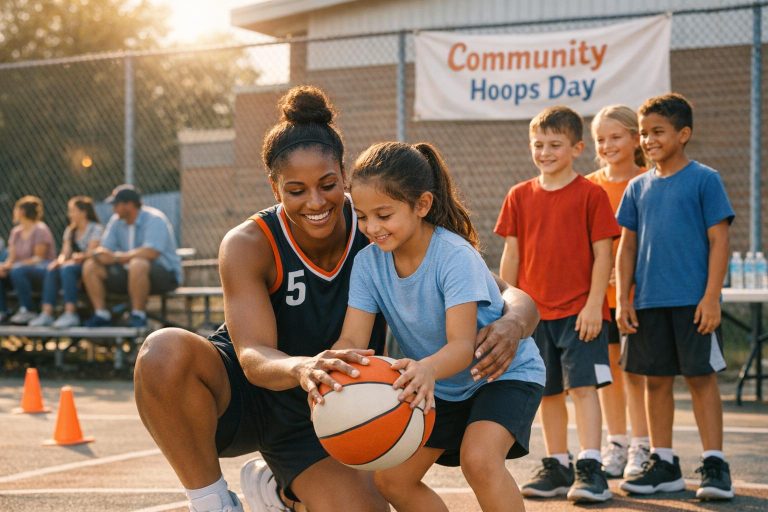
Community work is more than a side effort for WNBA teams – it’s a core strategy for growth and connection. Fans today want teams to engage with local issues, and the WNBA has embraced this demand. Here’s why it matters:
- Stronger Fan Loyalty: Community programs help turn casual viewers into committed fans by creating emotional bonds beyond the court.
- Boosted Attendance: Teams that invest locally see attendance grow, as shown by the New York Liberty’s move to Brooklyn, which increased their game-day crowd by 290%.
- Youth Engagement: Programs like "Her Time to Play" encourage young girls to stay in sports, building future fanbases while addressing barriers in underserved neighborhoods.
- Local Impact: From voter drives to funding STEM education, WNBA teams address social challenges, making them trusted community partners.
These efforts aren’t just good deeds – they’re driving franchise growth, with team valuations jumping 180% between 2024 and 2025. The WNBA’s focus on community work is shaping its future, proving that investing in people off the court pays dividends on it.
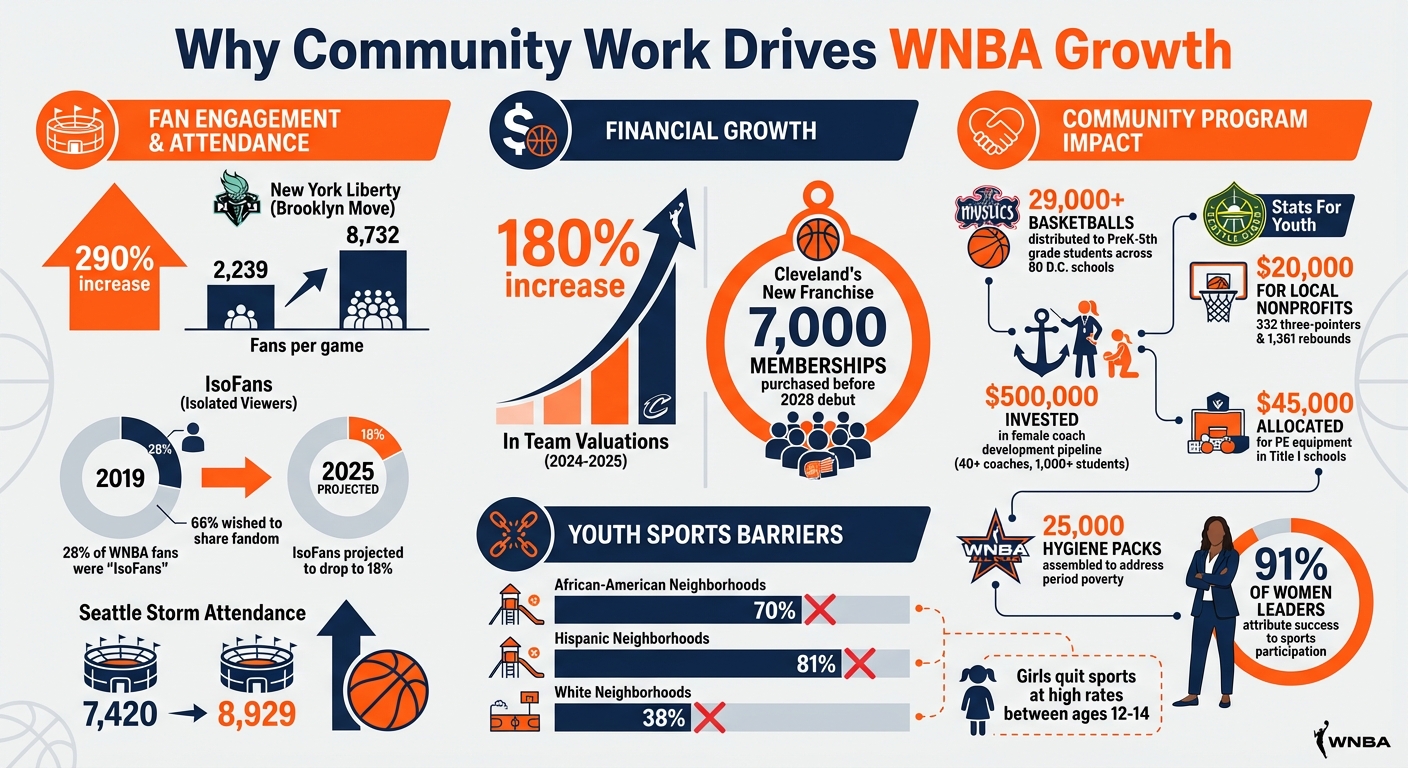
WNBA Community Engagement Impact: Key Statistics and Growth Metrics
Problems WNBA Teams Face Without Community Engagement
Building Fan Loyalty in a Crowded Market
WNBA teams face tough competition from other sports, concerts, and endless digital entertainment options. Without strong community ties, they struggle to give fans a compelling reason to choose their games over other activities.
Take this for example: in 2019, 28% of WNBA fans identified as "IsoFans" – fans who watched games alone. These fans tend to attend fewer games and engage less overall. Even more striking, 66% of these IsoFans said they wished they had more people to share their fandom with. Without initiatives that connect these fans to a larger community, teams miss out on turning casual viewers into devoted supporters.
The stakes are even higher when considering younger fans. Girls often quit sports between the ages of 12 and 14 at alarming rates. WNBA teams that neglect consistent youth programs lose the chance to create lifelong fans. At the same time, as the league grows in popularity, challenges like on- and off-court tensions have occasionally surfaced in arenas and online. Without programs that promote inclusivity and connection, teams risk alienating key groups of fans, including Black and LGBTQ+ supporters – two of the league’s most loyal demographics.
This lack of community engagement doesn’t just hurt loyalty; it also impacts attendance and the overall game-day experience.
Missed Opportunities to Connect with Local Supporters
Beyond fan loyalty, poor local outreach has a direct impact on attendance and venue success. The New York Liberty offers a clear example. In 2019, the team played at the Westchester County Center, located 30 miles from Brooklyn, and averaged only 2,239 fans per game. Fast forward to 2023, when the team moved to the Barclays Center in Brooklyn, and attendance soared to 8,732 fans per game, marking a 290% increase. Similarly, the Seattle Storm saw their attendance rise from 7,420 to 8,929 after relocating to the centrally located Climate Pledge Arena.
While location is crucial, connection matters just as much. Without robust community programs, teams miss out on becoming deeply rooted in their local areas. These attendance spikes highlight the importance of creating a sense of belonging. New York Liberty’s Breanna Stewart emphasized the role fans play in driving change:
"The biggest way that you can help us have this change and make these differences is buying tickets, buying custom basketball jerseys, buying the league pass, coming to games, watching on TV. Because that’s what matters."
Fans need to feel that their team is more than just a name – it has to feel like a part of their community. That level of connection requires consistent, meaningful engagement that extends far beyond game days.
sbb-itb-4d95ad3
How Community Engagement Strengthens WNBA Teams
Building Emotional Connections with Fans
Community outreach has a way of turning casual fans into lifelong supporters. When WNBA teams actively participate in local initiatives, they stop being just another sports team – they become a meaningful part of the community.
Take the Seattle Storm’s "Stats For Youth" program as an example. In 2025, the team’s on-court achievements – 332 three-pointers and 1,361 rebounds – generated $20,000 for local nonprofits. Fans saw their team’s success directly impact their community. Another initiative, "The Next Verse Project", brought creativity and self-expression to the forefront. In August 2025, the Storm partnered with poet Trey Baker to host workshops for four students, culminating in a live poetry performance during their "Kicks for Equality" game on August 1.
These efforts create what some call "communal jolts" – shared experiences that deepen the connection between fans and their teams. For example, during the July 2025 WNBA All-Star Changemaker Day in Indianapolis, volunteers came together with corporate partners like AT&T, Deloitte, and Nike to assemble 25,000 hygiene packs to address period poverty. Events like this transform fans into active contributors to their team’s mission.
Cleveland’s new WNBA franchise is a perfect case of how early community engagement sets the tone. Even before their 2028 debut, the team, led by President Allison Howard, committed to hosting 28 community events by June 30, 2026. Howard explained the team’s philosophy:
"Our approach begins with the community and leads into the court, not the other way around".
This approach not only builds emotional ties but also establishes a sense of loyalty long before the first game tips off.
Becoming Part of the Community Through Local Programs
Investing in local neighborhoods sends a powerful message of commitment. The Phoenix Mercury demonstrated this in July 2024 by renovating four basketball courts at the Rose Mofford Sports Complex. Similarly, in October 2023, the New York Liberty and Brooklyn Nets, under the leadership of co-owner Clara Wu Tsai, transformed Brooklyn’s Fox Playground in the Flatlands neighborhood. Wu Tsai captured the spirit of these efforts:
"This project is the perfect combination of my love for basketball, my affection for Brooklyn, and my commitment to equitable public safety and wellness".
Beyond physical improvements, educational programs also play a major role in strengthening community ties. The Seattle Storm’s "Fit Futures" program allocated $45,000 for PE equipment in Title I schools, ensuring students in underfunded areas have access to quality physical education. Additionally, the WNBA’s partnership with State Farm’s Assist Tracker has provided vital support for STEM education and mental health initiatives.
These programs go beyond surface-level involvement by addressing real-world challenges. For instance, the WNBA’s HBCU Event Intern Program, launched in July 2025, offered six students from Historically Black Colleges and Universities (HBCUs) – including three student-athletes from Hampton University – a chance to intern during All-Star Weekend. This initiative not only provided professional development but also opened doors for young women aspiring to careers beyond the basketball court.
Examples of WNBA Community Programs That Work
Washington Mystics: Scholarships for Students
The Washington Mystics have created a scholarship program that pairs players and coaches with students, mentoring them as they work toward their college goals. This initiative is part of their broader District of Change platform, which focuses on racial and gender equity, LGBTQ+ equality, and social and economic justice through active civic engagement. Monica Dixon, President of External Affairs at Monumental Sports & Entertainment, summed up the impact of sports on young girls:
"Sports equip girls with confidence, community, and a clear runway for who they can become".
The Mystics have delivered impressive results. For instance, their District Dribble campaign distributed more than 29,000 basketballs to PreK–5th grade students across 80 D.C. Public Schools. Additionally, Monumental Sports & Entertainment has invested nearly $500,000 to develop a pipeline for female coaches in Washington, D.C. This partnership with Coach Across America’s She Changes the Game® program aims to train at least 40 female coaches over four years, impacting over 1,000 K–12 students. These efforts demonstrate how WNBA teams influence communities well beyond the basketball court.
League-Wide Programs: Voter Drives and Title IX Events
Beyond individual team efforts, the WNBA organizes league-wide programs to empower fans and promote civic engagement. The Washington Mystics, for example, collaborated with the League of Women Voters to prepare fans for the 2024 presidential election, building on their 2022 midterm election partnership with HeadCount. As the team states:
"District of Change is our collective commitment to positive activism, elevated public discourse, civic engagement, and meaningful change".
These programs turn game attendance into a platform for community impact.
Her Time to Play: Engaging Young Girls in Basketball
Her Time to Play tackles barriers in youth sports by blending basketball training with life skills development, helping young girls build confidence, teamwork, and resilience. Studies show that 91% of women in leadership roles attribute their professional success to participating in sports.
In August 2024, the Mystics hosted a "Her Time to Play" theme game featuring trailblazing athlete Mo’ne Davis. The event allowed girls aged 6 to 14 to play alongside WNBA stars, and Mystics forward Shakira Austin joined a Jr. WNBA panel to share insights on overcoming challenges. The program also highlights disparities in recreational access – 70% of African-American neighborhoods and 81% of Hispanic neighborhoods lack facilities, compared to just 38% of white neighborhoods.
The WNBA has also hosted virtual community conversations, like the five sessions organized with AT&T during the 2020 season, connecting players, coaches, and executives with young athletes. In August 2025, the Mystics teamed up with the 318 Foundation, founded by WNBA legend Alana Beard, to launch the Champions Academy at George Washington University. This week-long leadership and basketball program was offered at no cost to 20 middle and high school girls from D.C. (focusing on Wards 7 and 8) and Shreveport, LA. Alana Beard described the initiative:
"This partnership is more than a camp – it’s a movement, designed to build bold dreamers, doers, and global leaders through the power of sport".
Programs like these not only inspire future athletes but also strengthen the WNBA’s commitment to being a positive force in their communities.
How Wooter Apparel Supports Community Events
Custom Apparel for Community Events
When WNBA teams host youth basketball clinics or civic engagement events, having a unified appearance makes a big difference. Custom uniforms from Wooter Apparel allow teams to showcase their colors, logos, and themes, creating a cohesive and recognizable presence. This not only strengthens their brand identity but also helps them stand out in local markets where competition for attention is fierce.
"Matching high-quality gear signals team unity and commitment to excellence."
The benefits go beyond just appearances. When players, coaches, and staff wear matching, professional gear, it boosts their morale and confidence. This, in turn, makes their interactions with the community more enthusiastic and impactful. A strong visual identity also ensures that teams stay memorable during outreach efforts.
Affordable Team Uniform Packages
Striking the balance between great design and affordability is essential for community outreach. Budget constraints shouldn’t stop teams from looking polished and professional. Wooter Apparel’s MVP Package, priced at $199.99, offers a complete set that includes jerseys, shorts, and warmups. This ensures teams can maintain a unified and credible look without breaking the bank.
This package is especially practical for outfitting volunteers, youth program participants, and staff who frequently engage with the community. It’s an affordable way to ensure everyone involved in outreach looks professional and aligned with the team’s brand.
Why Quality Uniforms Matter for Outreach
Quality uniforms do more than just look good – they help build trust and credibility. As Wooter Apparel explains, "A professional image can also help to build a sense of authority and expertise, which can be important in competitive sports."
When WNBA teams show up to community events wearing durable, well-made apparel, it sends a clear message: they’re serious about their commitment to the community. The high-quality materials ensure comfort and durability, standing up to long outdoor events, youth clinics, and repeated use. This consistency helps reinforce a trustworthy and recognizable brand image that local supporters can rally behind.
Conclusion
Key Points on Community Work for WNBA Teams
Earlier sections highlighted how initiatives like scholarship programs and voter drives are reshaping the WNBA’s connection with fans. Community engagement has become a cornerstone of the league’s strategy, turning occasional viewers into loyal supporters. Fans today seek shared experiences, moving away from isolated consumption. The drop in "IsoFans" – from 28% in 2019 to a projected 18% by 2025 – shows this shift clearly. By investing in local programs, teams are building emotional bonds that foster loyalty and long-term growth.
Franchise valuations skyrocketed by 180% between 2024 and 2025, thanks to these deep local connections. When teams address pressing local issues – like period poverty, STEM education, or mental health – they become integral to the community’s daily life. This isn’t just marketing; it’s about genuine integration.
These trends point to a future where community programs aren’t just supplementary – they’re central to the league’s success.
The Future of WNBA Community Programs
The WNBA’s future hinges on keeping community engagement front and center. Commissioner Cathy Engelbert has emphasized that expansion markets must meet three key criteria: committed ownership, a passionate fan base, and a community that values the impact of women’s sports. Cleveland’s new franchise is already proving this model works – nearly 7,000 memberships have been purchased years ahead of their 2028 debut.
"Our approach begins with the community and leads into the court." – Allison Howard, President, Cleveland WNBA
As the league expands, expect more partnerships focused on purpose-driven initiatives. Brands now see WNBA sponsorships as a way to join a movement, funding programs like financial literacy workshops, health equity clinics, and environmental efforts. The teams that will thrive are those that listen, consistently show up, and let their communities shape their identity.
WNBA launches “Line It Up” campaign
FAQs
How do WNBA teams measure community program ROI?
WNBA teams assess the success of their community programs by examining impact reports, engagement metrics, and real-world outcomes. They focus on key factors like youth involvement, empowerment programs, and measurable social benefits. These indicators, often reflected in events and detailed reports, highlight how their efforts build stronger connections with local communities and enhance fan loyalty.
What community programs boost ticket sales the fastest?
Programs that center around youth engagement – like sports clinics, camps, and coaching workshops – are excellent at driving ticket sales. These activities not only spark enthusiasm among young fans but also help foster early loyalty, creating stronger connections between teams and their local communities.
How can teams partner with local schools and nonprofits?
Teams have the opportunity to work with local schools and nonprofits to create programs that focus on leadership, education, and supporting young people. This could mean hosting basketball clinics, organizing leadership workshops, or running donation drives. For instance, the Seattle Storm partnered with the Nisqually Youth Center, where players participated in activities and shared memorabilia. Efforts like these not only inspire young fans but also strengthen ties within the community, showcasing a commitment to making a positive impact.