
The WNBA began on June 21, 1997, with eight original teams, marking a major milestone for women’s professional basketball in the U.S. The league’s debut season saw the Houston Comets claim the first championship, led by stars like Cynthia Cooper and Sheryl Swoopes. Teams like the New York Liberty and Los Angeles Sparks quickly became fan favorites, while others like the Cleveland Rockers and Charlotte Sting faced challenges and eventually ceased operations. The league’s early years laid the groundwork for its growth, inspiring future players to wear custom pro basketball jerseys and fans to support the game.
Key Highlights:
- Start Date: June 21, 1997
- Original Teams: Houston Comets, New York Liberty, Los Angeles Sparks, Phoenix Mercury, Charlotte Sting, Cleveland Rockers, Sacramento Monarchs, Utah Starzz
- First Champion: Houston Comets
- Attendance (1997): Over 1 million fans
- Legacy: Provided a platform for elite players and inspired a new generation of athletes.
The WNBA’s creation wasn’t just about basketball – it symbolized progress for women in sports, backed by the NBA‘s resources and vision. Today, its legacy continues to influence the game and empower athletes worldwide.
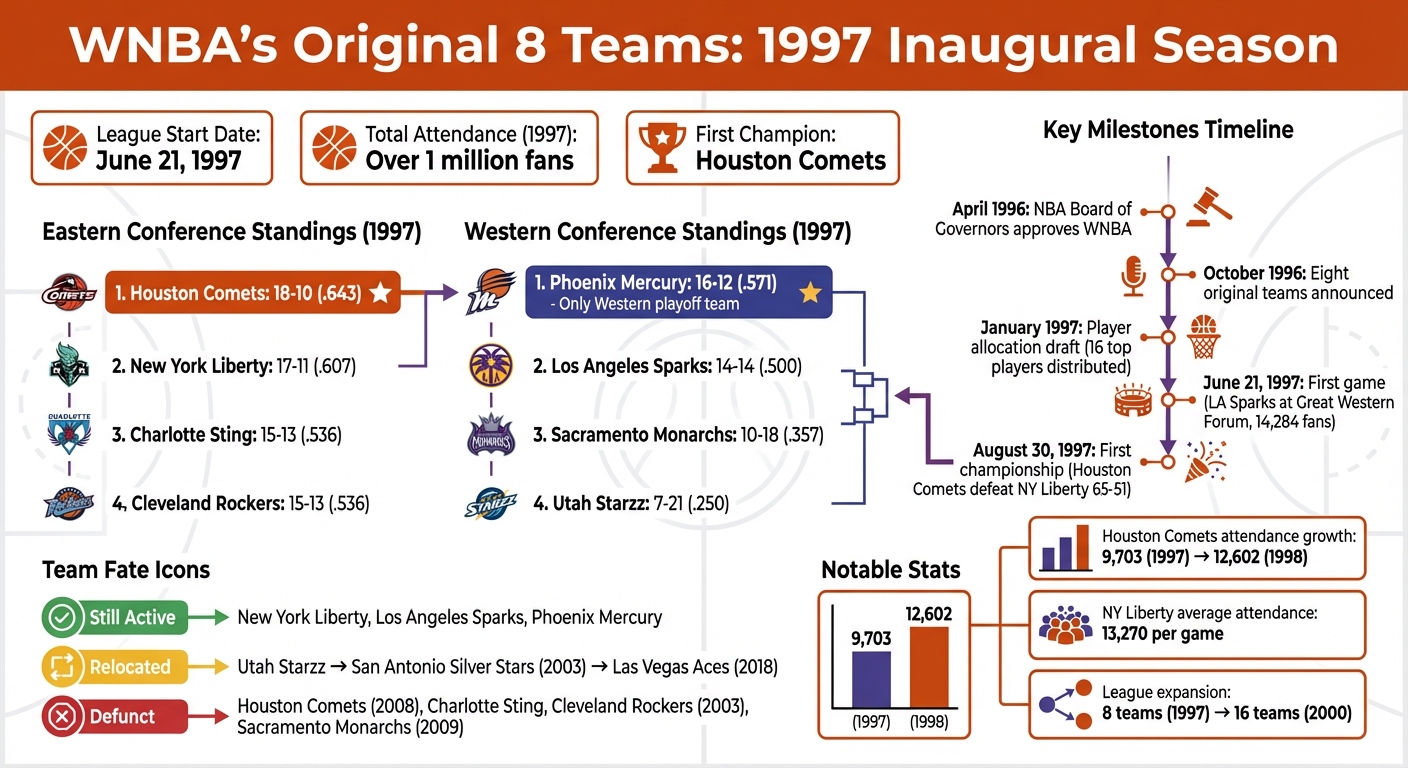
WNBA Original 8 Teams: 1997 Inaugural Season Overview
1997: The Birth of the WNBA | The League’s First Chapter
sbb-itb-4d95ad3
Eastern Conference Original Teams
Back in 1997, the Eastern Conference featured four trailblazing teams that shaped the WNBA’s early days. The NBA Board of Governors gave the green light to the league in April 1996, and by October of the same year, the eight original teams were officially announced. Each team was strategically placed in an NBA market, tapping into existing fan enthusiasm and basketball infrastructure.
All four Eastern Conference teams wrapped up the inaugural season with winning records. The Houston Comets led the pack at 18–10, followed by the New York Liberty at 17–11. The Charlotte Sting and Cleveland Rockers both finished with a 15–13 record. To ensure a level playing field, a player allocation draft was held in January 1997, assigning 16 top-tier players across the eight franchises. Here’s a snapshot of how the Eastern Conference teams performed that season:
| 1997 Eastern Conference Standings | W | L | PCT | GB |
|---|---|---|---|---|
| Houston Comets | 18 | 10 | .643 | – |
| New York Liberty | 17 | 11 | .607 | 1.0 |
| Charlotte Sting | 15 | 13 | .536 | 3.0 |
| Cleveland Rockers | 15 | 13 | .536 | 3.0 |
Let’s take a closer look at how each team made its mark during the league’s first season.
New York Liberty
The Liberty brought women’s basketball to the heart of New York City, playing their home games at Madison Square Garden – a venue synonymous with basketball history. Led by head coach Nancy Darsch, the team gained star power with Rebecca Lobo and Teresa Weatherspoon, who were allocated to the franchise in January 1997. Fans showed up in droves, with an average attendance of 13,270 per game – a clear sign of excitement for professional women’s basketball in the city.
The Liberty’s postseason run was impressive. They defeated the Phoenix Mercury 59–41 in a single-game semifinal on August 28, 1997, to advance to the WNBA Championship game. Although they fell short in the finals, their strong debut season cemented their status as a cornerstone of the league.
Houston Comets
The Houston Comets quickly became the WNBA’s first dynasty. Owned by Leslie Alexander, who also owned the Houston Rockets, and coached by Van Chancellor, the team set the standard for excellence. With Sheryl Swoopes and Cynthia Cooper allocated to the team and Tina Thompson selected as the No. 1 overall draft pick, the Comets built a powerhouse roster.
In 1997, the Comets finished 18–10 and claimed the league’s first championship by defeating the New York Liberty 65–51 on August 30. This victory was just the beginning – they went on to win the next three championships, dominating the league from 1997 to 2000. Their 1998 season was particularly memorable, finishing with a 27–3 record and an incredible .900 winning percentage.
Val Ackerman, the WNBA’s first president, later commented on Cynthia Cooper’s unexpected dominance:
"None of us realized how good Cynthia Cooper was, because if we had, she would not have been assigned to the Comets".
Despite their early success, the Comets were disbanded in 2008 due to financial difficulties. However, in March 2026, news broke that the team would return in 2027 after the Fertitta family purchased and relocated the Connecticut Sun franchise.
Charlotte Sting
The Charlotte Sting was among the league’s original teams, but their journey was marked by challenges. While they were part of the inaugural group, maintaining consistent success proved difficult, and the franchise eventually ceased operations.
Cleveland Rockers
The Cleveland Rockers made their presence felt in the league’s first season, securing a playoff spot. Over the years, the team became a key player in the Eastern Conference, making multiple playoff appearances. Unfortunately, the Rockers were disbanded in 2003, leaving a void in the Midwest’s representation in the WNBA.
Western Conference Original Teams
In 1997, the Western Conference welcomed four teams – Phoenix Mercury, Los Angeles Sparks, Sacramento Monarchs, and Utah Starzz. These teams not only competed fiercely but also laid the groundwork for the league’s early years. Here’s how they fared in their debut season:
| 1997 Western Conference Standings | W | L | PCT |
|---|---|---|---|
| Phoenix Mercury | 16 | 12 | .571 |
| Los Angeles Sparks | 14 | 14 | .500 |
| Sacramento Monarchs | 10 | 18 | .357 |
| Utah Starzz | 7 | 21 | .250 |
Among these, only the Phoenix Mercury managed to secure a playoff spot, showcasing their strength early on. Many teams began customizing their basketball gear to build a unique identity during these formative years. Let’s take a closer look at the inaugural seasons of these teams.
Los Angeles Sparks
On June 21, 1997, the Sparks made history by hosting the WNBA’s first-ever game at the Great Western Forum. With 14,284 fans in attendance, guard Penny Toler scored the league’s first basket just 59 seconds into the game. Although the Sparks ended their first season with a .500 record (14–14) and missed the playoffs, they quickly became a force to reckon with. Behind Lisa Leslie’s leadership, the team clinched back-to-back championships in 2001 and 2002, setting the tone for years of success.
Phoenix Mercury
The Mercury emerged as the top team in the Western Conference during their debut season, finishing with a 16–12 record. Coached by Cheryl Miller, they were the only Western team to make the playoffs in 1997. This strong start laid the groundwork for a franchise that would go on to win championships in 2007, 2009, and 2014.
Sacramento Monarchs
The Monarchs’ first season was a challenging one, ending with a 10–18 record. However, the team gradually built a competitive roster, thanks to standout players like Yolanda Griffith and Ticha Penicheiro. Despite their eventual rise to prominence, which included a championship in 2005, the franchise faced financial difficulties and ceased operations in 2009.
Utah Starzz
The Utah Starzz endured a rough start, finishing with the league’s poorest record at 7–21. Their journey, however, was one of transformation. In 2003, the franchise relocated to San Antonio, becoming the Silver Stars. Later, in 2018, they moved again, this time to Las Vegas, rebranding as the Aces. Under their new identity, the team has thrived, winning consecutive championships in 2022 and 2023.
Impact and Legacy of the Original Teams
The founding teams of the WNBA completely changed the landscape of women’s basketball in the United States. Before 1997, top American players often had to head overseas to pursue professional careers. The WNBA gave these athletes a homegrown platform, allowing collegiate stars to stay in the spotlight and connect with fans right here in the U.S.
The league’s early years showed just how much public interest there was. By 1998, the Houston Comets saw their average game attendance climb from 9,703 to 12,602. That wasn’t just a statistic – it was proof of a movement. As Tina Thompson, a four-time champion, explained:
"The Comets were the impact. They made people stand up and watch. They made skeptics of the league and its ability to survive into believers".
These early milestones laid the foundation for the league’s growth and long-term success.
But the influence of these teams went far beyond the hardwood. In 1995, Sheryl Swoopes made history as the first female basketball player to sign a signature shoe deal with Nike, resulting in the iconic "Air Swoopes." A few years later, on May 23, 2000, the Houston Comets became the first women’s professional sports team to be invited to the White House Rose Garden. President Bill Clinton honored their three consecutive championships, a moment that cemented women’s basketball as a key part of mainstream sports culture. This cultural shift also influenced fan apparel, with many supporters now wearing custom basketball hoodies to show their team pride.
The league’s initial success also led to rapid growth. Starting with eight teams in 1997, the WNBA expanded to 16 teams by 2000. Perhaps even more meaningful was the inspiration these teams provided for young athletes. High school basketball coach Ann Roubique reflected on this shift:
"It seemed like the girls’ basketball at the high school level got a little bit better and a little bit better, because they had somewhere to look to – ‘Maybe I’ll have that chance one day’".
This ripple effect shaped a new generation of players, including stars like Brittney Griner and the Ogwumike sisters, who grew up dreaming of playing in the league. The legacy of those original teams continues to motivate and empower future stars, ensuring the WNBA’s lasting impact for years to come.
Custom Uniforms for Celebrating WNBA History
Why Custom Uniforms Matter
When the WNBA tipped off in 1997, the debut jerseys weren’t just uniforms – they were statements. As Tom O’Grady, former NBA Creative Director, explained:
"It’s only first once. When you come out of the gate, it has to look terrific."
These jerseys defined the league’s identity, signaling a new chapter for women’s sports. Designed specifically for women – thanks to input from stars like Lisa Leslie and Sheryl Swoopes – they weren’t just scaled-down versions of men’s uniforms. Instead, they became symbols of the league’s originality and purpose. Ernest Wilkins captured their impact perfectly:
"These jerseys were the first megaphone. And they’re still some of the loudest in the game."
Over time, these designs have become collectibles. Vintage Champion WNBA jerseys, once listed for $10–$30 on eBay, now fetch upwards of $200. This shift highlights their transformation into cultural treasures. Today’s custom uniforms continue this tradition, blending modern design with the legacy of those trailblazing pieces.
Wooter Apparel: Custom Solutions for Teams
Honoring the WNBA’s history today means embracing its roots through custom uniforms. Teams looking to channel the league’s early spirit can create standout designs that draw from the original 1997 aesthetic. Wooter Apparel offers sublimated designs inspired by that era, and their free design services make it simple to incorporate bold typography, shimmering fabrics, and other throwback elements reminiscent of the Y2K style.
The pricing is straightforward and budget-friendly. Custom V-Neck Basketball Jerseys and Basketball Shorts are priced at $16.99 each, while the complete MVP Team Uniform Package – which includes jerseys, shorts, and warmups – is available for $199.99. Built for both performance and style, these uniforms allow teams to craft a unified look that reflects their heritage and community, echoing the spirit of the WNBA’s foundational franchises.
Conclusion
The eight founding teams of the WNBA forever changed the landscape of women’s basketball in the United States. Before 1997, top American players had to go overseas to pursue professional careers. But the New York Liberty, Houston Comets, Los Angeles Sparks, Phoenix Mercury, Charlotte Sting, Cleveland Rockers, Sacramento Monarchs, and Utah Starzz brought the game home, creating opportunities that hadn’t existed before.
The Houston Comets quickly became the league’s first dynasty, winning four straight championships from 1997 to 2000. Reflecting on their impact, four-time WNBA champion Tina Thompson shared:
"The Comets were the impact. They made people stand up and watch. They made skeptics of the league and its ability to survive into believers."
Meanwhile, teams like the New York Liberty and Los Angeles Sparks built lasting reputations, consistently reaching the playoffs and winning championships that helped solidify the league’s standing.
Today’s WNBA teams carry forward this rich history, blending tradition with innovation. Companies like Wooter Apparel offer custom sublimated designs that capture the essence of the league’s early days while allowing teams to create their own identity. With jerseys and shorts starting at $16.99 and an impressive 4.9-star rating from 252 reviews, teams can honor the pioneers who paved the way while crafting their own future.
These original eight teams proved that women’s professional basketball had a rightful place in America. Their influence continues to shape the game, inspiring a new generation nearly three decades later.
FAQs
How did the WNBA decide its original eight teams?
The WNBA initially chose eight teams, strategically placing them in cities known for their passionate basketball communities. Teams like the New York Liberty, Houston Comets, Los Angeles Sparks, and Phoenix Mercury were set up in cities with NBA franchises, aiming to tap into existing fan bases and use established facilities.
What happened to the WNBA’s original teams that folded or relocated?
The WNBA has seen its fair share of changes over the years. Some of its original teams, like the Houston Comets and Charlotte Sting, unfortunately ceased operations. Meanwhile, other teams found new homes and identities. For instance, the Utah Starzz transformed into the San Antonio Silver Stars before eventually becoming the Las Vegas Aces. Similarly, the Orlando Miracle relocated and rebranded as the Connecticut Sun, while the Detroit Shock moved and evolved into the Dallas Wings.
Why were the WNBA’s first uniforms such a big deal?
The WNBA’s first uniforms were groundbreaking because they symbolized the league’s role in shaping the identity of women’s basketball. These uniforms not only boosted the sport’s visibility but also helped garner more respect for both the athletes and the game itself.