
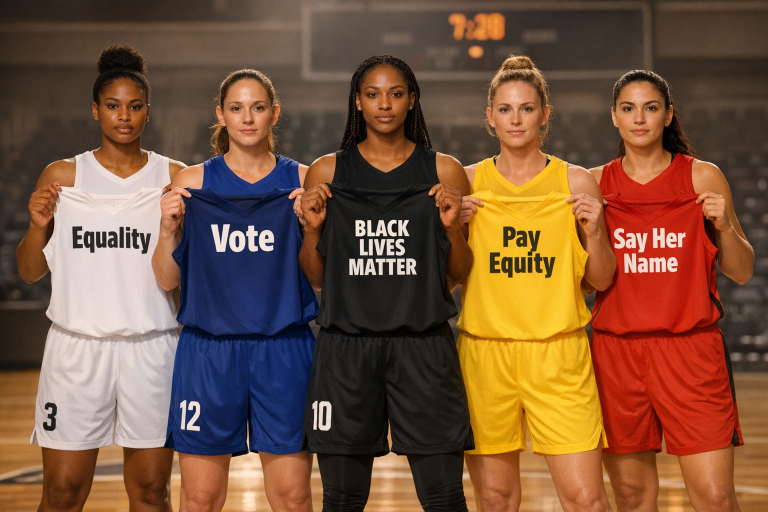
The WNBA has transformed jerseys into tools for advocacy, addressing issues like racial justice, gender equity, and political change. Players have used their uniforms to amplify causes, from wearing "Black Lives Matter" shirts in 2020 to protesting unfair wages at the 2025 All-Star Game. These actions have sparked national conversations, boosted merchandise sales, and influenced social movements. Highlights include:
- 2020 Season: Unified "Black Lives Matter" and "Say Her Name" jerseys honored victims of injustice like Breonna Taylor.
- Vote Warnock Campaign: Players wore "Vote Warnock" shirts in 2020, boosting Raphael Warnock’s Senate campaign and flipping control of the U.S. Senate.
- Jacob Blake Protest: Washington Mystics wore shirts with bullet hole graphics, protesting police violence.
- 2025 All-Star Game: Players demanded fair pay with "Pay Us What You Owe Us" shirts, resonating with fans and driving merchandise sales up 1,000%.
This approach has redefined how sports teams engage with activism, blending bold design with impactful messaging.
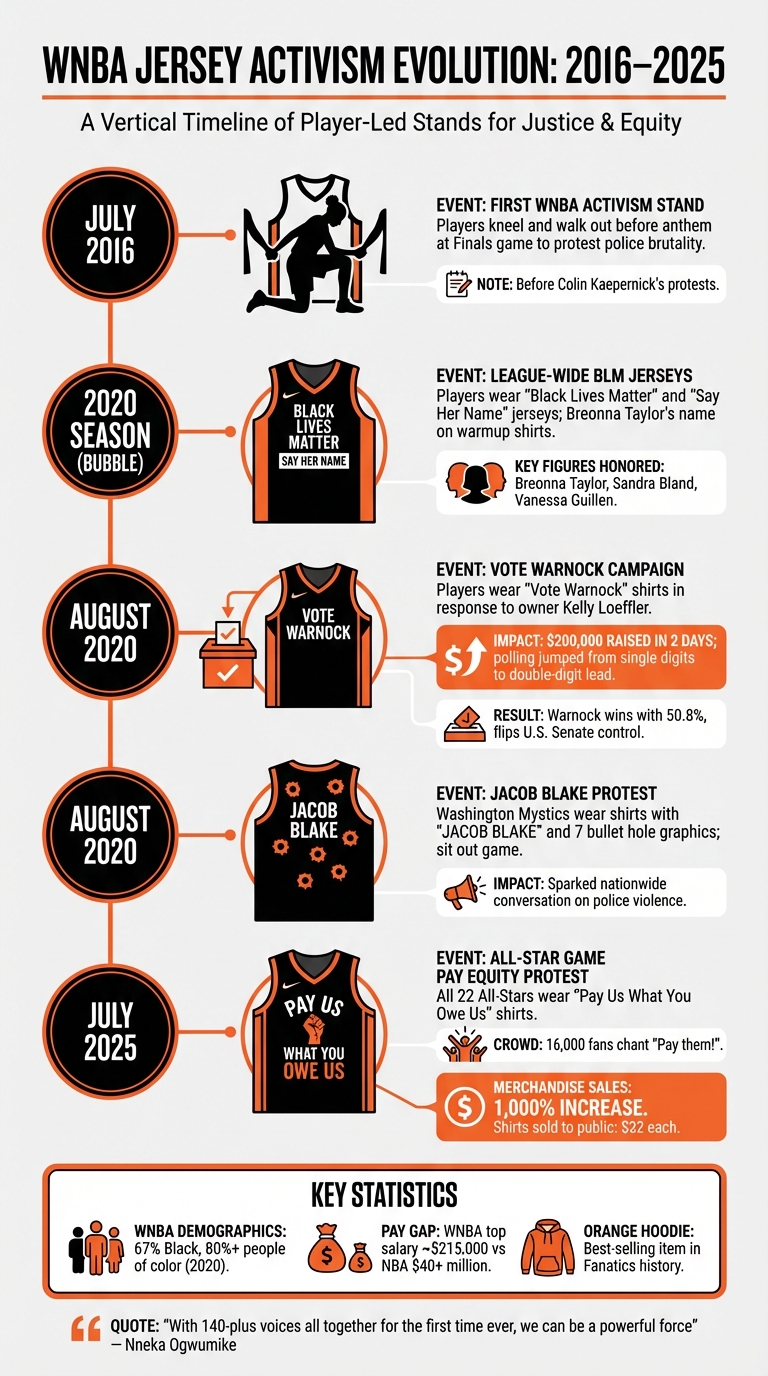
WNBA Jersey Activism Timeline: Key Moments from 2016-2025
Major Examples of WNBA Jersey Activism
Vote Warnock Shirts and Political Advocacy
In August 2020, WNBA players turned their warmup gear into bold political statements. Spearheaded by Seattle Storm guard Sue Bird and Atlanta Dream center Elizabeth Williams, players from teams like the Storm, Chicago Sky, Phoenix Mercury, and Dream wore "Vote Warnock" T-shirts during warmups in Bradenton, Florida. This action was a direct response to Atlanta Dream co-owner Kelly Loeffler’s criticism of the Black Lives Matter movement.
The players didn’t make this decision lightly. They thoroughly vetted Raphael Warnock, Loeffler’s opponent, through two Zoom calls – one with the executive committee of the WNBPA and another open to all players. Elizabeth Williams explained the rationale behind their move:
"If she wants to play this political game, we thought, we can, too. We’re college graduates. We’re not dumb here. We can strategize and learn from people."
The results were immediate and impactful. Warnock’s campaign raised nearly $200,000 within two days of the shirts appearing on national TV. His polling numbers also saw a dramatic rise, climbing from single digits in August to a double-digit lead by late September. This momentum carried him to secure 32.9% of the vote in the November 2020 election and ultimately win the January 2021 runoff with 50.8%, flipping control of the U.S. Senate.
This moment underscores how the WNBA has used its platform to engage directly with political issues, making a tangible impact.
Jacob Blake T-Shirts by the Washington Mystics
In the same month, the Washington Mystics delivered a powerful visual protest. The team wore white T-shirts that spelled out "JACOB BLAKE" on the front, with the backs featuring seven simulated bullet holes. Led by players like Ariel Atkins and Tianna Hawkins, they chose to sit out their scheduled game, shifting attention to the urgent issue of racial justice and sparking a nationwide conversation about police violence.
This protest showcased a different form of activism compared to the Vote Warnock campaign, emphasizing how teams used their platform to address a range of social justice issues.
League-Wide Black Lives Matter and Say Her Name Jerseys
Beyond individual team actions, the WNBA embraced a unified approach to activism during the 2020 season. At the IMG Academy bubble in Bradenton, Florida, players wore jerseys with Breonna Taylor’s name as a tribute to victims of injustice, marking the league’s most extensive activism effort to date.
This initiative was driven by the players themselves. Las Vegas Aces forward Angel McCoughtry, who proposed placing victims’ names on jerseys, addressed those who questioned the impact of such gestures:
"People have asked, what is putting the names on a jersey gonna do? Well we plant seed for a better tomorrow. Yes, it takes time to grow but in due time amazing things will bloom."
WNBPA President Nneka Ogwumike echoed this sentiment:
"With 140-plus voices all together for the first time ever, we can be a powerful force connecting to our sisters across the country and in other parts of the world."
The campaign highlighted victims like Sandra Bland and Vanessa Guillen, while also boosting sales of the league’s iconic orange hoodie, further amplifying the message.
Creating Custom Jerseys for Activism
Wooter Apparel‘s Customization Options
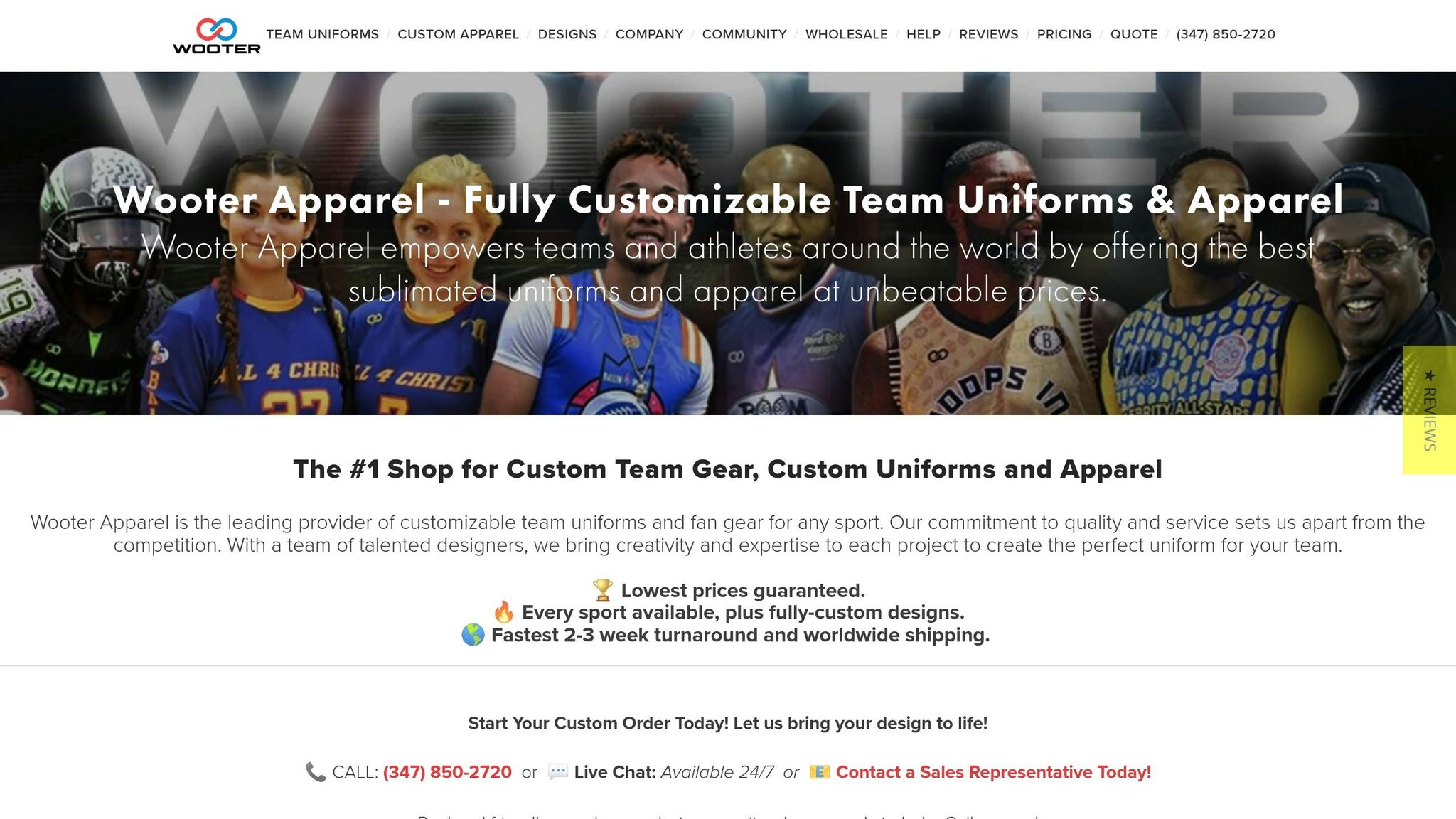
When teams want to make a statement with their jerseys, they need a partner that can handle intricate designs while preserving the clarity and impact of their message. Fully sublimated printing is a standout option, as it embeds graphics, text, and symbols directly into the fabric. This ensures that the message stays vibrant and intact, no matter the wear and tear from games or washes.
Enter Wooter Apparel (https://wooter.com), a company that specializes in creating custom designs tailored to social justice themes. They even offer free custom design services, making it easier for teams to incorporate meaningful messages into their uniforms. Whether it’s a bold warmup jacket or a basketball jersey, Wooter’s sublimation process is particularly effective for high-contrast designs. Teams have the flexibility to decide where their message makes the biggest impact – on game-day uniforms or pre-game warmup gear.
By partnering with a custom apparel provider like Wooter, teams can move beyond simple slogans to create striking visuals. This approach allows for precise rendering of intricate designs, like the Washington Mystics’ protest graphics honoring Jacob Blake. These technical capabilities make it possible for teams to use their apparel as a platform for powerful activist statements.
Adding Team Values and Messages to Jerseys
Advanced printing methods are just one part of the equation – strategic design choices can amplify activist messages even further. For example, warmup shirts can feature bold, attention-grabbing slogans, while game jerseys can honor individuals by replacing player names with meaningful tributes. A notable example of this was seen during the WNBA’s 2020 season, when players wore jerseys bearing Breonna Taylor’s name. Typography and color choices also matter; using high-contrast combinations like white text on black backgrounds ensures that messages remain visible from the stands and on TV broadcasts.
Authenticity is key when designing activist jerseys, and involving players in the process ensures the final product aligns with the team’s values. Washington Mystics guard Natasha Cloud highlighted this when discussing the team’s "Rebel" edition uniform, which featured a nod to the 19th Amendment:
"My challenge to Nike would be to please include us in the decision-making first… if we were in those rooms, we would have brought it up immediately"
Cloud’s comments point to the importance of thoughtfully incorporating historical references. For instance, while the 19th Amendment was a landmark achievement, it initially excluded Black women from voting rights. This attention to detail ties the design to the players’ lived experiences and reinforces the WNBA’s legacy of activism.
WNBA Players DEMAND To Be Paid More in All Star Warm Up Stunt…
sbb-itb-4d95ad3
How Activist Jerseys Influence Sports Culture
The WNBA has set a powerful example by using activist jerseys to challenge traditional expectations of athletes. Back in July 2016, WNBA players took a bold stand against police brutality – well before Colin Kaepernick’s anthem protests sparked nationwide debate. Reflecting on this groundbreaking moment, Atlanta Dream’s Elizabeth Williams said:
"For us to do that in 2016 – to kneel, to walk out before the anthem before a Finals game – that level of activism was unheard of in sports in 2016".
This early stand proved that activism and professional sports could go hand in hand, creating a ripple effect that encouraged athletes across leagues to raise their voices.
The financial success of these jerseys highlights their impact. In 2025, sales of player-specific merchandise, including activism-related items, soared by 1,000%, according to Fanatics and the WNBA Store. During the July 2025 All-Star Game in Indianapolis, all 22 All-Stars – including Caitlin Clark, Angel Reese, Nneka Ogwumike, and Napheesa Collier – wore black warmup shirts emblazoned with "Pay Us What You Owe Us." This public call for fair wages during collective bargaining negotiations resonated with fans, leading to a sold-out crowd of 16,000 chanting "Pay them!" during the MVP trophy presentation. The moment gained national attention, with figures like Hillary Clinton and Dave Portnoy joining the conversation. The WNBPA then released the shirts for public sale at $32, turning fan enthusiasm into tangible support for their cause. These moments show how activist jerseys are more than just clothing – they’re tools for sparking change.
The league’s makeup plays a key role in this activism. As of 2020, the WNBA was 67% Black and over 80% people of color, making social justice deeply personal for many players. WNBPA President Nneka Ogwumike explained:
"The reason why you see us engaging and leading the charge when it comes to social advocacy is because it is in our DNA".
This authenticity has reshaped sports culture, proving that athletes can excel on the court while advocating for major societal issues. Despite earning far less than their NBA counterparts – top WNBA stars make around $215,000 compared to NBA salaries exceeding $40 million – these players have shown that activism can coexist with professional excellence. The WNBA has made activism a defining feature of modern sports, demonstrating the power of jerseys to amplify voices and inspire change.
Conclusion: Combining Sports, Activism, and Design
WNBA jerseys have proven to be more than just sportswear – they’re catalysts for meaningful change. From honoring Breonna Taylor with her name on warmup shirts to the Washington Mystics’ striking protest T-shirts featuring seven faux bullet holes in response to Jacob Blake’s shooting, these designs have sparked national conversations and driven real-world impact. As WNBPA President Nneka Ogwumike aptly stated:
"With 140-plus voices all together for the first time ever, we can be a powerful force connecting to our sisters across the country and in other parts of the world".
This evolution in jersey design showcases how apparel can transcend its traditional role and become a platform for advocacy.
The success of these initiatives lies in the power of intentional design choices. Effective activist apparel tells a story – one that is specific, personal, and deeply resonant. Take the WNBA’s 2020 collaboration with BreakingT as an example. Their "WNBPA Speaks" collection allowed fans to purchase shirts representing any of the league’s nearly 150 players, with proceeds benefiting the Breonna Taylor Foundation and the African American Policy Forum. The campaign’s highlight? The WNBA orange hoodie, which became the best-selling item in Fanatics’ history. This success underscores the value of personalization – fans are drawn to causes and players they connect with on a deeper level.
For teams looking to amplify their message, partnering with a flexible and experienced customizer is essential. Companies like Wooter Apparel have demonstrated how customization can elevate a team’s narrative. Their collaboration with Ballin’ 4 Peace, for instance, used custom jerseys to spotlight gun violence awareness in New York City. Haron Hargrave, the organization’s founder, shared:
"The uniform process is really special to be a part of… Working with Wooter is seamless and efficient, uniting vision and execution." – Haron Hargrave, Founder, Ballin’ 4 Peace.
Beyond their design expertise, Wooter has committed $10 million over three years to support sports programs and non-profits worldwide.
Throughout the season, these jerseys have embodied a perfect blend of advocacy and design. When messaging is clear, visuals are professional, and goals are actionable, jerseys become more than just uniforms – they become instruments of change, both on and off the court.
FAQs
How do WNBA teams use jerseys to support social causes?
WNBA teams have transformed their jerseys into a canvas for social activism, using them to highlight pressing issues and encourage meaningful change. Take the 2020 season, for example: players wore jerseys bearing the names of victims of police violence, like Breonna Taylor, alongside powerful messages such as “Black Lives Matter” and “Say Her Name.” These gestures were a call to action, drawing attention to systemic racism and police brutality.
This trend has only grown stronger. At the 2025 All-Star Game, players made another bold statement by wearing shirts emblazoned with “Pay Us What You Owe Us,” calling for fair wages and improved working conditions. These actions underscore how WNBA players leverage their platform to push for justice and spark conversations that resonate far beyond the basketball court.
How did WNBA players support Raphael Warnock’s Senate campaign?
In August 2020, WNBA players made headlines by wearing shirts emblazoned with Vote Warnock during games. This bold move was a direct response to Kelly Loeffler, the then co-owner of the Atlanta Dream, who publicly criticized the league’s social justice initiatives.
The players’ actions not only amplified Raphael Warnock’s Senate campaign but also underscored their dedication to leveraging their platform for meaningful change – both within their sport and in the broader community.
How do WNBA teams use custom jerseys to promote activism?
Custom jerseys provide WNBA teams with a unique way to spotlight social justice causes and spark meaningful conversations. Through thoughtful designs, impactful slogans, and symbolic elements, players and teams use their uniforms to amplify important messages and encourage action beyond the game.
These jerseys often represent support for movements such as racial equality and gender equity, transforming them into powerful tools for advocacy. They go beyond being just sportswear – they become a statement of solidarity that connects with fans and communities on a deeper level.